Saturday, October 23, 2010

Happy Smurfday!

Photobucket

On this day in 1958 The Smurfs - a fictional race of blue dwarves later popularized in Hanna-Barbera's animated series The Smurfs - appeared for the first time, in the story Le flute à six schtroumpfs, a Johan and Peewit adventure by the Belgian cartoonist Peyo which was serialized in the weekly comics magazine Le Journal de Spirou.

The well-being of Smurfs has always been at the forefront of the Pop Culture Institute's charitable work; currently, we operate a Home For Wayward Smurfettes under the wardenship of Papa Smurf. Living in a village made of mushrooms with one female means more than those adorable faces of theirs are blue, and as a result those poor Smurfettes get worn out pretty quickly...
*

share on: facebook

Augusten Burroughs: Memoir and Peace

Photo Sharing and Video Hosting at Photobucket

Augusten Burroughs, who was born this day in 1965, became something of an overnight sensation when he published his memoirs, Running With Scissors, in 2002 - at the tender age of 37. It took his foster family, who were the subjects of the book, a bit longer than overnight to be outraged; in fact, it took them a couple of years to enter litigation against their former charge. Presumably they were waiting to see how well the sales went.

In 2005 the family who raised Burroughs took him to court, claiming defamation and invasion of privacy in addition to all sorts of other malfeasance on the part of the man who'd lived with them from for half a dozen years from the age of twelve. Feh! Go live with a writer. The case was settled in August 2007.

Fortunately, unlike Burroughs, I won't need to have truth on my side when I get around to publishing my memoirs; since I only have one family member left, and she's already admitted she's got a terrible memory, when the time comes I can pretty much say whatever I like.
*
share on: facebook

POPnews - October 23rd

Photobucket

42 BCE - During Rome's Republican civil wars, following the Second Battle of Philippi, Brutus's army was decisively defeated by Mark Antony and Octavian, following which Brutus committed suicide.

425 CE - Valentinian III became the Emperor of Rome at the age of 6.

1086 - During the Reconquista, at the Battle of az-Zallaqah, the army of Yusuf ibn Tashfin defeated the forces of Castile's King Alfonso VI.

1157 - When Denmark's King Sweyn III was killed at the Battle of Grathe Heath his death ended the civil war in that country and enabled his rival to assume the throne as Valdemar I.

1295 - The first treaty forming the Auld Alliance between Scotland and France against England was signed in Paris.

1641 - The Irish Rebellion of 1641 broke out - an anniversary commemorated by Irish Protestants for the next 200 years.

1642 - The Battle of Edgehill, the first major battle of the First English Civil War, pitted King Charles I and Prince Rupert of the Rhine against the Earl of Essex.

1707 - The Parliament of Great Britain - that is, England and Scotland combined, under the terms of the Acts of Union - met for the first time at the Palace of Westminster at the behest of Queen Anne.

1739 - British Prime Minister Robert Walpole reluctantly declared the War of Jenkins' Ear against Spain.

1812 - Claude François de Malet, a French general, undertook a conspiracy to overthrow Napoleon Bonaparte, claiming that the Emperor died in Russia and claiming he himself had been made the commandant of Paris. For his impertinence, De Malet would be executed on October 29th.

1935 - Dutch Schultz, Abe Landau, Otto Berman, and Bernard 'Lulu' Rosencrantz were all fatally shot at about 10:15 pm in the Palace Chophouse in Newark, New Jersey. Charles 'The Bug' Workman and Emanuel 'Mendy' Weiss, two hitmen working for Louis 'Lepke' Buchalter's Murder, Inc. carried out the deed. Berman died first, some four hours after the shooting; Landau died four hours after that. Schultz lingered, delirious, for 22 hours, having his last words taken down by a stenographer, while Rosencrantz died 7 hours later. Workman eventually served 23 years in prison for his part in the killings, while Weiss was executed for another murder he committed in 1944.

1942 - All 12 passengers and crewmen aboard an American Airlines DC-3 airliner were killed when it was struck by a US Army Air Forces bomber over Palm Springs, California; amongst the victims was award-winning composer and songwriter Ralph Rainger, responsible for such songs as Thanks for the Memory, Love in Bloom, and Blue Hawaii.

1956 - Hungarians rose up in revolt against their Communist overlords; the Hungarian Revolution lasted until November 4th, at which time a large Soviet army arrived and occupied Budapest.

1958 - An underground earthquake - since dubbed The Springhill Mine Bump - trapped 174 miners in the No. 2 colliery at Springhill, Nova Scotia, which at the time was North America's deepest coal mine. This disaster was the third to occur at the location, following a fire in 1891 and an explosion in 1956. It took rescuers from around the world nine days to dig out 100 survivors, making the death toll 74.

1983 - The US Marines barracks in Beirut was hit by a truck bomb, killing 241 US Marines; a French army barracks in Lebanon was also hit that same morning, killing 58 troops, marking one of the bloodiest days in the Lebanese Civil War for the Multinational Force in Lebanon.

1989 - The Hungarian Republic was officially declared by president Mátyás Szűrös, replacing the communist Hungarian People's Republic; the day is celebrated in Hungary as a national holiday.

1992 - Emperor Akihito of Japan became the first head of state from that country to visit China.

2001 - Apple released the iPod.

2002 - Chechen terrorists seized a theatre in the Dubrovka neighbourhood of Moscow, holding more than 850 hostages; the event was handled as disastrously as a later one in Beslan in 2004, and remains a blot on the already heavily blotted leadership of Russian President Vladimir Putin. As many as 200 people died, most from a mysterious gas meant to neutralize the Chechens - a gas which Putin's government still refuses to identify.
*
share on: facebook

Friday, October 22, 2010

Happy Birthday Marc Shaiman

Born this day in 1959, Marc Shaiman rose to prominence as an arranger and musical director for Bette Midler in the mid-1980s, even appearing in a cameo as her piano player in Beaches (1988); he co-produced Midler's biggest hit to date, Wind Beneath My Wings which comes from the soundtrack to that movie.

Photo Sharing and Video Hosting at Photobucket
Shaiman has since parlayed his early success into a career composing music for the movies, most often comedies, beginning with Broadcast News (1987) and including such recent classics as The Addams Family (1991), The First Wives Club (1996), and Team America: World Police (2004). While early in his career he often worked with Billy Crystal, Rob Reiner, and Garry Marshall, in recent years Shaiman is known for his work with Matt Stone and Trey Parker, co-writing such enduring classics as Uncle Fucka and Blame Canada.

Already the winner of a Tony and a Grammy for his work on the musical Hairspray, he has likewise won an Emmy for his work with Billy Crystal on the Academy Awards telecast. Despite five Oscar nominations he's never won, proof that there's no gay Mafia running Hollywood.

Since 1979 his collaborator in life as well as at work has been Scott Wittman.
*
share on: facebook

"Better Be Ready" by Annette Funicello


In 2007, when I first marked this particular birthday on the Pop Culture Institute, I chose a frankly pervy clip of birthday gal Annette Funicello singing Stuffed Animal while flouncing about in a baby doll nightie; the following year, naturally, that clip was unavailable, which gave me an excuse to spend a few idle minutes perusing what other Funicello-esque offerings YouTube might have for me. Pretty quickly I found this one, in which a more mature Annette swings, Sixties-style... Enjoy!
*
share on: facebook

Bonne Fete Catherine Deneuve

Her career spans 50 years now, during which time she has been a sex symbol, a respected actor, a muse, a goodwill ambassador, a 'bitch', and the emblem of her country - and often many of these at the same time.

Photo Sharing and Video Hosting at PhotobucketCatherine Deneuve was born on this day in 1943 into a theatrical family; her father Maurice Dorléac and her mother Renée Deneuve were both stage and screen actors. Catherine, the third of four daughters (the others being Françoise, Sylvie, and Danielle Dorléac) made her film debut at the age of 13, although she wouldn't have her first notable role until 1963.

The following year she starred in The Umbrellas of Cherbourg, which made her a star; it was followed in time by Repulsion and Belle de jour, which served to cement her reputation. In 1965, Deneuve married David Bailey, the renowned British fashion photographer.

The same year Belle de jour was released, Deneuve made the follow-up to The Umbrellas of Cherbourg - entitled The Young Girls of Rochefort - with her sister Françoise Dorléac, who died in a car crash in June 1967 shortly after filming completed.

Deneuve and Bailey split in 1972, but have remained friends; Deneuve later had two children, one with Roger Vadim, and another with Marcello Mastroianni, both of whom have gone into the family business. While continuing to act, Deneuve has also modeled, devoted herself to charity work, and been politically active.
*
share on: facebook

The Death of Pretty Boy Floyd

Charles Arthur 'Chock' Floyd was born in Adairsville, Georgia, in February 1904; when he was ten the Floyd family moved to Akins, in the Cookson Hills of Oklahoma, where in addition to dirt farming, they were known as moonshiners. Married to Ruby Hargrove at 17, Floyd committed his first crimes at eighteen, was a father to Jack Dempsey 'Jackie' Floyd at nineteen, in jail by 21 and divorced at 22. When he finally left jail at 26 in 1930 he moved to Kansas City, vowing never to return to prison...

Photo Sharing and Video Hosting at PhotobucketOne of a number of celebrity gangsters whose Midwestern crime sprees in the early 1930s electrified the general public, by the height of the gangster era of 1933-4 Floyd was already famous, not least because of the colourful moniker, which he hated. Misinformation, even more than the most sensational facts, is what legends are made of, and of the life and crimes of Pretty Boy Floyd there are far more myths than facts.

It begins with his name, which some say was given to him by a madam named Beulah Baird, and still others claim came from a description given of him by a witness to an early robbery. In addition, he was often accused of committing multiple bank robberies at the same time.

Even the circumstances surrounding his death are curious. There are those who claim that police from East Liverpool, Ohio, were with the FBI on the final raid against Floyd and his gang; still others claim that the FBI acted alone. One story has him wounded but fit to stand trial, another that Melvin Purvis summarily executed him. About all that is known for certain is that on this day in 1934, Pretty Boy Floyd - the sagebrush Robin Hood, as he had come to be known - died, aged almost 31, and that tens of thousands of people either filed past his body in the Sallisaw, Oklahoma funeral home or attended his funeral in his adopted hometown of Akins.

'Pretty Boy' Floyd was played by Channing Tatum in Michael Mann's eagerly anticipated 2009 summer blockbuster Public Enemies, which also starred Christian Bale as Melvin Purvis and Johnny Depp as John Dillinger; Floyd has already been portrayed on film by John Ericson, Fabian, Steve Kanaly, Martin Sheen, and Bo Hopkins. Larry McMurtry and Diana Ossana have already tried to rehabilitate Floyd's image in their 1994 work Pretty Boy Floyd, A Novel; a well-read hardcover copy of this out-of-print book resides in the collection of the Pop Culture Institute.
*
share on: facebook

"Hope" by Shaggy


It's always been a challenge for me to justify the author and performer of such a singularly upbeat song with the red carpet asshat who can't seem to resist an opportunity to demonstrate his own insecurity by gay-baiting and indulging in recreational misogyny.

To be fair, he has cleaned his act up somewhat; to appear (as he once did, in August 2007) on The Friday Night Project seated with Alan Carr and Gok Wan without making a single off-colour quip must have been a heckuva chore for old Shaggy.

So whether he's seen the light or is still a hater at heart, this song - which originally appeared on his fifth studio album, 2000's Hot Shot - continues to earn him our birthday wishes...
*
share on: facebook

Pop History Moment: Bomb Tries To Make Lady Antonia Fraser History

Photobucket

On this day in 1975 historian Lady Antonia Fraser - along with her husband, Conservative MP Sir Hugh Fraser and their house-guest Caroline Kennedy - narrowly avoided being killed by a bomb placed beneath his Jaguar XJ6 by the IRA outside their home in London's tony Holland Park. Only a telephone call from fellow Tory Jonathan Aitken prevented the device from killing its intended victims - possibly the one good deed Aitken ever managed. Killed in the blast was noted cancer researcher Gordon Hamilton-Fairley, who noticed the device while walking his two dogs, Benny and Emmy Lou, who also died.

Over the next couple of years the daughter of the Earl of Longford would cause a similar explosion beneath London's perpetually stodgy high society when she, a mother of six and a Catholic besides, would undertake an extramarital affair with playwright Harold Pinter, who was then married to the actress Vivien Merchant. Fraser and Pinter married in 1977, and remained together until his death in December 2008, living in that same house.

Many thanks go out to fellow blogger Another Nickel In The Machine for additional information on this event - the Campden Hill Square bombing - in particular, as well as the targeted bombing campaign conducted by the IRA in London throughout the 1970s in general.
*
share on: facebook

POPnews - October 22nd

Photobucket
[The Old Metropolitan Opera House, at 1411 Broadway - designed by J. Cleaveland Cady - occupied an entire block between W. 39th and W.40th; following a fire in August 1892 it was rebuilt along its original lines. After the company moved to posher digs at Lincoln Center in April 1966, a gala finale concert was given; unable to repurpose or renovate the building, or even secure landmark status for it, it was torn down in 1967 and replaced with an office tower which today provides the company with valuable revenue.]

1383 - When Portugal's King Fernando I died without a male heir it brought about the 1383-1385 Crisis, a period of civil war and disorder; his daughter Beatrice (by Leonor Telles de Menezes) and son-in-law John I of Castile tried to hold the throne, but ultimately the crown went to João I, the dead king's illegitimate half-brother, who became the first monarch of the House of Aviz following his victory at the Battle of Aljubarrota in April 1385.

1575 - The Mexican city of Aguascalientes was founded by Juan de Montoro.

1633 - Following the Ming Dynasty's fight with Dutch East India Company at the Battle of Southern Fujian Sea, Chinese forces commanded by Zheng Zhilong won a great victory.

1797 - One thousand meters (3,200 feet) above Paris' Parc Monceau, André-Jacques Garnerin made the first recorded parachute jump, landing without injury in front of a crowd of admiring spectators.

1836 - Sam Houston was inaugurated as the first President of the Republic of Texas.

1844 - Millerites - followers of William Miller - anticipated the end of the world in conjunction with the Second Coming of Christ, in what came to be known as The Great Anticipation; when nothing happened, the following day became known as the Great Disappointment, and many of Miller's followers simply abandoned their beliefs.

1877 - Scotland's Blantyre mine disaster killed 207.

1879 - Thomas Edison's preliminary test of the incandescent light bulb lasted 13.5 hours.

1883 - New York City's Metropolitan Opera House opened with a performance of Charles Gounod's opera Faust, starring the Swedish soprano Christine Nilsson.

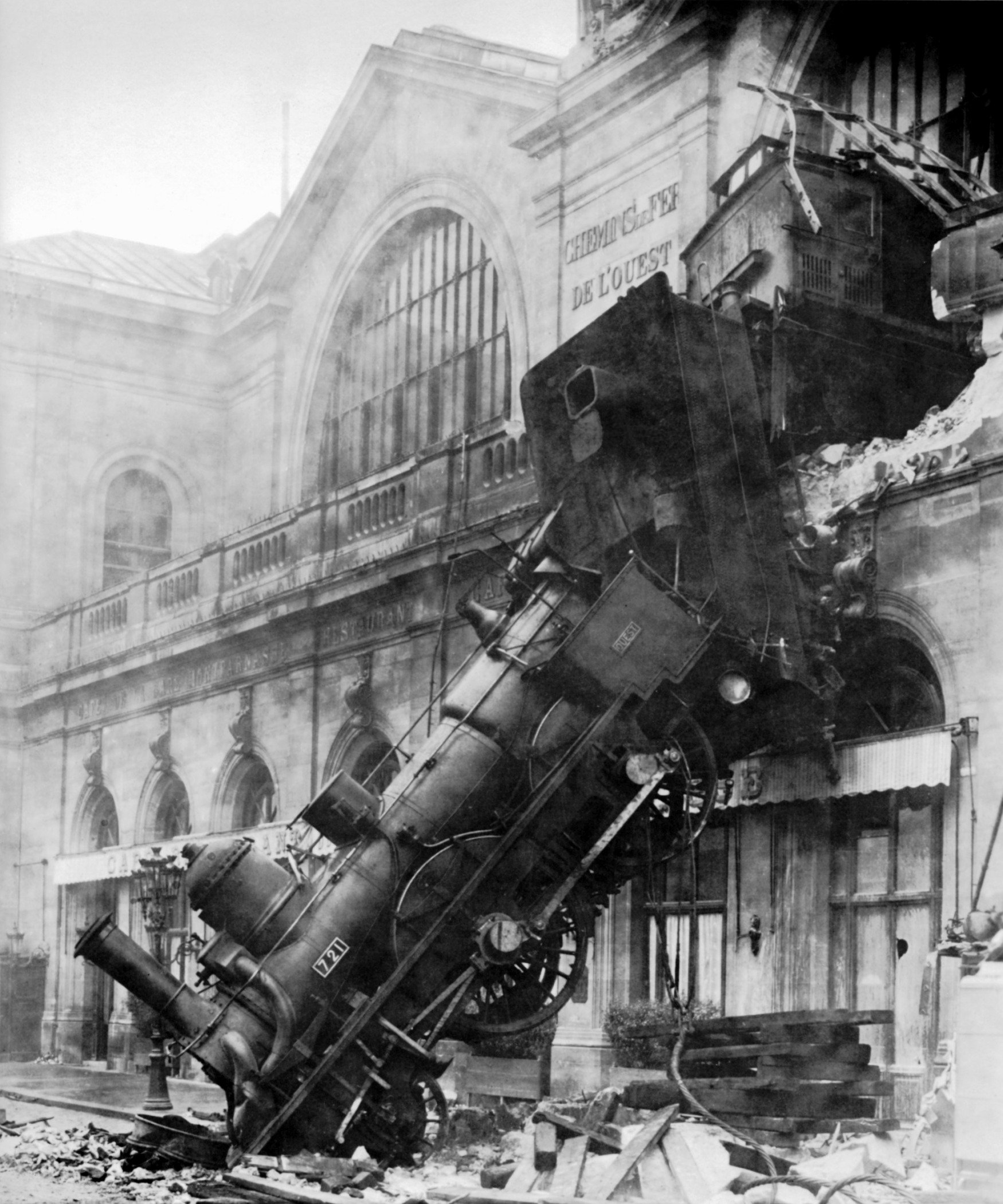
Photo Sharing and Video Hosting at Photobucket1895 - At Paris' Gare Montparnasse train station the Granville-Paris express derailed into the Places des Rennes (shown at right). This sensational photo was made by Levy & Sons, and remained popular throughout the Surrealist period of the 1920s for its depiction of a world gone mad.

1907 - A run on Knickerbocker Trust Company stock set events in motion that would lead to a depression called the Panic of 1907.

1910 - After a jury deliberated for just 27 minutes, Dr. Crippen was found guilty of killing his wife, Cora, a failed singer and actress known professionally as Belle Elmore; his lover, Ethel Le Neve, was acquitted of any complicity, and lived until 1967. The case was a huge cause célèbre in its day, partly because Crippen was the first murderer caught with the aid of wireless communication technology.

1924 - Toastmasters International was founded.

1926 - J. Gordon Whitehead sucker punched magician Harry Houdini in the stomach in Montreal, which may have led to Houdini's untimely death just nine days later.

1934 - In East Liverpool, Ohio, notorious bank robber Pretty Boy Floyd was shot and killed by Federal Bureau of Investigation agents under the command of Melvin Purvis.

1941 - 17-year-old Guy Môquet, a hero of the French Resistance, was executed by the Nazis, along with 29 other hostages, in retaliation for the killing of Karl Hotz, the commanding officer of occupation forces in the French département of Loire-Inférieure.

1964 - Jean-Paul Sartre turned down the Nobel Prize for Literature, apparently.

1986 - Jane Dornacker died when the WNBC traffic helicopter she was reporting from crashed into the Hudson River; the pilot, Bill Pate, was badly injured although he did survive the crash. Dornacker survived an earlier helicopter crash the previous April 18th over New Jersey's Hackensack River.

1999 - Maurice Papon, an official in the government of Vichy France during World War II, was jailed for crimes against humanity.
*
share on: facebook

Thursday, October 21, 2010

Brian Tobin: Rebel Without A Cod

Born on this day in 1954, and first elected to Canada's Parliament in 1980, Brian Tobin was one of the few Liberals who survived Brian Mulroney's Tory landslide of 1984; alongside his colleagues from Ontario - Don Boudria, John Nunziata, and Sheila Copps - the MP for Humber—Port au Port—Ste. Barbe helped form what the Ottawa press corps quickly dubbed the Rat Pack, which during the next nine years on the Opposition Bench gave the government what-for in an altogether unprecedented way.

Photo Sharing and Video Hosting at PhotobucketWhen the Liberals were returned to power in 1993 under Jean Chrétien, Tobin's previous loyalty to his new boss was rewarded; he was given the plum job of Minister of Fisheries and Oceans, which anyway is practically a Newfoundland sinecure. It was during his tenure at DFO that Brian Tobin had his finest hour (to date): the Turbot War.

Following a moratorium on fishing which devastated the Newfoundland economy, it was discovered that factory trawlers from Europe operating just outside Canada's 200-mile limit were vacuuming the ocean clean of all life, therefore potentially extincting such staple catches as cod and halibut from the Grand Banks, an area that was still prime fishing ground as recently as the 1970s. The source of the devastation having been determined, Tobin decided to make something of it; he had the Canadian Coast Guard trail a Spanish stern-trawler called the Estai which was suspected of just such illegal activity. In March 1996 shots were fired, the Estai was boarded, its crew arrested and its nets impounded.

The Estai had indeed been using illegal gill nets, which Tobin himself demonstrated during a press conference held on a barge in the East River near the UN, much to the chagrin of the Spanish and EU trade representatives like Emma Bonino. Accused of grandstanding by the timid do-nothings who'd been letting it happen, Tobin used the notoriety he'd gained during the incident to propel himself into the office of Premier of Newfoundland. In 2000 he returned again to federal politics, this time representing Bonavista—Trinity—Conception; disgusted, as many of us were, by the seemingly endless machinations of Paul Martin, Tobin retired from politics in 2002.

Still I, for one, am not counting him out; his memoirs are entitled All In Good Time, implying that the man once dubbed 'Captain Canada' may yet return to public life...
*
share on: facebook

"The Temptation Of Adam" by Josh Ritter


Birthday wishes go out today to folkie Josh Ritter, who was born on this day in 1976; The Temptation of Adam appears on his fifth studio album, The Historical Conquests of Josh Ritter, released in 2007.
*

share on: facebook

Happy Birthday Joyce Randolph

Consider, if you will, the plight of Joyce Randolph...

Photo Sharing and Video Hosting at PhotobucketFourth billed and forced to play third fiddle behind a booming tuba, a shrill harp, and a bassoon (or is that baboon? or maybe it's buffoon?) Joyce Randolph had the most thankless job on The Honeymooners. Most episodes she's lucky if Trixie gets one scene.

Nevertheless, she did get to play a part in one of the television era's first pop culture sensations. Not that she's the only person to play Trixie Norton - oh no; I've only just learned that Trixie was first played by Elaine Stritch, which about blows my mind.

Today the one-time Garbo of Detroit turns 86; long-retired from acting but not from performing, she currently serves of the board of the USO.
*
share on: facebook

Edna Purviance: Lady and A Tramp

Over the course of eight years - from 1915 to 1923 - she starred in 33 films with Charlie Chaplin; for the first two of those years, they were lovers, and she was in the background.

Photo Sharing and Video Hosting at PhotobucketA talented pianist - born on this day in 1895 - Edna Purviance was at first thought to be too serious for comedy; in the end it was her gravity which gave Chaplin's famed character of The Tramp something suitably durable against which to play his ineffable whimsy.

She would prove to be his best leading lady.

Although she starred in 33 films with Charlie Chaplin, Edna Purviance has yet to be recognized by the Hollywood Chamber of Commerce with a star on the Walk of Fame. There is a petition here and on Facebook to correct this grievous injustice.

If you have a moment, won't you please sign them for yourself?
*

share on: facebook

The Death of Horatio Nelson

Photo Sharing and Video Hosting at Photobucket

So beloved and revered a figure was Vice Admiral Horatio Nelson in his day that even more than 200 years after his death he is still being lionized as one of the greatest Britons to have ever lived. In life he was known for his ability to inspire men against long odds, and in death is fondly remembered in sailor's lore and cultural zeitgeist alike for the kindness and compassion he displayed while in command.

Which just goes to show you, you can carry on the most scandalous kind of private life imaginable provided you are really good at what you do (and it never hurts to be a nice guy as well). In Nelson's case scandal involved leaving his wife Fanny - the unlovely Lady Nelson (with whom he had no children) - to live together with Lady Emma Hamilton, a notable beauty of her day with whom he had a daughter, Horatia.

As a tactician and field commander Nelson was without match. His ability to change strategy mid-battle and willingness to disobey orders to do so was very much the opposite of what was expected of him, yet it was tactics like these that had brought him much glory at the Battle of the Nile, the Battle of Copenhagen, and finally his greatest victory at the Battle of Trafalgar.

Having lost the sight in his left eye in 1794 off of Corsica in the service of the Kingdom of Naples, and his right arm at the Battle of Santa Cruz de Tenerife in 1797, Nelson lost his life at Trafalgar on this day in 1805.

After running the most famous array of signal flags in British naval history up the mizzenmast of HMS Victory - England expects that every man will do his duty - he ordered an attack on the French flagship Bucentaure, damaging it badly enough to take it out of commission; then it was onto Redoutable. A bullet from a unknown French marksman in the riggings found its target, at a range of about 50 feet, and four hours later a great man was dead...
*

share on: facebook

Jack Kerouac Reads From "On The Road"


It is a voice simultaneously mannered and casual, confident that it ought to be spoken...  Here's Jack Kerouac, reading from his masterpiece On the Road, accompanied by Steve Allen on piano, and they're both on the top of their game. The year is 1959.

Just a decade later he'd reached the end of the road; on this day in 1969, in St. Petersburg, Florida, hemorrhaging from a cirrhotic liver, Jack Kerouac died.
*
share on: facebook

"Frost at Midnight" by Samuel Taylor Coleridge

The Frost performs its secret ministry,
Unhelped by any wind. The owlet's cry
Came loud--and hark, again ! loud as before.
The inmates of my cottage, all at rest,
Have left me to that solitude, which suits
Abstruser musings : save that at my side
My cradled infant slumbers peacefully.
'Tis calm indeed ! so calm, that it disturbs
And vexes meditation with its strange
And extreme silentness. Sea, hill, and wood,
This populous village ! Sea, and hill, and wood,
With all the numberless goings-on of life,
Inaudible as dreams ! the thin blue flame
Lies on my low-burnt fire, and quivers not ;
Only that film, which fluttered on the grate,
Still flutters there, the sole unquiet thing.
Methinks, its motion in this hush of nature
Gives it dim sympathies with me who live,
Making it a companionable form,
Whose puny flaps and freaks the idling Spirit
By its own moods interprets, every where
Echo or mirror seeking of itself,
And makes a toy of Thought.

But O ! how oft,
How oft, at school, with most believing mind,
Presageful, have I gazed upon the bars,
To watch that fluttering stranger ! and as oft
With unclosed lids, already had I dreamt
Of my sweet birth-place, and the old church-tower,
Whose bells, the poor man's only music, rang
From morn to evening, all the hot Fair-day,
So sweetly, that they stirred and haunted me
With a wild pleasure, falling on mine ear
Most like articulate sounds of things to come !
So gazed I, till the soothing things, I dreamt,
Lulled me to sleep, and sleep prolonged my dreams !
And so I brooded all the following morn,
Awed by the stern preceptor's face, mine eye
Fixed with mock study on my swimming book :
Save if the door half opened, and I snatched
A hasty glance, and still my heart leaped up,
For still I hoped to see the stranger's face,
Townsman, or aunt, or sister more beloved,
My play-mate when we both were clothed alike !

Dear Babe, that sleepest cradled by my side,
Whose gentle breathings, heard in this deep calm,
Fill up the interspersed vacancies
And momentary pauses of the thought !
My babe so beautiful ! it thrills my heart
With tender gladness, thus to look at thee,
And think that thou shalt learn far other lore,
And in far other scenes ! For I was reared
In the great city, pent 'mid cloisters dim,
And saw nought lovely but the sky and stars.
But thou, my babe ! shalt wander like a breeze
By lakes and sandy shores, beneath the crags
Of ancient mountain, and beneath the clouds,
Which image in their bulk both lakes and shores
And mountain crags : so shalt thou see and hear
The lovely shapes and sounds intelligible
Of that eternal language, which thy God
Utters, who from eternity doth teach
Himself in all, and all things in himself.
Great universal Teacher ! he shall mould
Thy spirit, and by giving make it ask.

Therefore all seasons shall be sweet to thee,
Whether the summer clothe the general earth
With greenness, or the redbreast sit and sing
Betwixt the tufts of snow on the bare branch
Of mossy apple-tree, while the nigh thatch
Smokes in the sun-thaw ; whether the eave-drops fall
Heard only in the trances of the blast,
Or if the secret ministry of frost
Shall hang them up in silent icicles,
Quietly shining to the quiet Moon.
*

share on: facebook

Remembering... Samuel Taylor Coleridge

Both the youngest and the favourite of 14 children, Samuel Taylor Coleridge (born on this day in 1772) took refuge in the place many bullied children do - the library; when not ensconced in a book he could be found rambling the Devonshire countryside, communing with Nature around Ottery St Mary where he was born.

Photo Sharing and Video Hosting at Photobucket
At the age of 23 Coleridge hatched a plan with his fellow poet Robert Southey to move to America and start a commune in the wilds of Pennsylvania; although the plan failed before it could be brought to fruition, the friends did end up marrying a pair of sisters out of it. In this endeavour Southey seems to have made the better match, whereas Coleridge merely added a failed marriage and divorce to the list of his woes.

Alongside his friend William Wordsworth*, Coleridge founded the Romantic movement of poetry, which rooted itself in the classics, and concerned itself with experiencing the joys of Nature amidst a booming industrial expansion already blackening much of Britain by the time he was a young man.

Due to a well-documented battle with toothache and facial neuralgia, Coleridge sought relief in opium as early as age 26, blissfully unaware as everyone around him was of the addictive qualities of the poppy. Although credited with giving his work its ethereal imagery, opium was to be the death of Samuel Taylor Coleridge, who died in the home of his physician, James Gillman, in the Highgate section of London in July 1834. He was 61.

*About which camaraderie Adam Sisman has written The Friendship: Wordsworth and Coleridge - available at all fine links immediately preceding this statement and in the collection of the Pop Culture Institute, natch...
*
share on: facebook

"Oye Como Va" by Celia Cruz


No, it's not a Spanish song about Donald Trump; that one's called Oye Como Ver*.

It's actually Celia Cruz, Cuba's late-lamented Queen of Salsa, who died in July 2003; in her homeland she's still known as La guarachera de Cuba... Today would have been her 85th birthday.

Oye Como Va was written by Tito Puente in 1963, and has since been widely covered, including a more famous version by Santana, from their 1970 album Abraxas.

*Badump-tish!
share on: facebook

Happy Birthday Carrie Fisher

Although her first film appearance was in Shampoo (1975), five-year-old me was not the slightest bit interested in subtle comedy-dramas based in recent current events...

Photo Sharing and Video Hosting at Photobucket7 year-old me, however, was captivated by loud movies filled with space ships, princesses in distress, and wise-cracking robots; lucky me, that was the year Star Wars came out. Ever since then there's been a warm place in my heart for Carrie Fisher...

Even though she writes far more than she acts these days she still turns up occasionally onscreen; I remember a particularly hilarious moment when Carrie Bradshaw (of Sex and the City) met Carrie Fisher during a fling with Vince Vaughan, who was playing Fisher's assistant in a classic episode from 2000 entitled Sex and Another City - and Fisher thought she was a hooker! Oh my... I laughed until I stopped.

Fisher also turned up - again unexpectedly - in Stephen Fry's amazing 2006 documentary The Secret Life of the Manic-Depressive, in which she discusses the challenges she's faced achieving mental wellness. Of course, her novels have consistently addressed the difficulty of growing up (not to mention staying sane) in LA, a subject about which she is circumspect without placing blame - a refreshing position for the spawn of entertainers to take.
*
share on: facebook

POPnews - October 21st

Photobucket
[Frank Lloyd Wright's only New York Building was also his last commissioned work; the struggles involved in getting his design from the drawing board to the corner of Fifth Avenue and E. 89th Street are legendary, not least of which was challenging the orthodoxy of concrete boxes which were then the prevailing norm in Manhattan architecture.]

1600 - Tokugawa Ieyasu defeated the leaders of rival Japanese clans at the Battle of Sekigahara, marking the beginning of the Tokugawa shogunate, which would rule Japan until the mid-nineteenth century.

1797 - The 44-gun US Navy frigate USS Constitution was launched at Edmund Hartt's shipyard in Boston Harbor; named by US President George Washington and one of six authorized by the Naval Act of 1794, she is today the oldest commissioned vessel afloat in the world.

1805 - At the Battle of Trafalgar, the Royal Navy defeated a combined French and Spanish fleet under Admiral Pierre-Charles Villeneuve; in striking at the heart of Napoleon Bonaparte's ambitions for the domination of Europe, Viscount Horatio Nelson inspired a burgeoning British Empire too fond of boats to have designs on European soil.

1816 - The Penang Free School - the oldest English-language school in Southeast Asia - was founded in George Town by the Reverend Sparke Hutchings.

1854 - Florence Nightingale and a staff of 38 nurses were despatched to the Crimean War...  Although Nightingale's mission of mercy would prove a disaster - troops consigned to her field hospital at Scutari faced higher than normal mortality rates due mainly to the lack of hygiene - in her later years she learned much from the ordeal, and modern nursing would not exist in the form it does today were it not for her pioneering work.

1867 - The landmark Medicine Lodge Treaty was signed near the Kansas town of Medicine Lodge by leaders of Kiowa and Comanche nations, requiring them to relocate to a reservation in western Oklahoma. Another, with the Plains Apache, was signed later that day, while a third a week later sealed the Fates of the Southern Cheyenne, and Southern Arapaho.

1892 - Opening ceremonies for the World's Columbian Exposition were held in Chicago, though because construction was behind schedule, the exposition did not open until May 1893.

1895 - The short-lived Republic of Formosa collapsed as Japanese forces invaded the island now called Taiwan.

1921 - President Warren G. Harding delivered a speech which called for the abolition of lynching, apparently.

1944 - The first kamikaze attack was carried out when HMAS Australia was hit by a Japanese plane carrying a 200 kg (441 pound) bomb off Leyte Island, as the Battle of Leyte Gulf began.

1945 - Future tinpot dictator and flabby Argentinian strongman Juan Perón discovered what the term 'better half' meant when he married erstwhile actress Eva Duarte, a charisma monster soon to be renowned for her legendary portrayal of Evita.

1959 - Frank Lloyd Wright's only major New York City building - the Solomon R. Guggenheim Museum - opened to the public.

1966 - A coal tip avalanche devastated the Welsh town of Aberfan, killing 144, including 116 children aged 7 to 10.

1969 - A coup d'état in Somalia brought Siad Barre to power.

1977 - The European Patent Institute was founded.

1978 - Australian civilian pilot Frederick Valentich vanished while flying a Cessna 182 over the Bass Strait south of Melbourne, after reporting contact with an unidentified aircraft.

1987 - Formerly the first Jewish Miss America, Ed Koch's best fruit-fly Bess Myerson was arrested for her involvement in an alimony-fixing scam; she was later acquitted.

1990 - The first Apple Day was held in London's Covent Garden.

1994 - 32 people were killed and 17 injured when Seoul's Seongsu Bridge collapsed.
*
share on: facebook

Wednesday, October 20, 2010

"Real Cool (Cool Love)" by Wanda Jackson


When I was researching this post I was thrilled to discover there are so many great clips of birthday gal Wanda Jackson on YouTube, only then I didn't know what to do. Given my proclivity for the obscure, I'm not used to the Internet yielding such an embarrasses des riches. In the end, I chose this one mainly because it's got the best image quality. Plus I love the song...

Cool Love was released as a single in 1957, and appears on Wanda Jackson's 1960 album Rockin' with Wanda.
*

share on: facebook

Wanda Jackson: The Queen of Rockabilly

My pulse quickens when I hear the open strum, the bouncy beat, the distinctive twang that are all the hallmarks of a Wanda Jackson song... Today the Amazonian brunette with the uniquest twang turns 73.

Photo Sharing and Video Hosting at PhotobucketDiscovered while still in high school, Jackson's unique blend of gospel, country, and blues made for a potent new form of music called rockabilly; often called the first female rock star, the one-time girlfriend of Elvis Presley occupies an unparalleled place in pop culture.

I must admit, I was a little leery about posting this, seeing as Ms. Jackson is a born-again Christian; I wouldn't like my enthusiasm for her music and 1950s-era persona to be tainted by anything as boring as homophobia, since Jesus wouldn't have done it either. In the end I decided - as is my wont - to throw caution to the wind, and honour her anyway. Even if, for whatever reason, she can't or won't return the favour...
*
share on: facebook

In Memoriam: Sir Christopher Wren

Christopher Wren (born in Wiltshire on this day in 1632) was a gifted mathematician and scientist with a relentless curiosity and a polymathic mind, whose work was said to be admired by such contemporaries as Sir Isaac Newton and Blaise Pascal.

Photo Sharing and Video Hosting at PhotobucketAlready noted for his architectural abilities (having built Cambridge's Pembroke Hall and Oxford's Sheldonian Theatre) - not to mention co-founding the Royal Society - when the City of London went up in flames in September 1666, Wren was the first to submit cogent plans for the rebuilding of the City; in 1669 he was named Surveyor-General of the King's Works, with the responsibility of making a modern capital out of the smoking ruins of a medieval maze.

That year he married Faith Coghill; they had two children, Gilbert (who died young) and Christopher Jr., whom Wren began training as an architect from a young age. Wren was knighted in November 1673 by King Charles II.

The first Lady Wren died of smallpox in September 1675; he was remarried less than 18 months later, this time to Jane Fitzwilliam. Again, two children were produced - a girl named Jane who died in 1702 and a son named named William, who was born retarded. The second Lady Wren died of tuberculosis in September 1680.

Although a sickly child, Wren lived to be 90 in an age when it was an achievement to turn 50. He died in London in February 1723, having lived to see it mostly reborn from the ashes of 1666. His tomb within St. Paul's Cathedral is suitably opulent; still, there are those (myself among them) who feel the entire place ought to be considered his tomb. The greatest of the 54 London churches he built, and universally recognized as his masterpiece since its completion on this day in 1708 - Wren's 76th birthday- bears a suitably confident epitaph:


Lector, Si Monumentum Requiris Circumspice*

*Reader, if you seek his monument, look around you.
*

share on: facebook

"Runnin' Down A Dream" by Tom Petty


Taken from birthday boy Tom Petty's 1989 solo album, Full Moon Fever - the same album that yielded such instant classics as Free Fallin' and I Won't Back Down - it's Runnin' Down A Dream, whose video was directed by Jim Lenahan, and features animation by Winsor McCay based on the classic comic strip Little Nemo in Slumberland.
* *

share on: facebook

"The Tortured Heart" by Arthur Rimbaud

My sad heart slobbers at the poop,
My heart covered with tobacco-spit:
They spew streams of soup at it,
My sad heart drools at the poop:
Under the jeering of the soldiers
Who break out laughing
My sad heart drools at the poop,
My heart covered with tobacco-spit!

Ithyphallic and soldierish,
Their jeerings have depraved it!
On the rudder you see frescos
Ithyphallic and soldierish.
O abracadabra waves,
Take my heart, let it be washed!
Ithyphallic and soldierish,
Their jeerings have depraved it.

When they have used up their quid,
How will I act, O stolen heart?
There will be Bacchic hiccups,
I will have stomach retchings,
If my heart is degraded:
When they have used up their quid
How will I act, O stolen heart?

Translated by Wallace Fowlie
*

share on: facebook

Arthur Rimbaud: The Original Angertwink

It takes considerable verve to scandalize the French; that Arthur Rimbaud did it so young and so thoroughly is as much a testament to his dedication as it is to his anarchist spirit...

Photo Sharing and Video Hosting at Photobucket The writer - most famously of Une Saison en Enfer (A Season in Hell) and born on this day in 1854 - was a prolific poet as a young man, although by the time he was 20 he seems to have lost interest in poetry. He may in fact have burned out; he was soon better known as a prolific hellraiser, the quintessential enfant terrible. Even the French found him obnoxious, so you get some idea how fabulous he must have been.

Rimbaud's work defied the poetic conventions of the day (giving rise to both Symbolist and Surrealist movements) which outraged the intelligentsia, his unkempt appearance and penchant for opium and hashish chased with absinthe similarly shocked the bourgeoisie, and his brief, tempestuous love affair with the better-known married poet Paul Verlaine offended just about everyone else.

Their relationship lasted less than three years, taking them finally to London, and ended with Verlaine's arrest in Brussels. While imprisoned at Mons, Verlaine converted to Catholicism; they last met in Stuttgart in 1875 following Verlaine's release.

From 1875 until his death, Arthur Rimbaud seems to have cleaned up his act. Although he continued to explore much of Europe on foot, he also took regular jobs, and even managed to find time to join the Dutch Navy only to desert in Java. While working in Cyprus, Aden, and Ethiopia he seems to have kept only female lovers.

In May 1879 he contracted typhoid fever, but recovered. For Arthur Rimbaud the end of his rambles around Europe came in November 1891 following complications from the amputation of his right leg; he died in great agony at a hospital in Marseilles, attended by his sister Isabelle.
*

share on: facebook

Happy Birthday Your Imperial Majesty

Even more so than its events, it's the path a life takes that can provide the outside observer with the greatest insight into the person who lived it...

Photo Sharing and Video Hosting at PhotobucketIn another life Michiko Shoda - born this day in 1934 - could have married the Japanese writer Yukio Mishima, and thus been his widow on the day in November 1970 when he committed suppuku. Instead, she met and married a shy, bookish man who in his own other life would have surely become a scientist instead of Emperor of Japan.

Certainly almost any life would have been easier than that of the first commoner to marry into the Japanese Imperial Household (or Kunaicho, which she did in April 1959), and almost any other mother-in-law would have been preferable to the formidable Nagako, who since her death in 2000 is known as Empress Kōjun. Though it is largely unknown within Japan, the rest of the world knows well enough how Nagako's constant bullying brought the ebullient young Michiko to the point of nervous breakdown in the early 1960s, and again as late as 1993.

Determined not to be such a dragon lady herself, the Empress has been entirely supportive of Crown Princess Masako throughout her decade-long struggle to adapt to her new life within the entirely conservative Imperial Household.
*
share on: facebook

"Gin & Juice" by Snoop Dogg


Bizzle wizzle* go out to Snoop Dogg, the West Coast rapper and porntrepreneur who began his career as a humble drug dealer and pimp before figuring out there was ten times the money and a chance to live past forty by going legit. Word!

Gin and Juice was Snoop's second single, and first appeared on his 1993 debut album Doggystyle; both the song and the video are the work of Dr. Dre. The video features early appearances by Lil Bow Wow and Eddie Griffin and cameos by Dre himself, as well as Warren G, Nate Dogg and Daz Dillinger.

*Birthday wishes, fo shizzle!
share on: facebook

POPnews - October 20th

Photobucket
[When HM The Queen of Australia formally opened the Sydney Opera House on this day in 1973 the performance of Beethoven's Symphony No. 9 she attended there was far from the venue's first show; previously Jørn Utzon's impressionistic architectural masterpiece - which dominates Sydney Harbour from Bennelong Point dwarfed only by Sydney Harbour Bridge - had been host to a performance of Sergei Prokofiev's opera War and Peace, in addition to a concert of Wagner favourites featuring soloist Birgit Nilsson, a recital of lieder songs by Nilsson and Geoffrey Parsons, a violin and piano recital by Parsons and Wanda Wiłkomirska, as well as a series of lunchtime performances for the workers, the first of which was given by Paul Robeson in 1960.]

1740 - Upon the accession of Maria Theresa to the Austrian throne, France, Prussia, Bavaria and Saxony refused to honour the Pragmatic Sanction, triggering the War of the Austrian Succession.

1803 - The US Senate ratified the Louisiana Purchase.

1818 - The Treaty of 1818 settled most of the border between Canada and the United States at the 49th Parallel.

1827 - At the Battle of Navarino a combined Turkish and Egyptian armada was destroyed by an allied British, French, and Russian naval force at a port now called Pylos on Navarino Bay; the victory marks the end of the Greek War of Independence and the affirmation of an independent, modern Greece.

1883 - Peru and Chile signed the Treaty of Ancón, by which the Tarapacá province of the former was ceded to the latter, bringing an end to Peru's involvement in the War of the Pacific.

1905 - The Turkish football club Galatasaray was founded.

1941 - Thousands of civilians in the Nazi-occupied Serbian town of Kragujevac were killed, in what came to be known as the Kragujevac Massacre.

1947 - The US and Pakistan established diplomatic relations.

1951 - The Johnny Bright Incident enflamed the Oklahoma town of Stillwater.

1952 - Kenya's Governor Evelyn Baring declared a state of emergency and began arresting hundreds of suspected leaders of the Mau Mau Uprising, including Jomo Kenyatta, the future first President of Kenya.

1955 - J. R. R. Tolkien novel The Return of the King - the last part of The Lord of the Rings - was published.

1967 - A purported bigfoot was filmed by Roger Patterson and Robert Gimlin.

1968 - Former First Lady Jacqueline Kennedy married Greek shipping tycoon Aristotle Onassis and became the emblematic mega-celebrity of the 1970s known as Jackie O.

1973 - During the so-called Saturday Night Massacre US President Richard M. Nixon fired his Attorney-General Elliot Richardson and Deputy Attorney-General William Ruckelshaus after they refused to fire Watergate prosecutor Archibald Cox, who was finally fired by Robert Bork.

1976 - The ferry George Prince was struck by a ship while crossing the Mississippi River between Destrehan and Luling, Louisiana; in all seventy-eight passengers and crew died, while only 18 people aboard the ferry survived.

1977 - An airplane carrying most of Lynyrd Skynyrd crashed in Mississippi; killed were lead singer Ronnie Van Zant and guitarist Steve Gaines along with backup singer Cassie Gaines, as well as the band's road manager, pilot, and co-pilot.

1979 - The JFK Library opened in Boston.

1984 - California's Monterey Bay Aquarium opened.

1991 - The Oakland Hills firestorm killed 25 and destroyed 3,469 homes and apartments, causing more than $2 billion in damage.
*
share on: facebook