Wednesday, October 27, 2010
"Destiny" by Vanessa Mae
Destiny is taken from birthday gal Vanessa-Mae's 2001 album Subject to Change, which is a very pointed title indeed...
For all that she's been criticized for destroying classical music (especially by British pundits - surprise!) I prefer to take the less apocalyptic view that she is simply bringing it up to date, allowing purists to slowly ossify in their repetitive and stultifying traditions. Of course, I do run a blog which is essentially history-based, so I'm not entirely devoid of respect for the past; I'm simply opposed to using sentimentality as a stick for beating back (or in any way preventing) progress - which anyway is as inevitable as a model-pretty concert level violinist making 21st Century classical music her way.
As she herself has said: 'Purists say that they know what they like, but in fact they only like what they know.' Amen...
*
share on: facebook


"Poem in October" by Dylan Thomas
It was my thirtieth year to heaven
Woke to my hearing from harbour and neighbour wood
  And the mussel pooled and the heron
          Priested shore
     The morning beckon
With water praying and call of seagull and rook
And the knock of sailing boats on the webbed wall
     Myself to set foot
          That second
  In the still sleeping town and set forth.

  My birthday began with the water-
Birds and the birds of the winged trees flying my name
  Above the farms and the white horses
          And I rose
      In a rainy autumn
And walked abroad in shower of all my days
High tide and the heron dived when I took the road
      Over the border
          And the gates
  Of the town closed as the town awoke.

  A springful of larks in a rolling
Cloud and the roadside bushes brimming with whistling
  Blackbirds and the sun of October
          Summery
      On the hill's shoulder,
Here were fond climates and sweet singers suddenly
Come in the morning where I wandered and listened
      To the rain wringing
          Wind blow cold
  In the wood faraway under me.

  Pale rain over the dwindling harbour
And over the sea wet church the size of a snail
  With its horns through mist and the castle
          Brown as owls
       But all the gardens
Of spring and summer were blooming in the tall tales
Beyond the border and under the lark full cloud.
       There could I marvel
          My birthday
  Away but the weather turned around.

  It turned away from the blithe country
And down the other air and the blue altered sky
  Streamed again a wonder of summer
          With apples
       Pears and red currants
And I saw in the turning so clearly a child's
Forgotten mornings when he walked with his mother
       Through the parables
          Of sunlight
  And the legends of the green chapels

  And the twice told fields of infancy
That his tears burned my cheeks and his heart moved in mine.
  These were the woods the river and the sea
          Where a boy
       In the listening
Summertime of the dead whispered the truth of his joy
To the trees and the stones and the fish in the tide.
       And the mystery
          Sang alive
  Still in the water and singing birds.

  And there could I marvel my birthday
Away but the weather turned around. And the true
  Joy of the long dead child sang burning
          In the sun.
       It was my thirtieth
  Year to heaven stood there then in the summer noon
  Though the town below lay leaved with October blood.
       O may my heart's truth
          Still be sung
  On this high hill in a year's turning.
share on: facebook
In Memoriam: Dylan Thomas
Of all the extraordinary talents lost to the curse of alcohol, Dylan Thomas is surely one of the greatest; born on this day in 1914 Thomas managed to drink himself to death at the White Horse Tavern in Greenwich Village by November 1953, aged only 39.
 Raised in the Welsh port of Swansea, his first poem - The Song Of The Mischievous Dog - was published in Bishop Gore School's magazine in 1926; Thomas left at the age of 16 to become a reporter for the South Wales Daily Post.
Childhood trips out of the city to visit his mother's family at their farm in Carmarthen seem to have given his works their ecstatic appreciation of nature, most notably Fern Hill. Deemed unfit for combat, he spent World War II writing scripts for government propaganda films.
It was Deaths and Entrances in 1946 that saw his career fully formed, and thereafter he became well-known in the UK and the US for his rich speaking voice, with which he held audiences rapt.
Dylan Thomas is perhaps best known for two works from this era: Under Milk Wood, a radio play set in the fictional but wittily named Llareggub (buggerall, spelt backwards) which originally starred Richard Burton on radio (who was joined in the movie version by his wife Elizabeth Taylor), and A Child's Christmas in Wales, which is required holiday viewing here at the Pop Culture Institute.
*
share on: facebook
Raised in the Welsh port of Swansea, his first poem - The Song Of The Mischievous Dog - was published in Bishop Gore School's magazine in 1926; Thomas left at the age of 16 to become a reporter for the South Wales Daily Post.Childhood trips out of the city to visit his mother's family at their farm in Carmarthen seem to have given his works their ecstatic appreciation of nature, most notably Fern Hill. Deemed unfit for combat, he spent World War II writing scripts for government propaganda films.
It was Deaths and Entrances in 1946 that saw his career fully formed, and thereafter he became well-known in the UK and the US for his rich speaking voice, with which he held audiences rapt.
Dylan Thomas is perhaps best known for two works from this era: Under Milk Wood, a radio play set in the fictional but wittily named Llareggub (buggerall, spelt backwards) which originally starred Richard Burton on radio (who was joined in the movie version by his wife Elizabeth Taylor), and A Child's Christmas in Wales, which is required holiday viewing here at the Pop Culture Institute.
*
share on: facebook
In Memoriam: Theodore Roosevelt
The 26th President of the United States left behind him a legacy few (if any) have been able to best; his accomplishments as a politician, historian, naturalist, explorer, author, and soldier leave many of his dour predecessors in the dust, and produced mighty big boots for his successors to fill...
 Born on this day in 1858, Theodore Roosevelt was the youngest President ever, succeeding the assassinated President William McKinley in 1901; a Republican, he was nevertheless a towering figure of the Progressive movement, and laboured mightily to infuse his party with those ideals. He was known to despise corruption and greed, favour conservation of the landscape, and use a no-nonsense approach in all his dealings.
His famous maxim 'speak softly and carry a big stick' contributed to a foreign policy which bordered on the imperialistic, though; believing the United States to be the apex of civilization, he ran roughshod over countries like Panama in order to build a canal through its isthmus (not to mention running Rough Rider over Spain in Cuba and the Philippines) in the years leading up to his presidency.
The author of thirty five books on various topics, boundlessly energetic, and a vigourous debater, the life and deeds of Theodore Roosevelt make for the kind of real-life story that would seem implausible in a work of fiction. Larger than life in life, he is even larger still in death, being one of four Presidents to adorn Mt. Rushmore.
*
share on: facebook
Born on this day in 1858, Theodore Roosevelt was the youngest President ever, succeeding the assassinated President William McKinley in 1901; a Republican, he was nevertheless a towering figure of the Progressive movement, and laboured mightily to infuse his party with those ideals. He was known to despise corruption and greed, favour conservation of the landscape, and use a no-nonsense approach in all his dealings.His famous maxim 'speak softly and carry a big stick' contributed to a foreign policy which bordered on the imperialistic, though; believing the United States to be the apex of civilization, he ran roughshod over countries like Panama in order to build a canal through its isthmus (not to mention running Rough Rider over Spain in Cuba and the Philippines) in the years leading up to his presidency.
The author of thirty five books on various topics, boundlessly energetic, and a vigourous debater, the life and deeds of Theodore Roosevelt make for the kind of real-life story that would seem implausible in a work of fiction. Larger than life in life, he is even larger still in death, being one of four Presidents to adorn Mt. Rushmore.
*
share on: facebook
Happy Birthday Fran Lebowitz
One of the first books with intellectual cachet (rather than merely intellectual pretensions, like me) to grace the collection of the Pop Culture Institute was a slim volume of razor-sharp insights into what would become the Yuppie lifestyle, Fran Lebowitz's superlative 1978 collection, Metropolitan Life. It's out of print now, but if you see it at least do yourself a favour and dip into it for an essay or two...
 Lebowitz got her start writing for Andy Warhol's Interview magazine which, since we all have to start somewhere, is pretty close to the top; she'd been expelled from high school for what she calls 'nonspecific surliness', and settled for a GED, so the fact that she's not only a writer but one whom people actually read is akin to a miracle - especially in this day and age of degree fascism.
Known as much for her distinctive wardrobe of bespoke suits as for her curmudgeonly demeanour, amazingly Lebowitz has only recently managed to overcome an 11 year bout with writer's block, during which time her repute as a writer grew in inverse proportion to her output. Supporting herself courtesy of an ever-increasing lecture circuit, she managed to produce Mr. Chas and Lisa Sue Meet the Pandas while grappling with her semi-mythical novel-in-progress Exterior Signs of Wealth.
*
share on: facebook
Lebowitz got her start writing for Andy Warhol's Interview magazine which, since we all have to start somewhere, is pretty close to the top; she'd been expelled from high school for what she calls 'nonspecific surliness', and settled for a GED, so the fact that she's not only a writer but one whom people actually read is akin to a miracle - especially in this day and age of degree fascism.Known as much for her distinctive wardrobe of bespoke suits as for her curmudgeonly demeanour, amazingly Lebowitz has only recently managed to overcome an 11 year bout with writer's block, during which time her repute as a writer grew in inverse proportion to her output. Supporting herself courtesy of an ever-increasing lecture circuit, she managed to produce Mr. Chas and Lisa Sue Meet the Pandas while grappling with her semi-mythical novel-in-progress Exterior Signs of Wealth.
*
share on: facebook
"Girls On Film" by Duran Duran
Birthday wishes go out today to Simon Le Bon, lead singer of 80s pop dinosaurs Duran Duran, whose third single was Girls on Film; accompanied by what was then a scandalous video - directed by pop auteurs Godley & Creme - the song originally appeared on the band's eponymous 1981 debut album, which was much more successful when it was re-released in 1983, following the massive success of their second album, 1982's Rio, and third album, Seven and the Ragged Tiger, from 1983.
Despite becoming tabloid fodder in the band's first rush of success, Le Bon met and wooed model Yasmin Parvaneh, whom he married in December 1985. Not only do they have three daughters together (after a brief, heartbreaking bout with infertility which included two miscarriages) but they're still together after nearly 25 years.
*
share on: facebook
POPnews - October 27th

[This map of Amsterdam, from Civitates orbis terrarum, was made by Georg Braun and Frans Hogenburg, circa 1572, at which time the city was a major international port - a far cry from the three little shacks in a swamp
it had been just 300 years before.]
312 CE - Roman Emperor Constantine the Great is said to have received his famous Vision of the Cross during the Battle of Milvian Cross; his rival for the imperial throne, Maxentius, was drowned during the fighting - settling the disputed succession in an entirely effective, if unduly brutal, manner. Whether or not divine intervention was responsible for either event is a matter of faith (the Arch of Constantine, which was erected in celebration, bears no Christian imagery, for instance) but as far as history is concerned Constantine's conversion to Christianity at this time would change the world forever... And not for the better either!
939 CE - Edmund I succeeded his half-brother Athelstan as King of England.
1275 - The earliest record of Amsterdam was made on this day; traditionally, then, this is the date of the city's founding.
1553 - Condemned as a heretic, Michael Servetus - one of the most renowned scientists of his day - was burned at the stake outside Geneva. Because that's what Jesus would have done.
1644 - The Second Battle of Newbury, during the English Civil War, provided as indecisive an outcome for the Parliamentary forces commanded by the Earl of Essex, Sir William Waller, and the Earl of Manchester as it did for those of King Charles I's Royalists under his nephew-by-marriage Prince Maurice of the Palatinate-Simmern.
1682 - The city of Philadelphia, Pennsylvania, was founded.
1795 - The United States and Spain signed the Treaty of Madrid, which established mutually acceptable boundaries between the Spanish colonies of the Western Hemisphere and the US.
1810 - The US government annexed the former Spanish colony of West Florida.
1838 - Missouri governor Lilburn Boggs issued the Extermination Order, which ordered all Mormons to leave the state or be exterminated.
1870 - Marshal François Achille Bazaine surrendered to the Prussian forces of Prince Friedrich Karl at Metz - along with 140,000 French soldiers - in one of the biggest defeats for France during the Franco-Prussian War, and after the city had withstood a siege lasting more than two months.
1904 - The first underground section of the New York City Subway opened; the city had already been served by elevated lines for 35 years.
1916 - At the Battle of Segale Negus Mikael, marching on the Ethiopian capital of Addis Ababa in support of his son Emperor Iyasus V, was defeated by Fitawrari Habte Giyorgis - securing the throne for Empress Zauditu.
1924 - The Uzbek SSR was founded in the Soviet Union.
1936 - Wallis Simpson's decree nisi was granted, clearing the way for her to marry England's Edward VIII.
1949 - An Air France flight from Paris to New York City bearing concert violinist Ginette Neveu, boxer Marcel Cerdan (the lover of Édith Piaf), and 46 others, crashed in the Azores, killing everyone onboard.
1962 - Major Rudolph Anderson of the US Air Force became the only direct human casualty of the Cuban Missile Crisis when his U-2 reconnaissance airplane was shot down over Cuba.
1991 - Poland held its first free parliamentary election since 1936.
1992 - Allen R. Schindler, Jr., USN, was brutally murdered by his shipmates Terry M. Halvey and Charles Vins because he was gay.
2004 - The Boston Red Sox won the World Series for the first time in 86 years - events captured quite by accident during production of the film Fever Pitch, starring Drew Barrymore and Jimmy Fallon.
*
share on: facebook
Tuesday, October 26, 2010
"Gott'n Idea" by Alma Cogan
It was still early in her career when Alma Cogan was being proclaimed throughout England as 'The Girl With the Laugh In Her Voice' owing to the spontaneous giggle she'd let slip in her 1953 recording of If I Had A Golden Umbrella...
Yet from these earliest professional appearances - such as on the BBC's radio comedy program Take It From Here (alongside the likes of June Whitfield) in that same year - Cogan's silky vocals were well-sought-after, and she recorded a string of hits (mainly cover versions of American songs) in the 1950s; probably the best known of these is her only #1 hit, Dreamboat. During this time she would become England's highest paid female performer...
By the 1960s Cogan's image was well out of date with the hipsters who bought the majority of the records, and in the face of increased apathy by the major labels she became better known as a hostess to London's glittering elite*, including The Beatles - whom she'd met in January 1964 during the filming of Sunday Night at the London Palladium. Hoping to capitalize on her connection with the world's most popular band, Cogan hustled back into the recording studio - in fact, Studio 1 at Abbey Road Studios, where so much of Lennon and McCartney's magic was to be wrought - but it was to be all in vain...
Alma Cogan died - of ovarian cancer, her system badly weakened owing to experimental diet treatments - on this day in 1966 following a three-week stay at Middlesex Hospital, before she could be embraced by a new generation as camp. She was 34.
Here we see her performing Gott'n Idea for the noted arranger formerly known as Wally Stott in 1955's The Eric Winstone Bandshow.
*As well as those bold-faced American names who found themselves in the capital.
*
share on: facebook
Remembering... Hattie McDaniel
Although she never really faded from the collective consciousness, Jill Watts' memorable 2005 biography Hattie McDaniel: Black Ambition, White Hollywood does much to limn the legacy of one of black Hollywood's pioneers...
 Famous in her day for the quote 'I'd rather play a maid for $700 a week than be a maid for $7', Hattie McDaniel was nothing if not true to her credo, eventually becoming the first African-American to win an Academy Award - Best Supporting Actress - for her portrayal of Mammy in Gone with the Wind (1939); she was also the first black woman to sing on the radio, the first black woman to star in her own radio and television program, and as early as the late 1920s record for Okeh Records...
McDaniel appeared in over 300 films during her career (although she only received onscreen credit for about 80 of them) including minor turns in Blonde Venus (1932) with Marlene Dietrich and I'm No Angel (1933) with Mae West (alongside another pioneer Louise Beavers), and a memorable one in Alice Adams (1935) with Katharine Hepburn; following her Oscar win she appeared in In This Our Life (1942) with Bette Davis and The Male Animal (1942) with Henry Fonda. Her final film role was Family Honeymoon (1949) with Claudette Colbert.
In life as in death her legacy has been blunted by political correctness; throughout the 1940s the NAACP lobbied Hollywood to write better roles for blacks than menials. Hollywood's response was typical; it simply stopped casting blacks altogether, a prohibition which lasted well into the 1970s, when the Blaxploitation genre first surfaced.
Not one to let such a turn of events get her down, Hattie McDaniel embarked on the final role of her career, that of Beulah - yet another wise-cracking maid. When she first played the role on radio McDaniel was the first black woman to have played the role; previously Beulah had been played by Marlin Hurt, a white man. McDaniel later replaced Ethel Waters in the role on television; after only a few episodes, she was diagnosed with breast cancer, and was in turn replaced by Louise Beavers.
Hattie McDaniel died on this day in 1952 at the Motion Picture House in Woodland Hills, California; she was 57. Once again she was followed by Louise Beavers, who also died on this day, in 1962.
Denied the opportunity to be buried at Hollywood Cemetery on Santa Monica Boulevard because she was black, McDaniel was instead buried at Angelus Rosedale Cemetery, now a part of Colonel Allensworth State Historic Park. In 1999, seeking to redress this egregious bigotry, the new owners of the Hollywood Cemetery offered her family the chance to bury her there after all; unwilling to disturb her remains, the offer was refused. Instead, the newly renamed Hollywood Forever Cemetery installed a cenotaph in her honour, which remains a popular attraction there.
*
share on: facebook
Famous in her day for the quote 'I'd rather play a maid for $700 a week than be a maid for $7', Hattie McDaniel was nothing if not true to her credo, eventually becoming the first African-American to win an Academy Award - Best Supporting Actress - for her portrayal of Mammy in Gone with the Wind (1939); she was also the first black woman to sing on the radio, the first black woman to star in her own radio and television program, and as early as the late 1920s record for Okeh Records...McDaniel appeared in over 300 films during her career (although she only received onscreen credit for about 80 of them) including minor turns in Blonde Venus (1932) with Marlene Dietrich and I'm No Angel (1933) with Mae West (alongside another pioneer Louise Beavers), and a memorable one in Alice Adams (1935) with Katharine Hepburn; following her Oscar win she appeared in In This Our Life (1942) with Bette Davis and The Male Animal (1942) with Henry Fonda. Her final film role was Family Honeymoon (1949) with Claudette Colbert.
In life as in death her legacy has been blunted by political correctness; throughout the 1940s the NAACP lobbied Hollywood to write better roles for blacks than menials. Hollywood's response was typical; it simply stopped casting blacks altogether, a prohibition which lasted well into the 1970s, when the Blaxploitation genre first surfaced.
Not one to let such a turn of events get her down, Hattie McDaniel embarked on the final role of her career, that of Beulah - yet another wise-cracking maid. When she first played the role on radio McDaniel was the first black woman to have played the role; previously Beulah had been played by Marlin Hurt, a white man. McDaniel later replaced Ethel Waters in the role on television; after only a few episodes, she was diagnosed with breast cancer, and was in turn replaced by Louise Beavers.
Hattie McDaniel died on this day in 1952 at the Motion Picture House in Woodland Hills, California; she was 57. Once again she was followed by Louise Beavers, who also died on this day, in 1962.
Denied the opportunity to be buried at Hollywood Cemetery on Santa Monica Boulevard because she was black, McDaniel was instead buried at Angelus Rosedale Cemetery, now a part of Colonel Allensworth State Historic Park. In 1999, seeking to redress this egregious bigotry, the new owners of the Hollywood Cemetery offered her family the chance to bury her there after all; unwilling to disturb her remains, the offer was refused. Instead, the newly renamed Hollywood Forever Cemetery installed a cenotaph in her honour, which remains a popular attraction there.
*
share on: facebook
Happy Birthday Seth MacFarlane
Creator of Family Guy and American Dad!, Seth MacFarlane came thisclose to dying in the 9-11 attacks; arriving at the airport about ten minutes too late, he was booked onto the next flight, and watched as the plane he'd missed flew into the North Tower of the World Trade Center.
 This was not the first time the universe was watching out for him. After Family Guy was originally cancelled, it proved so popular in reruns and especially on DVD that it was brought back - twice! It was the first cancelled show ever to be resurrected based on DVD sales alone - Seasons 1 & 2 sold 2.2 million copies in the first year, one of them to the Pop Culture Institute - a testament to how lucrative the home video market is to the networks.
In addition to animating both shows (designing the models, as they say) MacFarlane is also a talented voiceover artist, providing the voices for Peter Griffin, Brian Griffin, Stewie Griffin, Tom Tucker the Anchorman, Glenn Quagmire on Family Guy as well as Stan Smith and Roger the Alien on American Dad!. He's also done voices for Robot Chicken.
I like Family Guy well enough for the way it pushes envelopes left unpushed by The Simpsons (often proving only that some envelopes should remain unpushed, but oh well...) For my money, though, American Dad! is the better show; firstly, because it has a stronger narrative with fewer flashbacks, and secondly I just like its characters and overall look better, not to mention the more political aspect of its humour.
*
share on: facebook
This was not the first time the universe was watching out for him. After Family Guy was originally cancelled, it proved so popular in reruns and especially on DVD that it was brought back - twice! It was the first cancelled show ever to be resurrected based on DVD sales alone - Seasons 1 & 2 sold 2.2 million copies in the first year, one of them to the Pop Culture Institute - a testament to how lucrative the home video market is to the networks.In addition to animating both shows (designing the models, as they say) MacFarlane is also a talented voiceover artist, providing the voices for Peter Griffin, Brian Griffin, Stewie Griffin, Tom Tucker the Anchorman, Glenn Quagmire on Family Guy as well as Stan Smith and Roger the Alien on American Dad!. He's also done voices for Robot Chicken.
I like Family Guy well enough for the way it pushes envelopes left unpushed by The Simpsons (often proving only that some envelopes should remain unpushed, but oh well...) For my money, though, American Dad! is the better show; firstly, because it has a stronger narrative with fewer flashbacks, and secondly I just like its characters and overall look better, not to mention the more political aspect of its humour.
*
share on: facebook
"Stretchin' Out" by Bootsy Collins
Funk legend Bootsy Collins, bass player extraordinaire and 'the world's only rhinestone rockstar monster of a doll' today turns 59. Right on!
*
share on: facebook
The Death of Alfred the Great
Although the date of his death is known, the year is not; such is the obstinate reticence of history that things like these which cannot be known for certain aren't ever likely to be discovered either...
 The principle source of contemporary information about the life and exploits of the only English king ever to be granted the honorific 'the Great' is the notoriously inaccurate Anglo-Saxon Chronicle, which gives the year of his death as 901 CE. In fact, it isn't even known for certain when he was born, how many siblings he had, where or how he died.
The callous disregard history had for him in life is nothing compared to the disrespect it afforded him in death; originally buried in the Old Minster at his capital, Winchester, his bones were later moved to New Minster, thence to Hyde Abbey, and were either scattered by mistake in 1788 or else reburied outside Winchester's St. Bartholomew's Church in the 19th Century.
Yet Alfred the Great is remembered for fighting off the Danes, for uniting southern England into the Kingdom of Wessex, and for being the first to codify English law; he came 14th in a recent poll of the 100 Greatest Britons, and is credited by both the Royal Navy and the US Navy as the founder of their traditions.
*
share on: facebook
The principle source of contemporary information about the life and exploits of the only English king ever to be granted the honorific 'the Great' is the notoriously inaccurate Anglo-Saxon Chronicle, which gives the year of his death as 901 CE. In fact, it isn't even known for certain when he was born, how many siblings he had, where or how he died.The callous disregard history had for him in life is nothing compared to the disrespect it afforded him in death; originally buried in the Old Minster at his capital, Winchester, his bones were later moved to New Minster, thence to Hyde Abbey, and were either scattered by mistake in 1788 or else reburied outside Winchester's St. Bartholomew's Church in the 19th Century.
Yet Alfred the Great is remembered for fighting off the Danes, for uniting southern England into the Kingdom of Wessex, and for being the first to codify English law; he came 14th in a recent poll of the 100 Greatest Britons, and is credited by both the Royal Navy and the US Navy as the founder of their traditions.
*
share on: facebook
In Memoriam: Jackie Coogan
Jackie Coogan - born on this day in 1914 - was practically born onstage; he made his first film appearance in 1917, by which time he was already a seasoned veteran of vaudeville like his father. A natural mimic, Coogan was discovered by Charlie Chaplin; in 1921, at the ripe old age of 7, he appeared in his most highly acclaimed movie role, playing the title character in Chaplin's The Kid.
 Appearing in numerous other silent films (many of which are now considered lost) including the title role in Frank Lloyd's Oliver Twist, by 1935 Coogan had earned as much as $4 million in the course of his movie career; all but $135,000 of it his parents squandered on drugs and alcohol. Because of their malfeasance, California passed the California Child Actor's Bill, which is sometimes called the Coogan Act in his honour.
That same year Coogan was the only survivor of a car crash in San Diego which claimed the lives of four people, including his father and his friend, fellow child star Trent 'Junior' Durkin. During a respite from acting (1939-47) Coogan served as a glider pilot in the Burma campaign of World War II; returning to Hollywood, he acted both in films and on television, where his role as Uncle Fester in The Addams Family (1964-6) earned him a new generation of fans.
Jackie Coogan died in March 1984, at the age of 69.
*
share on: facebook
Appearing in numerous other silent films (many of which are now considered lost) including the title role in Frank Lloyd's Oliver Twist, by 1935 Coogan had earned as much as $4 million in the course of his movie career; all but $135,000 of it his parents squandered on drugs and alcohol. Because of their malfeasance, California passed the California Child Actor's Bill, which is sometimes called the Coogan Act in his honour.That same year Coogan was the only survivor of a car crash in San Diego which claimed the lives of four people, including his father and his friend, fellow child star Trent 'Junior' Durkin. During a respite from acting (1939-47) Coogan served as a glider pilot in the Burma campaign of World War II; returning to Hollywood, he acted both in films and on television, where his role as Uncle Fester in The Addams Family (1964-6) earned him a new generation of fans.
Jackie Coogan died in March 1984, at the age of 69.
*
share on: facebook
"You'll Never Walk Alone" by Mahalia Jackson
Born this day in 1911, Mahalia Jackson left her native New Orleans in 1927, moving north to Chicago during the Great Migration. The foremost singer of gospel music, Mother Jackson was originally derided for the way she sang it, accused of trying to make gospel mainstream (as if the credo 'spread the word' wasn't essential Christian doctrine).
For her part, no one spread the word better than Mahalia Jackson; in fact, despite numerous lucrative offers, she repeatedly refused to sing secular music. Even this version of You'll Never Walk Alone - from 1945 Rodgers and Hammerstein musical Carousel - appears to have been recorded only for television, and she sings it as gospel nonetheless.
By the time of her death in January 1972 she had won over all her critics, and was hailed by all as the Queen of Gospel. Though only 60, she'd already been awarded a lifetime achievement Grammy and was the first gospel singer honoured with a star on the Hollywood Walk of Fame.
*
share on: facebook
Happy Birthday Hillary Rodham Clinton
Former First Lady and junior Senator from New York, current Secretary of State of the United States Hillary Rodham Clinton (born this day in 1947) is often referred to as a polarizing figure; but why?
 Obviously, any number of 'faults' can be attributed to her because she's a politician: that she has no opinions except those of her pollsters, that she does what she does because it's politically expedient (rather than personally meaningful to her), that she is coached and scripted to such a degree that a candid remark is as out of the question as a shag from Bill.
On all counts she is guilty of nothing that every other successful politician does (or ought to do), and in fact many of these qualities are (or ought to be) essential for a politician. After all, she's not elected to represent herself, but all her constituents, even those who did not vote for her.
It may be that she's a woman, and these are still misogynistic times; it may be that she came to her public role as a politician's wife (as First Lady of Arkansas, then of the United States) even though she was a successful lawyer first. Since the First Lady has no official role, the fact that she took on the urgently needed task of health care reform in 1993 rankled a considerable number of very powerful people, both in government and out, mainly since it looked (at first at least) as though she might actually succeed - much to the chagrin of vested interests opposed to publicly-funded health care.
In any event, corporate health care (aided and abetted by the machinery of government) chewed up and spat out whatever good she might have done for the health of the American poor, and she turned her attention elsewhere - namely to an unsuccessful but still meaningful run for the Presidency, which brought her to the very pinnacle of the Department of State, if it failed to provide her a triumphant return to the White House...
*
share on: facebook
Obviously, any number of 'faults' can be attributed to her because she's a politician: that she has no opinions except those of her pollsters, that she does what she does because it's politically expedient (rather than personally meaningful to her), that she is coached and scripted to such a degree that a candid remark is as out of the question as a shag from Bill.On all counts she is guilty of nothing that every other successful politician does (or ought to do), and in fact many of these qualities are (or ought to be) essential for a politician. After all, she's not elected to represent herself, but all her constituents, even those who did not vote for her.
It may be that she's a woman, and these are still misogynistic times; it may be that she came to her public role as a politician's wife (as First Lady of Arkansas, then of the United States) even though she was a successful lawyer first. Since the First Lady has no official role, the fact that she took on the urgently needed task of health care reform in 1993 rankled a considerable number of very powerful people, both in government and out, mainly since it looked (at first at least) as though she might actually succeed - much to the chagrin of vested interests opposed to publicly-funded health care.
In any event, corporate health care (aided and abetted by the machinery of government) chewed up and spat out whatever good she might have done for the health of the American poor, and she turned her attention elsewhere - namely to an unsuccessful but still meaningful run for the Presidency, which brought her to the very pinnacle of the Department of State, if it failed to provide her a triumphant return to the White House...
*
share on: facebook
POPnews - October 26th
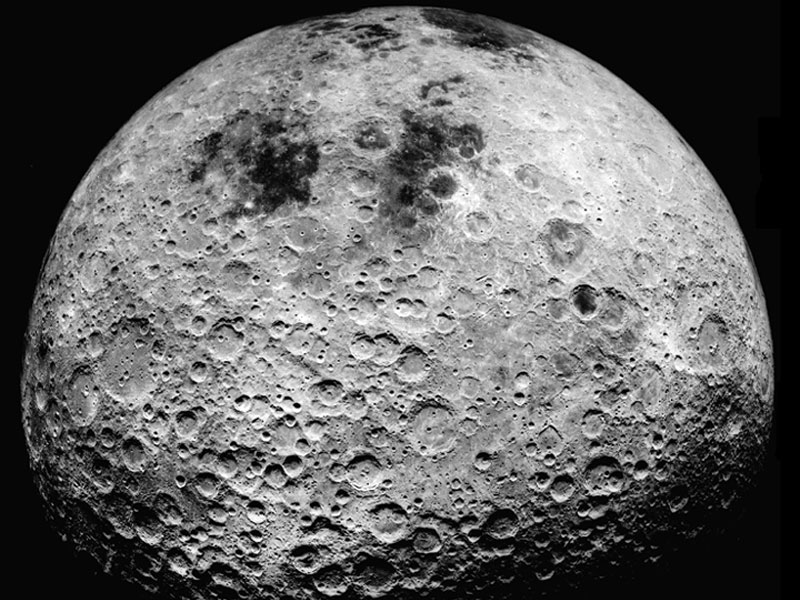
[The pitted appearance of the far side of the Moon suggests that it has shielded Earth from a number of significant impacts, including the South Pole-Aitken basin, which is the largest known impact feature in our solar system.]
1640 - The Treaty of Ripon was signed, restoring peace between Scotland and Charles I.
1689 - Austrian General Enea Silvio Piccolomini burned down Skopje to prevent the spread of cholera - or possibly in retaliation for an earlier siege of Vienna; he died of cholera himself soon after, and either way, at least he didn't have to live with himself for what he'd done.
1774 - The first Continental Congress adjourned.
1825 - The Erie Canal opened, connecting the Hudson River at Albany, New York, to the Great Lakes via Lake Erie.
1859 - The Royal Charter was wrecked off the Welsh coast of Anglesey, with as many as 459 dead.
1881 - The Gunfight at the OK Corral took place in Tombstone, Arizona.
1905 - Norway's King Oscar II renounced his claim to Sweden, and by signing the Treaty of Separation gave the former its independence from the latter; Denmark's Prince Carl (husband of England's Princess Maud and therefore son-in-law of Edward VII) soon took over as Sweden's King Haakon VII.
1951 - Britain's Conservative Party, led by Sir Winston Churchill, swept Clement Attlee's Labour Party from power. READ MORE! Also, former Heavyweight boxing champ Joe Louis came out of retirement to fight Rocky Marciano, only to lose after eight rounds on the wrong end of a knockout.
1955 - Ngô Đình Diệm declared himself Premier of South Vietnam.
1959 - The world got its first glimpses at the far side of the Moon, courtesy of Luna 3.
1964 - Eric Edgar Cooke became the last person to be executed in Western Australia.
1967 - Mohammad Reza Pahlavi crowned himself Shah of Iran before crowning his wife Farah Diba the Shahbanu.
1977 - The last naturally occurring case of indigenous smallpox (Variola minor) was diagnosed in Ali Maow Maalin, a hospital cook in Merca, Somalia; the last naturally occurring case of the more deadly Variola major had been detected in October 1975 in a two-year-old Bangladeshi girl, Rahima Banu. The death of Janet Parker in September 1978 aside, the WHO and the CDC consider this the date smallpox was eliminated, a singular day for supporters of vaccination, since smallpox is the only infectious human disease to ever be eradicated.
1979 - The President of South Korea, Park Chung-hee, was assassinated by Kim Jae-kyu, the head of the KCIA; in an attempt made five years earlier, his wife Yuk Young-soo was killed by Mun Se-gwang. READ MORE!
1984 - 'Baby Fae' received a heart transplant from a baboon.
1992 - Canada's Charlottetown Accord was defeated in a nationwide referendum.
2000 - Laurent Gbagbo took over as president of Côte d'Ivoire following a popular uprising against President Robert Guéï.
2001 - President George W. Bush passed the USA PATRIOT Act into law, a suspiciously fast 43 days after the attacks of 9-11.
2002 - The Moscow Theatre Siege reached its heartbreaking climax as approximately 50 Chechen terrorists and 150 of their hostages died when Russian Spetsnaz forces stormed the House of Culture at State Ball-Bearing Plant Number 1 in Dubrovna, near Moscow, which had been occupied by the terrorists during a musical performance three days before.
*
share on: facebook
Monday, October 25, 2010
In Memoriam: Pablo Picasso
Born on this day in 1881 in Málaga, Spain, from an early age Pablo Picasso would show the copious talent that would make him among the most famous and recognizable visual artists of the 20th Century... The son of an art teacher, Picasso was drawing almost before he could speak; in fact, his first word was 'pencil'.
 Although he was born in Spain, Picasso is more often associated with Paris, where he moved in 1900. Thereafter he divided his time (when not globe-trotting) between that city and Barcelona, where today the Museu Picasso contains the best collection of his works, including some from as early as 1889.
Desperately poor upon moving to France (sometimes even having to burn his own work to keep himself and his roommate Max Jacob warm), within a decade he had found himself a place in the salon of Gertrude Stein, who early on gave him encouragement (buying up and therefore rescuing many of those early, flammable works for her home at 27 rue de Fleurus). She also introduced him to people who could help his career, which they did.
There were times, though, when it seemed his scandalously bohemian life would overtake his reputation as an artist; with a deft sense of his own persona, he managed to intersperse the outrages of his private love life with very public awe at his prodigious output, continually reinventing himself in the process. Whichever direction he took, the art world inevitably followed him, from realism to symbolism, then from cubism (of which he is the co-founder, alongside his friend Georges Braque) to neoclassicism and finally surrealism.
His masterwork remains Guernica (1937), which brilliantly depicts the devastation of that town wrought by Luftwaffe bombers on April 26th of that year, at the height of the Spanish Civil War.
*
share on: facebook
Although he was born in Spain, Picasso is more often associated with Paris, where he moved in 1900. Thereafter he divided his time (when not globe-trotting) between that city and Barcelona, where today the Museu Picasso contains the best collection of his works, including some from as early as 1889.Desperately poor upon moving to France (sometimes even having to burn his own work to keep himself and his roommate Max Jacob warm), within a decade he had found himself a place in the salon of Gertrude Stein, who early on gave him encouragement (buying up and therefore rescuing many of those early, flammable works for her home at 27 rue de Fleurus). She also introduced him to people who could help his career, which they did.
There were times, though, when it seemed his scandalously bohemian life would overtake his reputation as an artist; with a deft sense of his own persona, he managed to intersperse the outrages of his private love life with very public awe at his prodigious output, continually reinventing himself in the process. Whichever direction he took, the art world inevitably followed him, from realism to symbolism, then from cubism (of which he is the co-founder, alongside his friend Georges Braque) to neoclassicism and finally surrealism.
His masterwork remains Guernica (1937), which brilliantly depicts the devastation of that town wrought by Luftwaffe bombers on April 26th of that year, at the height of the Spanish Civil War.
*
share on: facebook
Gratuitous Brunette: Adam Goldberg
I first saw Adam Goldberg - who was born this day in 1970 - in 1996, playing Eddie, who for three episodes was briefly Chandler Bing's wacko new roommate on Friends; being the quintessential 'Jew queen' I was instantly smitten, and being loyal I am smitten still.
 He was also memorable in Saving Private Ryan, mainly because he was a welcome respite from the almost ceaseless onslaught of pornographic violence that was that movie. A cute guy'll do that.
He certainly hasn't lacked for work since then, appearing in EDtv (1999), A Beautiful Mind (2001), and The Hebrew Hammer (2003); equally effective in movies and on television, he's made memorable appearances on My Name Is Earl, Joey (not that anyone saw it), and Entourage.
His on-again off-again relationship with Christina Ricci appears to be off again, which is too bad... Not only do they make a cute couple, but if a guy this hot must insist on being straight, I prefer it if he is with a girl (or girls) I like. Because I'm selfish that way.
*
share on: facebook
He was also memorable in Saving Private Ryan, mainly because he was a welcome respite from the almost ceaseless onslaught of pornographic violence that was that movie. A cute guy'll do that.He certainly hasn't lacked for work since then, appearing in EDtv (1999), A Beautiful Mind (2001), and The Hebrew Hammer (2003); equally effective in movies and on television, he's made memorable appearances on My Name Is Earl, Joey (not that anyone saw it), and Entourage.
His on-again off-again relationship with Christina Ricci appears to be off again, which is too bad... Not only do they make a cute couple, but if a guy this hot must insist on being straight, I prefer it if he is with a girl (or girls) I like. Because I'm selfish that way.
*
share on: facebook
"I Am Woman" by Helen Reddy
Birthday wishes go out today to Helen Reddy, whose 1972 feminist anthem I Am Woman remains one of the most culturally significant songs of the Seventies - and indeed of all time!
Co-written by fellow Australians Reddy and Ray Burton, the song was one of the first to encapsulate the aims of the feminist movement in a non-threatening* way... Nevertheless, radio stations were reluctant to play it, and Reddy's manager (her husband, Jeff Wald) booked extensive television appearances in order to build buzz for the song; many local radio stations eventually capitulated after they were inundated with calls by female listeners.
Wald's own persistence also paid off**... Having spent as much as 18 hours a day for weeks on the phone cajoling radio stations to play the track, I Am Woman hit #1 in the US on December 9th - some three months after its release; it's shown here on the TV series The Midnight Special, which performance was first broadcast on NBC in 1975, at a time when Helen Reddy was the show's permanent host.
*Pro-woman, as opposed to anti-man, I guess...
**In more ways than one... Reddy and Wald made an estimated $40 million from the song, which thanks to their lavish lifestyle they'd burned through by the time of their acrimonious divorce in 1982.
*
share on: facebook
Happy Birthday Ed Robertson
Born on this day in Scarborough, Ed Robertson (along with Steven Page) founded the hugely popular Canadian band Barenaked Ladies in 1988; their first hit, a cover of Bruce Cockburn's Lovers in a Dangerous Time, brought them their first public recognition - not to mention their first hit single - in 1991. It was their 1992 'debut' album Gordon (actually their fifth) that made them instant legends.
 Although he has always contributed lyrically to the band (writing or co-writing many of the band's trademark catchy, clever songs) as well as harmoniously (his and Page's distinct voices blending together like caramel and cream) since 1998's smash-hit album Stunt Robertson has done more solo writing and singing.
Married and the father of three, when not performing with Barenaked Ladies Robertson keeps busy working for ecology, with the charity 30-Hour Famine, and starring in his own show on Canada's Outdoor Life Network, called Ed's Up. In August 2008 he survived unscathed after crashing his Cessna 206, which may have been caused by wind gusts stalling the aircraft's engine; following an official investigation both Robertson and his plane were cleared of negligence, and investigators praised both Robertson's handling of the crisis (he was carrying three passengers, all of whom were unharmed) as well as his cooperation with the subsequent investigation.
*
share on: facebook
Although he has always contributed lyrically to the band (writing or co-writing many of the band's trademark catchy, clever songs) as well as harmoniously (his and Page's distinct voices blending together like caramel and cream) since 1998's smash-hit album Stunt Robertson has done more solo writing and singing.Married and the father of three, when not performing with Barenaked Ladies Robertson keeps busy working for ecology, with the charity 30-Hour Famine, and starring in his own show on Canada's Outdoor Life Network, called Ed's Up. In August 2008 he survived unscathed after crashing his Cessna 206, which may have been caused by wind gusts stalling the aircraft's engine; following an official investigation both Robertson and his plane were cleared of negligence, and investigators praised both Robertson's handling of the crisis (he was carrying three passengers, all of whom were unharmed) as well as his cooperation with the subsequent investigation.
*
share on: facebook
"The Charge of the Light Brigade" by Alfred, Lord Tennyson

[In addition to the poem below - The Charge of the Light Brigade by Alfred, Lord Tennyson - the Crimean War's Charge of the Light Brigade inspired the painter Richard Caton Woodville to create the above image in 1854, the year before his death at the age of 30; so strong was Woodville's aptitude his son would also become a military painter.]
Half a league half a league,
Half a league onward,
All in the valley of Death
Rode the six hundred:
'Forward, the Light Brigade!
Charge for the guns' he said:
Into the valley of Death
Rode the six hundred.
'Forward, the Light Brigade!'
Was there a man dismay'd ?
Not tho' the soldier knew
Some one had blunder'd:
Theirs not to make reply,
Theirs not to reason why,
Theirs but to do & die,
Into the valley of Death
Rode the six hundred.
Cannon to right of them,
Cannon to left of them,
Cannon in front of them
Volley'd & thunder'd;
Storm'd at with shot and shell,
Boldly they rode and well,
Into the jaws of Death,
Into the mouth of Hell
Rode the six hundred.
Flash'd all their sabres bare,
Flash'd as they turn'd in air
Sabring the gunners there,
Charging an army while
All the world wonder'd:
Plunged in the battery-smoke
Right thro' the line they broke;
Cossack & Russian
Reel'd from the sabre-stroke,
Shatter'd & sunder'd.
Then they rode back, but not
Not the six hundred.
Cannon to right of them,
Cannon to left of them,
Cannon behind them
Volley'd and thunder'd;
Storm'd at with shot and shell,
While horse & hero fell,
They that had fought so well
Came thro' the jaws of Death,
Back from the mouth of Hell,
All that was left of them,
Left of six hundred.
When can their glory fade?
O the wild charge they made!
All the world wonder'd.
Honour the charge they made!
Honour the Light Brigade,
Noble six hundred!
*
share on: facebook
"Rock You Like A Hurricane" by Scorpions
As classical music goes, this if far more to my liking than anything performed by the Drab Longhairs Quartet...
Here German metal gods Scorpions turn out a positively Wagnerian symphonic version of their monster hit Rock You Like a Hurricane - which first appeared on their 1984 album Love at First Sting, and is posted here in honour of the birthday of guitarist and songwriter Matthias Jabs - with the Berlin Philharmonic Orchestra from the 2000 DVD Moment of Glory.
*
share on: facebook
POPnews - October 25th

[22-year-old George III came to the throne with the usual excitement that ought to betoken the birth of a new era; alas, while it was long, his reign would bring the loss of the American colonies and is best remembered today for His Majesty's eventual descent into madness.]
1147 - The Seljuk Turks under Mesud I of the Sultanate of Rum completely annihilated the German crusaders of Conrad III at the Battle of Dorylaeum; from a force of some 20,000 Conrad III was only able to add 2,000 to a force commanded by France's Louis VII before attempting (and failing) to lay siege to Damascus in July 1148 as part of the Second Crusade.
1315 - Adam Banastre, Henry de Lea, and William Bradshaw led a putative attack on Liverpool Castle.
1415 - England's Henry V defeated the army of France's Charles VI commanded by Charles d'Albret and various Armagnac nobles at the Battle of Agincourt; the battle is one of the most celebrated in English history, and forms the core of William Shakespeare's play Henry V.
1616 - Dutch sea-captain Dirk Hartog made the second recorded landfall by a European on Australian soil, at the later-named Dirk Hartog Island off the coast of Western Australia.
1747 - The British fleet under Admiral Sir Edward Hawke defeated a French force commanded by Admiral Desherbiers de l'Etenduère at the second battle of Cape Finisterre.
1760 - George III ascended to the throne of England following the death of his grandfather, George II - his father Frederick, Prince of Wales, having died in March 1751.
1813 - Canadian forces (aided by Mohawks) defeated a much larger American army commanded by Major-General Wade Hampton at the Battle of Chateauguay, near Ormstown, Quebec, during the War of 1812.
1828 - London's St Katharine Docks opened; it would be the engineer Thomas Telford's only major project in the capital. Named for the former hospital of St Katharine's by the Tower and formerly an integral part of the Port of London, they are currently enjoying a second life after being converted into a popular housing and entertainment district known as Docklands.
1854 - The disastrous Charge of the Light Brigade - at the Battle of Balaklava - occurred during the Crimean War, under the command of Britain's Lord Cardigan.
1861 - The Toronto Stock Exchange was created.
1875 - The first performance of the Piano Concerto No. 1 by Pyotr Ilyich Tchaikovsky was given in Boston, with Hans von Bülow as soloist.
1912 - Richard Strauss' opera Ariadne auf Naxos received its world debut performance at the Vienna State Opera.
1924 - The forged Zinoviev Letter was published by London's Daily Mail, wrecking any chance Ramsay MacDonald's Labour Party might have had of re-election.
1944 - Heinrich Himmler ordered a crackdown on the Edelweiss Pirates, a loosely knit offshoot of the German Youth Movement in Nazi Germany which had been assisting those in hiding from the Hitler Youth, the Reich Labour Service, and/or compulsory military service; in all 13 members of the Ehrenfelder Gruppe were publicly hanged in Köln the following November 10th, including Bartholomäus Schink.
1976 - Her Majesty The Queen officially opened Britain's National Theatre on London's South Bank.
1983 - During Operation Urgent Fury the United States and its Caribbean allies invaded Grenada, six days after Prime Minister Maurice Bishop and several of his supporters were executed in a coup d'état.
1993 - Jean Chrétien was elected Prime Minister of Canada, winning a massive plurality for the Liberal Party, and reducing the former governing Progressive Conservative Party to 2 seats. Good times...
1995 - A commuter train collided with a school bus in Fox River Grove, Illinois, killing seven students.
2007 - The first Airbus A380 passenger flight - operating for Singapore Airlines, with flight number SQ 380 - flew its scheduled service between Singapore and Sydney.
*
share on: facebook
Sunday, October 24, 2010
Remembering... Harry Hay

In 1950, a generation before Stonewall, Harry Hay helped to co-found the Mattachine Society, which argued for gay and lesbian civil rights; at a time when it was illegal for lesbians and gay men to even congregate in public, he and his fellow members took a terrible risk. Where an earlier group - The Society for Human Rights - formed in Chicago in 1924 but was very quickly suppressed by the authorities, Mattachine survived well beyond the Stonewall era, not officially disbanding until 1987.
Harry Hay's place, then, as father not only of the gay rights movement but also of gay culture is unquestioned, like Del Martin and Phyllis Lyon are among the mothers of the lesbian community and culture.
Not satisfied, though, to liberate just one oppressed group, he co-founded the Radical Faeries in 1979 alongside his partner, John Burnside. Radical Faeries espoused an Earth-based neo-pagan religion which embraced all sorts of gay men, who in those days were largely ostracized from all religions, and in his opinion needed a welcoming place in which to be spiritual.
In his final years, Hay was dismayed to see the toll both AIDS and assimilation was taking on the community he had worked so hard to build. Harry Hay died on this day in 2002 of lung cancer at the age of 90 in San Francisco. He was survived by Burnside, his partner since 1963, who himself died in September 2008 at the age of 91.
*
share on: facebook
The Death of Tycho Brahe
Danish nobleman Tycho Brahe was, like many astronomers of the 16th Century, a prodigious dreamer; at a time when so little was understood of the mechanics of the sky, it took a man of two minds - one philosophical, the other analytical - to unite the physics and mythology of the skies into a unified whole.
 Born in December 1546, Tycho was just such a man. Alongside contemporaries such as Johannes Kepler (whose own work was a continuation of his), Tycho made observations which formed the basis of astronomy for decades, if not centuries. Despite this, he was never a believer in heliocentrism, which caused some friction between himself and Kepler; Tycho believed that the Sun orbited the Earth, while the other planets orbited the Sun.
The long-standing myth surrounding Brahe's final days is that he died of a bladder infection; because it would have been impolite for him to leave a banquet he was attending before it was over, even to relieve himself, he stayed and was said to have strained himself, dying 11 days later. Subsequent analysis of hair from his remains, however, detected massive quantities of mercury.
Since like most scientific men of his day, Tycho was also a keen alchemist, it's unlikely that he would have taken such massive quantities of it himself, even though mercuric chloride was a staple ingredient in much of that era's medicine. Modern fingers tend to point to poisoning, and to Kepler as the poisoner; Kepler had the means, motive, opportunity, and not only stole much of Tycho's research following his mentor's death but worked at submerging Tycho's reputation for generations to come as well.
Tycho Brahe is buried in the Church of Our Lady in front of Týn, in Prague, near the Old Town Square.
*
share on: facebook
Born in December 1546, Tycho was just such a man. Alongside contemporaries such as Johannes Kepler (whose own work was a continuation of his), Tycho made observations which formed the basis of astronomy for decades, if not centuries. Despite this, he was never a believer in heliocentrism, which caused some friction between himself and Kepler; Tycho believed that the Sun orbited the Earth, while the other planets orbited the Sun.The long-standing myth surrounding Brahe's final days is that he died of a bladder infection; because it would have been impolite for him to leave a banquet he was attending before it was over, even to relieve himself, he stayed and was said to have strained himself, dying 11 days later. Subsequent analysis of hair from his remains, however, detected massive quantities of mercury.
Since like most scientific men of his day, Tycho was also a keen alchemist, it's unlikely that he would have taken such massive quantities of it himself, even though mercuric chloride was a staple ingredient in much of that era's medicine. Modern fingers tend to point to poisoning, and to Kepler as the poisoner; Kepler had the means, motive, opportunity, and not only stole much of Tycho's research following his mentor's death but worked at submerging Tycho's reputation for generations to come as well.
Tycho Brahe is buried in the Church of Our Lady in front of Týn, in Prague, near the Old Town Square.
*
share on: facebook
Gratuitous Brunette: Zac Posen
 Once upon a time I wanted to be a fashion designer...
I bought and studied fashion magazines religiously, and even attended a couple of classes at a local fashion school, where I learned the essentials of millinery and fashion illustration among other arcane mysteries. It was something I was serious about, and dovetailed well with the study of makeup artistry and hairdressing which I undertook later, as well as with the photography that came after that.
All of this, of course, was prior to the rise of such designers as Marc Jacobs and Hedi Slimane, back when Isaac Mizrahi was still fat, and it didn't matter what fashion designers looked like.
Chased away from my dreams by the looks fascists I settled briefly in hairdressing and makeup, before being driven out of there; I was then driven out of photography by the same forces, and soon I'll be driven out of writing and blogging as well, the way things are going.
Nevertheless, by capitulating I'm as much to blame as the gay men I continue to meet who tell me that I'm 'so disgusting I don't deserve to live', which gives me a laugh now but really hurt when it started occurring (as it will) immediately following my 24th birthday.
New York City native Zac Posen's reputation is built principally upon the fact that he is the pet gay of such renowned fashion-plate actresses as Natalie Portman, Liv Tyler, Gwyneth Paltrow, and Claire Danes. Honestly, it's been so long since I studied fashion now that I couldn't tell a Zac Posen dress from the schmatte run up by the late Alexander McQueen; I just like looking at him.
*
share on: facebook
Pop History Moment: The Execution of Vidkun Quisling
Few people in history have been so good at what they do that their name becomes synonymous with their vocation; Vidkun Quisling, though, was one such person.
 Prior to the outbreak of World War II, Quisling and Johan Bernhard Hjort formed Nasjonal Samling (NS), or 'National Unity', a fascist political party in Norway founded in accordance with the same principle of Führerprinzip as applied to the National Socialists under Adolf Hitler.
Unilaterally declaring himself Premier of Norway following Operation Weserübung in April 194o, the former Minister of Defence tried to form a government under Josef Terboven, who'd been appointed Reichskommissar. Shortly thereafter The Times of London coined the term 'quisling' to mean 'traitor' or 'collaborator'.
Following the abolition of Norway's monarchy, Quisling was named Minister-President or Fører in February 1942; he remained in power until his arrest in May 1945, despite having never been recognized by the popular King, Haakon VII, and therefore enjoying little or no support from ordinary Norwegians. Although his party did boast 50,000 members at one point during the occupation, as many as half of these received jail time following the war.
Beginning with the outbreak of peace after six years of war Norway began to prosecute its traitors, and the chief quisling among them was naturally Quisling himself, along with the other two leaders of NS, Albert Viljam Hagelin and Ragnar Skancke. Quisling was found guilty of treason for his role in the coup of April 1940, and sentenced to death.
All three were eventually executed by firing squad at Akershus Fortress in Oslo, Vidkun Quisling's fatal bullet being the first to do its righteous duty on this day in 1945.
*
share on: facebook
Prior to the outbreak of World War II, Quisling and Johan Bernhard Hjort formed Nasjonal Samling (NS), or 'National Unity', a fascist political party in Norway founded in accordance with the same principle of Führerprinzip as applied to the National Socialists under Adolf Hitler.Unilaterally declaring himself Premier of Norway following Operation Weserübung in April 194o, the former Minister of Defence tried to form a government under Josef Terboven, who'd been appointed Reichskommissar. Shortly thereafter The Times of London coined the term 'quisling' to mean 'traitor' or 'collaborator'.
Following the abolition of Norway's monarchy, Quisling was named Minister-President or Fører in February 1942; he remained in power until his arrest in May 1945, despite having never been recognized by the popular King, Haakon VII, and therefore enjoying little or no support from ordinary Norwegians. Although his party did boast 50,000 members at one point during the occupation, as many as half of these received jail time following the war.
Beginning with the outbreak of peace after six years of war Norway began to prosecute its traitors, and the chief quisling among them was naturally Quisling himself, along with the other two leaders of NS, Albert Viljam Hagelin and Ragnar Skancke. Quisling was found guilty of treason for his role in the coup of April 1940, and sentenced to death.
All three were eventually executed by firing squad at Akershus Fortress in Oslo, Vidkun Quisling's fatal bullet being the first to do its righteous duty on this day in 1945.
*
share on: facebook
Happy Birthday B. D. Wong
Born on this day in 1960, Bradley Darryl Wong is a talented actor and writer, whose breakthrough Broadway role in M. Butterfly opposite John Lithgow was showered with honours: the Tony Award, the Drama Desk Award, the Outer Critics Circle Award, the Clarence Derwent Award, and the Theatre World Award - an unprecedented feat.
 B. D. Wong currently appears as Dr. George Huang on NBC's Law & Order: Special Victims Unit; previously he appeared as Father Ray Mukada on Oz. He also played Linus (my favourite character) in the 1999 Broadway revival of You're A Good Man, Charlie Brown.
In 2003 Wong wrote a memoir entitled Following Foo: the Electronic Adventures of the Chestnut Man, which concerned the tribulations involved in surrogate parenting when he and his partner Richie Jackson had their son Jackson Foo*.
That same year he was also given a GLAAD Award, which almost never go to gay people, since GLAAD's job is kissing up to straights. Not that I'm bitter.
*Jackson Foo Wong had a twin brother named Boaz Dov, who died 90 minutes after he was born; the pair were conceived using Wong's sperm and an egg from Jackson's sister, then carried via a surrogate mother.
*
share on: facebook
B. D. Wong currently appears as Dr. George Huang on NBC's Law & Order: Special Victims Unit; previously he appeared as Father Ray Mukada on Oz. He also played Linus (my favourite character) in the 1999 Broadway revival of You're A Good Man, Charlie Brown.In 2003 Wong wrote a memoir entitled Following Foo: the Electronic Adventures of the Chestnut Man, which concerned the tribulations involved in surrogate parenting when he and his partner Richie Jackson had their son Jackson Foo*.
That same year he was also given a GLAAD Award, which almost never go to gay people, since GLAAD's job is kissing up to straights. Not that I'm bitter.
*Jackson Foo Wong had a twin brother named Boaz Dov, who died 90 minutes after he was born; the pair were conceived using Wong's sperm and an egg from Jackson's sister, then carried via a surrogate mother.
*
share on: facebook
Remembering... Raúl Juliá
Born in Puerto Rico in March 1940, Raúl Juliá was both a gifted dramatic and comedic actor; married since 1976 to Meryl Poloway, he was the father of two sons (Raul, born in 1983, and Benjamin, born in 1987).
 His breakthrough dramatic role was in Kiss of the Spider Woman (1985), opposite William Hurt and Sonia Braga; it was his comedic turn as Gomez Addams in The Addams Family (1991) and Addams Family Values (1993), though, that made him a household name - at least around this household!.
Diagnosed with stomach cancer in 1991, Juliá went out of his way to conceal his illness; in fact, for his fans - myself included - the news that he'd suffered a stroke 8 days before he died (on this day in 1994) was nearly as much a shock as his death itself, even though his illness had been apparent for some time, and was the subject of much speculation by tabloid television.
*
share on: facebook
His breakthrough dramatic role was in Kiss of the Spider Woman (1985), opposite William Hurt and Sonia Braga; it was his comedic turn as Gomez Addams in The Addams Family (1991) and Addams Family Values (1993), though, that made him a household name - at least around this household!.Diagnosed with stomach cancer in 1991, Juliá went out of his way to conceal his illness; in fact, for his fans - myself included - the news that he'd suffered a stroke 8 days before he died (on this day in 1994) was nearly as much a shock as his death itself, even though his illness had been apparent for some time, and was the subject of much speculation by tabloid television.
*
share on: facebook
Subscribe to:
Posts (Atom)