Sunday, November 14, 2010

Pop History Moment: Princess Anne Married Mark Phillips

Photo Sharing and Video Hosting at PhotobucketOn this day in 1973 500 million people tuned in to watch the Queen's only daughter HRH The Princess Anne marry Lieutenant Mark Phillips, who was then serving with the 1st Queen's Dragoon Guards; it was the first Royal Wedding in over a dozen years, the last having been that of Princess Anne's aunt Princess Margaret to Antony Armstrong-Jones in 1960.

Anne and Mark were married in Westminster Abbey; they'd been engaged since May, and met through their shared love for all things equestrian.

Following an 18-day honeymoon upon the royal yacht HMY Britannia, the couple settled at Gatcombe Park. They had two children together: Peter Phillips, born in November 1977, and Zara Phillips, born in May 1981. Separating in August 1989 - due in large part to the fact that Phillips had fathered another woman's baby - the couple divorced in April 1992; Her Royal Highness was remarried in December of that year to Timothy Laurence, a commander in the Royal Navy, to whom she is married still.
*
share on: facebook

The Death of Nell Gwynne

Beloved by Charles II of England and admired by contemporary diarist Samuel Pepys - who called her 'pretty, witty Nell' - Nell Gwynne was the pre-eminent comedienne of the Restoration stage, and the first actress whose fame has outlived her lifetime, since women weren't permitted on the stage previously; the era also saw the emergence of Britain's first woman playwright, Aphra Behn.

Photo Sharing and Video Hosting at PhotobucketBorn most likely at the beginning of February 1650 (nobody seems to know where, and not even the date is certain, only likely) her first appearance at what would come to be known as Theatre Royal, Drury Lane was at the age of 14, selling oranges and other treats to the patrons - including, quite possibly, herself. Her first recorded treading of the boards was in 1665, in a play by John Dryden, under the tutelage of her first prominent love, the actor Charles Hart.

Later that year and early in the next, as the Great Plague ravaged London, Gwynne travelled with the court as a member of the King's Company, which entitled her to the great honour of wearing His Majesty's livery; fire in London in September 1666 probably prevented her return there, and she seems to have lived in Oxford during this time.

In 1667 George Villiers, 2nd Duke of Buckingham was eager to wean the King off of his current favourite mistress, Buckingham's cousin Barbara Palmer (who had anyway peeved the Queen, Catherine of Braganza) and so introduced him to both Gwynne and Moll Davis, who quickly became rivals for the King's affection. By hook or by crook, Gwynne seems to have prevailed by 1668, reportedly with the intervention of Aphra Behn and some powerful laxatives - a scene right out of Restoration comedy.

Gwynne made a brief, daring return to her stage career, but in May 1670 gave birth to the King's son Charles, and by 1671 she was once again retired from the stage at the ripe old age of 21. Which was all to the better, as she now had to fend off another challenge for the King's attention - this time from one of the Queen's maids, Louise de Kérouaille.

It was during this time that she was accosted in her carriage while driving through Oxford; mistaken for the King's Catholic mistress, de Kérouaille, she blithely leaned out the window and uttered her most famous line: 'Good people, you are mistaken; I am the Protestant whore.' Thereafter they left her alone, since (then, as now) the English have a great respect for anyone with a sense of humour about themselves. Another great quip has survived the predations of history; she broke up a fight in which her coachman was defending her honour by saying 'I am a whore. Find something else to fight about.' Once again, it worked.

On Christmas Day 1671 Gwynne gave birth to a second son by the King, James Beauclerk, who died mysteriously at school in Paris in 1680, aged 9. The King himself died in 1685, and two years later in March of 1687 she suffered a stroke, which left her paralyzed. A second stroke in May confined her to bed, and she made out her will in July.

Nell Gwynne died on this day in 1687, aged 37; she was buried in St Martin-in-the-Fields, in Trafalgar Square, following a funeral at which the Archbishop of Canterbury delivered the sermon. Not bad for a girl with shady origins who used her dodgy profession to sleep her way to the top...
*
share on: facebook

POPnews - November 14th

Photobucket
[While Colombian money has frequently featured portraits of mythical or allegorical women, Policarpa Salavarrieta is the only historical woman to be so honoured; currently, her image appears on the 10,000 peso note.]

1889 - Journalist Nellie Bly began a successful attempt to travel around the world in 80 days, inspired by the Jules Verne novel of that name... She actually completed the trip in under seventy-three days and her account of the trip, Around the World in Seventy-Two Days, became almost as big a best seller as Verne's.

1910 - Aviator Eugene Ely became the first to launch an airplane from a ship when he took off from a makeshift deck on the USS Birmingham at Hampton Roads, Virginia, in a Curtiss Model D designed by Glenn Curtiss himself.

1922 - The British Broadcasting Company (BBC) began radio service.

1940 - The city of Coventry was heavily bombed by the Luftwaffe, almost completely destroying Coventry Cathedral in the process.

1941 - The aircraft carrier HMS Ark Royal sank off Gibraltar - a day after sustaining heavy damage from the German submarine U-81, which was under the command of Friedrich Guggenberger.

1948 - The first child - a son and heir to the throne, named Charles Philip Arthur George - was born to Britain's Duke and Duchess of Edinburgh.

1952 - The first regular UK singles chart was published by the New Musical Express.

1957 - The Apalachin Meeting outside Binghamton in Upstate New York was raided by law enforcement, resulting in the arrest of many high level Mafiosi, including the meeting's host Joseph 'Joe the Barber' Barbara.

1965 - The Battle of the Ia Drang - the first major engagement between regular American and North Vietnamese forces during the Vietnam War - began.

1967 - The Congress of Colombia, in commemoration of the 150th anniversary of the death of Policarpa Salavarrieta, led that nation in celebrating this day as the first 'Day of the Colombian Woman'.

1969 - NASA launched Apollo 12, the second manned mission to the surface of the Moon.

1970 - Southern Airways Flight 932 crashed in the mountains near Huntington, West Virginia, killing 75 - including members of the Marshall University football team.

1971 - Shenouda III was enthroned as Pope of Alexandria and the Patriarch of All Africa on the Holy Apostolic See of Saint Mark the Evangelist, making him the spiritual leader of the Coptic Orthodox Church around the world.

1972 - The Dow Jones Industrial Average closed at 1,003.16 - above 1,000 for the first time.

1973 - The Queen's only daughter Princess Anne married Captain Mark Phillips at Westminster Abbey.

1975 - Spain relinquished its claim to Western Sahara.

1984 - Zamboanga City mayor Cesar Climaco - a prominent critic of the government of Philippine President Ferdinand Marcos - was assassinated in his home city.

1991 - Cambodia's Prince Norodom Sihanouk returned to Phnom Penh after thirteen years in exile.

2003 - Sedna* was discovered, although the discovery would not be announced until the following March... Already considered a trans-Neptunian object by scientists, whether or not it is an asteroid or dwarf planet is still being debated, and will obviously depend on whether or not it is in hydrostatic equilibrium, as is currently suspected. It is, nevertheless, the most distant observed natural body in our solar system.

*Named after the Inuit goddess of the sea...
*
share on: facebook

Saturday, November 13, 2010

POPnews - November 13th

Photobucket
[Despite the initial controversy surrounding the Vietnam Veterans Memorial it has proven so popular since its opening that it has been expanded; now, in addition to its iconic wall, the site includes the Three Soldiers statue and the Vietnam Women's Memorial, all of which are intended to help assuage the deep wounds caused to the American psyche by that unpopular war.]

1002 - As recounted in the writings of John of Wallingford, England's King Ethelred the Unready ordered the killing of all Danes in England, which is known today as the St. Brice's Day massacre; among those killed was Gunhilde, sister of Denmark's King Sweyn I, who invaded England the following year in reprisal.

1775 - Patriot revolutionary forces under Colonel Ethan Allen attacked Montreal, which was defended by British General Guy Carleton; Allen and his troops were disorganized and soundly defeated... However, US Brigadier General Richard Montgomery's force later entered Montreal unopposed after Carleton had withdrawn to Quebec City.

1851 - The Denny Party arrived at Alki Point aboard the schooner Exact; they later claimed to be the first settlers in what would become Seattle, Washington, despite the presence of Duwamish Indians and David Swinson 'Doc' Maynard, who were already living there.

1887 - Protesters demanding the release of imprisoned MP William O'Brien clashed with London's Metropolitan Police near Trafalgar Square on what came to be called Bloody Sunday.

1901 - The Caister Lifeboat Disaster claimed the lives of nine life-savers with the RNLI life-boat Beauchamp off of England's Norfolk coast.

1927 - The Holland Tunnel opened to traffic as the first vehicular tunnel linking New York City to New Jersey beneath the Hudson River.

1941 - The Royal Navy's aircraft carrier HMS Ark Royal was torpedoed by the Kriegsmarine's U-81, resulting in the death of Able Seaman Edward Mitchell; the rest of the crew was evacuated to the nearby HMS Legion before the eventual sinking of the Ark Royal the following day...

1950 - The President of Venezuela, General Carlos Delgado Chalbaud, was assassinated in Caracas.

1956 - The US Supreme Court declared Alabama and Montgomery laws requiring segregated buses illegal; although this should have ended the Montgomery Bus Boycott then and there, the buses wouldn't be fully integrated until December.

1965 - The SS Yarmouth Castle caught fire and sank 60 miles off Nassau with the loss of 90 lives.

1971 - NASA's Mariner 9 became the first spacecraft to orbit another planet successfully when it entered its planned trajectory around Mars.

1982 - The Vietnam Veterans Memorial - located in Washington DC's Constitution Gardens - was dedicated after a march to its site by thousands of Vietnam War veterans; the design, by Maya Lin, was controversial at first, but it is now one of the most-visited of that city's monuments.

1985 - The volcano Nevado del Ruiz erupted and melted a glacier, causing a lahar (or volcanic mudslide) that buried the Colombian town of Armero, killing approximately 23,000 people.

1988 - Mulugeta Seraw - an Ethiopian-born law student living in Portland, Oregon - was beaten to death by members of the neo-Nazi group East Side White Pride.

1990 - David Gray shot and killed 13 people over two days in the New Zealand resort town of Aramoana, in what became known as the Aramoana Massacre; it remains that country's deadliest shooting spree.

1994 - Voters in Sweden decided to join the European Union in a referendum.

2000 - Philippine House Speaker Manuel B. Villar, Jr. passed articles of impeachment against President Joseph Estrada on charges of corruption and plunder, charges which would ultimately fail to unseat him.

2002 - The oil tanker Prestige sank off the Galician coast, spilling 20 million gallons and soiling more than 1,000 beaches in northern Spain and southern France.

2007 - An explosion hit the south wing of the House of Representatives of the Philippines in Quezon City, killing four people, including Congressman Wahab Akbar, and wounding six; to blame was the militant Islamist group Abu Sayyaf.
*
share on: facebook

Friday, November 12, 2010

"Grace Kelly" by Mika


Mika's smash hit album Life in Cartoon Motion contains this UK #1, Grace Kelly; the track also attained the #1 spot in Argentina, Denmark, Ireland, Italy, Lebanon, Mexico, Norway, and Spain. Mika has stated in various interviews that the song's basis is the famous aria Largo al factotum from the opera The Barber of Seville by Gioachino Rossini, and that it was inspired by a less than inspiring meeting with a record company executive.

The award-winning video - starring Mika and Holly Muller - was directed by Sophie Muller; it's posted here today in honour of the birth of its subject.
*
share on: facebook

In Memoriam: Princess Grace

Born on this day in 1929 the daughter of Jack Kelly - himself a self-made millionaire and charismatic Olympic sculler - Grace Kelly wanted for nothing as, during her childhood, the world suffered from the effects of the Great Depression. Her family were prominent in Philadelphia as supporters of the arts, and her beloved gay uncle George Kelly (a pariah to the rest of the family) was a Pulitzer Prize-winning playwright.

Photo Sharing and Video Hosting at PhotobucketKelly attended Ravenhill Academy, where she began her career by modeling at social events; when she graduated from Stevens School in 1947 her yearbook listed her favourite singer as Jo Stafford, with whom she shares a birthday.

Failing to get into Bennington College, Kelly enrolled instead at New York City's American Academy of Dramatic Arts; there she was spotted by producer Delbert Mann, who cast her as the title character in a TV version of Sinclair Lewis' 1940 novel Bethel Merriday. Kelly's big screen debut came in 1951's Fourteen Hours.

It would prove a short but fruitful career; the majority of Grace Kelly's movies are still popular today: High Noon (1952), Mogambo (1953), Dial M for Murder, Rear Window, The Country Girl (all 1954), To Catch a Thief (1955), and High Society (1956). She won an Academy Award for her role in The Country Girl; her final screen appearance was in High Society, a musical remake of her uncle's play The Philadelphia Story.

Along the way she'd won more than an Oscar and the adoration of millions; she'd also won the heart of a Prince, even as she was playing a princess in the film The Swan during their courtship. Her marriage to Rainier III of Monaco in April 1956 ended her film career but brought her into a new phase in her life, a phase which tragically closed when she had a stroke while driving in September 1982, and crashed her Land Rover P6 off the Corniche moyenne and then 100 metres down a steep embankment. Her younger daughter, Princess Stéphanie, was badly injured in the crash, but survived.

The good works Her Serene Highness began in life continue in death through the Princess Grace Foundation, just as surely as her style, gentle manner, and cool beauty survive thanks to the magic of DVD.
*
share on: facebook

The Death of Dr. Norman Bethune

Though he lived but a short time, Dr. Norman Bethune certainly had a full life; born in March 1890 in Gravenhurst, Ontario, and educated at the University of Toronto, and later taught thoracic surgery at McGill University in Montreal.

Photo Sharing and Video Hosting at PhotobucketHe served in Europe during World War I, as a stretcher-bearer; upon his return to Canada he became an early proponent of universal health care. In 1935 he joined the Communist Party of Canada, and thereafter devoted the short remainder of his life to the battle against fascism.

While serving in Spain during the Spanish Civil War (1936-7) he devised the Mobile Surgical Army Hospitals made famous by the TV show M*A*S*H; he also came up with a way to transport blood, improving the odds of surviving combat injuries for untold numbers of soldiers.

After leaving Spain Bethune traveled to China (1938-9), where he conducted field surgery with the Communist Eighth Route Army during the Second Sino-Japanese War. It was there on this day in 1939 he died of blood poisoning from a cut he received while in the commission of his duty.

Virtually unknown in Canada during his lifetime, Bethune's memory was revived by the writings of Mao Zedong, who championed Bethune's selflessness and bravery. He's one of the few Westerners commemorated in China, where there are numerous hospitals named for him, as well as ubiquitous statuary.

His controversial legacy has meant he's less honoured in his home country, although that began to change by the mid 1970s; his birthplace, for instance, is now a National Historic Site, and there is a statue of him in Montreal. He's also been twice portrayed in films by that other Canadian icon, Donald Sutherland.
*
share on: facebook

"The Gentleman Is A Dope" by Jo Stafford


Among the preponderance of superlative female singers in the 1940s, few of them attained the degree of suave effortlessly managed by Jo Stafford, who was born on this day in 1917. Yet she and her husband, bandleader Paul Weston, did more for American music than the creation of some of the finest ear candy ever spun through a microphone; assuming their alter-egos of Jonathan and Darlene Edwards they assailed the mediocre in comedic fashion, which arose out of their party piece and involved their impersonation of a cheesy lounge act.

Where the above clip came from is the usual YouTube mystery, but the song The Gentleman Is A Dope is taken from the Rodgers & Hammerstein musical Allegro; a widow since September 1996, Stafford died in July 2008.
*
share on: facebook

Remembering... Eve Arden

Her first major film appearance was in Stage Door (1937), a film which was considered a flop when it opened, yet seems to be a bigger hit with each passing year; by the time she'd sashayed across the set in Mildred Pierce in 1945 her persona had been perfected*...

Photo Sharing and Video Hosting at PhotobucketYet Eve Arden's was a life nearly done in by insecurity. She seems to have suffered under the delusion that she wasn't beautiful, which notion is belied by her photographs. Fortunately, her supposed handicap allowed her to develop a sharp wit and a sardonic tone which is far more interesting than beauty anyway.

That sense of humour found its ideal showcase throughout the run (both on radio and TV) of Our Miss Brooks, which was on radio from 1948-1957 and was one of the first hit shows at the dawn of television, running from 1952-6. In the show, Arden played that greatest of creatures, a high school English teacher, of the kind many a gay boy once dreamt of having - or maybe that was just me. At the fictional Madison High School she tangled with Principal Osgood Conklin, played by fellow TV legend Gale Gordon, and swooned over biology teacher Philip Boynton (played on radio - and what a waste that was - by uber-hunky Jeff Chandler, who went on to be a movie star, then later by Robert Rockwell).

In her later years, Our Miss Arden got a promotion, becoming principal of the famed Rydell High in the movies Grease and Grease 2; born in April 1908, Eve Arden died on this day in 1990, aged 82.

*Both films have pride of place in the collection of the Pop Culture Institute, naturally.
*
share on: facebook

Sun Yat-sen: The Father of Modern China

The man called 'the father of modern China' was born on this day in 1866 - in a country which then would not have looked too different from the way it had 500 years before, a largely rural expanse smothering beneath the excesses of a decadent monarchy (in this case, the Qing Dynasty) unwilling to change with the times...

Photo Sharing and Video Hosting at PhotobucketAt the age of 13, Sun Yat-sen moved to Honolulu to live with his brother, who'd become a prosperous merchant there; attending the Iolani School, he progressed so quickly in his study of English that he was awarded a prize by Hawai'i's King, David Kalakaua.

Returning home after just 4 years, Sun was dismayed by the backwardness of China, beset by heavy taxes and institutions such as schools which did nothing to reward imagination, only encouraged rote learning and repetition. He converted to Christianity, which was to inform his revolutionary work from that point forward.

Initially behind a movement to force the Qing Dynasty to reinvent itself as a Western-style constitutional monarchy, it became clear that such a reform would never work; the Imperial Household wouldn't even consider his suggestions in this regard simply because he came from peasant stock. To his way of seeing, what China needed was technology, yet seemed afraid to import it. In 1894 Sun returned to Hawai'i to establish the Revive China Society, which later became the Kuomintang.

An 1895 coup failed, after which Sun Yat-sen spent 16 years in exile, travelling around Japan, Europe, and North America in an attempt to garner the support of expatriate Chinese. His time in Vancouver during this era is memorialized by a garden in the city's Chinatown, complete with a statue of his likeness.

In October 1911 the Xinhai Revolution arose out of the Wuchang Uprising, and in February 1912 Emperor Puyi (fabled on film as Bernardo Bertolucci's The Last Emperor) abdicated. For more than a dozen years from 1912 China remained politically fractured due to internecine struggles between Sun's protege Chiang Kai-shek and the old guard, represented by Wang Jingwei; the provisional government managed to survive to form the Republic of China in 1928, which lasted until the predations of Mao in 1949 destroyed any hope of democracy in China for more than 50 years.

Not that Sun Yat-sen lived to see any of that; he died in March 1925, aged 58. Nevertheless, his enduring popularity in Mainland China gives the pro-democracy movement (especially in Taiwan) a powerful symbol. He is buried in Nanjing, appropriately enough at the Sun Yat-sen Mausoleum.
*
share on: facebook

"(Don't Fear) The Reaper" by Blue Öyster Cult


What better time to call for more cowbell than the birthday of Buck Dharma, founding member and lead singer of Blue Öyster Cult, whose 1976 hit (Don't Fear) The Reaper - from their album Agents of Fortune - would later become the source of an inspired bit of lunacy in April 2000 by Will Ferrell, Chris Parnell, Christopher Walken, and company on Saturday Night Live?

The track - which actually got no higher than #12 on the Billboard Hot 100, but is a staple of classic rock nevertheless - was actually produced by Sandy Pearlman and not, as the sketch indicates, Bruce Dickinson; nor was the cowbell performed by Gene Frenkle. There is, however, some debate as to who is responsible; one faction says it was Albert Bouchard, while another claims it was Eric Bloom.
*
share on: facebook

Pop History Moment: The Closing of Ellis Island

Designed by architects Edward Lippincott Tilton and William Boring, the Ellis Island Immigrant Station opened on January 1, 1892 and was closed on this day in 1954, but not before more than 12 million (and as many as 20 million) immigrants were inspected there by the US Bureau of Immigration.


Photo Sharing and Video Hosting at Photobucket

Only third-class passengers were processed here, and after 1924 only refugees; those arriving were screened for illness (both physical and mental), criminal records, and work skills. About 2% were rejected, and untold numbers died in the adjacent hospital.

The first immigrant processed through Ellis Island was Annie Moore, a 15-year-old girl from County Cork, Ireland; the last was a Norwegian merchant seaman by the name of Arne Peterssen in 1954. Today, over 100 million Americans have an ancestor who passed through the site on their way to a better life; famous Ellis Islanders include Bob Hope, Irving Berlin, Knute Rockne, Pola Negri, Anna Q. Nilsson, Claudette Colbert, Chef Boyardee (Ettore Boiardi), Erich von Stroheim, Felix Frankfurter, Father Flanagan, Joseph Stella, Jule Styne, Charles Atlas, Isaac Asimov, the Trapp Family Singers, Ezio Pinza, Ludwig Bemelmans, Sig Ruman, Bela Lugosi, Charles Chaplin, Stan Laurel, Arthur Murray, and Max Factor.

Today the site is a park, museum, and national historic monument.
*
share on: facebook

POPnews - November 12th

Photobucket
[Isn't it cunning, the number of ways I have
of sneaking pictures of the Queen onto this blog?
]

1028 - Future Byzantine empress Zoe married Romanus Argyrus in accordance with the wishes of the dying Constantine VIII.
1793 - Jean Sylvain Bailly, the first Mayor of Paris, was guillotined during the Reign of Terror.
1892 - William 'Pudge' Heffelfinger became the first professional American football player when he was paid $500 for participating in a game for the Allegheny Athletic Association.
1893 - The treaty of the Durand Line - so named after British Foreign Secretary Sir Mortimer Durand - was signed between present day Pakistan and Afghanistan; the Durand Line has gained international recognition as an international border between the two nations.
1912 - The frozen bodies of Robert Scott and his men were found on the Ross Ice Shelf in Antarctica; Scott had died in March while on the Terra Nova Expedition, having attained the South Pole only to discover Roald Amundsen's team of Norwegians had already been and gone.
1920 - Representatives of Italy and the Kingdom of Serbs, Croats and Slovenes signed the Treaty of Rapallo in order to settle various boundary disputes concerning a portion of the upper Adriatic known as the Julian March.
1922 - The Sigma Gamma Rho sorority was founded on the campus of Butler University in Indianapolis, Indiana.
1936 - The San Francisco-Oakland Bay Bridge opened to traffic, six months before its more famous cousin, the Golden Gate Bridge.

1944 - As part of one of the most successful precision bombing attacks of the war - Operation Catechism, commanded by Group Captain James Brian Tait - Britain's Royal Air Force launched 30 Avro Lancaster bombers from No. 9 Squadron and No. 617 Squadron intent on sinking the German battleship Tirpitz with Tallboy bombs at her moorings in the Norwegian port of Tromsø; the mission was a success, with either two or three of the bombs scoring a direct hit, capsizing what had been the largest warship ever built in Europe and killing 1,000 of the 1,900 crew onboard.

1948 - In Tokyo the International Military Tribunal for the Far East sentenced seven Japanese military and government officials - including General Hideki Tojo - to death for their roles in World War II.

1969 - Independent investigative journalist Seymour Hersh broke the story of the My Lai Massacre.
1970 - Near Florence, Oregon, that state's Highway Division attempted to destroy a rotting beached sperm whale using half a ton of dynamite, with the entirely predictable results caught on film.
1980 - The NASA space probe Voyager I made its closest approach to Saturn and took the first 'close-up' images of its rings.

1981 - NASA's STS-2 mission, utilizing the Space Shuttle Columbia, marked the first time a manned spacecraft had been launched into space twice.
1982 - Yuri Andropov became the general secretary of the Soviet Communist Party's Central Committee, succeeding Leonid I. Brezhnev; on the same day Solidarity leader Lech Wałęsa was released from prison after eleven months' incarceration. Just under a year earlier the Soviet Union had come close to invading Poland because of the pro-democracy movement championed by Solidarity, compelling Polish dictator Wojciech Jaruzelski to impose martial law.
1984 - Nigel Lawson, Britain's Chancellor of the Exchequer, announced that the country's pound notes would be phased out in favour of coins.

1990 - Japan's Crown Prince Akihito was formally installed as Emperor, becoming the 125th Japanese monarch.

1991 - At the Dili Massacre, Indonesian forces opened fire on a crowd of student protesters in East Timor, killing at least 250 and as many as 400; the incident came to light principally due to the presence of American journalists Amy Goodman and Allan Nairn - who were both injured in the ensuing melee - and was covertly filmed by Yorkshire Television's Christopher Wenner (working under the name Max Stahl).

1997 - Ramzi Yousef was found guilty of masterminding the 1993 World Trade Center bombing.
*
share on: facebook

Thursday, November 11, 2010

Lest We Forget...


*
share on: facebook

"In Flander's Fields" by John McCrae

In Flanders Fields the poppies blow
Between the crosses row on row,
That mark our place; and in the sky
The larks, still bravely singing, fly
Scarce heard amid the guns below.

We are the Dead. Short days ago
We lived, felt dawn, saw sunset glow,
Loved and were loved, and now we lie
In Flanders fields.

Take up our quarrel with the foe:
To you from failing hands we throw
The torch; be yours to hold it high.
If ye break faith with us who die
We shall not sleep, though poppies grow
In Flanders fields.
*
share on: facebook

"For the Fallen" by Lawrence Binyon

With proud thanksgiving, a mother for her children,
England mourns for her dead across the sea.
Flesh of her flesh they were, spirit of her spirit,
Fallen in the cause of the free.

Solemn the drums thrill: Death august and royal
Sings sorrow up into immortal spheres.
There is music in the midst of desolation
And a glory that shines upon our tears.

They went with songs to the battle, they were young,
Straight of limb, true of eye, steady and aglow.
They were staunch to the end against odds uncounted,
They fell with their faces to the foe.

They shall grow not old, as we that are left grow old;
Age shall not weary them, nor the years condemn.
At the going down of the sun and in the morning
We will remember them.

They mingle not with their laughing comrades again;
They sit no more at familiar tables at home;
They have no lot in our labour of the day-time;
They sleep beyond England's foam.

But where our desires are and our hopes profound,
Felt as a well-spring that is hidden from sight,
To the innermost heart of their own land they are known
As the stars are known to the Night;

As the stars that shall be bright when we are dust,
Moving in marches upon the heavenly plain,
As the stars that are starry in the time of our darkness,
To the end, to the end, they remain.
*
share on: facebook

POPnews - November 11th

Photobucket

[As Britain's - and indeed the Commonwealth's - principal mourner, Her Majesty The Queen has presided over numerous ceremonies in honour of those who've died serving their respective countries in times of war... Yet even the Royal Family has not been immune from such tragedies, as her uncle HRH The Duke of Kent died while in the commission of his duty in August 1942.]

1724 - Joseph Blake (alias Blueskin) was hanged at London's Tyburn gallows; a highwayman known for attacking 'Thief-Taker General' (and thief) Jonathan Wild at the Old Bailey, Blake was later immortalized in Blueskin's Ballad by John Gay.

1750 - The College of William and Mary's F.H.C. Society - also known as the Flat Hat Club - was formed at Raleigh Tavern in Williamsburg, Virginia, making it the first-ever fraternity in the United States.

1778 - Seneca Indians in central New York state killed more than forty people, in what came to be known as the Cherry Valley Massacre.

1805 - At the Battle of Dürenstein 8000 French troops commanded by Édouard Mortier attempted to slow the retreat of a vastly superior Russian and Austrian force under Mikhail Illarionovich Kutuzov.

1831 - Nat Turner was hanged at Jerusalem, Virginia, for having incited a violent slave rebellion the previous August.

1839 - The Virginia Military Institute was founded.

1864 - Union General William Tecumseh Sherman began burning Atlanta to the ground in preparation for his famous March to the Sea; these events form the core of Margaret Mitchell's 1936 novel Gone With the Wind and the 1939 movie of the same name*.

*The most technically difficult sequence in the film has earned a place in film lore; the vast set-piece of the burning of Atlanta is indicated in the screenplay by just two words: 'Atlanta burns'. To this day, anything overly ambitious demanded by the director of a film will have the technicians on set grumbling these same two words until such time as they (inevitably) manage to achieve it.

1880 - Australian bushranger Ned Kelly was hanged at Melbourne Gaol.

1887 - Construction of the Manchester Ship Canal was begun at Eastham.

1889 - Washington became the 42nd US state.

1918 - At the eleventh hour on the eleventh day of the eleventh month an armistice between Germany and Allied forces was signed, in a railway carriage near France's Compiègne Forest, ending World War I (then known as the Great War); on the same day Austrian Emperor Charles I relinquished all political power, but did not abdicate.

1919 - The Centralia Massacre in Centralia, Washington, resulted in the deaths of four members of the American Legion and the lynching of a local leader of the IWW.

1921 - The Tomb of the Unknowns was dedicated by US President Warren G. Harding at Arlington National Cemetery.

1926 - Route 66 was established between Chicago and Los Angeles.

1966 - NASA launched Gemini 12.

1975 - Australia's Governor-General Sir John Kerr dismissed the government of Gough Whitlam and commissioned Malcolm Fraser as caretaker Prime Minister, announcing a general election to be held in early December; the country's gravest constitutional crisis to date is now more commonly known as The Dismissal.

1992 - The Church of England voted to allow women priests.

2004 - New Zealand's Tomb of the Unknown Warrior was dedicated at the National War Memorial in Wellington.

2008 - The RMS Queen Elizabeth 2 (QE2) set sail on her final voyage, to Dubai.
*
share on: facebook

Wednesday, November 10, 2010

"The Wreck Of The Edmund Fitzgerald" by Gordon Lightfoot


On this day in 1975 the 729-foot-long freighter SS Edmund Fitzgerald sank during a storm on Lake Superior, killing all 29 crew on board...

The event was famously sung about by Gordon Lightfoot in his classic song The Wreck Of The Edmund Fitzgerald.
*
share on: facebook

Remembering... Norman Mailer

When I was a little queerling (this was fifteen years ago now - okay, twenty...) Norman Mailer was considered the enemy of the gay community; always a macho posturer, Mailer had once allegedly made some offhand comment about how gay men had somehow taken the easy way out by opting not to be with women. Given the humourless tone of gay officialdom in those days (unlike today, he wrote, rolling his eyes so hard he almost gave himself a stroke) Mailer's comment wasn't even permitted enough context in which to grow, let alone be understood...

Photo Sharing and Video Hosting at PhotobucketFast forward a dozen years, when what should cross my desk but an old paperback copy of Advertisements for Myself (1959), a collection of many of Mailer's earliest essays. Among them was an article he wrote in 1955 entitled The Homosexual Villain regarding a pair of homophobic characters (among others) he had written - General Cummings, in his famous bestseller The Naked and the Dead (1948) and Teddy Pope in his forthcoming book The Deer Park (1955); the essay was unique in at least two respects.

Firstly, it was written specifically for the pioneering gay publication One (which had split from the early gay rights group the Mattachine Society in 1952) and when the article appeared Mailer's was far and away the most famous name ever to appear in its masthead. Secondly, the essay offered a profound apology for the laziness that went into making these characters, and for his own attitude, which had previously equated homosexuality with evil reflexively and without any introspection.

At the time, Mailer was the pre-eminent man of American letters, whose lofty fame offered an inbuilt protection from attacks by the lowly and oppressed. Although he later disdained the article as the worst he'd ever written the fact is that at least he wrote it; not only that, when the time came, he republished it. His own bravado meant that he was willing to say something poorly rather than not saying anything at all. Mailer's excoriation of homophobia - however mild - was well-publicized, and stands today as one of the earliest works by a straight man defending his gay brothers.

Mailer had a conflicted relationship to homosexuality at best; he was relatively comfortable with individual homosexuals and was an early defender of James Baldwin, to the extent of supplying Baldwin's explicitly gay novel Giovanni's Room (1956) with a quote for its jacket; he later even admitted to being a 'latent homosexual' himself, qualifying the statement by saying that he 'chose to be heterosexual' - a pretty provocative statement, then as now.

The fact is, he may have only said it to rile up the women's libbers, whose goat he loved to get at the height of their 1970s humourlessness. That they had already branded him an utterly masculine writer - 'without any spark of the female in him' - ought to have made him a kind of icon for the all-male world, rather than its sworn enemy. Unfortunately, centuries of relentless anti-gay violence have rendered the gay community immune to any comment by straight men, a situation which endured up to an indeed beyond this day in 2007, the day Norman Mailer died...


Photo Sharing and Video Hosting at Photobucket

*
share on: facebook

'Torchin' For Bill" by Ann Reinking


Here we see birthday gal Ann Reinking vamping it up as 'Troubles' Moran, in a little number called Torchin' for Bill, from the 1978 movie Movie Movie, directed by Stanley Donen and starring George C. Scott, his wife Trish Van Devere, and featuring a very scrummy young Harry Hamlin.

Movie Movie doesn't appear to be available on DVD DVD - sorry, I couldn't help myself - and more's the pity, since from watching this clip I am so plotzing! I think I ultimately chose it for its obscurity and the fact that it carries echoes of another favourite of ours, Marlene Dietrich's performance of Hot Voodoo from Blonde Venus.
*
share on: facebook

Happy Birthday Ann Reinking

Born on this day in Seattle in 1949, Ann Reinking originally trained for the ballet; she later took Broadway by storm, though, both as a dancer and as a choreographer - first as protege, then later as lover, and finally as heir of Bob Fosse...

Photo Sharing and Video Hosting at PhotobucketBeginning with a part in the chorus in Coco (1969) Reinking gradually rose through the ranks through a combination of hard work, talent, and bendiness. Early roles in Pippin (1972), Over Here! (1974), and Goodtime Charley (1975) led to bigger roles in the original run of Chicago (1975), A Chorus Line (1975), and a revival of Sweet Charity (1986).

Reinking made her film debut in All That Jazz (1979), which was a thinly veiled account of the life of Bob Fosse; she also appeared onscreen in Annie (1982) and Micki and Maude (1984).

As curator of Fosse's legacy, Reinking's greatest triumph to date remains her choreography (in the style of Fosse) and performance as Roxie Hart (based on real-life murderer Beulah Annan), opposite Bebe Neuwirth as Velma Kelly in the revival of Chicago (1996), which is still running on Broadway in addition to West End and touring productions. In 1999 Reinking conceived, co-directed, and co-choreographed the musical revue Fosse; in addition to a Tony Award and a Drama Desk award for Chicago, Reinking has also won a Bob Fosse Award for her work as a choreographer.
*
share on: facebook

In Memoriam: William Hogarth

The modern world owes much to William Hogarth; considered the first artist to create sequential drawings in pursuit of a storytelling aim, he can be considered as the father of the comic strip and thence the graphic novel. As skilled a painter as he was an engraver, his works staked out a place in the middle class where they could both entertain and enlighten the whole of the social strata...

Photo Sharing and Video Hosting at PhotobucketBorn in London on this day in 1697, it was William Hogarth's good fortune to be born in interesting times. The rise of industrialization and urbanization gave his biting satire much on which to chew; they were prosperous times as well, and a burgeoning leisure class was willing to pay good money to be immortalized by him, even if it meant also being lampooned into the deal. When he was paid the then-exorbitant sum of £200 for a single portrait in 1746 - which represented several years' wages for a working man - it wasn't a royal or other aristocrat who ponied up the dough but one of the new aristocrats - an actor, David Garrick.

Hogarth's works (as all great art must) both commented upon and influenced society and its attendant culture; A Harlot's Progress and its companion A Rake's Progress (both 1731) demonstrate the corrosive effects of capitalism upon morality, while also functioning as a stern rebuke of the dangers inherent in a dissipated sexuality. Beer Street and Gin Lane (1751) shows the difference between the happy English society that was and the miserable one that replaced it when the public's favour shifted from beer to gin; in the same year The Four Stages of Cruelty limned one of Hogarth's favourite subject, namely man's inhumanity to man (and, by extension, animal and planet).

About the only field of endeavour in which he was not successful was as a history painter, although, in the years since his death in October 1764 these paintings of his have come to be well-appreciated, proving that not only were his works timeless but ahead of their time as well.
*
share on: facebook

POPnews - November 10th

Photobucket
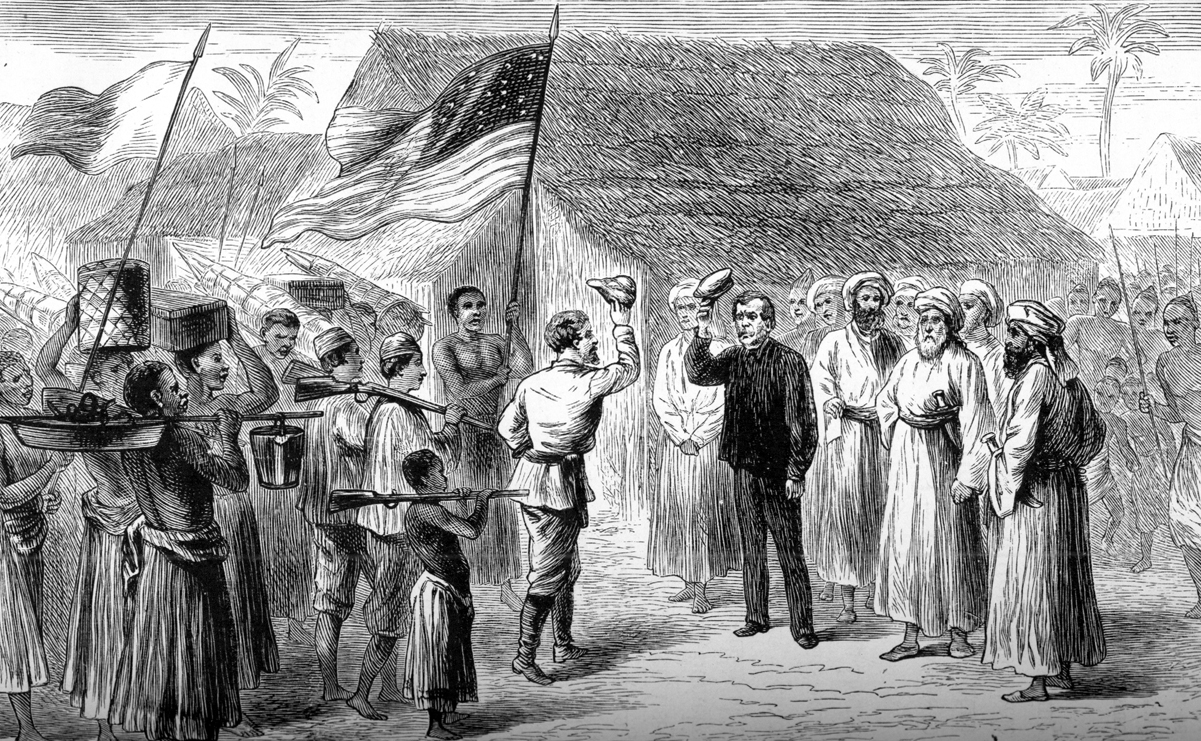
[When David Livingstone was discovered alive by Henry Stanley - on this day in 1871 - their initial meeting was responsible for one of the Victorian era's most indelible catch-phrases...]

1444 - At the Battle of Varna the crusading forces of King Vladislaus III of Varna* and János Hunyadi were crushed by a Turkish army commanded by Sultan Murad II, during which action His Majesty was also killed - thus ending the Crusade of Varna, and eventually leading to the fall of Constantinople in May 1453.

*AKA Ulaszlo I of Hungary and/or Wladyslaw III of Poland!

1520 - Following his successful invasion of Sweden in September, soldiers loyal to Denmark's King Christian II executed some 82 high-ranking Swedes (many of them members of the Sture Party) over a three-day period, in what came to be known as the Stockholm Bloodbath.

1766 - The last colonial governor of New Jersey, William Franklin, signed the charter of Queen's College (which was later renamed Rutgers University).

1775 - The United States Marine Corps was founded.

1793 - A Goddess of Reason was proclaimed by the French Convention at the suggestion of Pierre Gaspard Chaumette; a statue of the goddess - modeled on and by Thérèse Momoro, wife of the printer Antoine-François Momoro - was then placed on the high altar of Notre Dame de Paris.

1821 - The so-called Gesture of Rufina Alfaro set into motion a revolt which eventually led to Panama's independence from Spain (which occurred just in time for Panama to immediately thereafter become part of Colombia).

1847 - The passenger ship Stephen Whitney was wrecked in thick fog off the southern coast of Ireland, killing 92 of the 110 on board; the disaster resulted in the construction of the Fastnet Rock lighthouse.

1865
- Major Henry Wirz - the Confederate superintendent of Camp Sumter - became the only American Civil War soldier executed for war crimes.

1871 - Henry Morton Stanley located the missing explorer and missionary, Dr. David Livingstone, in Ujiji near Lake Tanganyika, uttering the now-famous phrase 'Dr. Livingstone, I presume?'

1898 - The Wilmington Insurrection of 1898 - the only instance of a municipal government being overthrown in US history - began in Delaware; originally considered a race riot, it is now more appropriately termed a coup d'etat.

1924 - Dean O'Banion, leader of the North Side Gang, was assassinated in his flower shop by members of Johnny Torrio's gang, sparking a bloody gang war which would dominate life in Chicago for the remainder of the 1920s.

1928 - Michinomiya Hirohito was crowned the 124th Emperor of Japan; since his January 1989 death he's been known by his posthumous name, Emperor Shōwa.

1938 - The founder of the Republic of Turkey, Mustafa Kemal Atatürk, died.

1944 - 3,800 tons of ordnance on the ammunition ship USS Mount Hood (AE-11) exploded while the vessel was docked in Seeadler Harbor at Papua New Guinea's Manus Island; all 350 men aboard ship were killed in the blast, as well as 82 members of the crew serving on the USS Mindanao (ARG-3), and some 22 other boats moored nearby were either sunk or severely damaged.

1954 - US President Dwight D. Eisenhower dedicated the USMC War Memorial (also known as the Iwo Jima Memorial) in Arlington National Cemetery.

1958 - The Hope Diamond was donated to the Smithsonian Institution by New York diamond merchant Harry Winston.

1969 - Sesame Street - created by Joan Ganz Cooney and Jim Henson - made its television debut on National Educational Television, the precursor to PBS.

1995 - In Nigeria, playwright and environmental activist Ken Saro-Wiwa, along with eight others from the Movement for the Survival of the Ogoni People (Mosop), were hanged by government forces.

2007 - The ¿Por qué no te callas? incident occurred, pitting Spain's King Juan Carlos I against Venezuelan president Hugo Chávez. Try and guess whose side the Pop Culture Institute was on during this particular contretemps...
*
share on: facebook