Wednesday, April 28, 2010
"Bye Bye Birdie" by Ann-Margret
Perennial sex-kitten Ann-Margret - who today turns 69 - was a smash in the 1963 film Bye Bye Birdie, which is about a teen idol who's drafted to serve in Vietnam; inspiration for the stage musical (which had itself inspired the movie) was the March 1958 induction of Elvis Presley, an act which had teenage girls around the world in a conniption for months.
*
share on: facebook


Gratuitous Brunette: Penélope Cruz

Although I can't say I've ever knowingly watched one of her films*, over the years I've nevertheless gotten to know Penélope Cruz in the usual manner - namely, from the tabloids and by watching her in interviews. Whatever I've seen has impressed me - or at least impressed me enough to award her the singular honour of Gratuitous Brunette on this, the occasion of her birthday**.
Admittedly the whole 'relationship with Tom Cruise' thing was a bit weird, but then I've already said too much... Cruz has often been outspoken about the effect the tabloid press has on people's ethics. I'd probably agree with her if I'd ever had any ethics to begin with! When you're a puny outlet in the brave new world of new media you gather your information in any way you can, and I don't see her beating my door down to offer me an exclusive interview.
A n y w a y... When not lighting up the silver screen Cruz busies herself with extensive charity works and within the fashion world, especially at the boutique she owns - called Amarcord - in the tony Salamanca district of her hometown, Madrid; additionally Cruz has modeled for Mango, Ralph Lauren and L'Oreal.
*I haven't. I checked. But that's not to say I wouldn't... Several of them have been directed by Pedro Almodóvar and one is a Woody Allen movie! Something tells me, though, I'll probably see her in Sex and the City 2 first...
**I promise, this is a legitimate post and not filler... Honest!
*
share on: facebook
Pop History Moment: Mussolini's Downfall

On this day in 1945 Benito Mussolini - for 21 years the Fascist dictator of Italy - along with his mistress Clara Petacci and an entourage of 15 were all shot and killed* in the village of Giulino di Mezzegra while attempting to escape to Spain; the following day the corpses of Mussolini and Petacci were hung on meathooks from a gas station in Milan's Piazzale Loreto, during which time they were stabbed, shot, pelted with rocks, spat upon, and generally desecrated by the crowds.
Il Duce was secretly buried in an unmarked grave at Musocco, Milan's municipal cemetery. On Easter Sunday 1946 his body was located and dug up by neo-fascist Domenico Leccisi (along with two friends), who took it on the lam for four months; it was found that August in a steamer trunk in Certosa di Pavia. Weekend at Benito's was over.
After 10 years in legal limbo - reasonably short in Italian terms - his remains were entombed at his birthplace of Predappio, the only posthumous honour he was given. Unless you count the reacharound of his epitaph, that is:
Here lies one of the most intelligent animals who ever appeared on the face of the earth.
Uh... Yeah. Just not smart enough to avoid being strung up by an angry mob, apparently.
The entire ghoulish story is related in Sergio Luzzato's book, The Body of Il Duce: Mussolini's Corpse and the Fortunes of Italy.
*According to his own self, by Walter Audisio.
*
share on: facebook
"Blow The Whistle" by Too Short
Birthday wishes go out to Too Short, the Oakland-based rapper who's been spittin' rhymes since 1980; although influential in the rise of gangsta rap, his own work is principally sexual (as opposed to criminal) in nature - he's been known to criticize crack, for instance, and rarely uses the n-word. Unlike many rappers who rave about pimping - he was even interviewed by the Hughes Brothers for their 1999 documentary American Pimp - the only ho he's ever pimped is himself; given that 'hip-hop' and 'longevity' are often mutually exclusive terms, I'd say he's done pretty well.
Blow the Whistle is the title track from his 16th album, released in 2006.
*
share on: facebook
In Memoriam: Odette Sansom
Many of the greatest heroes of World War II served in the French Resistance; still reeling from the massive losses it suffered during World War I, France had neither the manpower nor the will to fight off the Germans yet again, less than a generation after their previous onslaught. Also, given the improvements in aviation, Paris would have certainly been struck as hard as both London and Berlin - an unthinkable brutality. Nevertheless, despite their capitulation to Nazi rule French opposition to Hitler's onslaught was as vigourous as it was effective...
 Born on this day in 1912, Odette Sansom was just one of those heroes; married and living in England at the outset of hostilities, she trained under Colonel Maurice Buckmaster as part of the Special Operations Executive. Operating in the south of France with her supervisor (and future husband) Peter Churchill, she supplied him with funds and worked as a radio operator under the alias Lise.
They were betrayed by a double agent named Hugo Bleicher in April 1942; tortured by the Gestapo at Fresnes prison near Paris, she stuck to her cover story that she was married to Peter Churchill and that he was Winston Churchill's nephew (which he was not). Condemned to death in June 1943 she was sent to Ravensbrück, but survived the concentration camp and later testified at a war crimes tribunal against the guards there.
In addition to being the only woman to have received Britain's George Cross while alive, Sansom was also made an MBE and a chevalier in the French Légion d'honneur. The 1950 film Odette, in which Sansom was played by Anna Neagle, dramatized her wartime activities; Sansom died in March 1995, aged 82.
*
share on: facebook
Born on this day in 1912, Odette Sansom was just one of those heroes; married and living in England at the outset of hostilities, she trained under Colonel Maurice Buckmaster as part of the Special Operations Executive. Operating in the south of France with her supervisor (and future husband) Peter Churchill, she supplied him with funds and worked as a radio operator under the alias Lise.They were betrayed by a double agent named Hugo Bleicher in April 1942; tortured by the Gestapo at Fresnes prison near Paris, she stuck to her cover story that she was married to Peter Churchill and that he was Winston Churchill's nephew (which he was not). Condemned to death in June 1943 she was sent to Ravensbrück, but survived the concentration camp and later testified at a war crimes tribunal against the guards there.
In addition to being the only woman to have received Britain's George Cross while alive, Sansom was also made an MBE and a chevalier in the French Légion d'honneur. The 1950 film Odette, in which Sansom was played by Anna Neagle, dramatized her wartime activities; Sansom died in March 1995, aged 82.
*
share on: facebook
POPnews - April 28th

[Thailand's King Bhumibol has had the great good fortune throughout the five decades of his reign to have mastered the art of kingship, to have earned the adoration of his people and, most importantly, to have married the right woman. Queen Sirikit has been more than a consort, though; in December 1956 she served as the country's regent as well - only the second woman to do so, after Queen Saovabha, wife of Chulalongkorn - during the King's service as a monk, which is a customary rite of passage for Buddhist males in Thailand. As well, her unwavering understanding of the country's Muslim minority has earned her as much respect as has her ever-present smile...]
1192 - Conrad of Montferrat, King of Jerusalem, was assassinated in Tyre, two days after his claim to the throne was confirmed by election; the killing was carried out by Hashshashin - possibly under orders from England's King Richard I...
1253 - Nichiren, a Japanese Buddhist monk, propounded the chanting of Nam Myoho Renge Kyo for the first time, declaring it to be the essence of Buddhism, and in effect founding Nichiren Buddhism.
1611 - The Pontifical and Royal University of Santo Tomas - the Catholic University of the Philippines, and the largest Catholic university in the world, affectionately known as 'Ustê' - was established in Manila by archbishop Miguel de Benavides of the Order of Preachers.
1788 - Maryland became the seventh US state.
1789 - The crew of the HMS Bounty mutinied, following which Captain William Bligh and 18 sailors were set adrift; the rebel crew returned to Tahiti briefly and then set sail for Pitcairn Island. The story of the Mutiny on the Bounty has been captivating the imagination of readers and movie-goers alike ever since...
1789 - The crew of the HMS Bounty mutinied, following which Captain William Bligh and 18 sailors were set adrift; the rebel crew returned to Tahiti briefly and then set sail for Pitcairn Island. The story of the Mutiny on the Bounty has been captivating the imagination of readers and movie-goers alike ever since...
1920 - Azerbaijan was added to the Soviet Union following the establishment of the Azerbaijan SSR.
1930 - The first night game in organized baseball history took place in Independence, Kansas, at which the Independence Producers lost 13-3 to the Muskogee Chiefs, their Western Association rival.
1947 - Thor Heyerdahl and five crew mates set out from Peru on the Kon-Tiki to prove that Peruvian natives could have settled Polynesia; the expedition was later the basis for a wildly successful book, from which was made an Oscar-winning documentary.
1947 - Thor Heyerdahl and five crew mates set out from Peru on the Kon-Tiki to prove that Peruvian natives could have settled Polynesia; the expedition was later the basis for a wildly successful book, from which was made an Oscar-winning documentary.
1949 - Former First Lady of the Philippines Aurora Quezon was assassinated while en route to dedicate a hospital in memory of her late husband; her daughter and 10 others were also killed.
1950 - Thailand's King Bhumibol Adulyadej married Sirikit after a quiet 10-month engagement in Lausanne.
1952 - The US occupation of Japan ended.
1967 - Expo 67 opened to the public in Montreal, having been ceremonially opened the previous day by Canadian Governor-General Roland Michener.
1969 - Charles de Gaulle resigned as President of France.
1950 - Thailand's King Bhumibol Adulyadej married Sirikit after a quiet 10-month engagement in Lausanne.
1952 - The US occupation of Japan ended.
1967 - Expo 67 opened to the public in Montreal, having been ceremonially opened the previous day by Canadian Governor-General Roland Michener.
1969 - Charles de Gaulle resigned as President of France.
1977 - The Red Army Faction trial ended, with Andreas Baader, Gudrun Ensslin and Jan-Carl Raspe found guilty of four counts of murder and more than 30 counts of attempted murder.
1978 - Afghanistan's President Mohammed Daoud Khan was overthrown and assassinated in a coup led by pro-communist rebels.
1978 - Afghanistan's President Mohammed Daoud Khan was overthrown and assassinated in a coup led by pro-communist rebels.
1987 - American engineer Ben Linder was killed in an ambush by US-funded Contras in northern Nicaragua.
1988 - Flight attendant Clarabelle 'C.B.' Lansing was blown out of Aloha Flight 243 and fell to her death over Maui when part of the plane's fuselage ripped open in mid-flight; Lansing was later played by Nancy Kwan in the TV-movie Miracle Landing, which starred Connie Sellecca.
1996 - Martin Bryant went on a shooting spree in Tasmania - now known as the Port Arthur Massacre - killing 35 people and seriously injuring 37 more.
2001 - Billionaire and former NASA employee Dennis Tito became the world's first space tourist.
*
1988 - Flight attendant Clarabelle 'C.B.' Lansing was blown out of Aloha Flight 243 and fell to her death over Maui when part of the plane's fuselage ripped open in mid-flight; Lansing was later played by Nancy Kwan in the TV-movie Miracle Landing, which starred Connie Sellecca.
1996 - Martin Bryant went on a shooting spree in Tasmania - now known as the Port Arthur Massacre - killing 35 people and seriously injuring 37 more.
2001 - Billionaire and former NASA employee Dennis Tito became the world's first space tourist.
*
share on: facebook
Tuesday, April 27, 2010
"I Can't Stand the Rain" by Ann Peebles
One of the great things about writing a blog like this one is not only all the stuff you learn, but how constant that influx of new knowledge can be; for instance, not only did I recently learn that two of my favourite songs weren't originally performed by the people I'd thought they were - but rather by Ann Peebles - it was about the tenth such revelation on that day alone.
So while her name had been unfamiliar to me up until that point, well, it got familiar but quick; a brief Google through the Interwebs and voila! I've got someone new to add to my ever-lengthening list of divas who in my opinion are long overdue for rediscovery - along with Evelyn 'Champagne' King, Millie Jackson, Adeva...
So while my favourite Ann Peebles track is - and is likely to remain - 1971's Slipped, Tripped and Fell in Love* her original versions of I'm Gonna Tear Your Playhouse Down (a huge hit for Paul Young from his 1986 album The Secret of Association) and this little ditty, I Can't Stand the Rain (more familiar to me as the sixth single from Tina Turner's tour-de-force 1984 album Private Dancer) remain near and dear to me for the forceful R&B renderings she made that helped to set the standard for their performance.
I Can't Stand the Rain, of course, was originally the title track from Peebles' 1974 album; in addition to Turner's version a decade after its initial release, in the late 1970s the Anglo-Caribbean combo Eruption gave it the disco treatment; it's also been covered by Lowell George on his 1979 album Thanks, I'll Eat it Here, Bad Manners on their 1993 album Fat Sound, and Seal on his 2008 album Soul to name just four. Terry Manning did a live version for the 2006 CD re-release of his 1970 album Home Sweet Home; the song also formed the basis for Missy Elliott's The Rain (Supa Dupa Fly), from 1997's Supa Dupa Fly.
It gives me great pleasure to post it here on the occasion of Ann Peebles' birthday, with just a minor warning... The video starts out a bit slow, with a discussion as to the genesis of the song, but quickly segueways into a fairly recent performance of it by the lady herself.
*Which fairly cries out to be remixed, if not remade outright.
*
share on: facebook
Happy Birthday Kate Pierson

How much do I love The B-52s? Well, our crack team of researchers* here at the Pop Culture Institute has been working feverishly to come up with a number which is suitably large enough to express it. Alas, math is not the strong suit of anyone who lives and/or works here, and they got stuck somewhere north of 900...
My point is it's a lot, and as awesome as Cindy Wilson, Fred Schneider, Keith Strickland, and the late Ricky Wilson are - and they sure are! - well, in my opinion Kate Pierson is just that much awesomer!
Still performing and recording with The B-52s an amazing 35 years after they formed, in her off-time Pierson serves as a hotelier at Kate's Lazy Meadow Motel in the Catskill Mountains near Woodstock in Upstate New York, which she runs with her business and life partner Monica Coleman.
*To be honest, they really are more like a team of researchers on crack...
*
share on: facebook
Pop History Moment: The Opening of Expo 67

On this day in 1967, Expo 67 was declared officially open in Montreal; the lavish opening ceremony - featuring Canadian Governor-General Roland Michener - was broadcast around the world, although attendance in person was by invitation only. Situated on a series of manmade islands in the Saint Lawrence River (and an artificially enlarged Île Sainte-Hélène) the fair was the brainchild of Montreal mayor Jean Drapeau.
The fair itself was the centrepiece of the celebration of Canada's centennial year. It opened to the public the next day, setting attendance records; 50 million in total visited the park, with 559,000 on a single day. One of the fair's few remaining landmarks is Habitat 67, a housing development built by Moshe Safdie.
*
The fair itself was the centrepiece of the celebration of Canada's centennial year. It opened to the public the next day, setting attendance records; 50 million in total visited the park, with 559,000 on a single day. One of the fair's few remaining landmarks is Habitat 67, a housing development built by Moshe Safdie.
*
share on: facebook
"For Your Eyes Only" by Sheena Easton
Birthday wishes go out today to Sheena Easton, the sultry Scottish songstress who recorded For Your Eyes Only as the theme to the 12th James Bond film - a film which was entitled, appropriately enough, For Your Eyes Only. The song was released as a single in June 1981 alongside the movie and would eventually crack the Top Ten in the US and the Top Five in the UK*.
Easton's (actually Bill Conti's and Mike Leeson's) was not the only song of that name in the running, though; Blondie also wrote a song called For Your Eyes Only in hopes of scoring what at that time was a guaranteed hit single and a bit of pop culture immortality besides. They ended up having to settle for including it on their 1982 album The Hunter**, while Easton's version scored a nomination for Best Original Song at the 54th Annual Academy Awards.
To date Sheena Easton has had 3 of her 16 albums in the Top 40 for a total of 8 Top 40 singles, although her last album, Fabulous (2000), failed to chart. She has kept herself busy in recent years with stage and television appearances, such as in Young Blades, in which she played Queen Anne.
*It was also the second of three Bond themes to have been sung by Scots - the first being the theme to The Man with the Golden Gun, sung by Lulu in 1974, and the third being the theme to The World is Not Enough, which was performed by Shirley Manson and the band Garbage in 1999.
**The single did not chart, although Island of Lost Souls and War Child did. It would, however, be their last album of new material until 1999's No Exit.
*
share on: facebook
Pop History Moment: Betty Boothroyd Elected Commons Speaker
 On this day in 1992 Betty Boothroyd, a Labour MP for West Bromwich (northwest of Birmingham) and formerly with the Tiller Girls dancing troupe, became the first woman elected Speaker of the British House of Commons at the Mother of All Parliaments in Westminster, succeeding Bernard Weatherill.
She was not, however, the first woman to serve in that role; from 1970 to 1973 Betty Harvie Anderson served as deputy speaker under Selwyn Lloyd and occasionally presided over the House in his absence.
Boothroyd served as Speaker of the House until 2000, at which time she was succeeded by Michael Martin.
*
share on: facebook
Beethoven's "Für Elise" by Ivo Pogorelić
In order tuh, yuh know, class the joint up a bit, I thought I sh'd make with some plinky-plunky music pronto. This is by Ivo Pogorelić, whose supple style gives Für Elise a kind of tender carnality it doesn't usually get in performance. Or y'know... Whatever.
*
share on: facebook
POPnews - April 27th

[To my mind, Ludwig van Beethoven never had a greater booster than Schroeder, of Peanuts fame; the most famous version of the composer's Für Elise is arguably the one that appears in A Charlie Brown Christmas (as well as on its soundtrack) was actually played by the nimble jazz keyboardist Vince Guaraldi.]
1296 - At the Battle of Dunbar 40,000 Scots led by their King John Balliol were defeated by England's Edward I and John de Warenne, 7th Earl of Surrey, with just 12,000 troops; it was the first major battle of the First War of Scottish Independence.
1521 - At the Battle of Mactan in the Philippines, explorer Ferdinand Magellan was killed by natives led by chief Lapu-Lapu; at the time Magellan was about halfway through his seagoing circumnavigation of the world.
1565 - Cebu was established, making it the first Spanish settlement in the Philippines.
1578 - During the French Wars of Religion the so-called Duel of the Mignons claimed the lives of two favourites of France's King Henri III and two favourites of his heir and chief rival Henri I, Duke of Guise; while engaged in a re-enactment of the battles of the Horatii and the Curiatii Jacques de Caylus, Louis de Maugiron and Jean d'Arcès (representing the party of the King) fought with Charles de Balzac, Ribérac, and Georges de Schomberg (representing the party of the Guises). Maugiron and Schomberg were killed almost immediately, Ribérac died of wounds the following noon, d'Arcès was wounded in the head and convalesced in a hospital for six weeks, while Caylus sustained as many 19 wounds and passed away after 33 hours of agony. Only Balzac got off with a mere scratch on his arm.
1749 - The first performance of George Frideric Handel's Fireworks Music - commissioned by George II - was given in London's Green Park.
1777 - In the midst of the American Revolution, at the Battle of Ridgefield, a British invasion force commanded by then Royal Governor of the Province of New York, Major General William Tryon (with the assistance of Brigadier General William Erskine and Brigadier General James Agnew) engaged and defeated Continental Army regulars and militia irregulars under Major General David Wooster and Brigadiers-General Gold S. Silliman and Benedict Arnold at Ridgefield, Connecticut.
1805 - During the First Barbary War US Marines under General William Eaton and their allies the Berbers marched 500 miles across the Libyan Desert and attacked the city of Darnah; the ensuing Battle of Darnah is commemorated in the line 'shores of Tripoli' which occurs in the Marines' Hymn.
1810 - Ludwig van Beethoven composed his famous piano piece, Für Elise.
1840 - The foundation stone for London's new Palace of Westminster was laid by Sarah, the wife of the building's principal architect Sir Charles Barry; much of the old palace (except for Westminster Hall, the Jewel Tower, the crypt of St Stephen's Chapel and the cloisters) was destroyed by a catastrophic fire in October 1834.
1865 - While under the command of Captain J.C. Mason the steamboat Sultana, carrying 2,400 passengers, sank on the Mississippi River after one of its four boilers exploded; most of the 1,800 casualties were Union survivors returning home from Confederate prisoner-of-war camps at Andersonville and Cahawba. It remains the worst maritime disaster in American history, but its impact at the time was moderated by the recent assassination of President Abraham Lincoln.
 1904 - The Australian Labor Party became the first such party to form a national government anywhere in the world, under Chris Watson (shown, at right) who became the third Prime Minister of Australia; lasting just under four months, Watson's government was itself short-lived - it didn't for instance, have the chance to introduce a budget - but has exerted a strong influence over successive Labor governments nonetheless.
1909 - The Sultan of Turkey, Abdul Hamid II, was overthrown; he was succeeded by his brother, Mehmed V.
1941 - Nazi troops entered and occupied Athens.
1961 - Sierra Leone was granted its independence from the United Kingdom, with Milton Margai serving as the first Prime Minister; representing his cousin Elizabeth II at the ceremony was HRH the Duke of Kent, who was the first to unfurl and raise the country's new flag.
1982 - Former police officer Woo Bum-kon ended his own life following a drunken eight-hour shooting spree in South Korea's Gyeongsangnam-do province during which he killed 57 people.
1984 - The Libyan Embassy Siege in London ended; it had been sparked by the shooting of policewoman Yvonne Fletcher eleven days earlier.
1992 - The Federal Republic of Yugoslavia - comprising Serbia and Montenegro - was proclaimed.
1994 - The first truly democratic general election in the history of South Africa - namely one in which the country's black majority could also vote - was held; the African National Congress, headed by Nelson Mandela, just missed the two-thirds vote required to form a clear majority, and so opted to form the so-called Government of National Unity with the Inkatha Freedom Party and the National Party - which had, under the leadership of Frederik Willem de Klerk, done away with apartheid. The anniversary of the day is now a public holiday in South Africa, known as Freedom Day.
2006 - Construction began on the Freedom Tower portion of the new World Trade Center in New York City, a mere four and a half years after its predecessors were destroyed.
*
share on: facebook
Monday, April 26, 2010
Mama's Family: Cleaning Out The Attic
Starring birthday gal Carol Burnett as her most famous creation, Eunice Higgins, the series of sketches that eventually turned into Mama's Family was originally called simply The Family. The show-within-a-show was a popular feature of The Carol Burnett Show during its eleven-year run; Carol is joined here by sketch regulars Vicki Lawrence as 'Mama' Thelma Harper and Harvey Korman as Ed Higgins with special guest star Betty White as Eunice's stuck-up sister Ellen Harper.
Perennially put-upon loser Eunice gives as good as she gets as she joins Mama and Ed in cleaning out the attic; after Ellen arrives each uncovered treasure is seemingly accompanied by an emotional skeleton. By the time they're done spatting it's like the dust won't ever settle!
Surely, the moral of the story is: We're only as sick as our secrets.
*
share on: facebook
Happy Birthday Carol Burnett

Carol Burnett is one of the most beloved entertainers alive today; much of that affection was accrued during the eleven seasons she starred in The Carol Burnett Show on CBS, and for many years after that in syndicated reruns. Even though the show went off the air in 1978, those of us who remember it still can't help but raise a chuckle remembering its countless moments of TV magic.
*
share on: facebook
Pop History Moment: The Bombing of Guernica

On this day in 1937 the Basque town of Guernica was bombed by Fascist Italy's Aviazione Legionaria and the Condor Legion of Nazi Germany's Luftwaffe in an action code named Operation Rügen; the action - later depicted in the painting by Pablo Picasso shown above - was one of the most reviled atrocities of the Spanish Civil War.
Three quarters of the town's buildings were utterly destroyed by 28 bombers during the raid, and virtually none escaped damage; the most reliable casualty figures place the dead at 1,654 with 889 wounded out of a population of 5-7,000.
Picasso first exhibited the massive mural (349 × 776 cm or 137.4 × 305.5 inches) he made to commemorate the victims at the Paris International Exposition in July 1937; following the Exposition the painting toured Europe, then was sent to America. For many years, Picasso kept it in his Paris apartment, but it had been a popular attraction at New York City's Museum of Modern Art (MoMA) for awhile when, in 1974, it was defaced by artist Tony Shafrazi, who spray-painted the words 'KILL LIES ALL' in red on it. The lacquered surface was quickly repaired, with no permanent damage to the work.
Picasso had been insistent prior to his 1973 death that he did not want the painting returned to Spain until Spain had itself returned to democracy; in 1981 MoMA reluctantly returned the work to Spain following the November 1975 death of Francisco Franco. Originally shown in the Museo del Prado in Madrid, since 1992 it has hung in the Museo Nacional Centro de Arte Reina Sofía.
*
share on: facebook
POPnews - April 26th
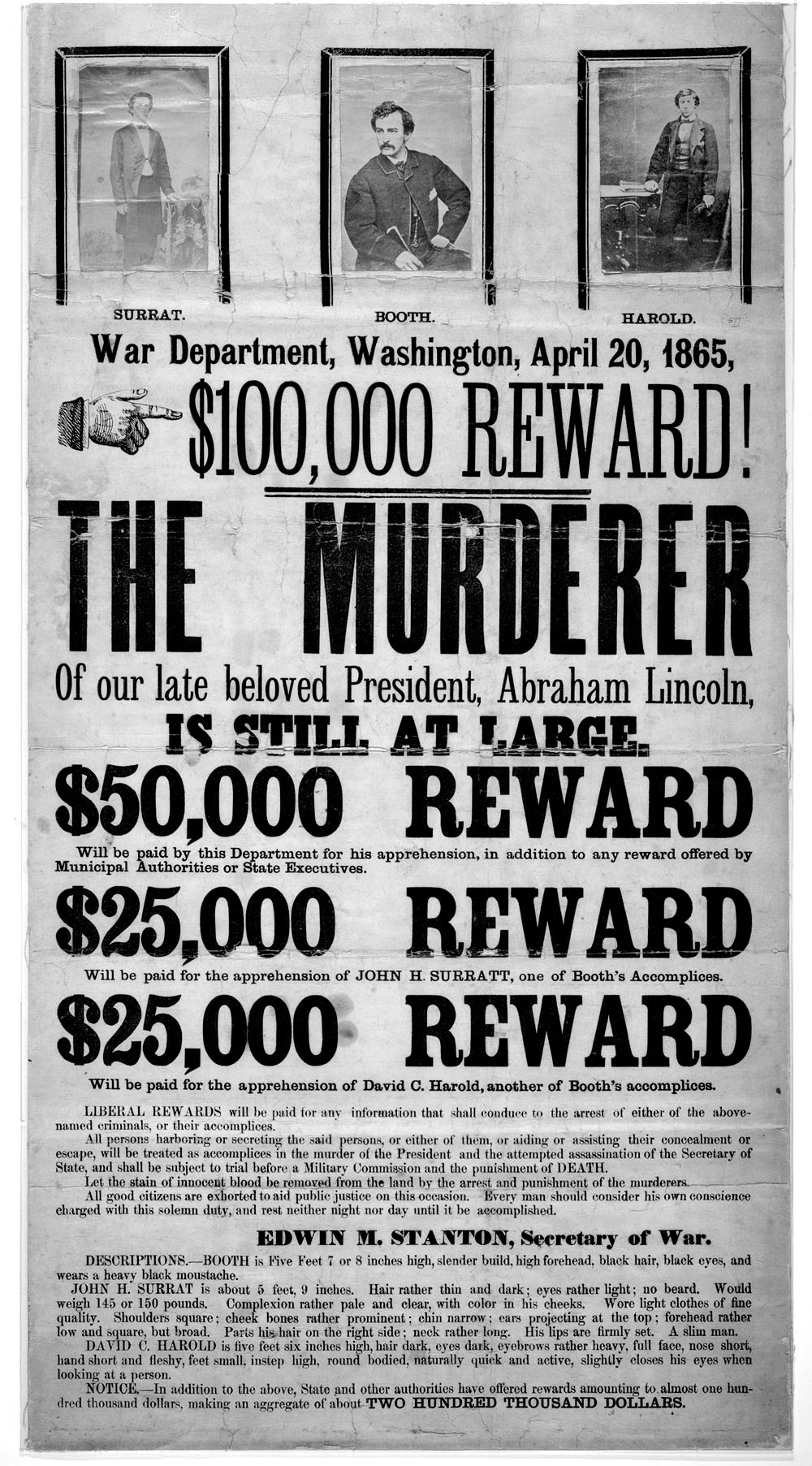
[While rewards were paid for the capture of his accomplices George Atzerodt and Lewis Powell, no one ever claimed the money set aside to bring Abraham Lincoln's assassin to justice; for this reason, numerous fanciful stories have circulated that John Wilkes Booth didn't actually die on this day in 1865 as history records. While the official report on the matter is a pretty dry read, for something wetter - downright juicy even! - try Manhunt: The 12-Day Chase for Lincoln's Killer, by James Swanson, one of the Pop Culture Institute's most highly recommended books.]
1336 - Italian sonneteer Petrarch made an ascent of Mt. Ventoux accompanied by his brother; he later claimed to have been the first person to climb the mountain since antiquity, which he was not. Ironically, that honour rightly belongs to the French priest Jean Buridan, whose scientific studies into impetus and inertia were some of the most important made in the Middle Ages, and whose own impetus to climb the mountain easily overrode whatever inertia he might have felt toward the task.
1478 - As part of the Pazzi Conspiracy Francesco de' Pazzi and Bernardo Bandini attacked Lorenzo de' Medici and killed his brother Giuliano during High Mass in the Duomo of Florence.
1607 - English colonists bound for Virginia's Jamestown Settlement made landfall at Cape Henry.
 1865 - Twelve days after US President Abraham Lincoln was shot (and 11 days after he died) Union cavalry troopers led by Lieutenant Edward P. Doherty cornered his assassin, John Wilkes Booth, in a tobacco barn at Garrett's Farm near Bowling Green, Virginia. With him was an accomplice, David Herold, who surrendered almost immediately. Despite setting fire to the barn in order to flush him out, the wounded Booth (he broke his leg fleeing from Ford's Theatre the night he shot Lincoln) would not be budged. Booth was eventually shot in the neck by Boston Corbett (shown, at right) in almost the same place Booth had shot Lincoln - behind the left ear; paralyzed, Booth was taken to the Garrett farmhouse, where he died three hours later on their porch, mumbling the words 'Useless, useless...'.
 1925 - Paul von Hindenburg defeated Wilhelm Marx in the second round of the German presidential election to become the first directly elected head of state of the Weimar Republic.
1933 - The Geheime Staatspolizei - better known as the Gestapo, the official secret police force of Nazi Germany - was established.
1937 - The Spanish town of Guernica was bombed by the Luftwaffe's Condor Legion and Italy's Aviazione Legionaria; code named Operation Rügen, it was one of the gravest atrocities committed during the Spanish Civil War.
1946 - Father Divine, a controversial religious leader who claimed to be God, married the much-younger Edna Rose Ritchings; theirs remains a celebrated anniversary in the International Peace Mission movement.
1962 - A computer error caused NASA's Ranger 4 spacecraft to crash into the dark side of the moon, rendering the device unable to perform any of its necessary tasks.
1964 - Tanganyika and Zanzibar merged to form Tanzania.
1966 - An earthquake of magnitude 7.5 destroyed Tashkent.
1970 - The Convention Establishing the World Intellectual Property Organization entered into force.
1982 - A shooting spree in which 57 people were killed by former South Korean police officer Woo Bum-kon began in Gyeongsangnam-do.
1986 - A nuclear reactor accident at the Chernobyl Nuclear Power Plant in Ukraine caused the worst nuclear disaster in history.
1991 - Seventy tornadoes broke out in the central United States; before the outbreak's end Andover, Kansas, would record the year's only F5 tornado.
1994 - An Airbus A300-600R carrying China Airlines Flight 140 crashed at Japan's Nagoya Airport killing everyone on board, with a death toll amounting to 264.
2002 - Robert Steinhäuser infiltrated Gutenberg-Gymnasium in the German town of Erfurt, managing to kill 17 at the school before dying of a self-inflicted gunshot.
2005 - Under international pressure, Syria withdrew the last of its 14,000 troop military garrison in Lebanon, ending its 29-year military domination of that country.
2007 - Hong Kong's Queen's Pier was officially closed by the government, after a bitter struggle by conservationists, in order to facilitate land reclamation in the city's central business district.
*
share on: facebook
Sunday, April 25, 2010
What's The Occasion? ANZAC Day
Although Anzac Day originally commemorated the heavy loss of life sustained by the Australian and New Zealand Army Corps (or ANZAC) while fighting the Gallipoli Campaign of World War I in Turkey on this day in 1915, since the end of World War II it has come to be a more general day of remembrance for all those whose lives have been lost in the service of their countries. In addition to Australia and New Zealand, the day is observed in the Cook Islands, Niue, Samoa and Tonga.
 The holiday gained in popularity very quickly... Its first observation could be said to have taken place on April 30th of that year, when word of the fighting (and its terrible casualties*) first reached Australia; a half-day holiday was then declared, which was again observed the following year on April 5th. New Zealand was the first country to make the day an official holiday when it passed the Anzac Day Act in 1920. Throughout the 1920s the holiday was observed in Australia to varying degrees (depending on the state) but by 1927 was uniformly marked, with its date set on April 25th.
The 1930s saw the various rituals that are now associated with Anzac Day - dawn vigils, marches, memorial services, reunions, sly two-up games - become part of Australian culture. The first dawn vigil took place at the Sydney Cenotaph in 1927, and like the Remembrance Day service familiar in Canada and the UK is marked by the playing of The Last Post**. The dawn vigil was first introduced to New Zealand in 1939, and remains a feature of Anzac Day there; it stems from the battle itself, which commenced in the hours surrounding the dawn.
Despite the creation of the Australian Federation in January 1901 and a similar move towards independence for New Zealand in September 1907, Anzac Day is considered the day both countries were born, having been forged in the horrors of war and christened in the blood of its finest young men...
*Allied casualties amounted to 21,255 from the UK, an estimated 10,000 from France, 8,709 from Australia, 2,721 from New Zealand, and 1,358 from British India.
**In the US, of course, the Memorial Day service every May is similarly serenaded by the playing of Taps.
share on: facebook
The holiday gained in popularity very quickly... Its first observation could be said to have taken place on April 30th of that year, when word of the fighting (and its terrible casualties*) first reached Australia; a half-day holiday was then declared, which was again observed the following year on April 5th. New Zealand was the first country to make the day an official holiday when it passed the Anzac Day Act in 1920. Throughout the 1920s the holiday was observed in Australia to varying degrees (depending on the state) but by 1927 was uniformly marked, with its date set on April 25th.The 1930s saw the various rituals that are now associated with Anzac Day - dawn vigils, marches, memorial services, reunions, sly two-up games - become part of Australian culture. The first dawn vigil took place at the Sydney Cenotaph in 1927, and like the Remembrance Day service familiar in Canada and the UK is marked by the playing of The Last Post**. The dawn vigil was first introduced to New Zealand in 1939, and remains a feature of Anzac Day there; it stems from the battle itself, which commenced in the hours surrounding the dawn.
Despite the creation of the Australian Federation in January 1901 and a similar move towards independence for New Zealand in September 1907, Anzac Day is considered the day both countries were born, having been forged in the horrors of war and christened in the blood of its finest young men...
*Allied casualties amounted to 21,255 from the UK, an estimated 10,000 from France, 8,709 from Australia, 2,721 from New Zealand, and 1,358 from British India.
**In the US, of course, the Memorial Day service every May is similarly serenaded by the playing of Taps.
*
share on: facebook
"Ev'rytime We Say Goodbye" by Annie Lennox
I last published this video some four months ago - Christmas Day, to be precise - on the occasion of Annie Lennox's birthday; I'm republishing it here now because a) I love it so much, and b) it was used as the love theme in Derek Jarman's 1992 film Edward II.
Originally recorded for 1990's AIDS charity album Red, Hot + Blue, which featured modern (if not always modernist) takes on the songs of Cole Porter, it's Ev'ry Time We Say Goodbye, performed by Annie Lennox, in a video directed by Ed Lachman.
*
share on: facebook
In Memoriam: Edward II
Even the most rabid of monarchists would have to admit that not everyone who's ever been born to (or indeed called upon) to fill a throne has been universally good at all aspects of reigning all the time; even in days of yore, when Kings were seen as living gods, it was accepted that some kings made war better than peace, for instance, or that most of them preferred the company of wenches to their queen.
 The point is, allowances were made for these quirks in their personality, benefits of the doubt offered; no such allowances were made for the man who became Edward II, though. Even as a child, his interests were more yeomanly than royal. Fond of animals, possessed of the common touch, Edward would have just as soon shod a horse or thatched a roof as entered into a joust.
That the son of Edward I (whose nickname was Longshanks) had no interest in the arts of war was the scandal of the age; to remedy the situation, the King procured for his son a young Gascon named Piers Gaveston, whose reputation for prowess with weaponry of all kinds was then still unburdened by the bevy of allegations that would later be attached to him. In lieu of a royal bride, it was Gaveston who was by his side when Edward was invested as the first Prince of Wales in February 1301.
Gaveston likewise took pride of place at the January 1308 marriage of Edward (then King) to Isabella of France, the beautiful and conniving daughter of Philip IV; during Edward's coronation in February 1308 - which Gaveston was called upon to organize - he barely made it out of Westminster Abbey alive, owing as much to the fiasco of his own organization as it was to the royal status the King had seemingly bestowed upon him - allowing him to wear purple in defiance of sumptuary laws, for one. Yet Edward II did fulfil his principle duty as King - to secure the succession with the birth of an heir; the boy who would become Edward III is universally recognized as one of England's greater kings, in sharp contrast to the negative opinion earned by his father and passed down as received wisdom over the next seven centuries.
Edward II's twenty year reign ended with his forced abdication, imprisonment, and eventual murder*; even the means of death - by legend a red-hot poker was inserted into his anus - points to the savage bigotry of the times. Whether Edward and Gaveston were lovers will never be proven, at least not directly; indirectly, though, the evidence is incontrovertible. Henry VIII and Charles Brandon were as close friends as King and noble could be, yet no ignominy clung to either of them for it. Somehow, though, nothing Edward II ever did earned so much as a molecule of praise during his lifetime, surely a text book example of homophobia in action if ever there was one.
In the centuries since he's gone from a reviled monster to a fascinating anomaly to a gay icon thanks almost entirely to pop culture; Christopher Marlowe's play Edward II was not only the first portrayal of the unfortunate King but is one of the earliest plays in English as well, having been performed since at least 1592. The most sensational recent work about Edward II is Derek Jarman's fanciful 1992 film Edward II, in which the King was portrayed by Steven Waddington and Gaveston by Andrew Tiernan; Isabella, better known to us now as the She-Wolf of France, was played to stunning effect by Tilda Swinton.
*As with most high-profile murders, conspiracy theories abound.
*
share on: facebook
The point is, allowances were made for these quirks in their personality, benefits of the doubt offered; no such allowances were made for the man who became Edward II, though. Even as a child, his interests were more yeomanly than royal. Fond of animals, possessed of the common touch, Edward would have just as soon shod a horse or thatched a roof as entered into a joust.That the son of Edward I (whose nickname was Longshanks) had no interest in the arts of war was the scandal of the age; to remedy the situation, the King procured for his son a young Gascon named Piers Gaveston, whose reputation for prowess with weaponry of all kinds was then still unburdened by the bevy of allegations that would later be attached to him. In lieu of a royal bride, it was Gaveston who was by his side when Edward was invested as the first Prince of Wales in February 1301.
Gaveston likewise took pride of place at the January 1308 marriage of Edward (then King) to Isabella of France, the beautiful and conniving daughter of Philip IV; during Edward's coronation in February 1308 - which Gaveston was called upon to organize - he barely made it out of Westminster Abbey alive, owing as much to the fiasco of his own organization as it was to the royal status the King had seemingly bestowed upon him - allowing him to wear purple in defiance of sumptuary laws, for one. Yet Edward II did fulfil his principle duty as King - to secure the succession with the birth of an heir; the boy who would become Edward III is universally recognized as one of England's greater kings, in sharp contrast to the negative opinion earned by his father and passed down as received wisdom over the next seven centuries.
Edward II's twenty year reign ended with his forced abdication, imprisonment, and eventual murder*; even the means of death - by legend a red-hot poker was inserted into his anus - points to the savage bigotry of the times. Whether Edward and Gaveston were lovers will never be proven, at least not directly; indirectly, though, the evidence is incontrovertible. Henry VIII and Charles Brandon were as close friends as King and noble could be, yet no ignominy clung to either of them for it. Somehow, though, nothing Edward II ever did earned so much as a molecule of praise during his lifetime, surely a text book example of homophobia in action if ever there was one.
In the centuries since he's gone from a reviled monster to a fascinating anomaly to a gay icon thanks almost entirely to pop culture; Christopher Marlowe's play Edward II was not only the first portrayal of the unfortunate King but is one of the earliest plays in English as well, having been performed since at least 1592. The most sensational recent work about Edward II is Derek Jarman's fanciful 1992 film Edward II, in which the King was portrayed by Steven Waddington and Gaveston by Andrew Tiernan; Isabella, better known to us now as the She-Wolf of France, was played to stunning effect by Tilda Swinton.
*As with most high-profile murders, conspiracy theories abound.
*
share on: facebook
Subscribe to:
Posts (Atom)