Monday, October 18, 2010

Gratuitous Brunette: Zac Efron

Photobucket

With each year that passes, I feel less and less pervy about Zac Efron... Which is good, because restraining orders are both a major hassle and entirely ineffective when it comes to a weapons-grade perv like myself.

Anyway, he's over 21 now, which means I now first and foremost respect him as a person and value his insights.

NOT!
*
share on: facebook

Remembering... Lotte Lenya

Photo Sharing and Video Hosting at Photobucket

As a young girl (born on this day in 1898) it was Lotte Lenya's goal in life to be a dancer; after a few years swinging it around in the chorus-lines of Berlin she met a piano player by the name of Kurt Weill and ended up settling for being a Muse instead. She was cast in his show Die Dreigroschenoper, and a star was born...

The couple married in 1926 and soon became a part of an unparalleled artistic community in Germany in the dying days of the Weimar Republic; by the time Lenya fled the Nazi threat and decamped to Paris in 1933, though, they had become estranged, and she divorced him. Again, though, she found herself singing his songs, this time in The Seven Deadly Sins. In 1935 Lenya and Weill were reunited and together they emigrated to the United States; they remarried in 1937 and would remain together until Weill's death in 1950.

Yet even after Weill's death it is for her performances of his works that she is best-known. In 1956 she won a Tony Award for her portrayal of Jenny in The Threepenny Opera, the role that had first made her famous in 1928. A decade later she originated the role of Fräulein Schneider in Kander and Ebb's original Broadway production on Cabaret, whose music was a spot-on homage to that of Brecht and Weill.

Her movie roles proved she had her funny side as well; playing the Contessa in The Roman Spring of Mrs Stone (1961) - based on a novel written by Tennessee Williams, and for which she was nominated for an Oscar - she got a chance to procure young men for wealthy older clients, namely Warren Beatty for Vivien Leigh, as well as be the first person in the American cinema to call herself a 'chicken-hawk'. Though not a comedy the movie is nevertheless a laugh-a-minute. Similarly, as Rosa Klebb in From Russia with Love (1963) she's so camp she could have changed her name to KOA.
*
share on: facebook

In Memoriam: Pierre Elliot Trudeau

Only one Canadian Prime Minister has ever jazzed his potential electorate to such a degree that someone had to append the word 'mania' to his surname to describe the phenomenon, and it sure as Hell wasn't Arthur Meighen...

Photo Sharing and Video Hosting at PhotobucketThe year was 1967, and as Prime Minister Lester B. Pearson was preparing to leave office, so was Canada preparing to leave the 1950s. Pearson was popular in the way that quiet people often attract quiet admirers - to him a golf clap would have been a thunderous ovation; his Justice Minister was also quiet, but he was quiet in an entirely different way...

Pierre Trudeau's tenure as Justice Minister saw an overhaul the likes of which the country had never seen - laws concerning divorce, homosexuality, and abortion more in line with the times were implemented. It was almost as though, following a century as an Imperial and Commonwealth Dominion, Canada was finally ready to be its own country. Trudeau's omnibus bill, Criminal Law Amendment Act, 1968-69, swept away the old so as to usher in the new as easily as would Trudeau's other masterpiece, Canada's Charter of Rights and Freedoms, a decade later.

Similarly, Trudeaumania shook Canadian society down to its very core, beginning in that centennial year... For many Baby Boomers the election of 1968 was their first chance to vote, and they sure as tooting weren't going to waste it by voting for some square who favoured the status quo. Trudeau was not only the first 20th Century Prime Minister born in the 20th Century (on this day in 1919) he was also the first Prime Minister elected in Canada's second century - single, athletic, and while not traditionally handsome, he was certainly attractive in other ways, as his never-ending stream of pretty dates could attest.

It didn't take long for his opponents to surface; whether the more staid rural Liberals in his own party or Quebeckers expecting one of their own to just hand them their sovereignty, Trudeau fought them all and won. To this day he's still dividing Canadians, who are still trying to come to terms with his legacy, especially as one of his more anodyne successors prepares to hand control of the Natural Governing Party - potentially even to one of Trudeau's sons, Justin, who could potentially become Canada's first PMILF*...

*Duh! What do you think it means?
*

share on: facebook

Pop History Moment: The Death of Jon-Erik Hexum

Photo Sharing and Video Hosting at PhotobucketThere is a substantial amount of footage of Jon-Erik Hexum on YouTube; which is surprising, actually, for someone who was little more than a male starlet when he died, more 25 years ago now. I had the honour to watch most of it in preparation for writing this piece, and all I can say is that my high opinion of him hasn't changed one iota through the years, but has, in fact, increased...

In addition to handsome and charming he is gentle, soft-spoken, and funny - a real gentleman, despite the idiotic questions he's forced to answer, such as in this interview with Merv Griffin, which was so sleazy someone clearly felt the need to do a second one.

Hexum's death, in addition to the personal loss it presented, was also literally a tragedy - in fact, the kind of accident that could only happen on a movie set*.

On October 12th, 1984, while rehearsing a scene for the TV show Cover Up, Hexum accidentally shot himself in the head using a gun loaded with blanks, in front of dozens of shocked onlookers; he was pronounced dead six days later, on this day in 1984, at the age of 26.

* In fact, it happened again - in 1993 - to Brandon Lee.
*
share on: facebook

Happy Birthday Martina Navratilova

Between 1982 and 1990, Martina Navratilova won at least one Wimbledon's women's tennis title each year, spending a record-breaking nine consecutive seasons as a champion in the hallowed precincts of the All England Club; throughout the same era as she was dominating women's singles she was also a champion in women's doubles as well. Just ask Judy Nelson...

Photo Sharing and Video Hosting at PhotobucketUnlike many professional athletes, who wait until their glory days have passed only to come out afterwards in order to sell more copies of their memoirs, Martina came out in 1981. Through it all she withstood a lot of the kind of sniggering misogyny that used to pass for adult entertainment in the 1980s. Her ploy for dealing with it? Playing better and better despite it....

Anyway, most of that contempt had evaporated by the time she retired; of course, by then she'd well proven herself by winning 18 Grand Slam singles (and 18 runner-ups), 31 Grand Slam women's doubles, and 10 Grand Slam mixed doubles titles, in addition to 167 other singles titles, not to mention career earnings of more than $21 million (none of which came from the lucrative endorsements she could have expected if she'd been among the many, many heterosexual women on the pro tennis circuit). It was, by any conceivable standard, one of the greatest careers in the history of professional tennis.

Since hanging up her racket in 2006 Navratilova's golden glow, confident soft-spoken demeanour, and egalitarian compassion have represented a significant line of defense in the War on Gays; whether at an after-dinner lecture or during a chat show appearance the concentration and work ethic she first honed on tennis courts around the world have made her an equally formidable opponent in the court of public opinion as well...

Currently dealing with breast cancer as aggressively as she used to play at the net, the Pop Culture Institute looks forward to wishing her many more happy birthdays in the decades to come.
*
share on: facebook

Pop Culture In Retrograde: "Daddy" by Julie London


In girl singer terms, it's inevitable that Julie London was always going to be a whole lot more girl than singer; not that she's anything less than a peerless vocalist despite what she herself called 'a thimbleful of voice', just that she's a whole lot more va-va-va-voom, as this video almost - but not entirely - fails to show. Still, you should consider yourself lucky for the paltry baud rate of YouTube, as there's no telling what this performance in hi-def might do your sensitive components*...

As great as this performance is, though, the song leaves me feeling distinctly icky; even watched ironically, I can't help be reminded that this is what today's Republicans have the utter temerity to call 'the good old days', and even 'simpler times'; thank goodness progress is inevitable no matter what obstacles it meets is all I have to say about that. Then again, I've always considered myself a fourth-wave feminist for insisting that women should avail themselves of whatever power they can in whichever way they can, whether in the boardroom or the bedroom - whether as brain or beauty or both** - so what do I know, eh?

Born in September 1926, Julie London died on this day in 2000, following a career on untold turntables, in smoky bars and on silver screens, and even tricked out in wet dreamy nurse's whites on Emergency!, produced by her ex-husband Jack Webb, (TV's Joe Friday of Dragnet fame).

*So totally a euphemism.
**Or neither, for that matter, although how a dumb ugly broad is gonna be successful I couldn't begin to tell you - I can tell you it probably involves really good management. That or a well-known surname...
*

share on: facebook

POPnews - October 18th

Photobucket
[The Regency TR-1 was the iPod of its day.]

1009 - The Church of the Holy Sepulchre, one of the most important of all Christian churches in Jerusalem, was completely destroyed by the Fatimid caliph Al-Hakim bi-Amr Allah, who hacked the Church's foundations down to bedrock.

1016 - Marauding Danes under Canute the Great, Thorkell the High, and Eiríkr Hákonarson defeated the Saxon forces of English King Edmund Ironside and Eadric Streona at the Battle of Ashingdon, which paved the way for Canute to become King of England.

1081 - The Normans defeated the Byzantine Empire at the Battle of Dyrrhachium.

1356 - An earthquake destroyed the Swiss town of Basel.

1386 - The University of Heidelberg opened, making it Germany's oldest such institution.

1685 - Legend has it France's King Louis XIV revoked the Edict of Nantes, which had protected French Protestants from religious intolerance; following the revocation, hundreds of thousands of Huguenots fled France, causing an early example of brain drain which may have contributed to the French Revolution.

1748 - The signing of the Treaty of Aix-la-Chapelle ended the War of the Austrian Succession.

1775 - African-American poet Phillis Wheatley freed herself from slavery.

1851 - Herman Melville's novel Moby Dick was first published as The Whale by Richard Bentley in London.

1867 - The US formally took possession of Alaska from Russia, a deal conducted by Secretary of State William Seward; despite secessionist views held by former Alaska governor Sarah Palin, she never did undo the deal.

1922 - The BBC was founded.

1925 - The Grand Ole Opry began broadcasting on WSM, where it's been broadcasting every Saturday night since, making it the longest-running radio program in US history.

1929 - Women were considered persons under Canadian law thanks to the participation of Emily Murphy, Henrietta Muir Edwards, Nellie McClung, Louise McKinney and Irene Parlby - known as the Famous Five - in the Persons Case.

1945 - A group of the Venezuelan Armed Forces, led by Mario Vargas, Marcos Pérez Jiménez and Carlos Delgado Chalbaud, staged a coup d'etát against then president Isaías Medina Angarita, who was overthrown by the end of the day.

1954 - The first transistor radio - the Regency TR-1 - was announced by Texas Instruments; when it went on sale a month later it retailed for $49.95, and despite the price (akin to $350 in today's money) 150,000 were sold in short order.

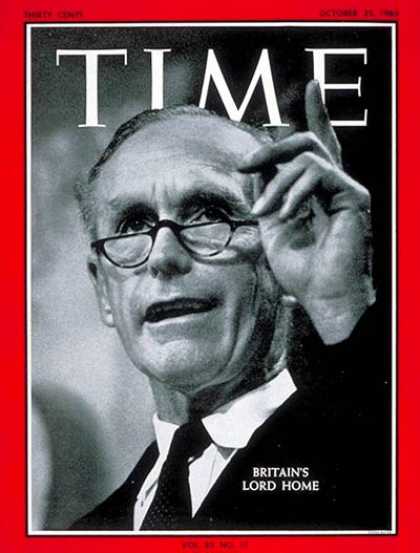
Photobucket1963 - Following the surprise resignation of Harold Macmillan as Prime Minister, Her Majesty The Queen invited Sir Alec Douglas-Home to form her next government; having won the leadership of the Conservative Party over Rab Butler and Quintin Hogg at a raucous convention, under the terms of the Peerage Act 1963 Home was then compelled to declaim his Earldom and other titles, give up his seat in the House of Lords, and contest a by-election in Kinross & West Perthshire in order to reside at 10 Downing Street.

1967
- The Soviet probe Venera 4 reached Venus and became the first human spacecraft to measure the atmosphere of another planet.

1989 - East German leader Erich Honecker resigned.

1991 - Azerbaijan declared its independence from the Soviet Union.
*
share on: facebook

Sunday, October 17, 2010

Pop History Moment: The Death of Pierre Laporte

On this day in 1970, members of the Chenier Cell of the FLQ announced that their high-profile hostage Quebec Minister of Labour and Vice-Premier Pierre Laporte had been executed; their communique to police referred to Laporte derisively as the 'Minister of Unemployment and Assimilation'. True to their word, Laporte's body was found strangled to death, stuffed into the trunk of a stolen car and abandoned in a wooded area near Saint-Hubert Airport, a few miles south of Montreal.

Photo Sharing and Video Hosting at PhotobucketMembers of the Chenier Cell - Paul Rose, Jacques Rose, Francis Simard, and Bernard Lortie - were all arrested on November 6th, at their hideout; all but Lortie escaped, only to be recaptured in St. Luc at the end of December. Though all four were charged with the murder of Pierre Laporte, and in March 1971 each of them were sentenced to life terms for their part in the crime, the last of them had been released into the community by 1982.

In the years since, Paul Rose (who was the cell leader) has tried to run for federal office for the NDP, which caused the national party to sever its ties to the provincial arm in the 1990s*; Rose is still active in the trade union movement and occasionally works as a radio commentator. Jacques Rose is an independent contractor and supporter of the separatist movement. Francis Simard has since written several books on the October Crisis, one of which Pour en finir avec octobre has been made into a movie by Pierre Falardeau. Bernard Lortie has kept a low profile; alas, not quite as low as Pierre Laporte...

*Decimating the gains for that party made there in the 1970s by leader Ed Broadbent.
*
share on: facebook

"Sikidim" by Tarkan


As I am ever on the lookout for music from around the globe (not to mention super hot guys performing that music!) at some point since I began this blog I stumbled across Tarkan; this song of his has seldom been off my iPod since...

From one of Turkey's most famous pop singers, Tarkan Tevetoğlu, this song Şıkıdım (Shake) is apparently taken from his 1994 album A-Acayipsin, and also appears on his 2006 English-language debut album Come Closer.
*
share on: facebook

Gratuitous Brunette: Montgomery Clift

Photobucket - Video and Image Hosting

After a decade spent distinguishing himself on the Broadway stage, Montgomery Clift - who was born on this day in 1920 - arrived in Hollywood in 1948 only to distinguish himself there too; his debut in Red River brought a new credibility to Westerns, the acting in which hadn't generally involved any psychological depth up to that point.

Clift's career prior to 1956 combined his angelic looks, massive talent, and inner turmoil to guarantee box-office gold; opposite 19 year-old Elizabeth Taylor in A Place in the Sun (1951) they fairly light up the screen, and in From Here to Eternity (1953) he added his considerable skill to what was already a powerhouse ensemble.

It was in May of that year, however, during principal photography for the antebellum epic Raintree County, that Clift was involved in a car accident which left him in chronic pain, his looks shattered... Before long they were calling his 'the longest suicide in Hollywood', as he added addiction upon addiction; while co-starring in The Misfits (1961) with Marilyn Monroe, she was quoted as saying that he was 'the only person I know who is in worse shape than I am.' Yikes!

Well, for what it's worth he managed to outlive her by four years, finally dying in July 1966. Ever since, armchair psychologists have attempted to understand Clift's torment, and most have put it down to his sexuality. Although he had always had affairs with both women and men, those who knew him best (like Taylor) felt that if he could have just found a nice man and settled down, he might have had at least a chance to be happy.

Just his luck, then, to be trapped in Hollywood, where nice men are said to be in as short a supply as quiet lives...
*
share on: facebook

Happy Birthday Margot Kidder

No matter how boring the movie she's in - and she's been in some real doozies! - you can bet she'll never be boring in it; whether it's because of her charisma or because her sheer viewability rivals that of Christopher Walken, well, who can say? Maybe it's a little bit of both.

Photo Sharing and Video Hosting at PhotobucketVaulted from obscurity* in 1978 - when she was cast to play Lois Lane opposite Christopher Reeve in Superman - it turns out Margot Kidder really just hated the attention. As her fame grew so did her reputation for being difficult; as her reputation for being difficult grew her fame shrank... Problem solved! Or so it would seem, anyway. After clashing with director Richard Donner during Superman II, for instance, her part in Superman III was cut to less than five minutes. She got considerably more screentime in Superman IV: The Quest for Peace, though. For what it's worth...

Whether the demons she's battled were the by-product of fame or within her all along (and whether the fame she found was toxic in and of itself or whether she was merely allergic to it) Margot Kidder is still with us, and therefore still likely to turn up in the strangest places; better yet, she's just as likely to be endearingly kooky - and cussing up a storm - when she does!

*AKA Canadian show business... >shudder<
*
share on: facebook

"My Oh My" by Aqua


Birthday wishes go out to supercute multi-ethnic pop phenom of yesteryear, René Dif - who was so effective in providing male vocals to Danish pop combo Aqua, and whose growly vocals have been in residence on my iPod ever since they first hit my CD player in the waning years of the 20th Century...

My Oh My was actually released as a single before Barbie Girl made the band an international sensation, owing to the litigiosity and corporate piggery of Mattel, Inc.; since I've already posted Barbie Girl here (on Barbie's birthday, natch!) I thought this video's jaunty pirate motif might make it most ideal to post in this Hallowe'en season. The song, of course, originated on the band's 1997 album Aquarium; although sung by René Dif and Lene Nystrøm Rasted, it was written by their fellow band members Claus Norreen and Søren Nystrøm Rasted. The video, like all five the band made in support of this album, was directed by Peder Pedersen.
*
share on: facebook

POPnews - October 17th

Photobucket
[Owing to a subway series between the Oakland Athletics and the
San Francisco Giants during the 1989 World Series, Game Three
- scheduled to be held at
Candlestick Park on this day in 1989 -
had to be cancelled; it also marks the first time an
American earthquake had been televised.
]

1091 - A tornado devastated central London.

1346 - Scotland's King David II was captured by England's King Edward III in Calais following the Battle of Neville's Cross and imprisoned in the Tower of London for 11 years before his country could afford to have him ransomed.

1456 - The University of Greifswald was established, making it only the second oldest such institution in northern Europe.

1604 - German astronomer Johannes Kepler began observing a supernova in the constellation Ophiuchus, which later came to be known as Kepler's Star, despite the fact that the spectacular phenomenon had first been observed in northern Italy on October 9th.

1610 - France's King Louis XIII was crowned at the cathedral in Rheims.

1660 - The Regicides who had ordered the death of Charles I in 1649 - among them Adrian Scroope, Thomas Scot, Gregory Clement - were themselves executed at Charing Cross.

1806 - Haiti's despotic Emperor, Jacques I, was assassinated.

1814 - The London Beer Flood occurred at the Meux and Company Brewery on Tottenham Court Road in the London parish of St. Giles, killing nine.

1860 - The first playing of The Open Championship (referred to outside the UK as the British Open) was held at Scotland's Prestwick Golf Club; nowadays, of course, Britain's premier golfing event rotates between nine different courses. For the record, the winner of that first tournament was Willie Park, Snr., who was awarded a championship belt for his efforts.

1931 - Al Capone was convicted of income tax evasion, apparently.

1933 - Albert Einstein, fleeing Nazi Germany, arrived in Princeton, New Jersey.

1956 - The world's first commercial nuclear power station was officially opened by Queen Elizabeth II at Sellafield, in the English county of Cumbria; when it was finally shut in March 2003 the main reactor had been in continuous operation for nearly 47 years.

1961 - As many as 400 Algerian protesters were massacred by the Paris police at the instigation of Nazi collaborator Maurice Papon, then chief of the city's Prefecture of Police.

1965 - The New York World's Fair closed after two years.

1967 - The musical Hair began its long run off-Broadway at the Public Theater.

1979 - Mother Teresa was awarded the Nobel Peace Prize.

1980 - Queen Elizabeth II became the first British monarch to be received at the Vatican when she visited Pope John Paul II.

1989 - The San Francisco Bay Area was badly shaken by the Loma Prieta earthquake, a 7.1 magnitude reminder of the Earth's power which occurred at 5:04 PM local time, during that day's rush hour.

2005 - Stephen Colbert's The Colbert Report debuted.
*
share on: facebook

Saturday, October 16, 2010

"Higher Ground" by Red Hot Chili Peppers


Birthday wishes go out today to Michael 'Flea' Balzary - bassist and founding member of the LA-based noise makers Red Hot Chili Peppers, whose original instrument was the trumpet, and whose original aspiration was to play jazz. Taught to play bass by his friend (and future Pepper) Hillel Slovak, Flea was a member of Slovak's band Anthym for a time, before quitting in favour of punk combo Fear; in 1983 he united with Anthony Kiedis and Jack Irons and the Red Hot Chili Peppers were born.

Higher Ground is of course one of many huge hits popularized by Stevie Wonder, appearing first on his 1973 album Innervisions; RHCP's version gave the band the breakthrough it needed in 1989, when it was released along with their album Mother's Milk. As per usual, in lieu of the original video - unavailable for the same reasons as always* - I've posted a clip of the band performing the song at Woodstock 94.

*The damn suits!
*
share on: facebook

In Memoriam: Eugene O'Neill

The works of Eugene O'Neill are not merely renowned but acclaimed for their bitterness and cynicism; his characters are generally downtrodden, prone to the abuse of alcohol, and generally speaking something of a sorry lot. This is probably why I have always studiously avoided them, and him. After all, it should come as no surprise to even the most casual observer of the Pop Culture Institute that its author is rather obsessed with comedy, and the reason why ought to be obvious even to the most glib of pop psychologists.

PhotobucketNevertheless, his is a name which recurs rather too often in the course of my research - especially since it so often appears in conjunction with other bold-faced names of 20th Century entertainment - and so for the sake of this blog I've decided to finally man up and face what amounts to one of my demons: the professional tragedian.

Born on this day in 1886 in a room of the Barrett Hotel in New York City's Times Square, as a child he was sent to Catholic boarding school, where naturally he found no solace in religion but plenty in books. A lengthy sojourn at sea ended when he contracted tuberculosis, following which he turned to writing to make his convalescence more bearable. A Greenwich Village bohemian long before it was a pose, in 1916 O'Neill discovered the Provincetown Players while on vacation in New England, and a memorable partnership was born...

At a time when the American theatre was still rather plagued by melodrama, O'Neill's stark realism was both a breath of fresh air and a challenge to the ruling orthodoxy - which simultaneously made him a bold innovator and a major threat. His first Broadway show was 1920's Beyond the Horizon, and its timing was propitious; as a nation embittered by its involvement in a European war entered the hedonistic Jazz Age and its government swore everyone off alcohol (wink, wink) O'Neill's dissipated vulgarians became contemporary archetypes seemingly overnight.

PhotobucketMany of Eugene O'Neill's plays were hugely successful both on Broadway and in repertory; a fair number were made into movies. The highlights of his literary career include The Emperor Jones, Anna Christie, Desire Under the Elms, Mourning Becomes Electra, Ah, Wilderness! (his only attempt at comedy), The Iceman Cometh, Long Day's Journey Into Night, and A Moon for the Misbegotten.

Given the lack of good examples from his life and the challenges he faced thanks to booze, it should be no surprise that Eugene O'Neill was never going to be either husband or father of the year; both husband and father of three, not only did his marriages scandalously overlap but his eldest son committed suicide, his middle child became a heroin addict (and also committed suicide), and his daughter Oona he disowned when she was just 18 for marrying 54 year-old Charlie Chaplin.

O'Neill was portrayed by Jack Nicholson in the 1981 film Reds; in life, O'Neill had been close friends with John Reed (and even closer to Reed's wife Louise Bryant, if you know what I mean). Reed, of course, was played by Warren Beatty and Louise Bryant by Diane Keaton. Both his Connecticut home (Monte Cristo Cottage) and his home in California (Tao House) have been designated national landmarks; even the site where he was born - at the epicentre of American entertainment, Times Square, now home to a Starbucks - is marked by a plaque. In addition to his numerous awards - including various Pulitzers as well as the Nobel Prize - The Eugene O'Neill Award named for him has been handed out annually in Sweden since 1956.

He died in November 1953.
*
share on: facebook

Remembering... Jean de Brunhoff

On this day in 1937 Jean de Brunhoff, creator of Babar, died - aged only 38; that's, like, younger I am now, man. Makes you think...

PhotobucketIt's a funny thing, but while I really liked Babar as a child, I hadn't thought about him for more than twenty years* when, this past summer, I was walking past a display of stuffed animals and saw a 10-inch tall Babar in amongst the others. Naturally, as I am a creature who is absolutely dominated by whim, I bought it and gave it pride of place on the shelf where I keep my books suitable for youngsters.

Then, mere weeks ago, The New Yorker ran an article by noted Canadian Francophile Adam Gopnik not merely about Babar and what he means but also about the man who created him - Jean de Brunhoff.

Well! Turns out I was quite the dupe even as a child; it would never have occurred to me then that what I was reading was a blatant propaganda in favour of colonialism. I mean, I certainly never got that out of it then, and to be quite honest I'm a bit afraid to revisit the books now out of the fear that yet another of those favoured things from my childhood should be rendered obsolete by politics.

*And had probably never given a thought to the man who created him, then or now.
*

share on: facebook

Günther Grass Is Always Greener On the Other Side

Every so often I come up with a title so compelling I feel the need to publish a post, even if it's about someone whose basic details are unknown to me*; well, it's not like I know nothing about Günther Grass - I know he wrote The Tin Drum, for which he won my most coveted literary prize, the Nobel - but other than that, as with a lot of the work that has appeared here, I'm learning about two steps ahead of you.

PhotobucketBorn on this day in 1927 in the Free City of Danzig Grass experienced first hand the upheavals that beset Poland and Germany during his youth. His later admission that he'd actually served with the Waffen-SS in the dying days of World War II was met with criticism both from his allies on the left and his enemies on the right; Grass easily brushed aside these critics, claiming youthful stupidity and pointed to a lifetime of work spent at undoing any damage he might have done in the service of National Socialism**.

Grass' Danzig Trilogy is the most openly critical of the tyranny in whose thrall he was briefly held; consisting of The Tin Drum (1959), Cat and Mouse (1961), and Dog Years (1963), it chronicles the life of its protagonist Oskar Matzerath through his interactions with the people of Gdansk, and does so with a deft magic realism which was rare in Northern Europe at the time, when a kind of brutal naturalism was favoured.

Grass continues to write this day, and his list of publications is prodigious: novels, plays, poetry, essays, speeches, and criticism. Add to that a 2007 memoir Peeling the Onion, and Grass proves he's anything but green.

*Or even if, like this one, it doesn't necessarily fit.
**Also, there's no telling what effect such an admission would have had on his future success had it been revealed in the 50s, as opposed to 2006.
*

share on: facebook

Pop History Moment: The Death of Marie Antoinette

By the time of her death by guillotine on this day in 1793, the feel of cold steel on her neck might have seemed like a sweet release to Marie Antoinette, especially compared to the agony her life had become over the previous few years. That she should lose her head to the blade is only apt, as her reputation had by then already been the victim of a serious hatchet job for years...

Photo Sharing and Video Hosting at PhotobucketFew stories fill me with such dread and loathing as those of the French Revolution, even when they're as well-written as they are in Antonia Fraser's excellent 2001 biography, Marie Antoinette: The Journey. In her book Fraser limns the life of the sheltered Austrian princess who again and again finds herself in over the head she would one day lose. It is a story told on a tumbrel of a woman who refused to believe in the depths of human evil, even as it was swallowing her whole.

At the birth of the Age of Reason there was an Age of Chaos: disguising mob rule as democracy, the newly 'freed' French went on a killing spree which at the time was unprecedented in the post-Renaissance era. It was only a matter of time, then, before the crowd caught up to its former Queen: both a foreigner and a woman, she would make a doubly good scapegoat. Utterly blameless and with no power to speak of, save the money she quietly distributed to orphanages and hospitals, Marie Antoinette was nothing less than a victim of her class, a martyr caught in the teeth of an unreasoning genocide...

Tales of her behaviour from those who knew her, even those who didn't like her, differ so greatly from the picture of her painted by scurrilous pamphleteers (none of whom had even met her) that only the most bigoted could believe the least of the allegations made against her. They are also testament to the corrosive effects of slander; 200 years later and her legend still calls out for understanding.

Yet xenophobia and misogyny are two of the oldest and therefore fondest of history's prejudices, and so might be the hardest ones to be overcome; Marie Antoinette faced them both with a poise that had been ingrained in her from birth. In fact, of her it could rightly be said she never once lost her head, right up until the moment she did.
*
share on: facebook

Oscar Wilde on "Monty Python's Flying Circus"


Here Graham Chapman plays Oscar Wilde, John Cleese plays James McNeill Whistler, and Michael Palin plays George Bernard Shaw in a somewhat anachronistic scene from Grandstand (aka Episode 39 of Monty Python's Flying Circus), given that Terry Jones is obviously playing Edward VII (they call him 'Your Majesty') even though the sketch is set in 1895, six years before the death of Queen Victoria.
*
share on: facebook

"The Ballad of Reading Gaol" by Oscar Wilde

Because of the length of The Ballad of Reading Gaol, I've decided to publish only the first part here; however, feel free to follow the link at the bottom of the post and read the rest. ~ MSM

I.

He did not wear his scarlet coat,
For blood and wine are red,
And blood and wine were on his hands
When they found him with the dead,
The poor dead woman whom he loved,
And murdered in her bed.

He walked amongst the Trial Men
In a suit of shabby grey;
A cricket cap was on his head,
And his step seemed light and gay;
But I never saw a man who looked
So wistfully at the day.

I never saw a man who looked
With such a wistful eye
Upon that little tent of blue
Which prisoners call the sky,
And at every drifting cloud that went
With sails of silver by.

I walked, with other souls in pain,
Within another ring,
And was wondering if the man had done
A great or little thing,
When a voice behind me whispered low,
"That fellow's got to swing."

Dear Christ! the very prison walls
Suddenly seemed to reel,
And the sky above my head became
Like a casque of scorching steel;
And, though I was a soul in pain,
My pain I could not feel.

I only knew what hunted thought
Quickened his step, and why
He looked upon the garish day
With such a wistful eye;
The man had killed the thing he loved
And so he had to die.

Yet each man kills the thing he loves
By each let this be heard,
Some do it with a bitter look,
Some with a flattering word,
The coward does it with a kiss,
The brave man with a sword!

Some kill their love when they are young,
And some when they are old;
Some strangle with the hands of Lust,
Some with the hands of Gold:
The kindest use a knife, because
The dead so soon grow cold.

Some love too little, some too long,
Some sell, and others buy;
Some do the deed with many tears,
And some without a sigh:
For each man kills the thing he loves,
Yet each man does not die.

He does not die a death of shame
On a day of dark disgrace,
Nor have a noose about his neck,
Nor a cloth upon his face,
Nor drop feet foremost through the floor
Into an empty place

He does not sit with silent men
Who watch him night and day;
Who watch him when he tries to weep,
And when he tries to pray;
Who watch him lest himself should rob
The prison of its prey.

He does not wake at dawn to see
Dread figures throng his room,
The shivering Chaplain robed in white,
The Sheriff stern with gloom,
And the Governor all in shiny black,
With the yellow face of Doom.

He does not rise in piteous haste
To put on convict-clothes,
While some coarse-mouthed Doctor gloats, and notes
Each new and nerve-twitched pose,
Fingering a watch whose little ticks
Are like horrible hammer-blows.

He does not know that sickening thirst
That sands one's throat, before
The hangman with his gardener's gloves
Slips through the padded door,
And binds one with three leathern thongs,
That the throat may thirst no more.

He does not bend his head to hear
The Burial Office read,
Nor, while the terror of his soul
Tells him he is not dead,
Cross his own coffin, as he moves
Into the hideous shed.

He does not stare upon the air
Through a little roof of glass;
He does not pray with lips of clay
For his agony to pass;
Nor feel upon his shuddering cheek
The kiss of Caiaphas.

[To continue reading...]
*
share on: facebook