Thursday, June 03, 2010

POPnews - June 3rd

Photobucket
[The holiest of the gurdwaras in Sikhism, the Harmandir Sahib was no stranger to unrest when, on this day in 1984, Indian troops fired upon it, causing extensive structural damage as well as killing 83 soldiers and 492 civilians in the process; it was nearby in April 1919 that Brigadier-General Reginald Dyer ordered British troops to open fire on a peaceful protest during what came to be known as the Jallianwala Bagh Massacre, at which official estimates claim 379 were killed with 1100 wounded, although some unofficial reports had 1,526 fatalities in that earlier clash.]

350 CE - Usurper Nepotianus, of the Constantinian Dynasty, proclaimed himself Emperor and entered Rome at the head of a group of gladiators.  His reign lasted just 28 days, whereupon he was killed by Marcellinus, a general in the service of rival usurper Magnentius

1326 - The Treaty of Novgorod delineated the border between Russia and Norway in Finnmark, which is today the northernmost county in Norway.

1621 - The Dutch West India Company received a charter for New Netherlands from the Republic of the Seven United Netherlands.

1770 - Mission San Carlos Borromeo de Carmelo was founded by Junípero Serra in Carmel-by-the-Sea, California.

1888 - The San Francisco Examiner first published the poem Casey at the Bat, which was written by Ernest Lawrence Thayer.

Photobucket1935 - A thousand unemployed workers boarded freight cars in Vancouver, beginning an historic protest trek to Parliament Hill in Ottawa; the so-called On-To-Ottawa Trek was met with harsh reprisals along the way by local authorities - most notably at the Regina Riot on that year's Dominion Day - but did succeed in discrediting the do-nothing* government of Prime Minister R. B. Bennett's Conservatives at the polls on October 23rd.  While most of those involved found little relief for their downtrodden state under his successor - the redoubtable Liberal Mackenzie King - the defeated Bennett (shown, looking typically smug, at left) decamped to the United Kingdom, where in June 1941 he became the first and only Canadian Prime Minister elevated to the House of Lords by King George VI on the advice of Prime Minister Winston Churchill; while there he served as Viscount Bennett of Mickleham (in the County of Surrey) and of Calgary and Hopewell in the Dominion of Canada.

*Which in French is called laissez-faire, and best pronounced 'lazy...  feh!'

1962 - A chartered Air France Boeing 707, Chateau de Sully, crashed after an aborted takeoff from Paris, killing 130; at the time it was the largest single airplane accident to date.

1963 - Pope John XXIII died; he was succeeded by Paul VI on June 21st.

1965 - Gemini 4 - the first multi-day space mission by a NASA crew - was launched.

Photobucket1968 - Valerie Solanas, misandric author of The SCUM Manifesto*, attempted to assassinate Andy Warhol by shooting him three times at his New York City studio, The Factory; she also shot and slightly injured art critic Mario Amaya and would have shot Warhol's manager Fred Hughes as well only her gun jammed. Warhol's injuries were serious enough that they would plague him throughout the rest of his life - he was forced to wear a girdle, for instance, and after any exertion his wounds would bleed - although he refused to testify against her in court; she received a three-year sentence for the attack. The incident is dramatized in the 1996 film I Shot Andy Warhol, in which Solanas is played by Lili Taylor and Warhol by Jared Harris; the film was directed by Canadian Mary Harron.

*SCUM was an acronym; it stood for 'Society for Cutting Up Men.'

1969 - During the so-called Melbourne-Evans Collision off the coast of South Vietnam, the Australian aircraft carrier HMAS Melbourne cut the US Navy destroyer USS Frank E. Evans in half, killing 74 American sailors.

1979 - A blowout at the Ixtoc I oil well in the southern Gulf of Mexico caused at least 600,000 tons (176,400,000 gallons) of oil to be spilled, making it the worst oil spill to date - although it will likely be surpassed (and then some) by the spill caused by the explosion that sank the oil rig Deepwater Horizon in April 2010.

1982 - The Israeli ambassador to the Court of St. James's, Shlomo Argov, was shot on a London street; although he survived the attack he was permanently paralyzed.

1984 - During an ill-considered attempt to arrest Jarnail Singh Bhindranwale, the Indian Army stormed the Harmandir Sahib - the Golden Temple near Amritsar which is the most sacred shrine of Sikhism - during Operation Blue Star, which was personally organized by Indian Prime Minister Indira Gandhi.

1989 - Iranian spiritual leader and theocratic dictator Ayatollah Ruhollah Khomeini died; he was succeeded the next day by Ali Khamenehei.

1990 - American punk rock legend Stiv Bators died in Paris after being hit by taxi while drunkenly crossing the street; although his friends took him to the hospital, he left voluntarily after several hours without being seen by a doctor, and later died in his sleep of a concussion.  He was 40.

1991 - Mount Unzen erupted on Japan's southernmost island of Kyūshū killing 43 people, all of them either researchers or journalists.

1998 - During the Eschede train disaster an ICE high speed train derailed in the German state of Lower Saxony, causing 101 deaths - surpassing the death toll of the May 1971 Dahlerau train disaster to become the world's deadliest train crash.

2007 - USS Carter Hall (LSD-50) engaged pirates after they boarded the Danish ship Danica White off the coast of Somalia.
*
share on: facebook

Wednesday, June 02, 2010

Now Showing - "Elizabeth Is Queen"


The fawning, sycophantic tone of the above clip came as a shock even to me, a fawning sycophant if ever there was one; Pathé News - renowned for jingoistic transports of ecstasy that even Fox News would have trouble accomplishing (let alone in such a blithe manner) - really manages to outdo itself on this cheerful (and cheerfully heavy-handed) bit of mid-century propaganda in honour of the coronation of Elizabeth II.

Of course, given the threat to Britain and its way of life presented by the Second World War - whose physical and psychological scars were then still much in evidence throughout the country - it's only natural that, following the cessation of hostilities in May 1945, the British media would spend a few years in a tizzy of uber-Britishness. What better time to indulge such a mania, then, than a coronation, which is at its heart an affirmation of the uniqueness of English government?
*
share on: facebook

Pop History Moment: The Coronation of Elizabeth II

Photo Sharing and Video Hosting at Photobucket

On this day in 1953, for the first time ever, the coronation of an English sovereign was shown on television when Elizabeth II was crowned in a lavish and historic ceremony at Westminster Abbey. Her heavily embroidered coronation gown on that day, designed by Norman Hartnell, featured the floral emblems of most of her realms, including the Tudor rose of England, the Scots thistle, the Welsh leek, the shamrock of Ireland, the wattle of Australia, the maple leaf of Canada, the New Zealand fern, South Africa's protea, two lotus flowers for India and Ceylon, and Pakistan's wheat, cotton and jute.

A colour film was also made of the event, entitled A Queen Is Crowned, which was exhibited all over the world to great acclaim; narrated by Laurence Olivier, the film has been released on DVD in the UK but not in North America.

Long may she reign!
*
share on: facebook

POPnews - June 2nd

Photobucket
[As an indication of how times have changed, the President and his intended were able to keep their engagement a secret until five days before they were married... They'd first met, though, when Miss Folsom was an infant - her father Oscar and the President were good friends; after Oscar Folsom died intestate as a result of an 1875 buggy accident Cleveland was appointed the administrator of Folsom's estate, clearly taking a keen interest in the loveliest of his late friend's fiduciary responsibilities. Theirs was a low-key wedding - attended by a few family members and friends as well as the Cabinet and their wives; the 7 pm service was conducted by the Reverend Byron Sutherland, with the assistance of the Reverend William Cleveland, the groom's brother.]

1098 - During the First Crusade the eight-month-long first Siege of Antioch ended when Crusaders Godfrey of Bouillon, Bohemund of Taranto, and Raymond IV of Toulouse took the city from its Muslim occupiers; their celebration, however, would be short-lived. A second siege - really a counter-siege - began just five days later, though neither Yaghi-Siyan nor Kerbogha were able to recapture the city, and after two weeks their own forces were routed outside the city's formidable walls.

1615 - The first Récollet missionaries arrived at Quebec City from Rouen.

1763 - During the period of conflict between European settlers at the First Nations known as Pontiac's Rebellion, a band of Chippewas captured Fort Michilimackinac (near what is now Mackinaw City, Michigan) by diverting the garrison's attention with a game of lacrosse, then chasing their ball into the fort.

1774 - Among the many so-called Intolerable Acts passed by Britain's Parliament intended to bring its rebellious Thirteen Colonies into line following the Boston Tea Party in December 1773, the Quartering Act (first passed in 1765) was reenacted; the legislation required American colonists to have British soldiers live in their homes rather than in barracks, which colonial assemblies had proven unwilling to build.

1848 - Overseen by František Palacký the Slavic Congress began, in Prague, as a show of solidarity in the face of increasing German nationalism in traditionally Slavic territories.

1855 - The Portland Rum Riot occurred in Portland, Maine.

1876 - Hristo Botev, a Bulgarian nationalist and revolutionary, was killed in Stara Planina.

1886 - US President Grover Cleveland married Frances Folsom in the Blue Room of the White House, becoming the first and so far only president to wed in the Executive Mansion; although John Tyler married Julia Gardiner in June 1844 while President, he did so in New York City.

1924 - US President Calvin Coolidge signed the Indian Citizenship Act into law, granting citizenship to all Native Americans born within the territorial limits of the United States.

1946 - The Italian Republic was born when, as a result of a referendum, Italians apparently decided to abandon their monarchy under the House of Savoy, following which the former King, Umberto II, was sent into exile.

1953 - The coronation of England's Queen Elizabeth II at Westminster Abbey was the first such ancient ceremony to be televised.

1966 - The Surveyor program's Surveyor 1 landed in the Moon's Oceanus Procellarum, making it the first American spacecraft to soft land on another planet.

1967 - Protests in West Berlin against the arrival of the Shah of Iran in that city turned into riots, during which student Benno Ohnesorg was killed by a police officer; Ohnesorg's death resulted in the founding of the terrorist group Movement 2 June, best known for its campaign of bombings in and around Berlin as well as the kidnapping of CDU mayoral candidate Peter Lorenz in February 1975, who was handily elected during his five-day captivity.

1990 - A tornado outbreak in the Lower Ohio Valley spawned 88 confirmed tornadoes in Illinois, Indiana, Kentucky, and Ohio, killing 12; the hardest-hit town in the outbreak, with 6 deaths, was Petersburg, Indiana.

1992 - Denmark rejected the Maastricht Treaty by a thin margin in a national referendum.

1997 - In a Denver courtroom, Timothy McVeigh was convicted on 15 counts of murder and conspiracy for his role in the 1995 terrorist bombing of the Alfred P. Murrah Federal Building in Oklahoma City.

1999 - The Bhutan Broadcasting Service began television transmissions in the remote Himalayan kingdom for the first time, on the night of King Jigme Singye Wangchuck's silver jubilee.

2003 - The European Space Agency's Mars Express probe was launched from the Baikonur space centre in Kazakhstan.

2004 - Ken Jennings began his 74-game winning streak on the syndicated game show Jeopardy!; all told, Jennings has earned $3,022,700 US from the show to date.
*
share on: facebook

Tuesday, June 01, 2010

"Wunderkind" by Alanis Morrissette


Birthday wishes go out today to Alanis Morissette, whose 2005 song Wunderkind is developing a pretty impressive pedigree...  Written for the 2005 film The Chronicles of Narnia: The Lion, the Witch and the Wardrobe*, Morissette also performed the song during the closing ceremonies of the 2010 Winter Olympics in Vancouver.

*Actually written on a Friday after she'd seen a rough cut of the movie, recorded on Saturday, and handed in on Sunday!
*

share on: facebook

Pop History Moment: The Release of "Sgt. Pepper's Lonely Hearts Club Band"

Photo Sharing and Video Hosting at Photobucket

On this day in 1967 Sgt. Pepper (courtesy of The Beatles) taught the world a new way to rock; Sgt. Pepper's Lonely Hearts Club Band either infused pop music with myriad new ideas or set the stage for the pomposity of art rock or maybe even did both, depending on your perspective.

Recorded at Abbey Road Studios in London over a period of 129 days, the album was a critical and popular success from the moment of its release; to date it has spent a grand total of 198 weeks on the UK chart. Prominent critic Kenneth Tynan called it 'a decisive moment in the history of Western Civilization'; while frequently given to hyperbole in his vitriol, he wasn't so inclined when it came to praise, so Tynan's review can be taken as sincere. Frank Zappa, on the other hand, pretty viciously parodied the album with one of his own, entitled We're Only in It for the Money, despite the fact that The Beatles openly named Zappa's album Freak Out! as an influence on their own ground-breaking work.

In 2003 Rolling Stone magazine named Sgt. Pepper's Lonely Hearts Club Band the greatest album of the rock era, and in pop culture terms it certainly has the most evocative cover...
*
share on: facebook

Bonus Video: "Material Girl" by Madonna


Despite the video's heavy-handed irony (in which Madonna sings about being a 'material girl' on stage but pointedly refuses to be one backstage) as a nickname the song's title haunts her still, nearly 25 years later*; for a woman whose entire career has supposedly been about her own control over her image, this was one of the first major losses of it she suffered, mainly because the only thing in her career not in her direct sway also happens to be one of the largest factors of anyone's fame, namely the public's (not to mention the media's) reaction to their output. Fans still clamour for her to play the song, which she despises - she's been quoted as saying that if she'd known how successful it would become she never would have recorded it - and which has been absent from her concert set-list for years.

The video is famously an homage to Diamonds Are a Girl's Best Friend, originally performed by Marilyn Monroe in the 1953 film Gentlemen Prefer Blondes; equally famous as a pioneering music video (directed by Mary Lambert) with a then-innovative 'video within a video' technique, it costars Keith Carradine as the mogul who tries but fails to win the leading lady's heart with diamonds and flash, but ends up scoring with an old pickup truck and a handful of wildflowers.

Material Girl was the second single from Madonna's second album Like a Virgin. Trivia buffs take note: it was during the filming of this video - at Hollywood's Ren-Mar Studios - that Madonna first met Sean Penn.

*Although it's been tapering off recently since her British nickname 'Madge' has begun to gain traction worldwide.
*

share on: facebook

"Candle In The Wind" by Elton John


Before it was a mawkish but necessary balm for the world-wide grief surrounding the death of Diana, Princess of Wales* in August 1997, Elton John's Candle in the Wind - from his 1973 album Goodbye Yellow Brick Road - was a tribute to another extraordinary (and extraordinarily damaged) blonde beauty, Marilyn Monroe.

Not much of a hit upon its initial release in 1974** it gained new life after December 1986, when it was released as a single in support of John's Live in Australia with the Melbourne Symphony Orchestra.  This time it made it all the way to #5 in the UK and #6 in the US, and is still played on radio nearly a quarter of a century later.

*Even before he'd dedicated it to his friend Ryan White in concert at Farm Aid 4 in Indianapolis the day before White's April 1990 death from AIDS.
**Originally paired with Bennie and the Jets on its B-side, Candle in the Wind went to Number 11 on the UK chart; meanwhile Bennie and the Jets - which was later released as a single over John's objections - went to Number 1 around the world and on the US R&B chart as well as achieving success on pop radio.
*

share on: facebook

"I Wanna Be Loved By You" by Marilyn Monroe


The final line of the 1959 film Some Like It Hot has Osgood Fielding III (Joe E. Brown) asserting to the ersatz Daphne (Jack Lemmon)* that 'Nobody's perfect.' While that may be true for people, in the case of this film it's not only a damn lie but potentially libelous!**

Part of the reason for the film's cinematic attainment of perfection may be the able direction of Billy Wilder, Robert Thoeren and Michael Logan's clever story (from which Wilder and longtime writing partner I. A. L. Diamond were able to polish a diamond-like screenplay), the celluloid reverie of cinematographer Charles Lang, or the whip-smart instincts of its top-notch cast...

A lion's share of the credit, though, must go to the unique magic possessed by the film's female lead, birthday gal Marilyn Monroe, whose sultry rendition of the Herbert Stothart-Harry Ruby-Bert Kalmar classic I Wanna Be Loved By You shown above reminds listeners of Helen Kane and Betty Boop *** yet is entirely distinct from either.

*Who's just revealed that she's not a she but a he!
**Clearly the American Film Institute agrees with me...  In June 2000 it listed Some Like It Hot as the greatest American comedy film of all time.
***Who each helped to make it famous in the 1920s.
*

share on: facebook

"Diamonds Are A Girl's Best Friend" by Marilyn Monroe


Taken from Howard Hawks' 1953 film Gentlemen Prefer Blondes - which is easily one of the giddiest musical comedies ever made - I can think of no greater tribute to the lady herself on what would have been her birthday than a demonstration of some of her finest work.

In 1985 the scene involving Diamonds Are a Girl's Best Friend was the subject of a famous homage by Madonna, but in 1953 it was merely one of those which literally cemented the reputation of both Marilyn Monroe and Jane Russell when, at the film's premiere, the two had their hand- and foot-prints preserved for posterity at Grauman's Chinese Theatre. Alas, plans to have the pair's bust-prints likewise enshrined had to be scrapped, as they would have posed a major safety hazard*.

*Okay, I made that last bit up! ~ MSM
*

share on: facebook

In Memoriam: Marilyn Monroe

Photo Sharing and Video Hosting at Photobucket

She was more than a raving beauty; she was a beautiful soul...

Yet wherever she went, squalor followed her, from the charity ward of L.A. County Hospital where she was born to the orphanage and foster homes where she endured untold suffering, right into the tabloid pages where, seemingly overnight, Norma Jean became Marilyn Monroe.

She never stopped looking for happiness, though, and sublimated her suffering into the most sublime kind of comedy. Once she was able to overcome the bad coaching she'd gotten early in her career, she suffused the screen with a kind of naturalism that is normally the birthright of angels.

Whether she ever felt loved is something we'll ever know; hopefully, wherever she is now, she knows how loved she still is...
*
share on: facebook

Pop History Moment: A Royal Massacre In Nepal

On this day in 2001 Prince Dipendra, the Crown Prince of Nepal, killed most of his family before turning the gun on himself at a banquet being held in the Narayanhity Royal Palace in the Nepali capital of Kathmandu. Despite his attempted suicide, Prince Dipendra lingered on life support for three days, during which time he was the de facto King of Nepal. He was eventually succeeded by his uncle Gyanendra.

Photo Sharing and Video Hosting at PhotobucketSlain by Prince Dipendra in the massacre were his father King Birendra, mother Queen Aishwarya, brother Prince Nirajan, sister Princess Shruti, former Prince Dhirendra (a younger brother who had renounced his title), the King's cousin Princess Jayanti, aunts Princess Shanti and Princess Sharada, and Princess Sharada's husband Kumar Khadga as well as an unspecified number of servants. Wounded were another aunt Princess Shova, Princess Shruti's husband Kumar Gorakh, Princess (now Queen) Komal, another of King Birendra's cousins Ketaki Chester, and Gyanendra's tearaway son and heir Prince Paras.

The whys and the wherefores of the massacre may never be accounted for; among the few survivors there are no tattle-tales and a book entitled Raktakunda (recently published in Nepal and purporting to be an eyewitness account) is said to be riddled with inconsistencies and has been labelled a 'fairytale'. The official line, though, is that Prince Dipendra had been forbidden to marry the woman he wanted, Devyani Rana; the conspiracies say that Gyanendra had engineered the massacre to restore himself to the throne*, that Dipendra hadn't even been the shooter, that the reason Gyanendra was spared is that he was conveniently in another part of the kingdom at the time, and on and on...

Only the results, as senseless as they are, seem to make any sense; anyway, what's done is done, and the reasons why scarcely matter any more. More than just a family died that day, though, but an entire royal house; the Shah Dynasty was abolished in May 2008, four days shy of the seventh anniversary of the massacre, having reigned since September 1768 and unable to regain the people's confidence following the tragedy that befell them.

The entire story is told in Amy Willesee and Mark Whittaker's excellent book Love and Death in Kathmandu: A Strange Tale of Royal Murder. Part history tome, part journalistic expose, part travelogue, the book follows the Australian marrieds as they travel through the famously secretive mountain kingdom in search of answers. Along the way they encounter Chinese Maoists bent on destroying the people's love of their King by hook or by crook, a history of a royal family drenched in blood from way back, and strangely eerie astrological predictions of the disaster to come in a land which takes it's astrology very seriously, as well as a cast of characters rendered unforgettable merely by the fact that they actually exist, including a young woman who was briefly the Hindu goddess Kumari, despite being a Buddhist herself.

*Gyanendra had served as King before, from November 1950 to January 1951, while his grandfather King Tribhuvan was briefly in exile, and was said to be unhappy at having to renounce his position after Tribhuvan's return.
*

share on: facebook

POPnews - June 1st

Photobucket
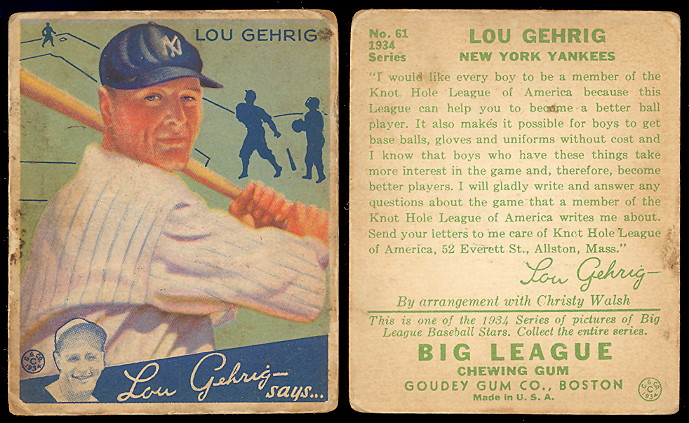
[Lou Gehrig was still five years away from considering himself the luckiest man in baseball when millions of cards just like these found their way into millions of grubby little hands; the cause he's stumping for here, the Knot Hole League, no longer seems to exist, while its mantle has been taken up by the Knothole Gang (which encourages attendance at minor league games by families with preteens) and of course by the Little League.]

193 CE - Roman Emperor Didius Julianus was assassinated just 64 days after succeeding Pertinax, making him the second to serve during the Year of the Five Emperors. He himself was succeeded by Septimius Severus, and I think you can guess how that went...

1215 - Beijing - then under the control of the Jurchen Emperor Xuanzong of Jin - was captured by the Mongols under Genghis Khan, ending the Battle of Beijing.

1283 - Duke Rudolph II of Austria waived his right to the duchies of Austria and Styria under the terms of the Treaty of Rheinfelden.

1495 - Friar John Cor recorded the first known batch of scotch whisky.

1533 - Anne Boleyn was crowned Queen of England in a lavish ceremony at Westminster Abbey.

1660 - Quaker Mary Dyer was hanged for defying a law banning those of her faith from the Massachusetts Bay Colony. Because that's what Jesus would have done.

1779 - During the American Revolutionary War, Benedict Arnold was court-martialed for malfeasance.  From an American perspective, however, the worst was yet to come; the event which made his name synonymous with treason - the so-called Betrayal at West Point - didn't occur until July 1780.

1792 - Kentucky became the 15th US state.

1796 - Tennessee became the 16th US state.

1831 - James Clark Ross discovered the North Magnetic Pole.

1868 - The Treaty of Bosque Redondo was signed at Fort Sumner, allowing the Navajo to return to their lands in Arizona and New Mexico.

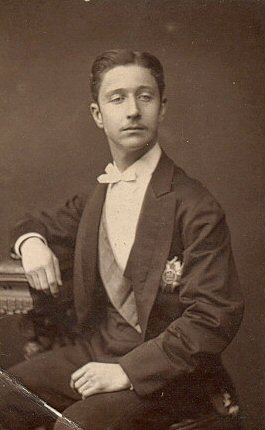
Photobucket1879 - France's Prince Imperial Napoleon Eugene was killed in battle during the Anglo-Zulu War, thwarting any hope the Bonaparte Dynasty might have had about regaining the throne once held by his father, Napoleon III. The only child of the king and his famous consort Eugénie, the young man still referred to as Napoleon IV in monarchist circles, was seemingly dogged by a death wish, having also come under fire during the Franco-Prussian War of 1870-1871. Still, what's an heir in exile to do? Well, he could have married Queen Victoria's youngest daughter, Princess Beatrice, or even the Spanish infanta María del Pilar, daughter of Queen Isabella II... Instead he enrolled in the Royal Military Academy, Woolwich, following which he accepted a commission into the Royal Artillery, and went and got his fool self blasted to bits.

1922 - The Royal Ulster Constabulary was founded, headquartered in Belfast.

1925 - Owing to a change in lineup by New York Yankees manager Miller Huggins, Lou Gehrig took to the field as a pinch hitter for Paul 'Pee Wee' Wanninger, whereupon he proceeded to play the first in a streak of 2,130 consecutive games; at 14 years' duration, it would be the longest such feat of endurance in professional baseball history until it was broken by Cal Ripken Jr. of the Baltimore Orioles in September 1995.

1941 - Battle of Crete - codenamed Unternehmen Merkur, or Operation Mercury - ended as Crete capitulated to Nazi Germany 12 days after the invasion by the 7th Flieger Division began.

Photobucket1943 - British Overseas Airways Corporation Flight 777 was shot down over the Bay of Biscay by 8 German Junkers Ju 88s, killing all 17 passengers and crew aboard, including actor Leslie Howard; almost immediately the crash led to speculation that the aircraft was downed in an attempt to kill British Prime Minister Winston Churchill, but in fact the Luftwaffe may have actually been gunning for Howard, who was not only an effective propaganda tool and Jewish, but may have been a British spy as well. Howard's early death, while cutting his career short, seems to have preserved the films he'd already made - including such beloved cinematic spectacles as Of Human Bondage (1934), The Petrified Forest (1936), and Gone with the Wind (1939) - in a kind of sentimental amber.

1974 - At the so-called Flixborough disaster an explosion at a chemical plant in the north of England killed 28 people.

1980 - Ted Turner's Cable News Network began broadcasting, thus beginning both the 24-hour news cycle and the stupidification of the media continued to this day by such outlets as Fox.

2001 - During the Dolphinarium massacre a Hamas suicide bomber named Hassan Khutari killed 21 people and injured more than 100 at a youth disco in Tel Aviv.
*

share on: facebook

Monday, May 31, 2010

Pop History Moment: The Execution of Adolf Eichmann

Photobucket

On this day in 1962
Adolf Eichmann was hanged at a prison in the Israeli city of Ramla for crimes against humanity he committed during the Second World War, specifically in regards to his role in establishing the concentration camps; his was the only civil execution ever carried out in the beleaguered country, which does not generally use the death penalty.  Eichmann's capture - in Buenos Aires in May 1960 - set off a political firestorm both around the world and in Argentina, where the far-right extremist group Tacuara Nationalist Movement took to the streets with an organized campaign of terrorism in reaction.  Following his execution Eichmann was cremated, and his ashes were scattered in the Mediterranean beyond Israel's territorial limit, in order to ensure that the place of his burial would not become a shrine to neo-Nazis.

Journalist Hannah Arendt wrote dispatches to The New Yorker about Eichmann's trial and execution, which she later compiled into a book, entitled Eichmann in Jerusalem (and which she pointedly subtitled A Report on the Banality of Evil).  Arendt's research revealed no particular anti-Semitism or zeal in Eichmann's personality*, other than a willingness to follow orders; needless to say, her theory regarding the banality of evil remains a controversial one...

*A point disputed by Eichmann scholar David Cesarani.
*

share on: facebook

"Turn The Beat Around" by Vicki Sue Robinson


The disco era seems to have had more than its fair share of one-hit wonders; ah, but what hits they were! It's difficult to explain to people who can't or won't appreciate disco - and I've already expended enough breath in the defense of gay folk music to have inflated a sizable blimp - so I will spare the delicate sensibilities of my readers (not to mention my own lungs) any further rhetoric on my part.

This particular tune is called Turn the Beat Around, and was made famous by Vicki Sue Robinson; for that special camp flavour, the video is slightly out of synch, just like most of the queens who used to sashay this around countless dance floors ten thousand midnights ago. Be thankful, then, that unlike them her dress is on straight, she isn't grinding her teeth, and her makeup isn't visible from space.

Today would have been Ms. Robinson's 56th birthday; alas, she was taken far too soon, dying of cancer in April 2000, just as her career was experiencing a resurgence when disco came back into fashion as part of the retro craze of the mid-1990s. Thanks to modern technology, though, some part of her will always be with us - just like it can be 1976 whenever we want, and in the best possible way as well: in safe, three minute doses.
*
share on: facebook

"O Captain! My Captain!" by Walt Whitman

O CAPTAIN! my Captain, our fearful trip is done,
The ship has weather'd every rack, the prize we sought is won,
The port is near, the bells I hear, the people all exulting,
While follow eyes the steady keel, the vessel grim and daring;
But O heart! heart! heart!
O the bleeding drops of red,
Where on the deck my Captain lies,
Fallen cold and dead.

O Captain! my Captain! rise up and hear the bells;
Rise up--for you the flag is flung--for you the bugle trills,
For you bouquets and ribbon'd wreaths--for you the shores a-crowding,
For you they call, the swaying mass, their eager faces turning;
Here Captain! dear father!
The arm beneath your head!
It is some dream that on the deck,
You've fallen cold and dead.

My Captain does not answer, his lips are pale and still,
My father does not feel my arm, he has no pulse nor will,
The ship is anchor'd safe and sound, its voyage closed and done,
From fearful trip the victor ship comes in with object won;
Exult O shores and ring O bells!
But I with mournful tread,
Walk the deck my Captain lies,
Fallen Cold and Dead.

NOTE: In addition to When Lilacs Last in the Dooryard Bloom'd, Walt Whitman wrote O Captain! My Captain! as an elegy to slain President Abraham Lincoln.
*

share on: facebook

In Memoriam: Walt Whitman

His was the first really American poetry; prior to the self-publication of his masterwork Leaves of Grass by Walt Whitman in 1855, most writers (as was the case with painters and performers of various kinds) still looked to Europe for their inspiration, conventions, and very often their audience as well...

PhotobucketWhitman helped to change all that, by giving his poetry a uniquely American voice; proof that he was really on to something was the criticism his work drew, although it would have been less obvious to cultural workers then than it is now that controversy in one generation usually means acclaim in the next. Certainly, Whitman had many wildly popular contemporaries who are now nearly forgotten (especially among poets) while his own fame - and, more importantly, the fame of his work - endures. Yet for every bluestocking who reviled his verse as obscene, there came to be a growing crowd who rejoiced in it, among the more famous of them Ralph Waldo Emerson. Condemnation, after all, is just a judgemental form of PR.

Born on this day in 1819, as a young man Whitman worked a variety of jobs, frequently on newspapers or in print shops of one kind or another. His affection for and affinity with Nature appears to have developed around this time, but it's impossible to know much about him for sure; as an older man, with his fame fully grown, Whitman cropped, re-arranged, and even outright invented his past to suit his future - even unto frequently contradicting himself - in what can only be considered a deliberate act of obfuscation.

What Whitman was hiding can only be deduced; judging by the tenor of his poetry, it's safe to say that sexual attraction to (and possibly even sexual experiences with) men are likely the principal targets of his personal revisionism. Yet even as he burned diaries and notebooks, he more or less left his poetry intact, despite frequent revisions* to the text as a whole, and for that we can be grateful.

*Between six and nine versions of Leaves of Grass were published, depending on which scholarly account is considered.
*

share on: facebook

"Black Dog" by Led Zeppelin


How better to celebrate the life of John Bonham (born on this day in 1948) than to show him doing what he did best - playing live before a stadium filled with screaming fans...

Black Dog was the first single from Led Zeppelin IV, one of the most successful albums of the rock era; released in 1971 with Misty Mountain Hop as its B-side, the title does not refer to depression (which is occasionally called the Black Dog) but to a Labrador retriever who took up residence in the studio at Headley Grange where the album was recorded. Despite this, the lyrics have nothing to do with a black dog at all, but are merely the product of Robert Plant at his most obtuse.
*
share on: facebook

Remembering... John Bonham

PhotobucketBy the time John Bonham - born on this day in 1948 - received his first drum kit at the age of fifteen he'd already been at it, banging out beats on coffee tins and anything else he could find, for a decade. Without a single lesson, but with an intuitive feel for music, he became the template by which every other rock drummer who came after him would be measured...

Despite his reluctance to join Led Zeppelin, from the first time they played together Bonham (along with bandmates Jimmy Page, Robert Plant, and John Paul Jones) knew they'd captured magic. Over a dozen years and as many albums together - not to mention hundreds of thousands of miles on the road and untold number of shows - they were proven right.

Bonham's tragic death in September 1980 proved to be the death of the band, and for many years they refused all offers to reunite; the surviving members were finally convinced to headline a one-off charity concert in tribute to Ahmet Ertegün at London's O2 Arena in December 2007. On drums was Jason Bonham, son of the late John Bonham; critics and fans alike raved, amazed that the band's power to rock was still intact after so many years apart, and with its once-furiously beating heart having been so successfully transplanted.
*
share on: facebook

In Memoriam: Rainier III

In 1955 Rainier III was an obscure princeling, ruling over a tiny country known mainly to that class of person who owned an ocean-going yacht and could afford to throw tens of thousands of francs every night at a baccarat table; one Cannes Film Festival, one fateful meeting, and two royal weddings later he's the husband of one of the most beautiful and glamourous movie stars of all time, suddenly an international celebrity in his own right, and yet still as obscure as ever.

PhotobucketIt may be because he was naturally reserved; after all, it's a wise monarch who keeps his own counsel. It is not the custom of rulers to give interviews, and so even though he was known to give a few, these were generally short on personal detail and long on extolling the virtues of Monaco as a place to do business. Or it may be that given the circumstances of his family's past he relied on reticence to keep it all under wraps.

Born on this day in 1923, the story of how he came to the throne is a long and convoluted one; the family tree of the House of Grimaldi has many rotten roots, and would not even exist today had it not been for several major grafts over the years. Nevertheless, in 1949 when his grandfather Louis II died, Rainier's legitimized mother Princess Charlotte ceded her succession rights to her son, who became Rainier III.

During the 56 years of his reign, His Serene Highness turned the fortunes of his principality around as surely as if they were on a roulette wheel; from a neglected possession 95% reliant on gambling at the outset, Monaco became a centre of international banking, a tax haven and über-resort whose coffers at the time of his death in April 2005 were only 3% enriched by the casino. Still, for all his business acumen, Rainier never could contain the Grimaldi abandon in his children... His son and heir (the current Albert II) can't seem to stop impregnating women out of wedlock, and his daughters Princess Caroline and Princess Stéphanie seemingly never met a playboy they didn't like, although the former's second marriage - to Stefano Casiraghi - may one day save the realm by providing it an heir.

For all the headaches his children must have provided, the worst day of his reign had to be that terrible day in September 1982 when Princess Grace suffered a stroke while driving, and plunged her Land Rover down a ravine, killing her; his grief was much in evidence at her funeral in Saint Nicholas Cathedral, and despite three decades' worth of tabloid rumours that theirs was more a business arrangement than a marriage, on that day this was a man whose ashen face and defeated posture belied a loss far greater than that of a colleague.

Rainier never remarried; he died in April 2005, aged 81, and was buried next to his beloved...
*
share on: facebook

"It's Like That (That's Just The Way It Is)" by Run-D.M.C.


It's a sad fact of our life here at the Pop Culture Institute that a full half of our traffic comes from approximately five posts; as much as a quarter of it, in fact - by far the largest percentage of any single post - comes as a result of my having rather innocently posted this video on January 21st of 2009, on what would have been the birthday of Jam-Master Jay.

Accordingly, today is Darryl McDaniels' birthday (he's the DMC in Run-D.M.C., dontcha know?) and so here it is again, utterly without apology; I can guarantee you, on Joseph 'Run' Simmons' birthday in November you will see it again, and on and on down through the years. Actually, the song itself has had such an interesting life, I may yet post it a fourth time, in March, on the anniversary of the date it was released.

It's Like That first appeared on Run-D.M.C.'s self-titled debut album in 1984; by the time the video was produced in 1997 the song had been remixed (by DJ Jason Nevins*) into the version you see here. And a decade later still I get between 5 and 15 hits every day because of it - hits from all over the world, not just the hip-hop capitals of New York and LA but Saudi Arabia and Thailand and Slovenia even. In a very real way, I see proof of this song uniting disparate peoples from around the globe every time I log onto Site Meter, making this song the embodiment of what the Pop Culture Institute is trying to achieve.

*I'm still looking into when his birthday is, so I can publish it a fifth time annually. Seriously, I may be a comment whore, but I'll take hits like Hendrix if that's all I get.
*

share on: facebook

POPnews - May 31st

This summary is not available. Please click here to view the post.
share on: facebook

Sunday, May 30, 2010

Pop History Moment: The Lincoln Memorial Was Dedicated

Photo Sharing and Video Hosting at Photobucket

On this day in 1922 the Lincoln Memorial - which had been designed by Henry Bacon after the Temple of Zeus at Olympia - was dedicated in Washington, DC; the sculptor on the project was Daniel Chester French, and the interior murals were executed by Jules Guerin. The Lincoln Memorial's position offers it sweeping views of both the National Mall and the Potomac River, and it shares the opposite view of the Reflecting Pool from the Washington Monument. Within are engraved the words of the Gettysburg Address and Lincoln's second inaugural address.

So much more than merely a monument to the 16th President of the United States, the Lincoln Memorial is also a powerful sigil; it's image appears - pointedly, in my opinion - on the reverse of America's only brown money (the penny*), and at times of crisis Americans** have gone to find solace there, especially during the Civil Rights Movement. Both Marian Anderson and Martin Luther King, Jr. at different times appeared with the soaring pillars and monumental statue of the Great Emancipator behind them to remind their country of the promise of freedom made by him, the same promise which cost Lincoln his life.

Ironically, the memorial to one of the greatest Presidents was dedicated during the Administration of one of the worst - Warren G. Harding - although thankfully he didn't attend the dedication ceremony, which was handled by former President and then-Chief Justice of the Supreme Court William Howard Taft; in the crowd that day was the only surviving child of President Abraham Lincoln and First Lady Mary Todd Lincoln, Robert Todd Lincoln.

*Not to mention its 21st Century equivalent, the $5 bill.
**Particularly those of the penny-coloured persuasion.
*

share on: facebook

POPnews - May 30th

Photobucket
[A somewhat smaller version of Tsao Tsing-yuan's Goddess of Democracy lives on in the beautifully landscaped grounds of the University of British Columbia in Vancouver, having been erected there by that institution's Alma Mater Society; it was built in honour of the one which temporarily resided in Beijing's Tiananmen Square during the nascent pro-democracy movement which tried to emerge in China in 1989 and which Chinese officials brutally quashed, then spent the next twenty years attempting to expunge from the historical record. Similar replicas exist in Hong Kong's Victoria Park, in Portsmouth Square in San Francisco's Chinatown, on the grounds of the campus of York University in Toronto, at the University of Calgary, at Freedom Park in Arlington, and at the Victims of Communism Memorial in Washington, DC.]

1416 - The Council of Constance, called by the Holy Roman Emperor Sigismund - a supporter of Antipope John XXIII - ordered Jerome of Prague burned at the stake following his trial for heresy. Because that's what Jesus would have done.

1431 - 19-year-old Joan of Arc was burned at the stake in Rouen.

1434 - At the end of the Hussite Wars, during the Battle of Lipany, Utraquist forces led by Diviš Bořek of Miletínek defeated and almost annihilated the Taborite forces of Prokop the Great. I have no idea what it means, but I just loved typing it...

1536 - England's King Henry VIII married Jane Seymour, who had previously been a lady-in-waiting to his first two wives, the cast-off Katherine of Aragon and the now-headless Anne Boleyn.

1574 - Henri III became King of France following the death of his brother Charles IX.

1635 - Following the Thirty Years' War the Peace of Prague was signed.

1806 - Andrew Jackson (the future 7th President of the United States) killed Charles Dickinson in a duel after he'd accused Jackson's wife Rachel Donelson Robards Jackson of bigamy - an accusation which may, in fact, have been technically accurate. Dickinson was the only man Jackson ever managed to kill, despite his having taken part in 13 duels; he was himself hit in the ribs, but made a speedy recovery and, despite being 39 years old at the time, in fact lived another 40 years.

1814 - At the end of the War of the Sixth Coalition the Treaty of Paris was signed, returning French borders to their 1792 extent, where they were prior to the Napoleonic Wars.

1854 - The Kansas-Nebraska Act became law, establishing (oddly enough) the US territories of Nebraska and Kansas in addition to repealing the Missouri Compromise of 1820.

1876 - Abd-ul-Aziz, sultan of the Ottoman Empire, was deposed and succeeded by his nephew Murat V.

1883 - A rumor that the Brooklyn Bridge was about to collapse caused a stampede which led to the  trampling deaths of twelve people.

1911 - At the Indianapolis Motor Speedway, the first Indianapolis 500 ended with Ray Harroun in his Marmon Wasp becoming the first winner of the 500-mile auto race.

1914 - The new and then-largest Cunard ocean liner RMS Aquitania - displacing 45,647 tons - sailed on her maiden voyage from Liverpool to New York City.

1922 - The Lincoln Memorial was dedicated by former President and then-current Supreme Court Chief Justice William Howard Taft.

1948 - A dike along the flooding Columbia River in Oregon broke, obliterating the town of Vanport within minutes; in all fifteen people died and tens of thousands were left homeless.

1953 - New Zealand's Auckland Harbour Bridge was officially opened by Prime Minister Sidney Holland, joining Saint Marys Bay to Northcote.

1971 - The Mariner program's Mariner 9 was launched to map 70% of the surface of Mars, and to study temporal changes in the atmosphere and surface of the planet.

1972 - The Angry Brigade went on trial over a series of 25 bombings throughout Britain.

1989 - The 33-foot high Goddess of Democracy statue was unveiled in Beijing's Tiananmen Square by student demonstrators during a well-publicized series of pro-democracy protests there.
*
share on: facebook