Friday, June 18, 2010

POPnews - June 18th

Photobucket
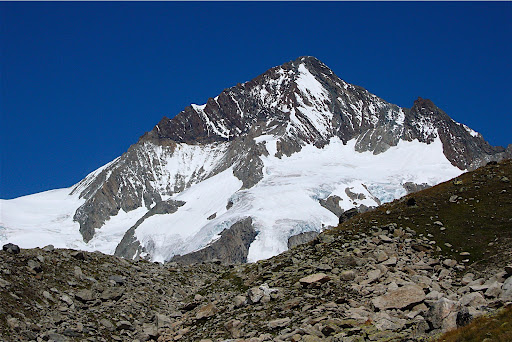
[Named for the Aletsch Glacier located at its base, the Aletschhorn is less well-known by climbers than its neighbours to the north, Jungfrau and Eiger; the latter even features in a book, The Eiger Sanction, which became a film.  Alas, there's no such book-cum-movie called The Aletsch Sanction...  And by 'alas' I mean 'not alas'.]

618 CE - Li Yuan became Emperor Gaozu of Tang, initiating three centuries of Tang Dynasty rule over China; so influential was his reign that to this day there are still men who willingly allow themselves to be governed entirely by 'tang...

1178 - As reported by the chronicler Gervase, five monks at the abbey of Canterbury Cathedral saw what was in all likelihood the Giordano Bruno crater being formed, while star-gazing during that year's Taurid meteor shower; the theory was first posited by geologist Jack B. Hartung in 1976.

1264 - The Parliament of Ireland met at Castledermot in County Kildare, which is the first definitively known meeting of this legislative body.

1429 - French forces under the leadership of Joan of Arc defeated the main English army under Sir John Fastolf at the Battle of Patay, which turned the tide of the Hundred Years' War in favour of the French.

1767 - Samuel Wallis - an English sea captain at the helm of HMS Dolphin - sighted Tahiti; he is considered the first European to reach the island.

1812 - The US Congress declared war on Great Britain, a war which became known as the War of 1812.

1815 - At the very end of the Napoleonic Wars a decisive military defeat by Britain's Duke of Wellington and Prussia's Gebhard von Blücher at the Battle of Waterloo led to the abdication of Napoleon Bonaparte for the second and final time, as well as his exile on the remote island of Saint Helena.

1859 - The first ascent of Aletschhorn - the second-tallest summit in the Bernese Alps, after the Finsteraarhorn - was made by Francis Fox Tuckett, J. J. Bennen, V. Tairraz and Peter Bohren. While at the summit, Tuckett made a series of scientific measurements.

1887 - Germany and Russia signed the Reinsurance Treaty.

1900 - China's Empress Dowager Longyu ordered all foreigners killed, including foreign diplomats and their families, in support of the Boxer Rebellion.

1908 - The University of the Philippines was established.

1940 - The Appeal of June 18 by Charles de Gaulle, leader of the Free French Forces, led to the establishment of the French Resistance.

1953 - Following the Egyptian Revolution of 1952 the monarchy of King Farouk I was abolished and the Republic of Egypt was declared by the Revolution Command Council; serving as the country's first president was General Muhammad Naguib.

1954 - Pierre Mendès-France became Prime Minister of France.

1972 - 118 people were killed when their plane crashed less than 3 minutes after take off from London Heathrow Airport while en route to Brussels; the Staines air disaster would remain Britain's worst until the loss of Pan Am Flight 103 over Lockerbie just days before Christmas 1988.

1979 - The second Strategic Arms Limitation Treaty - or SALT II - was signed by US President Jimmy Carter and the Soviet Union's Leonid Brezhnev.

1983 - Astronaut Sally Ride became the first American woman in space on board NASA's STS-7 Space Shuttle mission.

1984 - A major clash between about 5,000 police and a similar number of miners took place at Orgreave, South Yorkshire, during the UK miners' strike of 1984-5; the incident later became known as the Battle of Orgreave. Not only was it mentioned in a Dire Straits song, Iron Hand, from the band's 1991 sixth and final album On Every Street, it was given a historical re-enactment in 2001, which was itself filmed by Mike Figgis for inclusion in a documentary on the strike by Britain's Channel 4.

2006 - Kazakhstan's first satellite, KazSat, was launched.
*
share on: facebook

Thursday, June 17, 2010

In Memoriam: Carl Van Vechten

I've long been of two minds when it comes to Carl Van Vechten...

Photo Sharing and Video Hosting at PhotobucketOn the one hand he's a towering figure of American letters, alerting his downtown (read: white) friends to the great literary and artistic goings-on uptown during the Harlem Renaissance of the 1920s of which they might have otherwise remained ignorant; he was also a well-respected novelist and photographer who incidentally served as the literary executor of Gertrude Stein, thus bringing her mammoth unpublished works into print, even if it was posthumously.

Yet there is a hint of the patronizing in his view of the blacks he made such a show of supporting. I say hint because I'm white myself; obviously, there are blacks who might find his hint more like a holler.

In 1926, Van Vechten published his most famous work, N-word Heaven (although, obviously, he didn't use N-word). Reaction to it at the time was mixed: some white critics denounced his use of the word while some black critics loved the book and didn't even mention the use of the word.

Born on this day in 1880, Van Vechten died in December 1964.
*

share on: facebook

Rudolf Nureyev Meets Miss Piggy At The Baths


Here Miss Piggy demonstrates the art of the low-key courtship; actually, compared to me she's downright subtle. Holy maracas!

Upon meeting Rudolf Nureyev in the steam room - wearing a towel that's much too large for him, in my opinion - and exchanging a little racy (if one-sided) banter, the pair launch into a spirited rendition of that classic song of seduction Baby It's Cold Outside in Episode 213 of The Muppet Show, even though Piggy's attempts are a little, uh, ham-handed.

Naturally Season Two of The Muppet Show - that entertainment staple of the Pop Culture Institute - including this and many other golden moments, is available fully restored and remastered (and containing footage never before seen in North America) on DVD.
*
share on: facebook

Pop History Moment: The Defection of Rudolf Nureyev

PhotobucketOn this day in 1961 Russian-born ballet dancer Rudolf Nureyev defected at Le Bourget Airport in Paris, slipping away from embassy guards and dashing through a security barrier, exclaiming to nearby gendarmes: I want to be free.

Rudi's nocturnal activities in the bohemian underworlds of Moscow and St. Petersburg had come to the attention of the KGB, so when the Kirov Ballet's principal male dancer Konstantin Sergeyev injured himself, Nureyev used his own ballet training to leap at the chance to replace him on an international tour.

As the first major cultural figure to choose exile over life in the Soviet Union, Nureyev's defection was big news around the world in those dark days at the height of the Cold War, exactly the kind of notoriety the Grand Ballet du Marquis de Cuevas was looking for; within a week he became the principal dancer of that company, performing The Sleeping Beauty with Nina Vyroubova.

For those he left behind, though, the situation was quite different; their friendship with the star put them under a cloud of suspicion, and not even Nureyev's own mother escaped unscathed. They wouldn't meet again until Mikhail Gorbachev consented to let him return in 1989, when she was dying.
*
share on: facebook

Happy Birthday Ken Livingstone

Photo Sharing and Video Hosting at PhotobucketLondon's first Mr. (rather than Lord) Mayor, sometimes affectionately known as 'Red Ken' (and sometimes not), Ken Livingstone could never be accused of subtlety.

Personally, I think politics could use a few more plain-speaking people. You may not always agree with a loudmouth, but at least you know he's being sincere.

Alas, Londoners no longer have Red Ken to kick around; at the last election they chose instead to lead them that paragon of buffoonery, Boris Johnson.

(This should go well...)
*
share on: facebook

Remembering... Kate Smith


In what is truly one of the weirdest pieces of film I've ever seen Cher, Tina Turner, and Kate Smith sing a Beatles medley which even John, Paul, George, and Ringo must have found trippy; as if the rainbow sets and Cousin Itt dresses - dresses seemingly made entirely of fringe! - weren't enough, there's a cameo by Tim Conway to make it even more surreal.

Kate Smith died on this day in 1986, but surely some little part of her must have died on the day this was taped - even if it was only her dignity. (Although, to be fair, no one rocks the asymmetrical bouffant with a brooch in it like our gal Kate.)

File this one at the bottom of the 'What Were They Thinking' folder, beneath Kate Hudson's performance in The Four Feathers and Squinty McCokeface's ill-considered marriage to down-home down low Kenny Chesney.
*
share on: facebook

POPnews - June 17th

Photobucket
[The Taj Mahal is a prime example of Mughal architecture, and its over-the-top opulence is nothing compared to the ornate and enduring love that seems to have inspired it. History has conveniently erased almost everything that was once known about the woman whose tomb this is, but here is written in stone and tile a biography of one who clearly earned the sobriquet 'beloved ornament of the palace'.]

1462 - During the so-called Night Attack Vlad III the Impaler attempted to assassinate Ottoman Emperor Mehmed II, forcing him to retreat from Wallachia.

1497 - At the Battle of Deptford Bridge near London forces led by England's King Henry VII soundly defeated the rag-tag militia of blacksmith Michael An Gof, thereby effectively ending the Cornish Rebellion.

1565 - Matsunaga Hisahide assassinated the 13th Ashikaga shogun, Ashikaga Yoshiteru.

1631
- When Mumtaz Mahal died giving birth to their fourteenth child, Gauhara Begum, her dying wish prompted her grieving husband Shah Jahan to spend the next 20 years building the Taj Mahal as a tomb worthy both of her memory and their love.

1775 - During the Siege of Boston at the outset of the American Revolution, the Battle of Bunker Hill - which actually took place on Breed's Hill - pitted American general Israel Putnam against Britain's William Howe; technically an American loss, Howe was able to claim a Pyhrric victory at best, since he was the only one of his field staff who wasn't shot.

1885 - The Statue of Liberty arrived in New York Harbor packed in 214 boxes on board the French frigate Isère, although she wouldn't be formally dedicated by President Grover Cleveland until October 1886, as fund-raising efforts to provide her with a suitable pedestal foundered.

1898 - The United States Navy Hospital Corps was established.

1930 - President Herbert Hoover signed the rabidly protectionist Smoot-Hawley Tariff Act into law, thereby turning a temporary downturn caused by the Crash of 1929 into the decade-long Great Depression. Smoove move Hoove...

1932 - The so-called Bonus Army comprised of around a thousand First World War veterans amassed at the United States Capitol as the US Senate was deliberating a bill that would give them certain benefits such as pensions.

1933 - Four FBI agents and captured fugitive Frank Nash were gunned down by gangsters Charles 'Pretty Boy' Floyd, Vernon Miller, and Adam Richetti - who were attempting to free Nash from federal custody - during the Union Station Massacre in Kansas City, Missouri; the whole story is thrillingly told in Bryan Burroughs' riveting book Public Enemies - soon to be a major motion picture starring Johnny Depp!

1939 - At the last public guillotining in French history, convicted murderer Eugen Weidmann lost his head outside the Saint-Pierre prison near Versailles; the guillotine would still be used in private executions until September 1977, when it would be Hamida Djandoubi's turn to become the answer to an awesome Trivial Pursuit question.

1940 - The Baltic States - Estonia, Lithuania, and Latvia - fell under Soviet occupation, where they would remain until their independence was recognized by Russia in September 1991.

1944 - Iceland gained its independence from Denmark, following a plebiscite; the new republic's first president was Sveinn Björnsson. Previously the island dependency had been granted Home Rule in 1874, which was expanded in 1904; latterly, an Act of Union (passed in December 1918) gave Iceland full independence under the Danish crown. It was the Second World War, though - more specifically Denmark's occupation by Germany (not to mention Iceland's occupation by Great Britain) - that gave the country's independence movement its final burst of speed.

1953 - In order to quell the Workers Uprising in East Germany, the Soviet Union ordered units of the GSFG and Volkspolizei into East Berlin.

1958 - The Ironworkers Memorial Second Narrows Crossing being built to connect Vancouver with North Vancouver collapsed into the Burrard Inlet, killing many of the ironworkers on it and injuring others; the collapse was later deemed to be due to human error, the human in question being an engineer who was one of those who died.

1961 - Canada's New Democratic Party was founded following a merger by the Co-operative Commonwealth Federation and the Canadian Labour Congress.

1963 - The US Supreme Court ruled 8 to 1 against in the case of Abington School District v. Schempp, disallowing the reciting of Bible verses and the Lord's Prayer in public schools; the dissenting opinion was offered by that lovable kook Potter Stewart.

Photobucket1987 - With the death of the last individual - a male named Orange Band, who lived to the grand old age of eight at Walt Disney World Resort's Discovery Island nature preserve - Florida's Dusky Seaside Sparrow became extinct. Native to the natural salt marshes of Merritt Island and along the St. John's River, it's foe was the usual suspect of DDT - sprayed no doubt due to the rampant spread of ugly subdivisions with their contempt for the natural world. The species was officially declared extinct in December 1990.

1994 - Following a well-televised low-speed highway chase and a failed attempt at suicide so unconvincing it wouldn't have fooled Helen Keller, O.J. Simpson was arrested for the murders of his wife, Nicole Brown Simpson, and her friend Ronald Goldman.
*
share on: facebook

Wednesday, June 16, 2010

In Memoriam: Geronimo

Photo Sharing and Video Hosting at Photobucket

It seems that the good old Skull and Bones society at Yale - you know, Dubya's old drinking and coking and whoring buddies - regularly desecrate the remains of the Chiricahua Apache leader Geronimo, born on this day in 1829; reportedly, it is his skull they kiss during their initiation.

Of course, it's all just a rumour; just because the skull was stolen from Geronimo's grave at Fort Sill in 1918 - and just because it happened on Prescott Bush's watch - is a meaningless coincidence of the sort members of the Bush family have always worked mightily to erase from the public consciousness.
*
share on: facebook

Pop History Moment: The Assassination of Nikolai Bobrikov

Photo Sharing and Video Hosting at PhotobucketOn this day in 1904 Finnish nationalist Eugen Schauman (shown, at right) assassinated Nikolai Bobrikov, the Russian Governor-General of Finland.

What makes this particular event notable for our purposes - apart from its utter obscurity - is the fact that it's mentioned in the 1922 novel Ulysses by James Joyce; being so noted in a hugely influential novel makes this obscure killing legitimately pop.

The novel takes place on this day in 1904, the same day as the killing; fortunately for him Leopold Bloom has an airtight alibi.
*
share on: facebook

What's The Occasion? Bloomsday!

Bloomsday is the day in 1904 described in James Joyce's acclaimed novel Ulysses; as it happens, this day in 1904 turned out to be a most extraordinary day indeed for Leopold Bloom and his soon-to-be fiancee Nora Barnacle as they perambulated into and around South Dublin's Ringsend neighbourhood (which was then a separate village).

Photo Sharing and Video Hosting at PhotobucketYeah... I've still never read it. But I will, I swear. It's been right at the top of my read queue for several years now, staring at me with its phone book thickness, enticing me with the writerly cred I stand to gain by actually being one of the few to slog through it.

See, it's one of those things, like Waiting for Godot; listening to people rave about the thing for years kind of has me spooked that it'll never live up to the hype. I imagine it's how those poor PC people feel about Macs; I mean why else would you cling to some ugly out-moded piece of crap that doesn't work? I can only hope that, when I finally get down to reading it, Ulysses is as amazing as any of the Macs I've owned.

Still, whether you've read the book or not, today is the day to be in Dublin, as the city comes alive(r) with pub crawls and public readings to honour one of its favoured sons and his landmark work of Modernist literature. The event has been growing in popularity every year since it was first held in 1954; many of the events are sponsored by the James Joyce Centre.
*
share on: facebook

"Talk Of The Town" by The Pretenders


Musically The Pretenders have always alternated between punkish hardness and wistful sentiment; whereas Bad Boys Get Spanked would be a prime example of the former this, then, would be one of the foremost (and first) examples of the latter. Released on both of the band's 1981 albums, Extended Play and Pretenders II, Talk of the Town features some of guitar god James Honeyman-Scott's finest early work*; the video shows the band performing the song on Top of the Pops in 1980.

Honeyman-Scott (known as 'Jimmy') died on this day in 1982**, but not before successfully recruiting his eventual successor - Robbie McIntosh - at a band meeting two days before his death; at the same meeting founding band member Pete Farndon was famously dismissed for his rampant drug use. Farndon died ten months after his best mate Jimmy, leaving fellow founder Martin Chambers and later addition Chrissie Hynde to carry on without them.

*Although, given that he died at the age of only 25, all his work could be said to be early work.
**
Echoes of Jimmy's work have reverberated through rock and pop music ever since, and can be heard in the jangly genius of Johnny Marr, among other places.
*

share on: facebook

POPnews - June 16th

Photobucket
[Fortress Louisbourg was a ruin when, in 1961, the reconstruction of about one-quarter of the site was undertaken at the behest of Victor Malm; with as many of its original stones as possible, and availing themselves of the labour of unemployed coal miners who were specially trained in 18th Century building techniques, the archaeologists, historians, engineers, and architects responsible for one of Canada's most popular National Historic Sites have managed to plausibly recreate what fort life must have been like in Colonial Cape Breton Island in the 1740s.]

1487 - The Battle of Stoke Field - considered the final battle of the Wars of the Roses - pitted the Yorkist forces of the pretender Lambert Simnel under John de la Pole, Earl of Lincoln (who died in battle on that day) against those of the Lancastrian usurper Henry VII.

1745 - Sir William Pepperell captured Nova Scotia's French-held Fortress Louisbourg during the War of the Austrian Succession.

1755 - The French surrender to the British at New Brunswick's Fort Beauséjour during the French and Indian War would eventually lead to the expulsion of the Acadians from Nova Scotia - a time in Canadian history known as the Great Upheaval.

1858 - Abraham Lincoln delivers his House Divided speech in Springfield, Illinois.

1883 - At the Victoria Hall Disaster 183 children were crushed or trampled to death during a stampede at a theatre in Sunderland.

1891 - John Abbott became Canada's third prime minister.

1897 - A treaty annexing the Republic of Hawai'i to the United States, was signed, although the Republic would not be dissolved until a year later, when - under the terms of the Newlands Resolution - it became the Territory of Hawai'i.

1903 - The Ford Motor Company was incorporated.

1904 - Irish author James Joyce began a relationship with Nora Barnacle, and subsequently used the date to set the actions for his 1922 novel Ulysses; in the literary world - and especially in Dublin - today is traditionally regarded as Bloomsday.

1911 - A stony meteorite weighing 772 grams fell to Earth near the Wisconsin town of Kilbourn, damaging a barn.

1924 - China's Whampoa Military Academy was founded.

1958 - Imre Nagy, Pál Maléter and other leaders of 1956's Hungarian Uprising were executed.

1963 - On the Soviet Union's Vostok 6 mission, cosmonaut Valentina Tereshkova became the first woman in space.

1967 - The three-day Monterey International Pop Music Festival began in Monterey, California.

1976 - The Soweto Uprising - initially a non-violent march by 15,000 students in the Johannesburg township of Soweto - turned into days of rioting when police opened fire on the crowd, killing 566; the anniversary of the massacre is now commemorated as Youth Day in South Africa.

1977 - Oracle Corporation was incorporated by Larry Ellison, Bob Miner, and Ed Oates as Software Development Laboratories (SDL) in Redwood Shores, California.

1989 - Imre Nagy, the former Hungarian Prime Minister, was reburied in Budapest - 31 years to the day after his death.

1997 - At the Dairat Labguer massacre in Algeria, 50 people were killed by some 30 guerrillas; the massacre has been attributed to Islamist groups such as the GIA.

2008 - On the first day they were allowed to marry in California, many gay couples tied the knot throughout the state; despite the fact that their marriages were later ruled invalid by the passage of Proposition 8, their relationships remained intact - no doubt much to the chagrin of the haters responsible for denying as many as 18,000 couples their civil rights.
*
share on: facebook

Tuesday, June 15, 2010

In Memoriam: Saul Steinberg

Photo Sharing and Video Hosting at Photobucket

In his most famous work - the March 29th, 1976, cover of The New Yorker (sometimes called View of the World or some derivation thereof) - Saul Steinberg both celebrates and chides the supposedly sophisticated Manhattanite's parochial view of the rest of the world. It was quite a bold statement to make in the Bicentennial Year, but if it offended any New Yorkers they refused to show it. The image was a best-selling poster for many years, and not just in the city itself either, but in that emotional diaspora which mysteriously exists even in the hearts of those who've never been there*.

And to think - it almost never came to be; born on this day in 1914, Steinberg's entry to the United States in 1942 was sponsored by the magazine that would be his home for the bulk of his professional life. Had founding editor Harold Ross not been successful, the man and all of his talent would likely have perished in the furnaces of Fascism.

The 85 covers and over 1200 drawings Saul Steinberg crafted for The New Yorker are elegance and simplicity themselves, confections made richer by a considerable dollop of wit; his distinctive style features strong inked lines and surreal visual elements, indicative of the man's redoubtable good nature and unique perspective on the world. Enjoy them all (and many, MANY more) in The Complete Cartoons of The New Yorker, edited by Robert Mankoff and featuring all 70,000+ cartoons, doodles, scribbles, and scratchings published in the pages of the magazine between 1925 and 2006.

*Although for the life of me I can't think of anyone I know who's like that. Nope... Not one.
*

share on: facebook

"Spaceman" by Bif Naked


Taken from Bif Naked's second studio album, 1998's I Bificus, Spaceman concerns a young woman recalling a childhood encounter with an extra-terrestrial; the song made it all the way to #2 on the Canadian charts, the album as much as its single establishing Bif's cred in her adoptive country, which is proud to call her its own.
*
share on: facebook

Pop History Moment: The Signing of Magna Carta

On this day in 1215, England's unpopular King John was forced to sign Magna Carta by what can best be described as a passel* of disaffected nobles; the document was affixed with the Great Seal in a meadow at Runnymede, outside London. Said to be the first piece of legislation designed to curb the powers of a monarch, it is today considered the basis of English common law and is symbolically the load-bearing wall of the British Constitution, even though it was copied almost verbatim from the earlier Charter of Liberties, issued by Henry I in 1100**.

Photo Sharing and Video Hosting at PhotobucketIts preamble - to be followed by 63 fun-filled clauses - reads: JOHN, by the grace of God King of England, Lord of Ireland, Duke of Normandy and Aquitaine, and Count of Anjou, to his archbishops, bishops, abbots, earls, barons, justices, foresters, sheriffs, stewards, servants, and to all his officials and loyal subjects, Greeting.

The document was signed by many prominent nobles and clergymen thusly:

KNOW THAT BEFORE GOD, for the health of our soul and those of our ancestors and heirs, to the honour of God, the exaltation of the holy Church, and the better ordering of our kingdom, at the advice of our reverend fathers Stephen, archbishop of Canterbury, primate of all England, and cardinal of the holy Roman Church, Henry archbishop of Dublin, William bishop of London, Peter bishop of Winchester, Jocelin bishop of Bath and Glastonbury, Hugh bishop of Lincoln, Walter Bishop of Worcester, William bishop of Coventry, Benedict bishop of Rochester, Master Pandulf subdeacon and member of the papal household, Brother Aymeric master of the knighthood of the Temple in England, William Marshal earl of Pembroke, William earl of Salisbury, William earl of Warren, William earl of Arundel, Alan de Galloway constable of Scotland, Warin Fitz Gerald, Peter Fitz Herbert, Hubert de Burgh seneschal of Poitou, Hugh de Neville, Matthew Fitz Herbert, Thomas Basset, Alan Basset, Philip Daubeny, Robert de Roppeley, John Marshal, John Fitz Hugh, and other loyal subjects...


Clearly, the whole 'separation of church and state' thing came later; in fact, any day now...

*If you know a better collective noun for a whole bunch of riled up aristocrats, feel free to suggest one...
**Also, the version still on the books in England and Wales isn't the one signed on this day at all, but one reaffirmed by Edward I in 1297.
*

share on: facebook

Duke Ellington's "Don't Get Around Much Anymore" by Ella Fitzgerald


When Ella Fitzgerald made her singing debut in November 1934 not even she could have known when she died - on this day in 1996, three years after her retirement - that her career would one day span 57 years, surviving and even thriving despite the vagaries of various culture wars and an increasingly capricious audience; when she stepped out onto the stage of Harlem's famed Apollo Theater on that fateful night all she wanted to do was dance. Intimidated by a previous dance act - the Edwards Sisters - Ella decided to sing instead; the rest, as we like to say around here, is pop culture...

Here she is, joined on piano by her fellow legend Duke Ellington, from a television special circa 1968; the song is one of his all-time classics, Don't Get Around Much Anymore*. In total, Ella and Duke recorded two live (Ella and Duke at the Cote D'Azur and The Stockholm Concert - both 1966) and two studio (1957's The Duke Ellington Songbook and 1967's Ella at Duke's Place) albums together, and this clip demonstrates the total ease with which they worked together.

*Also known as Never No Lament; lyrics by Bob Russell.
*

share on: facebook

POPnews (US) - June 15th

Photobucket
[Arlington House - formerly the estate of the family of Robert E. Lee and his wife Mary Anna Lee (nee Custis, a descendant of Martha Washington) - was seized by the US government in 1864, which claimed that taxes hadn't been paid on it; it was then decided to bury the Union dead on its grounds to ensure that Lee would never return there to live. While neither General Lee nor his wife ever sued for the return of their property their eldest son Custis Lee did; despite $26,800 having already been paid for the property, after having the land returned to him in 1877 Lee turned around and sold it to the US government for a tidy profit - $150,000! The Greek Revival mansion with its views of the Potomac River and the National Mall is now the centerpiece of an idyllic tribute to the country's most illustrious dead, including President John F. Kennedy, and even serves as a memorial to Robert E. Lee himself.]

1752 - Benjamin Franklin proved that lightning is electricity. 

1775 - George Washington was appointed commander-in-chief of the Continental Army. 

1804 - New Hampshire approved the Twelfth Amendment to the US Constitution, thereby ratifying it.

1836 - Arkansas became the 25th US state.

1846 - The Oregon Treaty established the 49th parallel as the border between the United States and Canada, from the Rocky Mountains to the Strait of Juan de Fuca.

1859 - Due to an ambiguity in the Oregon Treaty concerning the ownership of the San Juan Islands the 'Northwestern Boundary Dispute' - more colourfully known as the Pig War - erupted between American and British Columbian settlers on the treaty's 13th anniversary.

1864 - Arlington National Cemetery was established when 200 acres (0.8 km²) around Arlington House - formerly owned by Confederate general Robert E. Lee - were officially set aside for that use by US Secretary of War Edwin M. Stanton.

1867 - The Atlantic Cable Quartz Lode gold mine was located in Deer Lodge County, Montana.

1877 - Henry Ossian Flipper became the first African-American cadet to graduate from the United States Military Academy at West Point.

1904 - A fire aboard the steamboat General Slocum in New York City's East River killed more than 1000.

1920 - Three black employees of the James Robinson Circus - Elias Clayton, Elmer Jackson, and Isaac McGhie - were lynched in Duluth, Minnesota - not only for a crime they didn't commit but for a crime that was never committed by anyone; needless to say, no one was ever convicted for the very real crimes which actually were committed that night, although three men were later sent up to Stillwater State Prison for rioting. A nine-year-old boy named Abram Zimmerman witnessed the murders and eventually passed the memory onto his son, who in 1965 wrote a song about the event entitled Desolation Row. The city took nearly 40 years more to finally build its own tribute to the victims; when it was unveiled in October 2003, though, the Clayton Jackson McGhie Memorial became the largest anti-lynching monument in the United States.

1934 - The Great Smoky Mountains National Park - on the border between Tennessee and North Carolina - was established by President Franklin Delano Roosevelt.

1978 - Jordan's King Hussein married American Lisa Halaby, who took the name Noor-al-Hussein, or 'light of Hussein'.
*
share on: facebook

POPnews - June 15th

Photobucket
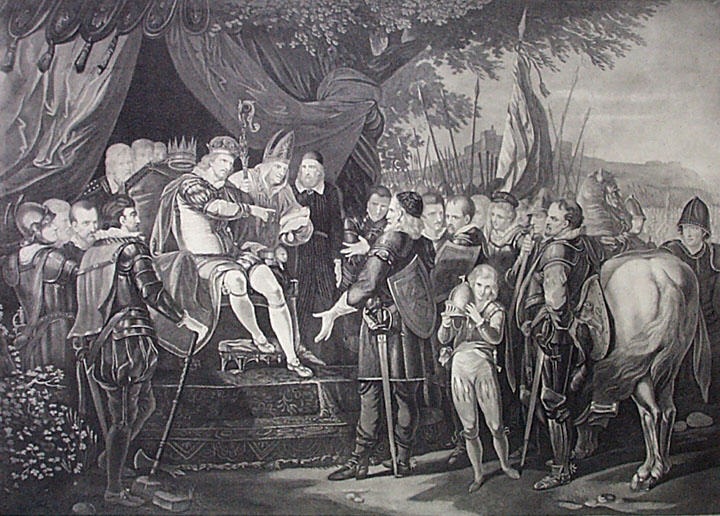
[The above scene of King John signing the Magna Carta was engraved by William Ryland after a picture by 18th Century neo-classicist painter John Hamilton Mortimer, whose romanticism was often wrought at the expense of accuracy; upon embiggening, please observe Exhibit A: a portrait of His Majesty looking altogether more handsome than he actually did in real life.]

923 CE - At the Battle of Soissons France's King Robert I was killed (legend has it by the usurper King Charles III himself); the so-called Charles the Simple was later arrested and imprisoned by Rudolph, Duke of Burgundy, who himself became king.

1184 - Norway's King Magnus V was killed at the Battle of Fimreite.

1215 - King John of England put his seal to the Magna Carta at the Thames-side meadow of Runnymede in order to thwart a rebellion by his aristocracy.

1219 - According to legend Dannebrog - the flag of Denmark and the oldest national flag in the world - fell from the sky during the Battle of Lyndanisse near Estonia's Toompea Castle, turning the Danes' luck.

1246 - With the death of Duke Frederick II, Austria's Babenberg dynasty ended.

1520 - Pope Leo X threatened to excommunicate Martin Luther in a papal bull entitled Exsurge Domine.

1667 - The first human blood transfusion was administered by Dr. Jean-Baptiste Denys.

1785 - Jean-François Pilâtre de Rozier - co-pilot of the first-ever manned flight - and his companion, Pierre Romain, became the first-ever casualties of an air crash when their hot air balloon exploded during an attempt to cross the English Channel.

1888 - Germany's Crown Prince Wilhelm became Kaiser Wilhelm II following the death of his father Frederick III, making him third in the so-called Year of Three Emperors; he was also to be the last emperor of the German Empire.

1905 - Britain's Princess Margaret of Connaught married Gustav, Crown Prince of Sweden.

1913 - The Battle of Bud Bagsak in the Philippines concluded with a decisive US victory for General John 'Black Jack' Pershing over the Moro Rebellion.

1919 - John Alcock and Arthur Brown completed the first nonstop transatlantic flight at Clifden, in Ireland's County Galway.

1944 - In Saskatchewan, the CCF Party of Tommy Douglas was elected, forming North America's first socialist government.

1945 - The General Dutch Youth League (ANJV) was founded in Amsterdam.

1954 - The UEFA (Union des Associations Européennes de Football) was formed in Basle, Switzerland.

1978 - Jordan's King Hussein married American Lisa Halaby, who took the name Queen Noor; at the time of their meeting Halaby - an architect and urban planner - was working on the Jordanian capital's Amman Intercontinental Airport.

1985 - Rembrandt's painting Danaë was attacked at St. Petersburg's Hermitage Museum by a man later judged insane, who threw sulfuric acid on the canvas and cut it twice with his knife. Restoration of the eight by ten foot masterpiece took nearly 12 years.

1991 - The first federal political party in Canada that supported Quebec nationalism, the Bloc Québécois, was founded by former Conservative MP Lucien Bouchard.

1996 - A terrorist bomb in the UK injured over 200 people and devastated a large part of Manchester's city centre.
*
share on: facebook

Monday, June 14, 2010

"Do You Really Want To Hurt Me" by Culture Club


Part of the appeal of Culture Club to little 12 year-old me was the fact that Boy George used to drive my father crazy; we'd been rocking out to this song on the radio for months before he finally saw a picture of the Boy, at which point my father's full-on closet-case hypocrisy revealed itself for what it was. Fortunately it happened in the TV room and not on the highway.

Do You Really Want to Hurt Me? was a huge smash all over the world, propelling the band to stardom and their debut album, Kissing to Be Clever, along with them; fame being what it is - namely a hideous bitch goddess - the band's success proved to be its undoing, not that the inevitable descent into tabloid ignominy wasn't as hugely entertaining as it was tragic. While revelations of George's heroin abuse didn't much interest me, the stories about his affair with bandmate Jon Moss* did add an element to the scandal which was then quite unique.

*The object and subject of one of my most long-standing schoolboy crushes.
*

share on: facebook

Happy Birthday Boy George

Photo Sharing and Video Hosting at Photobucket


I prefer to remember Boy George this way, before the toxic effects of fame really took effect...

Once upon a time he was a nelly bloke who wrote cryptic poems; now he's a rude bitch, mincing his way to oblivion.

Oh wait... I forget. Were we just talking about me or Boy George?
*

share on: facebook

In Memoriam: Ernesto 'Che' Guevara

How cool is that? A New Yorker cartoon featuring an iconic image of Che Guevara wearing a Bart Simpson t-shirt... It's so pop, I think I'm gonna pop!

Photo Sharing and Video Hosting at PhotobucketSeriously though, there are plutocrats and robber barons of all kinds who can't sleep at night (and not just because of their coke habit) who wish they could cram their memes as deep into the culture as this snapshot of a communist by Alberto Korda. I see Che t-shirts all over Vancouver, often layered with Calvin Klein, and the irony fairly makes me quiver.

Oh, and in case you're a plutocrat and a robber baron yourself, the story has a happy capitalist ending. Señor Korda shot his most famous image (some have called it the most famous image of the 20th century) for the Cuban newspaper Revolucion and never received a penny in royalties for it; entitled Guerrillero Heroico, it was taken in March 1960 at a memorial in Havana for the victims of the La Coubre explosion and not published internationally until seven years later.

A great many people have gotten rich with this image, just not the author or the subject... Vive la marketplace!

Born on this day in 1928, Guevara was executed by Mario Terán in October 1967, a day after his capture in Bolivia by CIA operative Félix Rodríguez.
*
share on: facebook

POPnews - June 14th

Photobucket
[As depicted by Jean Froissart in his famous Chronicles (which principally concerns itself with the events of the Hundred Years' War, albeit from a French perspective) peasants from Essex and Kent opposed to the poll tax stormed into the capital across London Bridge and temporarily seized the Tower of London - summarily executing Simon of Sudbury, the Lord Chancellor and Archbishop of Canterbury, as well as the Lord Treasurer Robert de Hales, both of whom were behind the tax's implementation and had taken refuge there in the (mistaken, as it turns out) belief they would be safe within its sturdy walls; whether or not the rebels had been let in to the Tower by sympathetic keepers remains one of history's great unanswered questions... Meanwhile, in nearby Westminster, another group was responsible for destroying John of Gaunt's Savoy Palace on the Strand.]

1381
- England's 15 year-old King Richard II met with the leaders of the Peasants' Revolt - including a face-to-face confrontation with Wat Tyler - on Blackheath, near London; at the meeting Tyler was mortally wounded by London mayor William Walworth, and without Tyler's leadership the revolt soon dispersed.

1645 - At the Battle of Naseby - the key battle of the first English Civil War - 12,000 Cavalier troops loyal to King Charles I were badly beaten by 15,000 Roundheads of the New Model Army commanded by Sir Thomas Fairfax and Oliver Cromwell.

1775 - At the outset of the American Revolution the Continental Army was established by the Continental Congress, marking the birth of the US Army.

1777 - The Stars and Stripes was adopted by Congress for use as the American Flag, today the source of the little-observed Flag Day.

1807 - Emperor Napoleon I's French Grande Armee defeated its Russian counterpart at the Battle of Friedland in Poland (near the modern-day Russian enclave of Kaliningrad Oblast) ending the War of the Fourth Coalition.

1821 - Badi VII, king of Sennar, surrendered his throne and realm to Ismail Pasha, general of the Ottoman Empire, ending the existence of that Sudanese kingdom.

1846 - The Bear Flag Revolt began when English-speaking settlers in Sonoma, California, started a rebellion against the Mexican government of Alta California and proclaimed the California Republic.

1919 - John Alcock and Arthur Whitten Brown departed St. John's, Newfoundland, on the first nonstop transatlantic flight.

1934 - James J. Braddock scored one of the most upsetting victories of his boxing career - not to mention riveted an America deep in the throes of the Great Depression - by defeating the 'Ozark Cyclone' John 'Corn' Griffin in three rounds. The bout marked the beginning of one of boxing's greatest comeback stories - for Braddock, that is; for Griffin... Not so much. In the days after the fight noted wag Damon Runyon dubbed Braddock 'Cinderella Man', much to his manager Joe Gould's delight; and to think it only took seventy years to be made into a movie!

1937 - The US House of Representatives passed the 1937 Marihuana Tax Act effectively rendering pot illegal.

1941 - The Soviet Union's so-called June Deportation - a series of mass deportations and murder of Estonians, Lithuanians and Latvians - began.

1951 - UNIVAC I was dedicated by the US Census Bureau.

1952 - The keel of the nuclear submarine USS Nautilus was laid by US President Harry S. Truman.

1954 - US President Dwight D. Eisenhower signed a bill into law placing the words 'under God' into the Pledge of Allegiance, thereby ruining the nation and all it once stood for.

1962 - Albert DeSalvo, better known as the Boston Strangler, murdered his first victim, Anna Slesers.

1966 - The Vatican announced the abolition of its Index Librorum Prohibitorum - an index of prohibited books originally instituted in 1557.

1967 - Mariner 5 was launched toward Venus.

1982 - The Falklands War ended when Argentine forces in the capital Stanley unconditionally surrendered to Britain.

2002 - The near-Earth asteroid 2002 MN came within 75,000 miles (120,000 km) of the Earth, which is about one-third of the distance between the Earth and the Moon.
*
share on: facebook