Monday, August 23, 2010

Pop History Moment: Sally Makes Her "Peanuts" Debut

Photobucket

It was on this day in 1959 - a Sunday - when Charlie Brown's little sister Sally first appeared in the Peanuts comic strip; in case you were wondering*, that's her in the stroller in the very last frame...

Of course, the arrival of a new sibling is a commonplace enough occurrence (and in those days, at the height of the Baby Boom, even more so) but Charles Schulz's genius was in crafting a strip about such an everyday event that would not only render the ordinary extraordinary but do so with cross-generational appeal. In fact, doing that very thing - and consistently at that - quickly became and would remain Schulz's stock-in-trade throughout his entire career.

This post was first published in 2007, and has been 'improved' along the way**; I've published it here for a fourth time having once again offered a sacrifice to my principal deity, Fair Use. It's taken from The Complete Peanuts: 1959-1960, itself just one of 25 projected volumes in an ambitious undertaking by Fantagraphics to make available the entire 50-year run of Peanuts to collectors such as myself - a project about which I've written extensively in the past, and intend to continue writing about in the future, even (if the Fates allow) long after the last in the series has been published...

*Or are an utter thicko.
**For instance, I replaced a photograph of the above image I originally posted with a scan - actually a pair of scans, as there is a larger version of it behind the one you see before you; I've also rewritten the text subtly each time I've republished it.
I figure if I'm going to keep rehashing the same old stuff year in and year out the very least I can do is keep trying to make it the best it can be! I really should redo the scan because of the warp at the bottom left, but maybe I'll save that for another year...
*
share on: facebook

I Dream Of Barbara Eden

Photobucket

Birthday gal Barbara Eden, of course, was the focal point of the sitcom I Dream of Jeannie, even more than her navel was the focal point of much consternation by the network censors of the day. The show - which ran for 139 episodes from September 1965 to May 1970 - was much-loved by fans of slightly dizzy entertainment with just a hint of the supernatural, and much-reviled by anyone for whom implications are more important than what's actually being shown onscreen.

As with other supernatural sitcoms (My Favourite Martian, Bewitched, Nanny and the Professor) I Dream of Jeannie offered viewers a bit of escapism that a more reality-based show couldn't; yet aside from the fact that Jeannie called Tony Nelson (played with suave aplomb by a young Larry Hagman) 'master' and was ostensibly supposed to obey him, the show could be considered feminist in that while she was honour-bound to obey the letter of what he said she often did what she wanted anyway without any heed to the intention of his demands which, anyway, weren't many. As usual, of course, context is everything... To modern eyes the show seems an entirely retrograde male fantasy, yet to its contemporary viewers it was nothing short of a declaration of girl power.

Much of the show's success was due to the bubbly beauty of its star; sure she was pretty, but she was also sweet and kind - an assessment just as accurate offscreen as on. Unlike some stars who come to be so heavily identified with a character early in their career (often to the detriment of their later work) Eden has been unfailingly gracious with her fans over the years, appearing at autograph fairs and the like, only to be mobbed by people not even born when the show first aired - a testament to the show's (and her own) enduring popularity.

Now seeing as this is me and not, say, any straight guy who's ever seen I Dream of Jeannie I can reassure you that any dreams I've ever had about Barbara Eden have been entirely dry. Still, I feel that I owe it to my straight male readers to balance my around-the-c(l)ock coverage of gay porn stars by occasionally throwing them a bone; I can only, uh, dream that the above photo will help them return the favour.
*
share on: facebook

"Singin' in the Rain" by Gene Kelly


Birthday boy Gene Kelly* was an ever-jovial presence in the films of the 1950s; his boyish looks, quarterback's build, and supple style set him apart from the other dancers of the era, such as Fred Astaire, Donald O'Connor, or Ray Bolger...

Arguably Kelly's most famous number was Singin' in the Rain - as shown here in the 1952 film of the same name - a song sung with much bitterness on the three hundred days a year it rains in Vancouver, but offered here in the dog days of summer with a kind of wistful foreboding.

*Who was born on this day in 1912 but who left this world in February 1996...
*
share on: facebook

Happy Birthday Your Majesty

Photo Sharing and Video Hosting at PhotobucketQueen Noor-al-Hussein may indeed have been the light of Hussein; since His Majesty's untimely death in February 1999, though, she's had to content herself with being the light of the world instead...

Since she has no constitutional role in Jordan - the present King, Abdullah II is her stepson - Her Majesty spends most of her time in Washington, lobbying on behalf of causes such as civil rights for children and women, the arts and culture, and ecology, as well as being the current president of the United World Colleges.

Her Majesty's autobiography, entitled Leap of Faith: Memoirs Of An Unexpected Life, tells the unforgettable story of the all-American girl who became a Queen.
*
share on: facebook

POPnews - August 23rd

Photobucket
[The case of Sacco and Vanzetti electrified the punditocracy of
the 1920s - including the artist Ben Spahn, who created
this portrait of them in their honour in 1931-2.
]

1305 - Scottish patriot William Wallace was executed by order of England's King Edward I at London's Smithfield for high treason following a show trial; a plaque on the wall of the city's St. Bartholomew's Hospital marks the site today, and is itself a place of pilgrimage for his modern-day compatriots.

1328 - At the Battle of Cassel French troops under King Philip VI stopped a peasant revolt in Flanders led by Nicolaas Zannekin.

1514 - The Battle of Chaldiran - in what is now north-western Iran - ended with a decisive victory for Sultan Selim I of the Ottoman Empire over Shah Ismail I, founder of the Safavid Dynasty.

1541
- Jacques Cartier made landfall at Stadacona (near the future Quebec City) during his Third Voyage to the New World.

1595 - Romania's Michael the Brave confronted an Ottoman army led by Sinan Pasha at the Battle of Calugareni, yielding a tactical victory for the Wallachian commander during the so-called Long War.

1614 - Holland's University of Groningen was established.

1708 - Meidingnu Pamheiba was crowned King of Manipur.

1784 - Eight counties in western North Carolina (now eastern Tennessee) declared themselves an independent state under the name of Franklin, with its capital at Greeneville... Despite appeals to its namesake, Benjamin Franklin, the fledgeling state never garnered much support; after just four years it became part of the Southwest Territory, while the would-be state's governor, John Sevier, went on to become the first governor of Tennessee.

1793 - During the French Revolution a levée en masse (or mass conscription) was decreed by the National Convention.

1813 - At the Battle of Grossbeeren, a combined force of Prussians and Swedish under Friedrich von Bülow and Crown Prince Charles John fought off the French army commanded by Nicolas Oudinot during the War of the Sixth Coalition. While Napoleon had ordered the battle in hopes of removing Prussia from the Sixth Coalition by capturing their capital the swampy terrain south of Berlin combined with poor weather and the ill-health of Marshal Oudinot all conspired against him.

1839 - The United Kingdom captured Hong Kong for use as a base of operations while it prepared to go to war with Qing China; the ensuing 3-year conflict would later become known as the First Opium War.

1873 - London's Albert Bridge, connecting Chelsea on the north bank of the River Thames with Battersea on the south, was opened without ceremony... Designed and built by Rowland Mason Ordish as an Ordish-Lefeuvre Principle modified cable-stayed bridge, when it soon proved structurally unsound - soldiers from the Chelsea Barracks who marched over it caused the bridge to shimmy, earning it the sobriquet 'The Trembling Lady' - it was redesigned as a suspension bridge by Sir Joseph Bazalgette; further modifications made in 1973 gave it elements of a beam bridge, making the current structure a rather unique hybrid of three different styles rarely seen in a single bridge.

1921 - Faisal I was crowned King of Iraq.

1927 - Sacco and Vanzetti were executed for the murders of Frederick Parmenter and Alessandro Berardelli and the the theft of $15,776.51 from the Slater-Morrill Shoe Company of South Braintree, Massachusetts.

1944 - Romania's King Michael dismissed the pro-Nazi government of General Ion Antonescu, who was then arrested, in what came to be known as King Michael's Coup; Romania then switched sides from the Axis to the Allies. The action distracted the Nazis long enough to allow the Red Army to occupy Romania, and may in fact have shortened World War II in Europe by as much as six months.

1948 - The World Council of Churches was formed, in Amsterdam, by the merger of the Faith and Order Movement and Life and Work Movement.

1977 - The Gossamer Condor won the Kremer prize for human powered flight.
*
1979 - Soviet dancer Alexander Godunov defected to the United States while on tour with the Bolshoi Ballet in New York City.

2006 - Natascha Kampusch - who was abducted in March 1998 at the age of 10 - managed to escape from her captor Wolfgang Priklopil after more than 8 years of captivity.
*

share on: facebook

Sunday, August 22, 2010

Now Showing - "Black Adder: The Foretelling"


As history the first episode in the first series of Blackadder functions almost as well as William Shakespeare's Richard III (meaning accuracy matters less here than entertainment); fortunately, as entertainment it succeeds beautifully. Entitled The Foretelling, it stars Rowan Atkinson as Edmund Blackadder, Tony Robinson as Baldrick, and special guest star Peter Cook as Richard III. Written by Atkinson and Richard Curtis, it originally aired in June 1983.


Having overslept (and thus nearly missed the Battle of Bosworth Field) the hapless Prince Edmund hurries thence; along the way he discovers someone trying to steal his horse, and kills him. The fact that this someone is swathed in ermine and royal purple, wearing a helmet with three feathers on it, and generally looking exactly like the King means nothing to this dull plodder, who only realizes too late that he's committed yet another cock-up. Hilarity (if not exactly history) ensues...

This segment features Elspet Gray as the entirely fictional (although altogether probable) Gertrude of Flanders, Edmund's mother and a Belgian nymphomaniac to boot; it also boasts a fine example of the superb yelling skills of Brian Blessed, who at the end of it is crowned King Richard IV - rather than Perkin Warbeck or Richard of Shrewsbury, 1st Duke of York (one of the unlucky Princes in the Tower whom history tells us died at the hands of Richard III) instead his childless uncle's protege and heir.


Despite heaping ill-begotten honours upon himself by generally weaselly means, the misfortunes just keep piling up for Prince Edmund; not only does the wealthy man he's nursing back to health for the reward money turn out to be Henry Tudor, he's suddenly haunted by the headless ghost of the dead King, who keeps calling him Edna. I just hate it when that happens...


In the end, of course, Edmund manages to slither out of things pretty neatly, bumbling through history for a total of 27 classic episodes in all. As the action closes on the first chapter, Edmund is summoned to a misty moor by three witches, who foretell of his one day becoming King. To see if he succeeds, well, you'll just have to spend a mere 13 and a half hours watching the entire clever schamozzle unfold...
*
share on: facebook

Pop History Moment: The Battle of Bosworth Field (1485)

On this day in 1485, Richard III lost both his crown and his life, and England gained its most English Royal Family ever, overturning four centuries of French cultural dominance in the British Isles. History is fraught with decisive moments, but few of them have had the impact on British culture - and especially British pop culture - that the Battle of Bosworth Field has...

Photo Sharing and Video Hosting at PhotobucketFor instance, the reign of Henry VII is generally credited as the genesis of the English Renaissance, a flowering of the arts fostered both by his son, Henry VIII and his granddaughter Elizabeth I*. In addition to theatre, innovations in music, painting, and architecture marked the Tudor Age. In the modern day, of course, the Tudors are somewhat more than a cottage industry - they're a palace industry, you might say - with tours and souvenirs helping to fill the insatiable demand wrought by television, movies, and books about them.

Naturally, as the creation myth of the House of Tudor, the Battle of Bosworth Field features prominently in the art and culture of the era as well; the action in William Shakespeare's Richard III (c.1591) naturally centres around the battle. The play is one of Bosworth's more famous representations, and in true Shakespearean style, functions better as mythology than history. The Bard, eager to curry favour with his Queen, lays it on as thick in his defamation of Richard III as he trowels treacle into his portrayal of Henry VII.

In the 1955 film version, Laurence Olivier portrayed Richard III, and Stanley Baker played the future Henry VII; a 1995 version starring Ian McKellan as Richard and Dominic West as Henry both masterfully and stylishly set the play in a fictional Nazi England of the 1930s. For those with a slightly more comic bent, the Battle also features in the first episode of Blackadder 1, entitled The Foretelling.

*And even, to an extent, under Mary I, since great art tends to flourish best in the most repressive times.
*

share on: facebook

POPnews - August 22nd

Photobucket
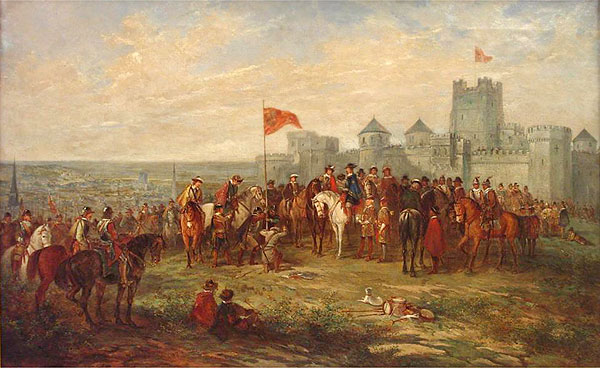
[Although hostilities in the English Civil War wouldn't begin in earnest for another two months - at the Battle of Edgehill on October 23rd - both sides had been massing their forces for months when the King's provocative actions on this day in 1642 would prove the last straw for Parliament... In addition to the conflict itself (which was devastating enough) the Civil War had at least one consequence which still resonates today; after His Majesty stormed out of the House of Commons chamber for the last time following a set-to with Speaker William Lenthall in January 1642 no sovereign has ever entered it again!]

392 CE - Arbogast had Eugenius elected Western Roman Emperor.

476 CE
- Odoacer was proclaimed King of Italy by his troops after riding into Rome on his way to depose the Western Emperor, Romulus Augustulus, who was then in residence at Ravenna; many historians feel that Odoacer's election marks the end of the Roman Empire in Europe, as well as the beginning of the Middle Ages or medieval period, although in reality the Roman Empire had either been falling for some time and/or wouldn't fall for another fifteen centuries...

565 CE - St. Columba reported the first sighting of a monster in the River Ness - which itself flows into the more famous Loch Ness which gives the monster its moniker.

851 CE - Erispoe defeated Charles the Bald at the Battle of Jengland, near the Breton town of Jengland.

1138 - At the Battle of the Standard near the Yorkshire village of Northallerton the Scottish forces of King David I were repelled by English commander William of Aumale, whose smaller force decimated their opposition... The Scottish King had invaded England to support his niece Matilda's claim to the throne (as the only surviving direct descendant of William the Conqueror in the paternal line) over that of King Stephen, during a period of English history known as The Anarchy.

1639 - The Indian city of Madras (now called Chennai) was founded by the British East India Company after it bought a sliver of land on India's east coast from local Nayak rulers.

1642 - Still outraged by the Long Parliament's Grand Remonstrance of December 1641 and a threat by the House of Commons to impeach Queen Henrietta Maria, after England's King Charles I proclaimed Parliamentary forces to be traitors as he raised his standard outside Nottingham Castle, and the first English Civil War began...

1654 - Jacob Barsimson arrived in New Amsterdam (later New York City), making him among the first Jewish settlers in America.

1770 - Captain James Cook's expedition landed on Possession Island, off the coast of New South Wales, Australia; it was here that Cook formally claimed the coastlines of Queensland and New South Wales for Great Britain.

1791 - A slave rebellion began in the town of Saint-Domingue which would eventually lead to the creation of Haiti as the world's first black republic under Toussaint Louverture.

1827 - José de La Mar became President of Peru for the second time.

1851 - The first America's Cup was won by the yacht America.

1864 - Following the signing of the first Geneva Convention, the Red Cross was created. The Geneva Convention was most recently in the news in January 2002 when White House Counsel (and future US Attorney-General) Alberto Gonzales mocked it as 'quaint'.

1901 - The Cadillac Motor Company was founded.

1922 - Irish revolutionary Michael Collins was shot and killed during an ambush in Ireland's County Cork.

1926 - Gold was discovered near Johannesburg.

1932 - The BBC began conducting experiments with television broadcasting.

1950 - Althea Gibson broke the colour barrier in tennis, competing with whites at the US Open.

1973 - Henry Kissinger was named Secretary of State by US President Richard Nixon.
*
share on: facebook

Saturday, August 21, 2010

Happy Birthday Kim Cattrall

Photobucket

As much as I used to wish, while watching Sex and the City, that I could be more like sexy Samantha Jones, somehow I always end up being cynical Miranda Hobbes (or, on a good day, observant Carrie Bradshaw); I suppose it could be worse*... Still, I have known Samanthas in my life, and I have always admired their confidence and brazenness, despite the difficulty I've had with expressing either of those traits in my own life.

I think it would be a mistake, though, to think that Kim Cattrall is at all like Samantha; for one thing, in interviews Cattrall comes across as highly gracious and very soft-spoken as well, neither of which qualities are much in evidence in the character of Samantha. For all her highly erotically charged performances (say, in films like Porky's or Mannequin) she's either an excellent actress onscreen or off; that is to say, either her public persona is her greatest role or she gets it all out of her system when the cameras are rolling.

Either way, you can count on my following her career closely to continue searching for clues as to what makes this lovely, classy lady tick...

*I could be more like uptight Charlotte York... (shudder)
*

share on: facebook

"What The World Needs Now Is Love" by Jackie DeShannon


In the 1960s few female performers had the string of hits enjoyed by Jackie DeShannon; often considered the first female singer-songwriter of the rock era, DeShannon may have been hurt as much as helped by her luminous blonde beauty, at least in the United States. Songs like Needles and Pins and When You Walk in the Room were even bigger hits in Canada and the UK than they were in the US which, if it dismayed the American-born singer she didn't let it show. In fact, much of DeShannon's early output would prove more popular for other artists than for her, including the two previously mentioned, which became huge sellers for The Searchers.

Jackie DeShannon's version of Burt Bacharach and Hal David's What the World Needs Now Is Love was for years the gold standard version of the song; here she's seen performing it on the popular show Shindig! She followed it up with the similarly popular Put a Little Love in Your Heart.

Born on this day in 1944, Jackie DeShannon still records and tours, owing to the huge market for nostalgia; her songs have also been recorded by Tracey Ullman, Annie Lennox and Al Green, Tom Petty & The Heartbreakers, and Dolly Parton. Then there's the little matter of a song called Bette Davis Eyes, which was named the most successful pop single of the 1980s after it was paired with the raspy contralto of Kim Carnes in 1981.
*
share on: facebook

Jeff Stryker: The Poet Laureate of Dirty Talk

Like many diehard consumers of hardcore gay porn whose first exposure to the genre came about in the mid- to late-1980s, the first model* who made an indelible impression upon me then was Jeff Stryker. The reasons for his pre-eminence are multiple, and not merely related to the size of his member; his looks (which put me, at least, in mind of the young Elvis Presley) and his rough, dominating manner seem to complete the fantasy - fantasy being the whole point of porn in the first place - of the rough trade top. No less a wit than John Waters has referred to Stryker as 'the Cary Grant of porn'.

PhotobucketBorn on this day in 1962, Stryker was discovered by legendary porn producer John Travis in 1986 and immediately got on the porn treadmill, starring in dozens of films a year owing to the fact that the shelf-life of the average porn star is about five years.

Stryker's real innovation, however, was in the creation and marketing of the Jeff Stryker dildo, although even this highly successful endeavour was tainted when it was revealed that its manufacturers had added an inch to both the length and the girth of the popular adult conversation piece. Stryker later confessed to being hurt by this turn of events, although it's nothing on the hurt its many consumers have felt. If Stryker got screwed at least he was well-paid for his first attempt at bottoming; no doubt they were gentler than Stryker ever was.

Nowadays, of course, most porn stars with even minor name recognition have been honoured with similar rubber trophies, but Stryker's marketing juggernaut has also extended to an album of music entitled Buck Wild, including the title track of one of his most famous films, 1986's Bigger Than Life; another bears the imaginative title Pop You In The Pooper**. Additionally there have been Jeff Stryker lube, condoms, and playing cards. As gay porn continues its steady transit to the mainstream, expect to see much more of this sort of merchandise available; it's important to remember, however, that the marketplace might be somewhat stretched, seeing as who was there first.

*While I have no problem calling them porn stars, I cannot bring myself to call even the best of them porn actors, as some do.
**Warning: Do not click on the link unless you have headphones in or your computer is muted; it's definitely NSFW from the first line.
*

share on: facebook

Happy Birthday Your Majesty

Photobucket

One of the Arab world's most moderate* leaders, Mohammed VI has been the King of Morocco since the death of his father Hassan II in July 1999; His Majesty is the 18th sovereign of the country's Alaouite dynasty, which has ruled the North African country since 1666.

Born on this day in 1963, His Majesty's mother is Lalla Latifa Hammou, whose only title is Mother of the Princes; the King's wife is Princess Consort Lalla Salma, who's the first wife of a Moroccan King to ever be given a title, no doubt part of His Majesty's commitment to liberalizing his country.

Moroccan Muslims (especially the conservative ones) are known to be quite touchy where images of their King are concerned; I'd like to state here and now that the above image was placed with all due reverence, and will continue to be treated as such. I may be an irreverent gay pagan, but I'm smart enough to pick and choose my opportunities to express each of these facets of my personality when they'll be best received...

*That is to say, friendly to the West; it's also a highly relative term, but a good effort besides.
*

share on: facebook

Who Killed Benigno Aquino?

More than a quarter of a century has passed since Benigno Aquino Jr. (known as Ninoy) was assassinated, on this day in 1983... In the years since then his widow, Corazon Aquino, has come and gone from the Malacañang Palace*, plagued while in office not only by the usual politics but also by natural disasters, such as the 1991 eruption of Mount Pinatubo, which devastated the Luzon region.

Photo Sharing and Video Hosting at PhotobucketFourteen soldiers have been detained since 1983 for their role in the assassination; while Mrs. Aquino had said that she forgave them she also made it clear that she would never appeal for either clemency or their release.

It is suspected that the trigger was pulled by Rolando Galman, who was himself fatally shot by airport security, but to this day there is no concrete evidence who killed Aquino; even less is known about who ordered it, although naturally people have their theories.

As to the mastermind of the operation, the chief suspect, Ferdinand Marcos, was recovering from a kidney transplant that day, although he certainly could have given the order, even from a hospital bed. The other main suspect is Fabian Ver, Marcos' first cousin, who at the time was head of the Armed Forces of the Philippines, or AFP. Marcos himself blamed Rodolfo Salas, head of the Philippine Communist Party, who was his favourite scapegoat following the various atrocities he ordered committed (such as the Plaza Miranda bombing, twelve years to the day earlier, which dealt a major blow to Aquino's Liberal Party.

The Agrava Commission, which Marcos promptly struck in the days following the crime to investigate them, was controversial from the start; for one thing, it cleared Rolando Galman of the crime, as it did for Marcos, Ver, and Salas. After a year of meetings and investigation, it issued a report claiming a military conspiracy but refused to point fingers or assign blame.

Ten days after his murder as many as 2 million people attended the funeral of Ninoy Aquino, which lasted from 9am to 9pm; his death polarized opposition to the Marcos regime, in a way that mere speeches and political campaigning could not have done. Today the Monday nearest August 21st is a public holiday in his homeland, his face appears on the 500-peso note, and there are statues and memorials to him around the country.

'...the Filipino is worth dying for...' he said, in an interview just prior to his fateful return. Presumably he meant it, but until his killers are identified, justice cannot be served.

*Indeed, she's come and gone from this life as well...
*
share on: facebook

POPnews - August 21st

Photobucket
[Although he argued strenuously against slavery during 7 three-hour debates with Stephen Douglas, Abraham Lincoln lost the Illinois Senate seat to his longtime rival anyway... Following the defeat, Lincoln had his thoughts on the subject published in book form; the massive popularity of that book, as much as the widespread publicity engendered by the debates, made him a shoo-in for the nomination at the 1860 Republican National Convention - which itself set in motion a series of events that would within a decade would render Lincoln a legend.]

1680 - Pueblo Indians captured Santa Fe from the Spanish colonists living there, thus ending the Pueblo Revolt; those who survived Popé's cunning strategy of cutting off the city's water supply were relocated to El Paso del Norte.

1689 - The Battle of Dunkeld occurred in the vicinity of Dunkeld Cathedral, pitting the royalist supporters of Scotland's so-called James VII under Alexander Cannon against the ultimately victorious Cameronians of William Cleland (who died in battle) and George Munro of Auchinbowie.

1770
- Captain James Cook claimed for England the territory in Australia he called New South Wales.

1810 - French-born Jean-Baptiste Bernadotte was elected Crown Prince of Sweden and made Generalissimus of the Army; he would later succeed Charles XIII as Charles XIV John.

1821 - Jarvis Island was discovered by the crew of the British ship, Eliza Frances, which was owned by Edward, Thomas and William Jarvis and mastered by a Captain Brown. Initially claimed by Britain, the island was annexed by the US in February 1858 under the Guano Islands Act, and it remains to this day classified as one of the United States Minor Outlying Islands despite being uninhabitable (owing to the fact that it has no fresh water and very little rainfall - and is covered with bird shit besides!) and therefore uninhabited.

1831 - Nat Turner led slaves and freemen alike in a rebellion in Southampton County, Virginia, which claimed 57 whites and as many as five times as many blacks, including Turner himself.

1842 - The Tasmanian city of Hobart was founded; if you don't know where that is, ask any Australian woman to show you her map of Tasmania and she'll likely accommodate you. (snicker, snicker)

1858 - The Lincoln-Douglas debates began, pitting Republican Abraham Lincoln against his Democratic rival Stephen A. Douglas at Ottawa, Illinois; at stake was a seat in the Illinois Senate. This also marks the last time the Pop Culture Institute ever rooted for a Republican to win anything (except possibly a seat in a dunk tank!).

1862 - The Vienna Stadtpark opened its gates, making it the first public park in that city.

1863 - The pro-Union town of Lawrence, Kansas (itself an abolitionist stronghold) was destroyed during the Lawrence Massacre by a legion Confederate guerrillas called Quantrill's Raiders led by William Clarke Quantrill.

1878 - The American Bar Association was founded.

1911 - In what may be the single largest example of internal shrinkage ever Leonardo Da Vinci's priceless masterpiece, the Mona Lisa, was discovered stolen from Paris' Musée du Louvre by artist Louis Béroud; Vincenzo Peruggia was later arrested for trying to sell the painting to the Uffizi Gallery in Firenze.

1944 - The Dumbarton Oaks Conference - at which the United Nations began to take shape - began; it would conclude on October 7th.

1959 - President Dwight D. Eisenhower signed the Hawai'i Admission Act, making Hawai'i the 50th state; to this day the third Friday in August is celebrated statewide as Hawai'i Admission Day - although our sources tell us the 'celebration' is growing increasingly muted with each passing year...

1968 - A posthumous Medal of Honor was awarded to James Anderson Jr., the first African-American to be so honoured.

1969 - An Australian national named Michael Dennis Rohan set Jerusalem's Al-Aqsa Mosque on fire, gutting the southeastern wing of the Temple Mount holy site, in the process destroying a thousand-year-old minbar which had been the gift of Saladin.

1971 - Two hand grenades were tossed onstage at a campaign rally held by the Liberal Party of The Philippines in Manila's Plaza Miranda, injuring 95 and killing 9 anti-Marcos political candidates and their supporters including a five-year-old child and a photojournalist.

1983 - Benigno Aquino Jr. was assassinated on the tarmac at Manila Airport upon his return from exile. The killing hastened the demise of the Marcos regime, which has been seen as responsible; within three years Ninoy's widow would be President of the Philippines, and while she was unable to discover who killed her husband, at least she renamed the airport after him.

1991 - Latvia seceded from the Soviet Union, which at least helped to halt the military's August Putsch against the government of Mikhail Gorbachev.
*
share on: facebook

Friday, August 20, 2010

Gratuitous Brunette: David Walliams

Photobucket

In addition to talents for acting and writing, David Walliams recently rediscovered an affinity for swimming, which he first took up as a youth to combat a weight problem; since July 2006 he's made charity swims of the English Channel (which raised £1,000,000 for Sport Relief) and a similar crossing of the Strait of Gibraltar alongside James Cracknell in March 2008.

Born on this day in 1971, David Walliams has been very busy indeed since he made his TV debut (as 'Lesley Luncheonmeat') on Sky1's Games World; not only have he and comedy partner Matt Lucas appeared on Bang Bang, It's Reeves and Mortimer (starring Vic and Bob) they wrote and co-starred in Rock Profile.

It was their hugely popular gallery of grotesquerie Little Britain, though, that made them household names in Britain and cult favourites elsewhere in the English-speaking world following its debut in September 2003. Little Britain was followed by a concert tour (appropriately called Little Britain Live) and in Little Britain Abroad; going from success to success, Walliams and Lucas took things up a notch for Little Britain USA - which aired on HBO in September 2008.

Walliams' first children's book The Boy In The Dress (illustrated by Quentin Blake) was released the following month, and was reviewed positively for its themes if somewhat less so for its writing; another, Mr Stink, was published in November 2009 with the same illustrator.  He's also continued making forays onto the silver screen - having appeared in such films as Plunkett & Macleane, Tristram Shandy: A Cock and Bull Story, and Run Fat Boy Run among others - voicing the character of Bulgy Bear, in The Chronicles of Narnia: Prince Caspian.  He's also a popular addition to that perennial British telly fave, the panel show...

Then this year the world's most effeminate womanizer did the unexpected thing and got married - to a lady! (Dutch model Lara Stone) - in a swanky affair at Claridge's...
*

share on: facebook

In Memoriam: Rajiv Gandhi

Photo Sharing and Video Hosting at Photobucket

Rajiv Gandhi's first impulse was to stay out of the family business, namely the governance of India; both his grandfather and his mother had been Prime Minister. But it was the death of his brother Sanjay in an air crash in June 1980 which made him abandon his job at Indian Airlines and follow in his mother's footsteps.

Problem is, he followed a little too closely; she was assassinated in October 1984, and he in May 1991. In the intervening years, though, he did his part towards modernizing one of the world's oldest cultures (not to mention secularizing a country too often awash in sectarian strife). India's burgeoning middle class owes itself to the soft-spoken, Cambridge-educated Jewel of India, born on this day in 1944.
*
share on: facebook

Happy Birthday Peter Oakley


Peter Oakley - aka geriatric 1927 - is a genuine Internet phenomenon; since joining the YouTube community in 2006 his videos have received millions of hits. Best of all, any rude and abusive comments he's received* have been dealt with abruptly by his legion of fans in the same manner they usually are on YouTube, where a unique kind of etiquette has begun evolving over exactly what kind of behaviour and language is appropriate on the Internet.

Oakley's video memoirs are entitled Telling It All, and run the gamut of his life and experiences as seen from the mellow perspective of his eighth decade. There are more than 60 of these online already (more than 250 videos in total) with many more to come.

From what I've seen it couldn't happen to a nicer chap...

The video posted above deals with how he deals with the blues... As usual sage advice dispensed in such a warm and gentle manner has brought a tear to my already sentimental eye; hearing Peter Oakley discuss how he handles melancholy has ensured my life will be melancholy-free for many days to come.

*You know who you are - you should be ashamed of yourselves for treating such a nice man that way.
*
share on: facebook

"The Island" by Milton Acorn

Since I'm Island-born home's as precise
as if a mumbly old carpenter,
shoulder-straps crossed wrong,
laid it out, refigured
to the last three-eighths of shingle.

Nowhere that plowcut worms
heal themselves in red loam;
spruces squat, skirts in sand
or the stones of a river rattle its dark
tunnel under the elms,
is there a spot not measured by hands;
no direction I couldn't walk
to the wave-lined edge of home.

Quiet shores -- beaches that roar
but walk two thousand paces and the sea
becomes an odd shining
glimpse among the jeweled
zigzag low hills. Any wonder
your eyelashes are wings
to fly your look both in and out?
In the coves of the land all things are discussed.

In the ranged jaws of the Gulf,
a red tongue.
Indians say a musical God
took up his brush and painted it,
named it in His own language
"The Island".
*
share on: facebook

Remembering... Milton Acorn

In many ways Milton Acorn was the quintessential Canadian; born in Prince Edward Island, he lived in Toronto, moved to Montreal following military service in World War II, and latterly found himself in Vancouver, where he lived for years before returning to the place of his birth.

PhotobucketAcorn's contribution to the social and cultural life of Vancouver can be seen every Thursday, when new issues of The Georgia Straight are released. Although the paper he helped to found has since strayed far from its counter-cultural roots (a person like I, for instance, could not write for them today because I lack the adequate formal education) it still functions as a pretty effective hammer against the city's free enterprise* over-class.

Acorn died on this day in 1986, broken-hearted over the death of a beloved sister and having spent most of his life wracked with pain from wounds he sustained in the war, living with bi-polar disorder, and diabetic besides. Nicknamed 'The People's Poet', in his life he published 18 volumes of verse; in death the annual Milton Acorn People's Poetry Award was established by Ted Plantos in his memory.

*'Free enterprise' is code in BC for 'rabidly fascist'.
*

share on: facebook

In Memoriam: Yootha Joyce

Photobucket

The most constant element in the life of any comedian is the grief or rage or self-loathing that lurks behind the amusing mask; such was certainly the case with Yootha Joyce, who did yeoman service in theatre, film, and television throughout the 1950s and 1960s, only to be undone at a tragically early age by success, or more specifically typecasting.

The fame she found as Mildred Roper (alongside Brian Murphy) made them one of the finest comedy teams working in British sitcoms during the 1970s, and made her a household face (if not name) besides; yet the role - which she originated on Man About the House and continued in George and Mildred - is what she is best remembered for today. In fact, it's the main reason why I'm writing about her, truth be told.

In many ways, the bane of typecasting* isn't the scourge today it once was, due to the proliferation of chat shows and PR gurus, whose job it is to shoehorn celebrities into high-profile charity work and so get their real name in front of the public more than their character's; the situation likely changed, in part, because of people like Yootha Joyce.

Born on this day in 1927, Joyce died in 1980 - four days after her 53rd birthday, her costar Brian Murphy by her side - from an advanced case of alcoholism. At the time it was generally agreed that she drank herself to death, having imbibed as much as half a bottle of brandy daily for ten years. So terrified was she at the prospect of having to play some derivation of Mildred Roper for the rest of her life, she saw to it the remainder of that life was as short as possible...

*Generally manifested by members of the public calling you by your character's name dozens of times a day, but also by narrow-minded producers who can't see any potential beyond that one big role; in Joyce's case, this would have meant a plethora of offers to play scolding wives or sex-starved social-climbing working class suburbanites.
*
share on: facebook

Happy Birthday Connie Chung

As a journalist, Connie Chung's career has been all over the map, geographically as well as professionally; from giving dispatches to her idol Walter Cronkite during the Watergate proceedings to giving douchebags like Gary Condit the easy interview to a brief and embarrassing foray into the sleazy territory of her husband Maury Povich Chung's brand has been consistent only in its inconsistency...

PhotobucketYet, as one of the few female Asian faces on American television, I feel it's my responsibility to go as easy on her as others have gone rough*; after all, she was fired from her job for suggesting that emergency services were having trouble dealing with the Oklahoma City bombing, which no white or male anchor would have been.

It seems like (if I may stray into the oleaginous verbiage of the HR professional for a moment) Chung just hasn't 'found the right fit' regarding her job, which anyway hasn't stopped her from trying them all, from reporter to anchor to host.

Personally, I can't wait to see where she turns up next...

*For precisely the same reasons as well...
*
share on: facebook

"Ship Of Fools" by Robert Plant


Birthday wishes go out today to Robert Plant, founding member of Led Zeppelin and a successful recording artist in his own right; Ship of Fools originally appeared on his 1988 solo album Now and Zen, and was co-written with keyboard player Phil Johnstone.

The phrase 'ship of fools' is an ancient one which dates to at least the 1490s and is depicted both in a well-known German woodcut entitled Narrenschiff as well as a painting by Hieronymous Bosch, representing the relationship between Earth (the ship) and the humanity (or fools) piloting it. It would be just like Robert Plant to draw the inspiration for the song from such a source, as he's pretty deep that way.

Katherine Anne Porter's most famous novel*, published in 1962, bears the same name, and updates the allegory to the modern day, with an ocean liner bearing an international passenger list and the folly of World War II representing the eternal struggle humanity has had with self-destruction; the book was sold (reportedly for $400,000) and adapted by Abby Mann into a 1965 film, which was directed by Stanley Kramer and starred Vivien Leigh** at the head of an all-star cast.

*Also her only novel.
**In her last film role.
*
share on: facebook

Pop History Moment: Fergie's (First) Comeuppance

Photobucket

On this day in 1992 Britain's Daily Mirror published a ten-page spread featuring photographs of the Duchess of York in a compromising position with Texas multimillionaire John Bryan; despite having insisted that Bryan was her financial manager, he was photographed with her toes in his mouth, which is surely not the sort of thing likely to come up at an audit...

The former Sarah Ferguson was already well on the way to being estranged from her husband when these revelations surfaced; it was widely rumoured the year before that Her Royal Highness had also favoured the company of one Steve Wyatt - also a multimillionaire and also from Texas. In much the same way she was always on holiday or always eating, at least she was being consistent in her cuckoldry.

The scandal broke as the Royal Family was enjoying its annual sojourn at Balmoral Castle in Scotland; many late nights were reportedly spent as Sarah and her best chum Diana tried their best to do damage control. Naturally, none of their efforts came to much, and the Yorks were divorced in 1996, at roughly the same times as the Waleses.
*
share on: facebook

POPnews - August 20th

Photobucket
[Not only would the cover of Abbey Road inspire the whole
'Paul is dead' hysteria, but it's also been parodied untold number
of times since by any prat with a camera and four friends.
]

636 CE - Following the six-day Battle of Yarmouk - during which Arab forces of the Rashidun Caliphate led by Khalid ibn al-Walid, Abu Ubaidah ibn al-Jarrah, Amr ibn al-A'as, Shurahbil ibn Hassana, and Yazid ibn Abu Sufyan took control of Syria and Palestine away from the Byzantine Empire - the first great wave of Muslim conquest and the rapid advance of Islam outside Arabia began. Although the Byzantine commander Heraclius managed to survive the slaughter - as did Jabalah ibn al-Aiham, Buccinator, and Gregory - his colleagues Theodore Trithyrius, Vahan, and Dairjan fell in battle.

917 BCE - At the Battle of Anchialus Bulgaria's Tsar Simeon I invaded Thrace and successfully drove the Byzantine Empire (commanded by Leo Phocas) out.

1083 - Stephen I - who'd first established Hungary as a Christian kingdom 83 years earlier - was canonized by Pope Gregory VII.

1391 - Konrad von Wallenrode became the 24th Hochmeister of the Teutonic Order.

1775 - The Spanish presidio which would one day become Tucson, Arizona, was completed.

1804 - The Corps of Discovery - the team that accompanied the Lewis and Clark Expedition's exploration of the Louisiana Purchase - suffered its only death when its quartermaster, Sgt. Charles Floyd, died (apparently from acute appendicitis) en route; the site of his burial is now called Floyd's Bluff in his honour, despite an 1891 ruling by the US Board on Geographic Names that such features (such as Pikes Peak) cannot bear a possessive apostrophe.

1866
- President Andrew Johnson officially declared an end to the US Civil War.

1882 - Tchaikovsky's masterpiece, the 1812 Overture - commemorating the unsuccessful attempt by Napoleon Bonaparte to invade Russia - made its concert debut in Moscow.

1920 - The first commercial radio station in the US began operating in Detroit; originally known by the call letters 8MK, in October 1921 it was given the letters WBL, and since March 1922 the station has been known as WWJ.

1940 - Exiled Russian revolutionary Leon Trotsky was fatally wounded at his home in Mexico City by NKVD agent Ramón Mercader, who did the deed with an ice pick to the skull; Trotsky died of his injuries the next day.

1968 - 200,000 Warsaw Pact troops and 5,000 tanks invaded Czechoslovakia in order to end the so-called Prague Spring, a period of political liberalization.

1969 - All four of The Beatles were together in the studio for the final time as they finished recording their album Abbey Road with producer George Martin.

1975 - NASA launched the Viking 1 planetary probe toward Mars as part of its Viking Program.

1977 - The Voyager 2 spacecraft was launched as part of the Voyager Program, intended to explore the planets of Jupiter, Saturn, Uranus and Neptune as well as their moons; it is still in operation after more than 11,000 days, and is considered the most productive probe ever launched by NASA.

1979 - The East Coast Main Line rail route between London and Edinburgh was restored when the Penmanshiel Diversion opened.

1986 - American postal employee Patrick Sherrill gunned down 14 of his co-workers before committing suicide in Edmond, Oklahoma; the incident is attributed with introducing the phrase 'going postal' into the collective lexicon.

1988 - The single worst day of the Yellowstone fire at Yellowstone National Park - dubbed 'Black Saturday' - brought about a major change to the 'let it burn' policies favoured by the Reagan Administration.

1991 - Estonia seceded from the Soviet Union, taking advantage of the confusion caused by the military's anti-Gorbachev coup attempt in Moscow to do so.

1998 - The Supreme Court of Canada ruled that Quebec could not legally secede without the approval of the federal government.
*
share on: facebook

Thursday, August 19, 2010

"Still I Long For Your Kiss" by Peter Gallagher


Best known for his formidable eyebrows, actor Peter Gallagher* added a hyphenate to his job description in 2005 when he recorded Still I Long For Your Kiss, which appears on his album 7 Days In Memphis. The video also features Kelly Rowan, who played his wife on The O.C.

Unlike with the output of many actor-singers, though, this isn't a total embarrassment; indeed, an entire blog post could be dedicated to the musical efforts of Don Johnson, Jack Wagner, Bruce Willis, Eddie Murphy (and so on and so on, ads both infinitum and nauseum). Then again, I don't really feature having the Pop Culture Institute flagged as inappropriate - despite the boost it might give to my readership - so I won't bother. For now, anyway...

*Whose birthday it is, natch!
*

share on: facebook

In Memoriam: Madame du Barry

Photobucket

Although to many of us, the idea of a cosseted life in a palace, flouncing down corridors in flashy clothes and enjoying the undivided attention of the most important man in the country sounds like a pretty nice way to spend a few years, it wasn't all truffles and diamonds for women like Madame du Barry...

Given the intensity of social politics at the Palace of Versailles, hers was very precarious perch indeed, as outlined in the excellent book Sex With Kings, by Eleanor Herman; while her favour was frequently courted by courtiers looking to become favourites, her time with the king was intended to relieve him of his worries, not compound them with politicking. Despite the headaches her, uh, position must have given her, she was not allowed to have them if and when the king ordered her to, er, assume it.

Madame du Barry - born on this day in 1743 - was already well-experienced in the ways of the boudoir when she replaced the late Madame de Pompadour in the official affection of Louis XV in 1769; at the time she was just 26 and he was 59, and each of them was at the height of their respective powers. Far less political than her predecessor, she nevertheless fell a-foul of the new Dauphine Marie Antoinette, whose own upbringing in Austria had seen far less decadence under the formidable Empress Maria Theresa than that of her adopted homeland. Their one social interaction occurred on New Year's Day 1772, after which it was made clear that there would not be another.

In the end, of course, Madame du Barry became one of the more celebrated non-royal victims of the Reign of Terror when she visited the guillotine in December 1793; she was just 50 when she died, yet was overcome with girlish hysterics at the prospect, to the great amusement of the crowd assembled at the Place de la Concorde. Her final words - 'Encore un moment, monsieur le bourreau, un petit moment' ('One moment more, executioner, one little moment') - have resonated with that country's existentialists ever since.

Fortunately for Madame du Barry history loves a whore, and she's never been far from the public imagination since; she's been portrayed in operetta and Broadway musical alike, and in the movies as well, played by such women as Theda Bara, Pola Negri, Gladys George, Lucille Ball, Martine Carol, and Asia Argento. Hers is also the oldest wax figure on display at Madame Tussaud's in London, entitled The Sleeping Beauty, which according to Tussaud family lore may have even been modelled from life by Marie Tussaud herself.
*
share on: facebook