Wednesday, March 24, 2010
"Cruel To Be Kind" by Nick Lowe and Rockpile
Appearing here on Top of the Pops with Rockpile, it's birthday boy Nick Lowe, whose vocals rocketed Cruel To Be Kind up the American charts in 1979.
*
share on: facebook


Pop History Moment: Elvis Presley Was Drafted

If I live to be a hundred*, I'll never believe that the drafting of Elvis Presley on this day in 1958 wasn't an attempt by the US government to stifle the social dissent amongst young people being caused by rock and roll, of whom Elvis was even then the greatest icon. It failed, of course, as subterfuge of this kind inevitably does; it did, however, shift the axis of popular music from the US to the UK**, and so bring about the British Invasion of the early 1960s.
Reporting for duty at Fort Chaffee, near Fort Smith, Arkansas, Presley was accompanied by a media whirlwind, which seems to have taken the base's information officer Captain Arlie Metheny entirely by surprise. For his part the singer undertook his military service studiously, despite the fact that he could have easily fought for and won deferment. 'The Army can do anything it wants with me,' he is reported as saying.
Despite his training at Fort Hood, Texas, and service in Friedberg, West Germany - during which time he developed hankerings for amphetamines, karate, and 14-year-old Priscilla Beaulieu - between the time of his induction and his discharge in March 1960 Presley had ten Top Ten hits, including Wear My Ring Around Your Neck, the best-selling Hard Headed Woman, and One Night in 1958, and (Now and Then There's) A Fool Such as I and the number one A Big Hunk o' Love in 1959.
*At the rate I'm going, not even a remote possibility...
**Which has a professional army, untainted by conscription or 'selective service', to use the odious euphemism of the US government.
*
share on: facebook
"Pity The Nation" by Lawrence Ferlinghetti
Today marks the 91st birthday of poet Lawrence Ferlinghetti, co-founder of City Lights Booksellers & Publishers and one of the last surviving members of a scene which shook the literary establishment in the 1950s.
Best known for A Coney Island of the Mind, first published in 1958, Ferlinghetti's scorching indictment of the American bourgeoisie has been drawing criticism that the left is anti-American for half a century now, despite the fact that his has always been a criticism meant to inspire self-improvement of both citizen and state rather than the mindless devotion to national symbolism, which without vigilance is as prone to entropy as anything.
Or, y'know, whatever...
*
share on: facebook
Remembering... Queen Mary

Her Majesty Queen Mary - consort to George V and the current Queen's grandmother - died in her sleep at Marlborough House after a lengthy (and secret) battle with lung cancer on this day in 1953, just ten weeks before the much-anticipated coronation of the new Elizabeth II; one of her last acts was to insist that her death not be allowed to postpone the ceremony, and indeed it wasn't. Even as London was being scrubbed down and hung with bunting, mourners were filing past her coffin in Westminster Hall or else lining the route along which she was taken to be buried next to her husband in St. George's Chapel, Windsor.
Initially she'd been brought to England in 1891 as a prospective match for Queen Victoria's eldest grandson - and thus the heir presumptive - Prince Albert Victor, Duke of Clarence; he promptly died, six weeks after their engagement was announced, and she ended up marrying the Duke of York instead, thanks to a bit of matrimonial switcheroo the Royal Family has used on occasion before although - as with the case of Catherine of Aragon - usually with tragic results for the bride. By all accounts, though, theirs was a love match; George V famously took no mistresses. She became Princess of Wales following the accession of her father-in-law Edward VII in January 1901, and Queen upon his death in May 1910.
In character and bearing, Queen Mary was a Victorian; even as the first half of the 20th Century wrought immense changes to the United Kingdom - and not a few to her own family as well - hers was the sort of stalwart presence currently represented by her granddaughter. Her diligence restored to the once great Royal Collection the possessions of the Crown - which rightly belong to the people, and are held in trust by the sovereign - that had over the past century been pilfered and stashed throughout the Nation's noblest homes; she was also inordinately fond of jewellery, and the precious stones she was able to secure in her lifetime are considered every bit as prestigious (not to mention priceless) as the Crown Jewels themselves. Her duty compelled her to continue with public life, despite having outlived three of her six children, even as it compelled her to shun one of the surviving ones - The Duke of Windsor - for the damage she felt his abdication had caused to crown and country.
The biography of record remains Anne Edwards' exceptional Matriarch: Queen Mary and the House of Windsor, first published in 1984.
*
share on: facebook
Pop History Moment: The Death of Elizabeth I

Her reign - coming as it did after a brief but vicious period of religious tyranny under her aptly nicknamed half-sister Bloody Mary - was greeted by the populace as nothing short of the start of a Golden Age; poets and playwrights sang her praises, and as her procession approached Westminster Abbey on the day of her coronation she met the cheering, exuberant crowds who lined the route with cheering and exuberance of her own. Given those initial high expectations, then, it's almost inevitable that her reign should close on a disappointing note; as exceptional a figure as she was, not even Elizabeth I could live up to that kind of hype.
The defeat of the Spanish Armada in 1588 - without a doubt the apogee of the Elizabethan era - had come at a terrific cost; fifteen years later, as the queen who'd so bravely rallied her troops at Tilbury was dying in Richmond Palace the people were still paying for it. At the same time, some of the worst weather of the century had plagued the harvest during her final years. No doubt many of her subjects - still prone to superstition either of the heathen of Christian variety - blamed the queen herself, either for not marrying and providing an heir or for otherwise refusing to clarify the matter of the succession.
Of course, she was right to leave her thoughts on the matter private; given that the idea of a queen regnant - let alone the idea that one could be successful - was still a revolutionary one in much of Europe, she had every reason to believe that upon naming her successor she might find herself rather callously despatched. Having spent her entire reign as the subject of plots and conspiracies to separate her body from her throne (not to mention her life from her body) and having only recently succeeded in putting down a rebellion by the Earl of Essex - a former favourite - she'd come by her paranoia honestly; 45 years as a Queen will do that to a person.
As much for the good of the kingdom as for his own career, it was her secretary of state Robert Cecil who finally took matters into his own hands, conducting secret negotiations with Scotland's King James VI (son of Elizabeth's great rival Mary, Queen of Scots) to provide for a smooth succession when the time came. Having been well-schooled by his father - the great statesman Lord Burghley - in the ways of dealing with the recalcitrance of this particular monarch, Cecil was particularly diplomatic in his persistence; having also picked up a few pointers from the Queen's famous spymaster Sir Francis Walsingham likewise ensured he wouldn't be caught playing both ends against the middle and thus risk execution for treason.
Meanwhile, following the February 1603 death of her friend Catherine Carey, Countess of Nottingham - her once-handsome beauty ravaged by age, a near-fatal bout with smallpox in 1592, and tooth decay - the Queen sank into what was called a 'settled and unremovable melancholy'; for two weeks before she died she either sat propped up against cushions or stood all day, lost in contemplation, seemingly without sleep and taking very little food. Her last recorded words, on the day before her death, were 'I wish not to live any longer, but desire to die,' following which she allowed the Earl of Nottingham to carry her to her bed. When Robert Cecil approached her bedside and persisted in his enquiries concerning James VI she responded by holding her hands above her head in the shape of a crown.
Elizabeth I, who'd once breathed fire at her brother-in-law Philip II and his ill-fated flotilla, breathed her last shortly before 3 AM on this day in 1603, aged 69; she was discovered - still warm - by her attendant Lady Scrope. Although news of the Queen's death met with grief up and down the country, there was also a sense of relief that her moribund reign had come to an end. With the closing of her once-bright eyes, so closed the vivid chapter of English history that was known as the Tudor dynasty, born 117 years earlier with her grandfather Henry VII on the battlefield at Bosworth...
*
share on: facebook
Pop History Moment: The Exxon Valdez Disaster
On this day in 1989 an oil tanker, the Exxon Valdez, ran aground in Prince William Sound off the Alaskan coast, spilling 240,000 barrels (42,000 m³) of crude oil into the sea; given the remote location of the accident and the time of year, the cleanup effort was severely hampered. Rumours have continued to dog the ship's master Joseph Jeffrey Hazelwood that he was drunk at the time of the accident...
 The story has an interesting Vancouver angle; my buddy Nyac (pictured) was rescued from the muck and brought to live at the Vancouver Aquarium as a pup - where she lived, alongside her buddy Milo, until her death in 2008. Although Nyac was 20 years old when she died - twice the age she could have expected to attain in the wild - when she died she was the first sea otter ever to have been diagnosed with leukemia - likely as a reult of her exposure to crude oil as a pup all those years ago.
In fact, for years I had a picture of them linking paws on my keychain, as well as pictures of the two of them cavorting on my hard drive which are now treasured mementos.
In another one of those spooky coincidences that occasionally happens, another oil tanker (this time the Amoco Cadiz) caused another, much worse, oil spill off the Brittany coast of France on the same day, only in 1978.
*
share on: facebook
The story has an interesting Vancouver angle; my buddy Nyac (pictured) was rescued from the muck and brought to live at the Vancouver Aquarium as a pup - where she lived, alongside her buddy Milo, until her death in 2008. Although Nyac was 20 years old when she died - twice the age she could have expected to attain in the wild - when she died she was the first sea otter ever to have been diagnosed with leukemia - likely as a reult of her exposure to crude oil as a pup all those years ago.In fact, for years I had a picture of them linking paws on my keychain, as well as pictures of the two of them cavorting on my hard drive which are now treasured mementos.
In another one of those spooky coincidences that occasionally happens, another oil tanker (this time the Amoco Cadiz) caused another, much worse, oil spill off the Brittany coast of France on the same day, only in 1978.
*
share on: facebook
POPnews - March 24th
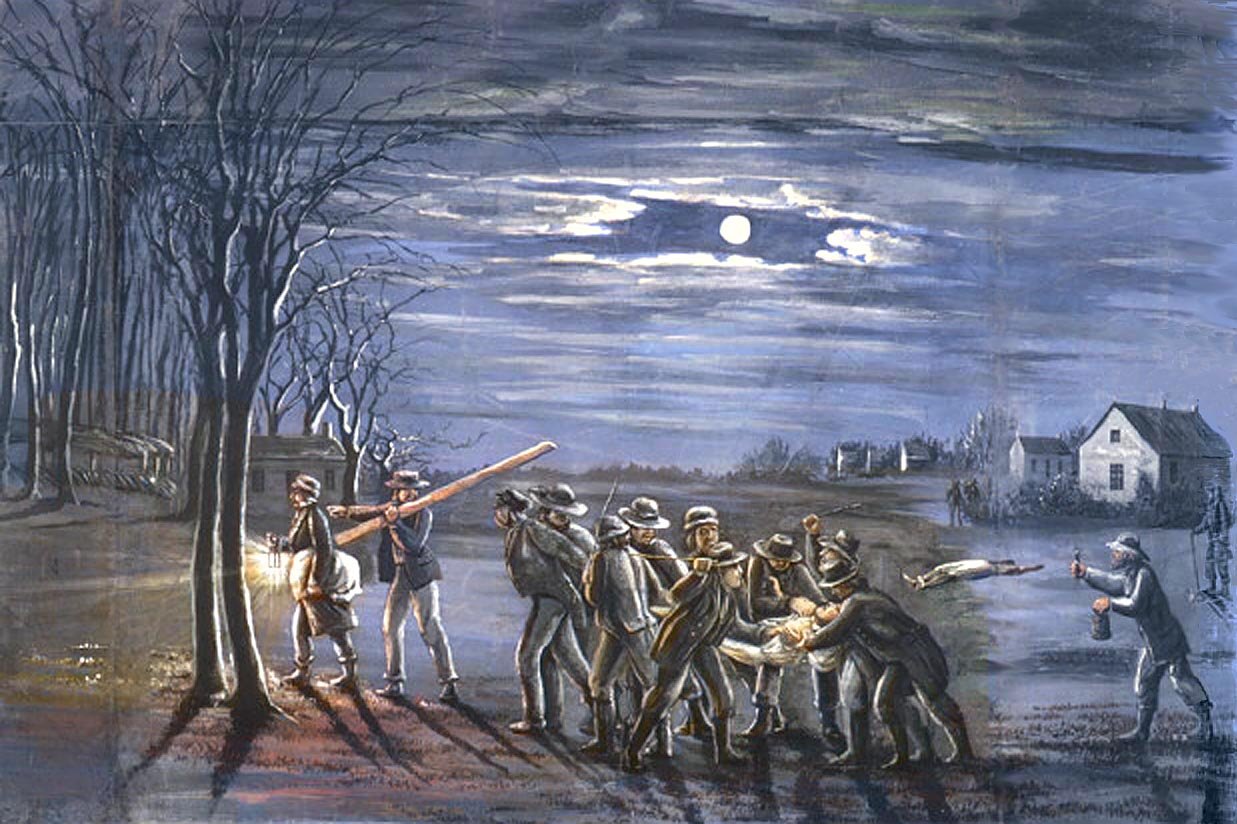
[The tarring and feathering of Mormon leader Joseph Smith - shown here in a scene by C. C. A. Christensen - was all well and good for 1832, but today's modern Christianist wingnut has become attuned to such treatment, and might even liken it to the tortures endured by Christ; in fact, methinks some of them even get off on it a little bit, and their battery-operated underwear or whatever it is they wear simply cannot cope. For their egregious support of Proposition 8, for their interference with and denial of the civil rights of others, for their refusal to believe anything but the bunkum taught from their pulpits without any critical thinking being employed whatsoever, only the mockery and derision of the modern Internet will do.]
1455 - Pope Nicholas V died; he was succeeded by Pope Callixtus III on April 8th.
1603 - James VI of Scotland became James I of England following the death of Elizabeth I, although the so-called Union of the Crowns was to be a personal rule only; the Acts of Union in 1707 - ratified under his great-granddaughter Queen Anne - would be needed to formalize the arrangement.
1765 - The first Quartering Act - which required householders in the Thirteen Colonies to house British troops - received the royal assent of King George III; one of the so-called Intolerable Acts issued in direct response to the Boston Tea Party of December 1773 - along with the Boston Port Act, the Massachusetts Government Act, and the Administration of Justice Act - their heavy-handedness virtually assured the inevitability of the American Revolution.
1832 - A group of men tarred and feathered Mormon leader Joseph Smith, Jr. in Hiram, Ohio.
1868 - The Metropolitan Life Insurance Company was formed.
1878 - The British frigate HMS Eurydice sank off the Isle of Wight; only 2 of the 378 on board survived.
1882 - Robert Koch announced the discovery of mycobacterium tuberculosis, the bacterium responsible for tuberculosis.
1900 - Mayor Robert Anderson Van Wyck broke ground at the corner of Bleecker and Greene streets in Greenwich Village for a new underground 'Rapid Transit Railroad' that would link Manhattan and Brooklyn; in what seemed like no time at all the New York City Subway was the largest in the world.
1934 - The US Congress passed the Tydings-McDuffie Act allowing the Philippines to become a self-governing commonwealth.
1958 - Elvis Presley was officially inducted into the US Army as Private #53310761, having been granted a deferral the previous December to complete work on the film King Creole; he completed his basic training at Fort Hood, in Texas.
1959 - The Party of the African Federation (PFA) was launched by Senegal's Léopold Sédar Senghor and Modibo Keita of Mali.
1965 - NASA's Ranger 9, equipped to convert its signals into a form suitable for showing on domestic television, brought images of the Moon into ordinary homes before crash-landing exactly as planned in the crater Alphonsus.
1976 - Argentina's military deposed President Isabel Perón and started the National Reorganization Process.
1980 - Archbishop Óscar Romero was killed by government troops while celebrating Mass in San Salvador; an outspoken advocate of liberation theology, Romero had embraced Marxist ideology but had also run afoul of the Vatican for his attempts to help the poor in a 20th Century fashion as well as his support for human rights.
1981 - Fugitive Ronnie Biggs - who was kidnapped from his home in Brazil by John Miller and Patrick King among others and transported to Barbados in hopes that his captors could claim the reward on his head - was rescued and returned to Brazil. Despite its status as a Commonwealth nation, Barbados has no extradition treaty with the UK, rendering the entire operation a total failure. Biggs, of course, was best known for his role in the Great Train Robbery of 1963; he escaped from HM Prison Wandsworth in 1965, but returned voluntarily to Britain in 2001.
1989 - After running aground on Bligh Reef in Alaska's Prince William Sound the Exxon Valdez spilled 240,000 barrels (or about 20% of its total cargo) of petroleum; far from the largest in terms of volume, the Exxon Valdez oil spill nevertheless united environmentalists and sportsmen alike against the carelessness of oil companies when transporting their hazardous material through otherwise pristine wilderness areas. At the time of the accident ship's master Joseph Hazelwood was in his cabin, allegedly drunk.
1992 - Britain's satirical Punch magazine - founded in July 1841 - ceased publication after 150 years; it was revived in 1996 by Mohamed Al-Fayed but folded again in May 2002.
1998 - At the Jonesboro massacre Andrew Golden, aged 11, and Mitchell Johnson, 13, fired upon teachers and students at Westside Middle School in Jonesboro, Arkansas. All told five people were killed - Natalie Brooks (11), Paige Ann Herring (12), Stephanie Johnson (12, no relation), Brittheny R. Varner (11), and Shannon Wright (32) - and ten were wounded; both shooters were released from custody on their 21st birthdays, having essentially gotten away with murder.
1999 - 39 people died when a Belgian transport truck carrying flour and margarine caught fire in the Mont Blanc Tunnel which connects France and Italy beneath the Alps.
*
share on: facebook
Tuesday, March 23, 2010
"Liebestod" from "Tristan und Isolde" by Eileen Farrell
The death of Eileen Farrell, on this day in 2002, put to rest any possibility she would either perform or record Richard Wagner's opera Tristan und Isolde in its entirety - one of the great tragedies in a genre which itself excels at great tragedy. The opera, of course, was based on the legend of Tristan and Isolde, which is thought to pre-date (and therefore inform) much Arthurian legend.
Here Farrell performs Mild und leise, the opera's closing aria, in which the Irish princess Isolde mourns the death of her knightly lover Tristan in one of opera's greatest moments.
*
share on: facebook
In Memoriam: Cedric Gibbons
For every high-strung flash-in-the-pan pretty face in front of the camera, Hollywood has had a long-haul hard worker (or ten) behind it. They may be as obscure as you or I; they may be as celebrated as - or, in some cases, even more celebrated than - those they painted, clothed, or lit simply because their jobs didn't rely on looks alone but talent, fortitude, and discretion...
 Cedric Gibbons - born on this day in 1893 - was one such technician; he began working in the art department of Samuel Goldwyn in 1918, and when Goldwyn later merged with Metro and Mayer Gibbons went on to work with the fledgling MGM from 1924-1956 - a 32-year career under the thumb of Louis B. Mayer, a feat of the utmost endurance. During his tenure there the famed art director personally oversaw 150 productions and had his name on ten times as many - a feat which I can safely say will never be replicated.
As Head of the Art Department at MGM, Gibbons was one of 36 founding members of the Academy of Motion Picture Arts and Sciences, an initiative by that studio to give itself trophies for work from which it already made obscene amounts of money. He even designed the Oscar statuette - a knight (whose physique was based upon that of Emilio 'El Indio' Fernández, a friend of Gibbons' then-wife Dolores del Río) standing atop a film canister with five spokes (one for each of the founding creative branches of film - namely actors, writers, directors, producers, and technicians); the work was then sculpted by George Stanley from Gibbons' design. From the day he designed it until the day he retired he earned 11 of them for his work, out of a total of 39 nominations.
It was said of Gibbons' work that if he was called upon to design Paris for a movie, it could out-Paris Paris; the films he worked on are simply redolent with style. I can single out one - Gaslight (1944) - that depicted a Victorian London so lavish that an actual Victorian would have been appalled by its exuberance. No slave to sentiment, he was also the first designer to use modern architecture in film, being especially fond of Art Deco and Art Moderne styles. For viewers, though, whether they knew it or not, his sets were a big part of the enthralling experience that was movie-going in the Golden Age of Hollywood.
After Gibbons and his ilk began retiring from the grinding schedule that was the film business during the studio era Hollywood underwent a sea change that took a full three decades to correct; while his successors in the 1960s and 1970s favoured a greater naturalism in film, their successors since the 1990s have begun to return to the more lavish style that made American cinema so great in the first place, many of them consciously honouring the work of great artists like Cedric Gibbons in the process.
*
share on: facebook
Cedric Gibbons - born on this day in 1893 - was one such technician; he began working in the art department of Samuel Goldwyn in 1918, and when Goldwyn later merged with Metro and Mayer Gibbons went on to work with the fledgling MGM from 1924-1956 - a 32-year career under the thumb of Louis B. Mayer, a feat of the utmost endurance. During his tenure there the famed art director personally oversaw 150 productions and had his name on ten times as many - a feat which I can safely say will never be replicated.As Head of the Art Department at MGM, Gibbons was one of 36 founding members of the Academy of Motion Picture Arts and Sciences, an initiative by that studio to give itself trophies for work from which it already made obscene amounts of money. He even designed the Oscar statuette - a knight (whose physique was based upon that of Emilio 'El Indio' Fernández, a friend of Gibbons' then-wife Dolores del Río) standing atop a film canister with five spokes (one for each of the founding creative branches of film - namely actors, writers, directors, producers, and technicians); the work was then sculpted by George Stanley from Gibbons' design. From the day he designed it until the day he retired he earned 11 of them for his work, out of a total of 39 nominations.
It was said of Gibbons' work that if he was called upon to design Paris for a movie, it could out-Paris Paris; the films he worked on are simply redolent with style. I can single out one - Gaslight (1944) - that depicted a Victorian London so lavish that an actual Victorian would have been appalled by its exuberance. No slave to sentiment, he was also the first designer to use modern architecture in film, being especially fond of Art Deco and Art Moderne styles. For viewers, though, whether they knew it or not, his sets were a big part of the enthralling experience that was movie-going in the Golden Age of Hollywood.
After Gibbons and his ilk began retiring from the grinding schedule that was the film business during the studio era Hollywood underwent a sea change that took a full three decades to correct; while his successors in the 1960s and 1970s favoured a greater naturalism in film, their successors since the 1990s have begun to return to the more lavish style that made American cinema so great in the first place, many of them consciously honouring the work of great artists like Cedric Gibbons in the process.
*
share on: facebook
"Parklife" by Blur
Birthday wishes go out to Damon Albarn, the brains behind Blur, and lately Gorillaz as well; n between times he's been involved with yet another side project, the critically acclaimed The Good, the Bad and the Queen.
I chose to feature Parklife - rather than, say Girls & Boys or Song 2, which are equally good - because the song's quintessential Englishness meant it didn't get played in North America much; whereas quintessential Englishness makes whatever it is a dead cert to be published here. Plus, I adore the song's estuarian sprechgesang, almost as much as I love typing the phrase estuarian sprechgesang.
The title track to the band's third album (a smash after the predictably sluggish reviews for their sophomore effort Modern Life is Rubbish) Parklife - the album and the song - catapulted the band back into relevance in 1994, debuting at Number One and remaining on the charts in the UK for 90 weeks.
*
share on: facebook
Happy Birthday Your Royal Highness
The youngest daughter of the Duke of York and Sarah, Duchess of York, turns 20 today; as with the births of Princes William and Harry and Princess Beatrice before her, I was on high alert waiting to hear the news - from London's Portland Hospital - that she'd been born...
 Her Royal Highness - having completed a gap year after graduating from Marlborough College that included a high-profile mugging in Cambodia - keeps a low profile as is usually the case with young royals (her cousins William and Harry being glaring exceptions) who generally wait until after university to decide if they're going to carry out royal duties or not. Princess Eugenie has, however, been quietly carrying out royal duties since October 2008, when she opened a cancer ward for teenagers in Leeds; when not on duty, though, she's been known to use public transportation. Since September 2009 she's been reading a Combined Studies BA at Newcastle University.
Currently sixth in line to the British throne, she is named for a famous granddaughter of Queen Victoria, namely Queen Victoria Eugenie of Spain, the consort of Alfonso XIII.
*
share on: facebook
Her Royal Highness - having completed a gap year after graduating from Marlborough College that included a high-profile mugging in Cambodia - keeps a low profile as is usually the case with young royals (her cousins William and Harry being glaring exceptions) who generally wait until after university to decide if they're going to carry out royal duties or not. Princess Eugenie has, however, been quietly carrying out royal duties since October 2008, when she opened a cancer ward for teenagers in Leeds; when not on duty, though, she's been known to use public transportation. Since September 2009 she's been reading a Combined Studies BA at Newcastle University.Currently sixth in line to the British throne, she is named for a famous granddaughter of Queen Victoria, namely Queen Victoria Eugenie of Spain, the consort of Alfonso XIII.
*
share on: facebook
Pop History Moment: Taco Bell's Big Gamble
Since I am always looking for a bit of variety for my readers, here's what is definitely our (and may in fact be the world's) first-ever pop culture math word problem for you to ponder...
 Given that a) the Pacific Ocean has a surface area of 169.2 million square kilometers - give or take - and b) the Mir space station had a living volume of 350 cubic meters, and that c) on this day in 2001 the Taco Bell corporation placed a 144 square meter target in the ocean 15 km off the coast of Australia with the stated aim that if any part of Mir that didn't burn up on re-entry struck the target following its deorbit they would give every American a free taco, what was the chance of them actually having to pay out on their PR stunt?
The odds of this potential occurrence have been calculated by crack mathematicians (or were they mathematicians on crack?) at the Pop Culture Institute as being Not Bloody Likelyshitload*. Then again, math never was our strongest subject - obviously; William Ailor, director of The Aerospace Corporation's Centre for Orbital Re-entry Debris Studies, told the Associated Press at the time that the odds were 'slim to none'. Gee, for a smart guy that doesn't sound very scientific.
Still, as PR stunts go, it was pretty effective; even with a probability of 'Not Bloody Likely to the power of shitload' Taco Bell took out a pretty hefty insurance policy, just in case. After all, 280 million tacos costs a lot of money; not to mention what it would have done to the sales of Charmin. Had Mir hit the target, it would have gone down in the annals - not to mention the anals - of history.
Nevertheless, when Mir made it's run for the border of space it was the largest item in history to have been de-orbited; Skylab's mass was 77,088 kg compared to Mir's 124,340, and when it returned to Earth in July 1979 pieces of it rained down all over the town of Esperance, in Western Australia, the largest one the size of a washing machine. (The town fined NASA $400 for littering - a fine which has never been paid, I might add.) Had Mir struck land the possible fine could easily have bankrupted the Russian government, just as surely as it could have bankrupted Taco Bell's insurer had it struck the target.
*Kudos to regular commenter and Brain Trust member Sr. Mainar for providing some calculation of the possibility of Skylab hitting the target, which sounds pretty accurate to me; check it out in the comment section below.
*
share on: facebook
Given that a) the Pacific Ocean has a surface area of 169.2 million square kilometers - give or take - and b) the Mir space station had a living volume of 350 cubic meters, and that c) on this day in 2001 the Taco Bell corporation placed a 144 square meter target in the ocean 15 km off the coast of Australia with the stated aim that if any part of Mir that didn't burn up on re-entry struck the target following its deorbit they would give every American a free taco, what was the chance of them actually having to pay out on their PR stunt?The odds of this potential occurrence have been calculated by crack mathematicians (or were they mathematicians on crack?) at the Pop Culture Institute as being Not Bloody Likelyshitload*. Then again, math never was our strongest subject - obviously; William Ailor, director of The Aerospace Corporation's Centre for Orbital Re-entry Debris Studies, told the Associated Press at the time that the odds were 'slim to none'. Gee, for a smart guy that doesn't sound very scientific.
Still, as PR stunts go, it was pretty effective; even with a probability of 'Not Bloody Likely to the power of shitload' Taco Bell took out a pretty hefty insurance policy, just in case. After all, 280 million tacos costs a lot of money; not to mention what it would have done to the sales of Charmin. Had Mir hit the target, it would have gone down in the annals - not to mention the anals - of history.
Nevertheless, when Mir made it's run for the border of space it was the largest item in history to have been de-orbited; Skylab's mass was 77,088 kg compared to Mir's 124,340, and when it returned to Earth in July 1979 pieces of it rained down all over the town of Esperance, in Western Australia, the largest one the size of a washing machine. (The town fined NASA $400 for littering - a fine which has never been paid, I might add.) Had Mir struck land the possible fine could easily have bankrupted the Russian government, just as surely as it could have bankrupted Taco Bell's insurer had it struck the target.
*Kudos to regular commenter and Brain Trust member Sr. Mainar for providing some calculation of the possibility of Skylab hitting the target, which sounds pretty accurate to me; check it out in the comment section below.
*
share on: facebook
"You Might Think" by The Cars
Birthday wishes go out today to Ric Ocasek, one of the lead singers for and founding member of Boston-based New Wave pop group The Cars - along with the late Benjamin Orr, Elliot Easton, Greg Hawkes, and David Robinson.
You Might Think originally appeared on the band's 1984 album Heartbeat City, and it's trippy video with cutting edge special effects won numerous awards for its director, Alex Weil - including the very first Video of the Year at the very first MTV Video Music Awards. The video costars Ocasek and model Susan Gallagher.
*
share on: facebook
POPnews - March 23rd

[The E.V. Haughwout Building - located at 488 Broadway and the corner of Broome Street in Manhattan's tony SoHo district - was designed by John P. Gaynor to house Haughwout's emporium of fine china, which once attracted such bold-named clients as Mary Todd Lincoln. The building's original Otis Elevator - the first in the world - cost $300 and went the amazing speed of 20 cm (8 inches) per second; it is no longer in place.]
1568 - The Peace of Longjumeau ended France's so-called Second War of Religion when again King Charles IX and Catherine de' Medici (his mother and widow of Henri II) made substantial concessions to the Huguenots.
1708 - James Francis Edward Stuart - son of the deposed James II and VII of England and Scotland, known colloquially as the Old Pretender - attempted to invade England by landing a French fleet at the Firth of Forth; the ships were ultimately driven back by Admiral Sir George Byng.
1775 - American patriot Patrick Henry delivered his famous speech - proclaiming 'give me liberty or give me death' - to the Virginia House of Burgesses at St. John's Church in Richmond, supposedly in the presence of fellow revolutionaries Thomas Jefferson and George Washington. Or did he? And was he the first to utter those famous words?
1801 - Russia's Tsar Paul I was struck with a sword, then strangled, and finally trampled to death in his bedroom at St. Michael's Castle in what was surely one of the most labour-intensive assassinations in history... In the end the Tsar was killed by a group of men led by Levin August, Count von Benningsen and General Vladimir Yashvil.
1806 - After traveling overland through the vast territory encompassed by the Louisiana Purchase and reaching the Pacific Ocean, explorers Lewis and Clark and their Corps of Discovery set out from Fort Clatsop in the Oregon Country to begin their equally arduous journey back to St. Louis.
1848 - The ship John Wickliffe arrived at Port Chalmers carrying the first Scottish settlers for a proposed colony at Dunedin, resulting in the founding of New Zealand's Otago province.
1857 - Elisha Otis's first elevator was installed at 488 Broadway in New York City.
1889 - The free Woolwich Ferry officially opened connecting Woolwich in the Borough of Greenwich to North Woolwich in the Borough of Newham in the east end of London across the Thames.
1896 - The Raines Law was passed by the New York State Legislature, restricting the Sunday sale of alcohol to hotels, rather than saloons - which anyway soon found a loophole by fitting out 'rooms' in storehouses which later proved highly propitious to prostitutes and their clients. The Raines Law's principal depiction in pop culture remains Eugene O'Neill's play The Iceman Cometh, in which the saloon room has been outfitted for use as a gambling parlour.
1908 - American diplomat Durham Stevens was attacked while staying at San Francisco's Fairmont Hotel by Korean assassins Jeon Myeong-un and Jang In-hwan, leading to his death in a hospital two days later.
1919 - Benito Mussolini founded his Fascist political movement, the Fasci Italiani di Combattimento (Italian Combat Squad), in Milan; within two years the organization became known as the National Fascist Party.
1931 - Revolutionaries Bhagat Singh, Rajguru and Sukhdev were hanged during the Indian struggle for independence, their request to be executed by firing squad having been refused.
1933 - Germany's Reichstag passed the Enabling Act of 1933, effectively making Adolf Hitler that country's dictator.
1983 - US President Ronald Reagan made his initial proposal to develop the Strategic Defense Initiative, a technology designed to intercept enemy missiles from space.
1994 - At an election rally in Lomas Taurinas, a poor neighbourhood in Tijuana, Mexican presidential candidate Luis Donaldo Colosio of the centre-right PRI party was assassinated by Mario Aburto Martínez.
1996 - Taiwan held its first direct elections, choosing Lee Teng-hui as President despite offshore missile tests conducted by China, which were intended as a scare tactic in support of such candidates as Lin Yang-kang, who supported the One-China Policy.
1999 - Gunmen assassinated Paraguay's Vice President Luis María Argaña; no saint himself - he was a high-ranking judge during the regime of Alfredo Stroessner - Argaña's death was thought to have been masterminded by his political rival Lino Oviedo, although no proof one way or the other has ever been found.
2001 - Russia's Mir space station became a 'mere' memory when it was removed from orbit, breaking up in the atmosphere before falling into the southern Pacific Ocean near Fiji.
2007 - A pile-up involving three trucks and four cars in Melbourne's Burnley Tunnel resulted in an explosion and fire which rescue crews estimated burned as hot as 1000 °C (1800 °F); three people died, including Commonwealth Games gold medal cyclist Damian McDonald.
*
share on: facebook
Monday, March 22, 2010
Happy Birthday Reese Witherspoon

Turns out I gotta give mad props to our girl Reese here, for landing - in succession - two of the hottest Y chromosomes in history... If anyone else - and, to be fair, I include myself in this rather large group - had snagged Ryan Phillippe and Jake Gyllenhaal in short order I'd have been the first villager with the largest torch at the head of the angriest mob baying for the blood of the witch.
The secret to her success, however, is right there onscreen, and if anyone is entitled to the moniker of 'America's Sweetheart' right now it's Reese Witherspoon; her role in Pleasantville gave her the chance to display 1950s wholseomeness with 1990s whatever-ness in equal measure, but it was her appearance in Election which proved to be a star turn par excellence. Anyone who could make the ruthlessness of Tracey Flick likable could surely do the same for the airheaded sweetness of Elle Woods in Legally Blonde, let alone that of the much-played bundle of contradictions that is Becky Sharp in Vanity Fair.
Which she did...
*
share on: facebook
"Litany" by Billy Collins
Here then to tap the capper of today's Billy Collins hat-trick oh-so gingerly through the 5-hole is the man himself, reading his poem Litany with the kind of dry wit his ever-growing legion of fans have come to expect from him.
*
share on: facebook
"Forgetfulness" by Billy Collins
Forgetfulness informs much of what I do...
It takes from me my sacred past, replaces it with movie versions of actual events - as less and less of fewer and fewer of those movies play over and over in my head in their loops, like in a store that sells televisions, until the same few minutes of the same movie is showing on all screens, and the point of my memories isn't to help me be sentimental but to demonstrate relative picture quality. In the present, it gives me my persona, which is less and less that of the desired hipster and more and more that of a befuddled professor, and one who has not only forgotten more than he currently knows at that, but is about to forget even more than that. Besides, it looms over my future, a threat greater than cancer or murder or any other heinous way to die; first helping me forget my life, then making me forget that I am living, then leaving it up to the ages whether anyone else will remember me or not because I've forgotten to ask them if they will...
But also in the present, forgetfulness impels me to write this blog, to scribble out and peck down everything I know - indeed, to learn things I may only know for a day - as if to show those heirs I will have begotten without birthing that I was here, that I did know, that it's as possible for them to know as it was for me, and that I haven't forgotten them even though we've never met because I died years before they were born...
*
share on: facebook
"The Dead" by Billy Collins
Birthday wishes go out today to two-time US Poet Laureate Billy Collins, the New York City native whose work is accessible and humourous and yet no discredit to the art and craft of poetry for being either.
Here he reads his poem The Dead accompanied by some truly lovely animation, which makes an ideal opening to today's poetry hat-trick...
*
share on: facebook
In Memoriam: Gabrielle Roy
Canada has a tradition of creating sensitive novelists whose works are innately political yet manage to transcend politics - Stephen Leacock, Lucy Maud Montgomery, Sinclair Ross, Ethel Wilson, and Morley Callaghan to name just a few... On this day in 1909 they welcomed another into their midst - Gabrielle Roy; born in Manitoba's French-speaking enclave at Saint Boniface, Roy originally trained as a teacher, and was an accomplished visual artist as well as an uncommonly gifted writer.
 It's no surprise, then, that the picture painted in words of Montreal's hardscrabble Saint-Henri neighbourhood should prove so educational as to be one of the catalysts of Quebec's Quiet Revolution. Bonheur d'occasion (1945) showed Quebec to Quebeckers as few novels written in that province had before, and blazed a trail for social realism that would later be heavily trod by Mordechai Richler; when it was published in 1947 as The Tin Flute it did the same for English Canada, bridging the Two Solitudes as handily as Ottawa's Pont Alexandra Bridge. The novel is half despair, half d'espoir* as it follows its young heroine Florentine through her crucial transition from girl to woman, using adolescence as an allegory for the struggles of Quebec in the post-war era. Never published in an unabridged form in Canada - not to mention sorely in need of a new translation - for all its faults it remains one of the finest novels ever published in this country; the three-quarters of a million copies it sold in the United States are a testament to its universal appeal.
She would publish 15 more before her death in 1983, plus an autobiography that was more candid than the standard hagiography writers typically give themselves at the point where their living career ends and their legend begins. While none of her subsequent works achieved the fame of that first one, each one exceeds the last in compassion and eloquence.
*Hope
*
share on: facebook
It's no surprise, then, that the picture painted in words of Montreal's hardscrabble Saint-Henri neighbourhood should prove so educational as to be one of the catalysts of Quebec's Quiet Revolution. Bonheur d'occasion (1945) showed Quebec to Quebeckers as few novels written in that province had before, and blazed a trail for social realism that would later be heavily trod by Mordechai Richler; when it was published in 1947 as The Tin Flute it did the same for English Canada, bridging the Two Solitudes as handily as Ottawa's Pont Alexandra Bridge. The novel is half despair, half d'espoir* as it follows its young heroine Florentine through her crucial transition from girl to woman, using adolescence as an allegory for the struggles of Quebec in the post-war era. Never published in an unabridged form in Canada - not to mention sorely in need of a new translation - for all its faults it remains one of the finest novels ever published in this country; the three-quarters of a million copies it sold in the United States are a testament to its universal appeal.She would publish 15 more before her death in 1983, plus an autobiography that was more candid than the standard hagiography writers typically give themselves at the point where their living career ends and their legend begins. While none of her subsequent works achieved the fame of that first one, each one exceeds the last in compassion and eloquence.
*Hope
*
share on: facebook
Pop History Moment: The Conviction of Dr. King
 On this day in 1956 civil rights leader Dr. Martin Luther King Jr. was convicted of organizing an illegal boycott - the famous Montgomery Bus Boycott - which began with the arrest of Rosa Parks for refusing to give up her seat to a white man the previous December 1st; King was fined $500 and a similar amount to cover court costs, although his lawyers immediately gave notice to Judge Eugene Carter of their attention to appeal, at which time the fine became a 386-day jail stay, suspended until the appeal hearing.
I can see it being illegal to incite a riot, but to organize a boycott? That's some hardcore racism, yo... Even worse than Arizona refusing to commemorate his birthday.
*
share on: facebook
Subscribe to:
Posts (Atom)