Thursday, April 08, 2010
"Pennyroyal Tea" by Nirvana
From MTV Unplugged - the show which gave me my first real appreciation for the work of Kurt Cobain and Nirvana - it's Cobain himself with Krist Novoselic and Dave Grohl; originally aired in December 1993, and later a hugely successful album, it was the band's last televised appearance together.
Pennyroyal Tea appeared on Nirvana's album In Utero, and was slated to be a single in April 1994, when Cobain was found dead; its B-side, tellingly, was to be a song entitled I Hate Myself and I Want To Die.
*
share on: facebook


Remembering... Kurt Cobain
Even to a person who feels normally, the world can seem like an overwhelming and cruel place at times; to a highly sensitive person, though - unequipped with the ability to occasionally shut out the more hurtful aspects of human nature and focus on the good - life can make them feel like the only sardine in a bucket of piranha...
 Kurt Cobain was one such person. By all accounts a joyful and loving boy, following his parent's divorce in 1974 (when he was just seven) Cobain became withdrawn and began acting out. He developed an early interest in punk music, likely as a release for pent-up emotion; when it became clear that he wasn't going to be like a regular guy - that is, a misogynist jock - the bullying started. An early friendship with a gay classmate didn't make things any better.
With as much emotional pain as he had, Cobain also spent most of his life with chronic physical pain as well; persistent bronchitis frequently left him ill, and doctors were unwilling or unable to determine the cause of a debilitating stomach ailment. In 1980, at the age of 13, Cobain tried marijuana; when that superior brand of pain relief failed to work he found something stronger: heroin. For the first time in his life, his physical pain was gone. However, his emotional pain would only worsen as that drug wove its tendrils around him...
Cobain was 14 when he'd first picked up a guitar, and within a decade Nirvana was the biggest rock band in the world. Yet if there was anyone in the world less able to deal with the peculiar savagery of stardom it was Kurt Cobain. For awhile it looked like Cobain had come to some peace via his art; marriage to Courtney Love and the birth of his daughter Frances Bean ought to have made things right. That is, if life were anything like a fairytale. But Love had her own struggles, and given the couple's individual reputations, their being together didn't merely double their problems but multiply them.
In retrospect, it all happened so fast; Nirvana's first album Nevermind was released in September 1991 and the band was propelled to super-stardom on the strength of the teen-angst anthem Smells Like Teen Spirit, he married Love in February 1992 shortly before his first attempt at rehab, Frances Bean was born in August, there was an overdose in July 1993, and an initial suicide attempt the following March.
On this day in 1994 Cobain was found dead in the room over his garage at his home in Lake Washington, a room known as 'the greenhouse'; he was 27. His body was discovered - by Gary Smith, a technician who'd been hired to install security lighting - holding a shotgun; when found it was obvious he had suffered a major head trauma. A suicide note, addressed to his childhood imaginary friend Boddah, quoted lyrics by Neil Young: 'It's better to burn out than to fade away.'
Since then, many conspiracy theories have bloomed - many of them pointing directly at Love; most of these are discussed in Nick Broomfield's documentary Kurt & Courtney. Such things, though, are often smoke screens for the simple truth, since the grief-stricken will believe anything - it seems - but their own grief; the simple truth in Kurt Cobain's case seems to be that he was tired of being in pain, and could think of no other way out...
*
share on: facebook
Kurt Cobain was one such person. By all accounts a joyful and loving boy, following his parent's divorce in 1974 (when he was just seven) Cobain became withdrawn and began acting out. He developed an early interest in punk music, likely as a release for pent-up emotion; when it became clear that he wasn't going to be like a regular guy - that is, a misogynist jock - the bullying started. An early friendship with a gay classmate didn't make things any better.With as much emotional pain as he had, Cobain also spent most of his life with chronic physical pain as well; persistent bronchitis frequently left him ill, and doctors were unwilling or unable to determine the cause of a debilitating stomach ailment. In 1980, at the age of 13, Cobain tried marijuana; when that superior brand of pain relief failed to work he found something stronger: heroin. For the first time in his life, his physical pain was gone. However, his emotional pain would only worsen as that drug wove its tendrils around him...
Cobain was 14 when he'd first picked up a guitar, and within a decade Nirvana was the biggest rock band in the world. Yet if there was anyone in the world less able to deal with the peculiar savagery of stardom it was Kurt Cobain. For awhile it looked like Cobain had come to some peace via his art; marriage to Courtney Love and the birth of his daughter Frances Bean ought to have made things right. That is, if life were anything like a fairytale. But Love had her own struggles, and given the couple's individual reputations, their being together didn't merely double their problems but multiply them.
In retrospect, it all happened so fast; Nirvana's first album Nevermind was released in September 1991 and the band was propelled to super-stardom on the strength of the teen-angst anthem Smells Like Teen Spirit, he married Love in February 1992 shortly before his first attempt at rehab, Frances Bean was born in August, there was an overdose in July 1993, and an initial suicide attempt the following March.
On this day in 1994 Cobain was found dead in the room over his garage at his home in Lake Washington, a room known as 'the greenhouse'; he was 27. His body was discovered - by Gary Smith, a technician who'd been hired to install security lighting - holding a shotgun; when found it was obvious he had suffered a major head trauma. A suicide note, addressed to his childhood imaginary friend Boddah, quoted lyrics by Neil Young: 'It's better to burn out than to fade away.'
Since then, many conspiracy theories have bloomed - many of them pointing directly at Love; most of these are discussed in Nick Broomfield's documentary Kurt & Courtney. Such things, though, are often smoke screens for the simple truth, since the grief-stricken will believe anything - it seems - but their own grief; the simple truth in Kurt Cobain's case seems to be that he was tired of being in pain, and could think of no other way out...
*
share on: facebook
In Memoriam: Mary Pickford
It's always struck me as slightly humourous that one of the first women to be known as 'America's Sweetheart' was actually a Canadian; then again, it's happened often enough one would think the humour had worn off this particular gag by now, but I guess the classics never lose their zing. That Mary Pickford was one of the first Canadian women to infiltrate American show business - and to do it so thoroughly - is a given; that she was also one of the first film actors to be known to her millions of fans by name* (even though, as with so many others, it was not her birth name they knew her by) not to mention the first woman to sign a million-dollar contract makes her more than a mere actor but the blazer of multiple trails...
 Born on this day in 1892, Pickford's career began even as the 19th Century was ending, when she hit the boards of Toronto's Princess Theatre at the age of only seven, in a stock company production of The Silver King. Thereafter she undertook numerous roles with the city's Valentine Company, culminating in the starring role of Little Eva in their stage production of Uncle Tom's Cabin, the most popular play of the era.
Having well and truly caught the acting bug, Mary Pickford spent six years of the early 20th Century seeing America the hard way - by rail - with her mother, Charlotte Hennessy, and two younger siblings Lottie and Jack Pickford (thespians all) in tow. Finding herself in New York City at the end of that wearying era she gave herself just a year to find a role on Broadway or else return home to Toronto - keeping in mind that she was about 15 when she made this momentous decision. That break came in 1907, when she landed a role in The Warrens of Virginia, by William C. deMille, whose brother Cecil B. deMille was also appearing in the cast. More than a mere costar, DeMille's impending epics as a director would prove as important to her future as the play's producer, David Belasco, would be to her present, when he swept away the Gladys Smith of the past and ushered Mary Pickford into the rapt footlights of the New York stage.
From that lucky break - hard won and well-earned as it was - Pickford's career picked up considerable momentum; she was screen-tested by D. W. Griffith for the Biograph Company in April 1909, and although the role in Pippa Passes went to someone else, Griffith was taken with the budding ingenue. Not only was she hired, but after just one day on set she was earning double the salary of the other players - an extraordinary $10 a day against $40 a week. It was during her tenure at Biograph that Mary Pickford would develop her extraordinary range as an actor, which of course would later matter not one whit thanks to the typecasting her public foisted upon her.
In January 1910 she was among the players who travelled out to California with Biograph to investigate the possibility of relocating the nascent film industry there; the strong perpetual sun and considerable distance from the thugs of Thomas Edison's Motion Picture Patents Company must have made Los Angeles a very attractive prospect to all those involved.
In December of that year Pickford left Biograph for Carl Laemmle's Independent Moving Pictures Company (which in 1912 would be absorbed into Universal Pictures); during this time, Pickford also made films for another company, called Majestic. Unhappy with the lower creative standards she encountered at both of these studios she returned to Biograph - but not for long - leaving them for good in 1912 to return to Broadway for an appearance in A Good Little Devil for her former employer, David Belasco.
Tempting as it is to write the longest piece in the history of the Pop Culture Institute extolling the talents and accomplishments of this indomitable lady over the next 25 years, though, her story has been better told at length elsewhere, including in a very thorough work by Scott Eyman. Suffice it to say, the life and career of the canny and talented Mary Pickford - which we leave off here just as it was asserting itself - could fill a blog of their own, although you've neither seen nor heard the last of her here, Dear Reader. Not by a long shot, not even by a close-up...
*The first, of course, being Florence Lawrence - who was also Canadian.
*
share on: facebook
Born on this day in 1892, Pickford's career began even as the 19th Century was ending, when she hit the boards of Toronto's Princess Theatre at the age of only seven, in a stock company production of The Silver King. Thereafter she undertook numerous roles with the city's Valentine Company, culminating in the starring role of Little Eva in their stage production of Uncle Tom's Cabin, the most popular play of the era.Having well and truly caught the acting bug, Mary Pickford spent six years of the early 20th Century seeing America the hard way - by rail - with her mother, Charlotte Hennessy, and two younger siblings Lottie and Jack Pickford (thespians all) in tow. Finding herself in New York City at the end of that wearying era she gave herself just a year to find a role on Broadway or else return home to Toronto - keeping in mind that she was about 15 when she made this momentous decision. That break came in 1907, when she landed a role in The Warrens of Virginia, by William C. deMille, whose brother Cecil B. deMille was also appearing in the cast. More than a mere costar, DeMille's impending epics as a director would prove as important to her future as the play's producer, David Belasco, would be to her present, when he swept away the Gladys Smith of the past and ushered Mary Pickford into the rapt footlights of the New York stage.
From that lucky break - hard won and well-earned as it was - Pickford's career picked up considerable momentum; she was screen-tested by D. W. Griffith for the Biograph Company in April 1909, and although the role in Pippa Passes went to someone else, Griffith was taken with the budding ingenue. Not only was she hired, but after just one day on set she was earning double the salary of the other players - an extraordinary $10 a day against $40 a week. It was during her tenure at Biograph that Mary Pickford would develop her extraordinary range as an actor, which of course would later matter not one whit thanks to the typecasting her public foisted upon her.
In January 1910 she was among the players who travelled out to California with Biograph to investigate the possibility of relocating the nascent film industry there; the strong perpetual sun and considerable distance from the thugs of Thomas Edison's Motion Picture Patents Company must have made Los Angeles a very attractive prospect to all those involved.
In December of that year Pickford left Biograph for Carl Laemmle's Independent Moving Pictures Company (which in 1912 would be absorbed into Universal Pictures); during this time, Pickford also made films for another company, called Majestic. Unhappy with the lower creative standards she encountered at both of these studios she returned to Biograph - but not for long - leaving them for good in 1912 to return to Broadway for an appearance in A Good Little Devil for her former employer, David Belasco.
Tempting as it is to write the longest piece in the history of the Pop Culture Institute extolling the talents and accomplishments of this indomitable lady over the next 25 years, though, her story has been better told at length elsewhere, including in a very thorough work by Scott Eyman. Suffice it to say, the life and career of the canny and talented Mary Pickford - which we leave off here just as it was asserting itself - could fill a blog of their own, although you've neither seen nor heard the last of her here, Dear Reader. Not by a long shot, not even by a close-up...
*The first, of course, being Florence Lawrence - who was also Canadian.
*
share on: facebook
Introducing: The Naked Cowboy
Times Square is one of New York City's most popular tourist attractions, and one of Times Square's most popular tourist attractions is the Naked Cowboy.
Actually, his Nom de Busk is a multiple misnomer: for obvious reasons* he isn't naked in public (he wears tighty-whities with his name emblazoned on them) and he was born in Cincinnati (not exactly prime cowboy territory). He's been at it for a decade now, and he's doing pretty well (reportedly making 100k a year); besides, how many buskers do you know who have a website, let alone a video?
Plus, for a blonde he's pretty hot.
*Human bodies are disgusting and shameful, according to the Bible and the various people who swear by it despite never having read it.
*
share on: facebook
Pop History Moment: Longacre Square Became Times Square

On this day in 1904 Longacre Square in New York City was renamed Times Square by Mayor George B. McClellan, Jr. at the behest of Adolph Ochs, owner and publisher of The New York Times, which had only recently relocated its offices there. For its profusion of chop houses, gambling dens, and brothels, the area had already earned its reputation as 'Thieves Lair'; the mayor was further persuaded to locate a subway station in the basement of the Times Building - now called One Times Square - allowing the card sharps and pickpockets a handy means of escape should the need arise. Its northern end was later dubbed Duffy Square.
Already home to the Olympia Theatre (built by impresario Oscar Hammerstein I in 1895 and razed in 1935), the intersection's proximity to subway lines meant that before long it would be not only the transit but the entertainment hub of Manhattan as well. While the year before the corner had been lit by a single gas street lamp, it took just three weeks for the first electrically illuminated sign to be erected, which started something of a precedent. Another precedent was born when, on New Year's Eve 1907, a ball was dropped from the roof of One Times Square to the delight of a crowd below, a crowd which seems to grow larger every year. Prior to the advent of cars, buses, and trains the area had housed a number of carriage makers, all of whom progress had swept away by 1913, when Times Square became the terminus of the Lincoln Highway, which connected it to Lincoln Park in San Francisco for the first time by road. That same year the Times itself left its eponymous locale for more spacious premises nearby.
It'd been a long journey from country estate - which it was when George Washington stayed there during the American Revolution - to the urban thoroughfare it had become more than a century later, but if anything it was the next century which saw the greatest changes to the place. From vaudeville stages in the 1920s to movie theatres in the 30s and 40s to grindhouses in the 50s and porno palaces in the 60s and 70s, Times Square's degradation had reached its nadir (or apex, if you're a degradation aficionado) by 1975, when Martin Scorsese filmed Taxi Driver there.
In relative terms, the transformation of Times Square from a Tenderloin District to a Disney Attraction (and an E ticket at that) has been remarkably rapid. Today, despite what a few grumbling New Yorkers may have to say about how it was so much better in the old days, Times Square remains one of the city's foremost tourist attractions and one of the most concentratedly entertaining parts of one of the most exciting cities in the world.

share on: facebook
POPnews - April 8th

[Despite its dramatic West Front, there's very little about Winchester Cathedral that would indicate the marvels to be found within its precincts; yet this is one of the largest churches in England and has both the longest nave and greatest overall length of any Gothic church in Europe. Dedicated to the Holy Trinity as well as St. Peter and St. Paul its name also commemorates one who is actually buried there, namely Saint Swithun, who was Bishop of Winchester until his death in 862 CE. Plus, it has a pop song written about it... Take that Brompton Oratory!]
217 CE - Roman Emperor Caracalla was assassinated by one of his bodyguards, Julius Martialis, while urinating at the side of the road near Harran; he was succeeded by his Praetorian Guard prefect, Marcus Opellius Macrinus, who was almost certainly complicit in the killing.
1093 - The new Winchester Cathedral was dedicated by Walkelin, the first Norman to serve as Bishop of Winchester; situated adjacent to the Old Minster - which was founded sometime in the 4th decade of the sixth century CE - the cathedral marks the resting place of Saxon royalty such as King Eadwig and his queen Ælfgifu as well as the notable novelist Jane Austen.
1149 - Pope Eugene III took refuge in the castle of Ptolemy II of Tusculum, where he would remain until November; while there he met France's King Louis VII and his wife Eleanor of Aquitaine, who stopped over while on their way home from the disastrous Second Crusade.
1271 - Sultan Baibars conquered the Krak of Chevaliers in Syria, capturing it from the Knights Hospitaller by tricking them into thinking Bohemond VI, count of Tripoli, had enjoined them to surrender; the castle's design was later adapted by England's Edward I (who saw it while on the Ninth Crusade) to fortify his new vassal state of Wales.
1730 - Shearith Israel, New York City's first synagogue, was dedicated, apparently.
1808 - The Roman Catholic Diocese of Baltimore was promoted to an archdiocese, with the founding of the dioceses of New York, Philadelphia, Boston, and Bardstown (now Louisville) by Pope Pius VII.
1820 - The Venus de Milo was apparently discovered, on the Aegean island of Melos, by a peasant named Yourgos; sculpted of parian marble around 130 BCE and attributed to Alexandros of Antioch, the sculpture was subsequently seized by the Turkish then purchased by the French for the Louvre, where it still resides. For a statue she's had quite a life, as detailed in Disarmed: The Story of the Venus de Milo by Gregory Curtis.
1886 - Liberal Prime Minister William Ewart Gladstone introduced the first Irish Home Rule Bill into the British House of Commons.
1895 - The US Supreme Court declared unapportioned income tax to be unconstitutional in Pollock v. Farmers' Loan & Trust Co.; the opinion was delivered by Chief Justice Melville Fuller.
1904 - The French Third Republic and the United Kingdom signed the Entente cordiale, ending nearly a thousand years of conflict between the two nations.
1913 - The 17th Amendment to the US Constitution - requiring the direct election of Senators - became law.
1935 - The Works Progress Administration was formed when the Emergency Relief Appropriation Act of 1935 became law.
1950 - Pakistani Prime Minister Liaquat Ali Khan and Indian Prime Minister Jawaharlal Nehru signed the Liaquat-Nehru Pact in an attempt to cool sectarian tensions between the two countries.
1953 - Jomo Kenyatta was sentenced to seven years' hard labour by Kenya's British rulers for organizing the Mau Mau movement and planning the Mau Mau Rebellion.
1973 - Pablo Picasso died at his villa at Mougins.
1974 - Hank Aaron hit his 715th career home run, surpassing Babe Ruth's 39-year-old record.
1986 - Actor-director Clint Eastwood was elected mayor of Carmel-by-the-Sea.
1992 - Retired tennis great Arthur Ashe announced that he had AIDS, acquired from blood transfusions during one of his two heart surgeries.
2006 - The bodies of eight men, all shot to death, were found in a field 5 km north of Shedden, Ontario; the murders of what came to be known as the Shedden Massacre were soon linked to members of the Bandidos motorcycle gang.
*
share on: facebook
Wednesday, April 07, 2010
"Strange Fruit" by Billie Holiday
The 1930s in America saw a veritable epidemic of lynching, the likes of which hadn't been seen in that country since the hey-day of that fine Christian organization, the Ku Klux Klan, at the end of the Civil War in 1865. In times of financial hardship, when the populace is hardest hit but unable or unwilling to go after those truly responsible for it - namely those more powerful - the knee-jerk human reaction seems to be to go after those even less powerful than themselves. During the Great Depression that meant blacks...
The song Strange Fruit is a product of that terrible time.
Originally a poem - written by Abel Meeropol* in reaction to a news photograph by Lawrence Beitler of the August 1930 lynching of Thomas Shipp and Abram Smith in Marion, Indiana - it first appeared in a union magazine called The New York Teacher in 1936. Meeropol set it to music himself, and it was as a protest song that Strange Fruit first began to be performed at the various anti-lynching protests which took place in New York City during the latter half of the 30s.
It was the impresario Barney Josephson - owner of Cafe Society, Greenwich Village's most prominently integrated nightclub - who introduced the song to Billie Holiday, and Holiday who easily made it her own. Getting the song onto vinyl, however, proved more challenging...
Holiday's label Columbia balked at releasing such an overtly political song, and didn't care to take a stance even against a crime as heinous as lynching to do it; instead they chose to waive Holiday's exclusive contract in a single exception, and she recorded the track for Milt Gabler**, the owner of an experimental jazz label called Commodore Records. In fact, she recorded it for them twice - the first time in 1939, and again in 1944. So strongly was the song identified with Holiday that she always ended her set with it thereafter.
Following Holiday's death in July 1959 the song was adopted by Nina Simone, and it has been recorded numerous times since; here, though, it is performed in a rare television appearance by Billie Holiday herself. In December 1999 no less a publication than Time magazine named Strange Fruit its 'song of the century'.
*Meeropol's other claim to fame is that he later adopted Robert and Michael, the two sons of Julius and Ethel Rosenberg, who had been orphaned by their parents' executions.
**Among Gabler's more illustrious descendants is his nephew, the comedian Billy Crystal.
*
share on: facebook
In Memoriam: Billie Holiday

Try as I might I can't quite work up the same sympathy for artists with terrible childhoods that I can and do for others, mainly because I know that whatever Hell they've been through, their art not only helped them survive it at the time but that they can only stand to benefit from such travails after the fact as well...
One possible exception is Billie Holiday, born illegitimate* in Philadelphia on this day in 1915; in Holiday's case, the privation she encountered almost guaranteed she never had much of a chance at happiness or contentment. According to her own memoirs Lady Sings the Blues - admittedly not the most scrupulously accurate document, even amongst creative people's memoirs, but a gripping read nonetheless - she was raped at the age of ten which led to truancy and eventually Catholic reform school, in this case Baltimore's House of the Good Shepherd. Holiday would be raped other times as well, including once by a family friend named Wilbert Rich, who was caught in the act by Billie's mother and eventually served time in jail for the crime - a whole three months!
Of course, where such an early violation of sexuality occurs without any recourse to counselling self-medication tends to follow, and in those terms Billie Holiday was a one-woman Walgreen's. Still, she not only possessed a full complement of demons but seemed to possess all the other qualities of a star as well... She had remarkable presence, no doubt honed during all the years she worked for tips in smoky bars; hers was a thin voice in musical terms but it bulged with emotion in all the right places, as well as having the good fortune to be distinctive. She had terrible taste in men, which was pretty much expected of her, but was otherwise fairly easy to work with - especially in the early days - and obstinate mainly about turning in a good performance.
A May 1947 arrest and conviction for narcotics possession resulted in the loss of her New York City Cabaret Card, meaning she could no longer legally perform in Manhattan**. This draconian measure likely helped to shorten her life; inasmuch as performing was in her blood the conditions she would have encountered on tour in a heavily-segregated America would have been intolerable, both to her fragile state of mind and to the precarious nature of her health.
Having performed and even composed some of jazz's most enduring standards - her signature tune, God Bless the Child, was her own creation - Billie Holiday checked herself into New York's Metropolitan Hospital for what would be the last time on the final day of May 1959; having been raided for drug possession while there, and placed under armed police guard on her death bed, she died of liver failure and heart disease on July 17th at the age of only 44.
*It is the official position of the Pop Culture Institute that there are no illegitimate children, only illegitimate parents, but there you have it... Billie's father was jazz guitarist named Clarence Holiday, who was a father to her only in that he inseminated her mother. Even though she took his name when she was older, he made little effort to connect with her.
**Except for a single performance at the Ebony Room in 1948 under the aegis of John Levy she remained strictly verboten among the city's club owners for the last dozen years of her life.
*
share on: facebook
Gratuitous Brunette: James Garner
Thanks to the miracle of DVD, the TV buff with a keen eye for the hot guy no longer has to comb that entertainment backwater known as the daytime listings to choose their favourite James Garner to crush on; nowadays the burly hunk of Maverick from the 50s, the washed up burly hunk of The Rockford Files from the 70s, or the gravelly-voiced grandad burly hunk of 8 Simple Rules from more recent times are all available digitally remastered and commercial free!
 Garner's oeuvre isn't restricted to being a hunk on TV, though; such is his extraordinary range that he's also played a hunk in dozens of movies as well, including Sayonara, The Children's Hour, The Great Escape, Victor Victoria, and Murphy's Romance. Although most of his films have been Westerns - as befits a native of Oklahoma who suits a saddle to a tee - he's shown an equal aptitude for the kind of fluffy comedies starring lovely ladies like Doris Day, Julie Andrews, and Elke Sommer. Whether or not any saddles were used in the production of these so-called sex comedies will have to remain a secret between co-stars for the time being...
Of course, the secret to Garner's hunkitude isn't just his manly physique, his shiny black hair, or rugged punim... No, it's his politics, which have trended to the left of the Democratic Party (in other words, the centre) and have been doing so for five decades. He even got the chance to play a Democratic president in 1996's My Fellow Americans opposite Jack Lemmon, who has considerable fun playing his Republican foil.
*
share on: facebook
Garner's oeuvre isn't restricted to being a hunk on TV, though; such is his extraordinary range that he's also played a hunk in dozens of movies as well, including Sayonara, The Children's Hour, The Great Escape, Victor Victoria, and Murphy's Romance. Although most of his films have been Westerns - as befits a native of Oklahoma who suits a saddle to a tee - he's shown an equal aptitude for the kind of fluffy comedies starring lovely ladies like Doris Day, Julie Andrews, and Elke Sommer. Whether or not any saddles were used in the production of these so-called sex comedies will have to remain a secret between co-stars for the time being...Of course, the secret to Garner's hunkitude isn't just his manly physique, his shiny black hair, or rugged punim... No, it's his politics, which have trended to the left of the Democratic Party (in other words, the centre) and have been doing so for five decades. He even got the chance to play a Democratic president in 1996's My Fellow Americans opposite Jack Lemmon, who has considerable fun playing his Republican foil.
*
share on: facebook
"The Robots" by Kraftwerk
Birthday wishes go out today to Florian Schneider, founding member of Kraftwerk and therefore an electronic music pioneer; Schnieider's specialty was the flute, which he would filter through a variety of machines to help achieve that distinctive Kraftwerk sound.
The song The Robots originally appeared on the band's seventh album, The Man-Machine; another song from that album, The Model, went all the way to #1 in the UK.
*
share on: facebook
Pop History Moment: Genocide Spreads In Rwanda
On this day in 1994 Agathe Uwilingiyimana, the Tutsi Prime Minister of Rwanda (and first female prime minister anywhere in Africa, shown below left), was assassinated in the opening days of the Rwandan Genocide...
 One day earlier a plane carrying Rwandan President Juvénal Habyarimana (as well as Cyprien Ntaryamira, the Hutu President of Burundi) was shot down as it was landing in Rwanda's capital Kigali, killing all 10 people on board.
Over the next 100 days between 500,000 and one million Tutsis and moderate Hutus were slaughtered by Hutu extremists...
The genocide was rendered in the 2004 film Hotel Rwanda starring Don Cheadle as real-world figure Paul Rusesabagina and in the book Shake Hands with the Devil: The Failure of Humanity in Rwanda by Canadian Lt. Gen. Roméo Dallaire, who was in charge of the UN peacekeeping operation during the genocide and its aftermath.
*
One day earlier a plane carrying Rwandan President Juvénal Habyarimana (as well as Cyprien Ntaryamira, the Hutu President of Burundi) was shot down as it was landing in Rwanda's capital Kigali, killing all 10 people on board.Over the next 100 days between 500,000 and one million Tutsis and moderate Hutus were slaughtered by Hutu extremists...
The genocide was rendered in the 2004 film Hotel Rwanda starring Don Cheadle as real-world figure Paul Rusesabagina and in the book Shake Hands with the Devil: The Failure of Humanity in Rwanda by Canadian Lt. Gen. Roméo Dallaire, who was in charge of the UN peacekeeping operation during the genocide and its aftermath.
*
share on: facebook
Pop History Moment: The Killing of Thomas D'Arcy McGee

Despite a noble tradition of electing venal cretins to public office, Canada has had exactly two political assassinations* in its long and storied history, and only one at the federal level: Thomas D'Arcy McGee. In keeping with the more ignoble tradition of only assassinating the good guys, though, he definitely fits the bill...
One of this country's Fathers of Confederation - a journalist and sometime poet who foresaw great things from Canada, as well as a passionate advocate on behalf of Irish immigrants in North America - D'Arcy McGee was also adamantly opposed to sectarianism. Initially a supporter of the Fenians in Ireland, he later ran afoul of the Fenian Brotherhood in Boston, mainly because they advocated a forcible US takeover of Britain's colonies in Canada - a position he whole-heartedly did not support. Although elected MP for Montreal West in the 1st Canadian Parliament (as one of Prime Minister Sir John A. Macdonald's Conservatives) in doing so he'd alienated Irish support in the riding, and intended to stand aside for a plum civil service job in the coming year.
D'Arcy McGee was killed by a single shot to the head early in the morning on this day in 1868 on the front steps of his Ottawa rooming house - before the country he'd helped to establish was even a year old. A $2,000 reward was offered, and within 24 hours Patrick J. Whelan was arrested for the crime, largely because of his supposed Fenian sympathies (which were only implied, seeing as he was Irish**). Whelan was hanged in Carleton County Gaol in February 1869 before a crowd of 5,000 spectators, protesting his innocence to the last; his ghost is said to haunt the premises still, although nowadays it's a youth hostel, which might explain anything spectral that may or may not be going on.
The incident has been the subject of a play by Pierre Brault, entitled Blood on the Moon - which was apparently made into a TV movie - and Canadian folk group Tamarack wrote a song about Whelan called The Hangman's Eyes; seeing as this is a Canadian story, though, it remains woefully absent from the cultural record. In 2005, however, the gun that likely killed D'Arcy McGee was sold at auction to the Canadian Museum of Civilization for $105,000 (CDN), which brought the story back into the news briefly; just long enough, in fact, for it to come to light that the bullet which definitely killed him - formerly in the possession of Library and Archives Canada - has been missing since 2000.
*The other one was Pierre Laporte, a Quebec provincial Cabinet minister, in October 1970.
**Anti-Fenian sentiment had been even higher than usual ever since Prince Alfred, Duke of Edinburgh - second son of Queen Victoria - was shot by Henry James O'Farrell on March 12th during a royal visit to Sydney.
*
share on: facebook
POPnews - April 7th

[On this day in 1805 the Lewis and Clark Expedition's intrepid Corps of Discovery broke camp at Fort Mandan - so named for its having been raised in the midst of the Mandan Nation of North Dakota in November 1804 - and resumed their journey West to the Pacific Ocean along the Missouri River. Upon their return voyage in August 1806 they found the fort burnt down; in subsequent years the advancing riverbank has swallowed up much of the historic ruin. This replica was built at the North Dakota Lewis and Clark Interpretive Center, two and a half miles up-river.]
1348 - Prague's Charles University was founded by Holy Roman Emperor Charles IV, who made the city his imperial capital.
1521 - Ferdinand Magellan arrived at Cebu during his ill-fated circumnavigation of the world; just three weeks later he would meet his fate in the Philippines, at the Battle of Mactan...
1541 - Francis Xavier left Lisbon on a mission to serve as Apostolic Nuncio in Goa.
1541 - Francis Xavier left Lisbon on a mission to serve as Apostolic Nuncio in Goa.
1776 - Captain John Barry and the USS Lexington captured the British sloop Edward, a tender to the frigate Liverpool; although a good start at naval warfare for the would-be United States, the Lexington under Henry Johnson would herself be surrendered to Britain's John Bazely a-helm the 10-gun cutter Alert in September 1777.
1798 - The Mississippi Territory was organized from land ceded by Georgia and South Carolina; it would later be twice expanded to include disputed territory claimed by both the US and Spain.
1805 - The first public performance of Ludwig van Beethoven's Third Symphony - now known as Eroica but almost entitled Bonaparte - was conducted by the maestro himself at the Theater an der Wien in Vienna.
1868 - Thomas D'Arcy McGee, one of Canada's Fathers of Confederation, was assassinated - apparently by Patrick J. Whelan, a Fenian sympathizer who was anyway hanged for the crime; one of only two political assassinations in Canadian history (and the only one of a federal politician) it can be said to remain unsolved, as Whelan's supposed guilt looks more and more like a frame-up with each passing year.
 1940 - Booker T. Washington became the first African-American to be depicted on a United States postage stamp; his cautious approach to civil rights contrasted with the more radical methods favoured by W.E.B. DuBois in a similar - albeit more muted - contrast to that between Dr. King and Malcolm X two generations later.
1948 - The World Health Organization was established, by the United Nations.
1954 - US President Dwight D. Eisenhower gave his Domino Theory speech during a news conference, outlining his own particular paranoia about the geopolitical threat posed by communism.
1956 - Spain relinquished its protectorate over Morocco - France having already done so in March - marking the independence of Morocco, during the reign of King Mohammed V.
1963 - The Socialist Federal Republic of Yugoslavia adopted a new constitution, making Josip Broz Tito its President for Life.
1963 - The Socialist Federal Republic of Yugoslavia adopted a new constitution, making Josip Broz Tito its President for Life.
1964 - IBM announced System/360; I have no idea what it was or what it did, but I bet it made ugly computers run shitty software badly...
1969 - The publication of RFC 1 marked the symbolic birth date of the Internet.
1969 - The publication of RFC 1 marked the symbolic birth date of the Internet.
1977 - West German Federal Prosecutor Siegfried Buback and his driver were shot and killed by two Red Army Faction members while waiting at a red light in Karlsruhe en route from Buback's home to the Bundesgerichtshof, the country's highest appeal court, where he worked. The shooter is thought to have been Stefan Wisniewski.
1983 - During STS-6, astronauts Story Musgrave and Don Peterson performed the first spacewalk from a Space Shuttle.
1989 - The Soviet submarine Komsomolets sank in the Barents Sea off the coast of Norway, killing 42 sailors.
2001 - The Mars Odyssey space probe was launched to scout for water and volcanic activity there.
*
2001 - The Mars Odyssey space probe was launched to scout for water and volcanic activity there.
*
share on: facebook
Tuesday, April 06, 2010
The Death of Richard the Lionhearted
This enormous bronze statue, cast in 1860 by Carlo Marochetti (actually a copy of one made for the Great Exhibition in 1851) neatly sums up the Victorian attitude towards Richard the Lionhearted - noble, heroic, and as quintessentially English as King Arthur; not by accident was it given pride of place outside the House of Lords in London when the Palace of Westminster was rebuilt following a devastating fire in 1834.
 History, though - since it is constantly in the process of revision - has vacillated wildly both before and since on the contributions made by this extremely French King of England (who spent just six months of his decade-long reign in his kingdom); currently he is either considered a merciful tyrant, a bipolar whoopsie, or whatever else his most recent biographer can make of him from the scant propaganda that serves us as his biography.
What we thought we knew is that sometime in 1199 a farmer living near the Château de Chalus-Chabrol had uncovered a cache of Roman gold, which Richard considered his by right under feudal law, but which the local viscount Aimar V of Limoges refused to surrender; this story appears now to have been a later fabrication, but which is such a great story it's no wonder it caught on. Aimar's feud with Richard was unrelated to anything so petty, and longstanding enough that on March 25th and with characteristic zeal, the King's army set about plundering the woefully undefended place, killing the unruly noble in the process.
During the siege - carrying a shield but cockily not wearing his armor - Richard came too close to the castle and was struck in the left shoulder by a crossbow bolt. Calmly returning to his tent (so as not to give the defenders a boost in morale at his expense) he received the very best medical attention the 12th Century had to offer; frankly, it's a miracle he managed to live the twelve days he did considering the butchery he must have suffered at the hands of his surgeon.
Figuring he was already a goner, and seeing as it was the Easter season, the King summoned Peter Basile - the boy responsible for this grievous injury - and forgave him, tossing in a purse of 100 shillings for good measure. And so, just after 7 PM on this day in 1199, as dusk was falling and with his sins expunged, Richard the Lionhearted died of gangrene in the arms of his mother, Eleanor of Aquitaine.
As soon as the King was dead the captain of the guard - the ruthless Mercadier - found the forgiven regicide and ordered him skinned alive and then hanged, no doubt pocketing the 100 shillings for himself as a reward. As agonizing as Richard's death had been, his burial was no less gory than the fate assigned his killer: as the King lay dead his entrails were buried in the castle's chapel, his brain sent to the Abbey at Charroux, his heart to Rouen Cathedral, and what remained to Fontevraud Abbey in Anjou, next to his father Henry II.
One of the more thrilling books I've ever read on the subject of Richard I is David Boyle's engaging history The Troubadour's Song; truly, as a medieval scholar he is the Lionhearted one, managing to fashion a memorable narrative out of an historical record which is not only in tatters but as shot through as the King's shoulder with legends, half-truths, and outright lies.
*
share on: facebook
History, though - since it is constantly in the process of revision - has vacillated wildly both before and since on the contributions made by this extremely French King of England (who spent just six months of his decade-long reign in his kingdom); currently he is either considered a merciful tyrant, a bipolar whoopsie, or whatever else his most recent biographer can make of him from the scant propaganda that serves us as his biography.What we thought we knew is that sometime in 1199 a farmer living near the Château de Chalus-Chabrol had uncovered a cache of Roman gold, which Richard considered his by right under feudal law, but which the local viscount Aimar V of Limoges refused to surrender; this story appears now to have been a later fabrication, but which is such a great story it's no wonder it caught on. Aimar's feud with Richard was unrelated to anything so petty, and longstanding enough that on March 25th and with characteristic zeal, the King's army set about plundering the woefully undefended place, killing the unruly noble in the process.
During the siege - carrying a shield but cockily not wearing his armor - Richard came too close to the castle and was struck in the left shoulder by a crossbow bolt. Calmly returning to his tent (so as not to give the defenders a boost in morale at his expense) he received the very best medical attention the 12th Century had to offer; frankly, it's a miracle he managed to live the twelve days he did considering the butchery he must have suffered at the hands of his surgeon.
Figuring he was already a goner, and seeing as it was the Easter season, the King summoned Peter Basile - the boy responsible for this grievous injury - and forgave him, tossing in a purse of 100 shillings for good measure. And so, just after 7 PM on this day in 1199, as dusk was falling and with his sins expunged, Richard the Lionhearted died of gangrene in the arms of his mother, Eleanor of Aquitaine.
As soon as the King was dead the captain of the guard - the ruthless Mercadier - found the forgiven regicide and ordered him skinned alive and then hanged, no doubt pocketing the 100 shillings for himself as a reward. As agonizing as Richard's death had been, his burial was no less gory than the fate assigned his killer: as the King lay dead his entrails were buried in the castle's chapel, his brain sent to the Abbey at Charroux, his heart to Rouen Cathedral, and what remained to Fontevraud Abbey in Anjou, next to his father Henry II.
One of the more thrilling books I've ever read on the subject of Richard I is David Boyle's engaging history The Troubadour's Song; truly, as a medieval scholar he is the Lionhearted one, managing to fashion a memorable narrative out of an historical record which is not only in tatters but as shot through as the King's shoulder with legends, half-truths, and outright lies.
*
share on: facebook
Standup by Gina Yashere
The pride of London's Finsbury Park, Gina Yashere today turns one year funnier...
Here she is, making history in January 2008 as the first British comic to appear on HBO's Def Comedy Jam; and here's where you'll find her whenever you need her.
*
share on: facebook
Pop History Moment: The Olympics Are Reborn
On this day in 1896 the first modern-day Olympic Games - more properly known as the Games of the I Olympiad - opened at Panathinaiko Stadium in Athens, Greece; they were the first Olympics organized by the International Olympic Committee, which was itself founded in Paris in 1894 by Pierre de Coubertin, who in turn had been inspired by Dr. William Penny Brookes, organizer of an Olympic Games at the Crystal Palace in London in 1866, who adopted many of the ideas of Evangelis Zappas, an early advocate for the re-creation of the ancient athletic spectacle, who sponsored an event called the Olympic Games in Athens as early as 1859. Got that? In fact, tracking the provenance of the modern Olympics could almost be an Olympic event in itself...
 The Games were opened by Greece's King George I, who attended with Queen Olga and their sons, including the Crown Prince, the future Constantine I. Over the next nine days the King lobbied hard to get the games permanently set in Greece, but the decision was made to move them around, making them the traveling circus of international infrastructure investment they are today.
Although the number of participants was small by modern standards, it was the largest athletic event that had ever been held in the world to date; James Connolly, an American, won the first gold medal, although German gymnast Carl Schuhmann was the big winner (with 4), and Spiridon Louis became a hero in his native Greece for winning the first marathon.
Organization of the first Olympics was a bit slipshod, especially given their later zeal for accurate statistics; for one thing, the winners of individual events were given silver medals, and the second place finisher medals of copper; gold, silver, and bronze medals were awarded retroactively. There is also some debate over how many countries participated. For instance Australia - not yet a Dominion within the British Empire - fielded its own team; Austria, still in possession of Hungary, sent a team from each country. A Swiss athlete named Charles Champaud living in Bulgaria may have competed in his heart for his adopted country, but is credited as having competed for the land of his birth. A Chilean athlete named Luis Subercaseaux seems to have competed, yet didn't manage to get himself included in the records that were kept. Sweden and Denmark both sent teams, but neither managed to win anything.
The Games were closed - again by the Greek King - on April 15th.
*
share on: facebook
The Games were opened by Greece's King George I, who attended with Queen Olga and their sons, including the Crown Prince, the future Constantine I. Over the next nine days the King lobbied hard to get the games permanently set in Greece, but the decision was made to move them around, making them the traveling circus of international infrastructure investment they are today.Although the number of participants was small by modern standards, it was the largest athletic event that had ever been held in the world to date; James Connolly, an American, won the first gold medal, although German gymnast Carl Schuhmann was the big winner (with 4), and Spiridon Louis became a hero in his native Greece for winning the first marathon.
Organization of the first Olympics was a bit slipshod, especially given their later zeal for accurate statistics; for one thing, the winners of individual events were given silver medals, and the second place finisher medals of copper; gold, silver, and bronze medals were awarded retroactively. There is also some debate over how many countries participated. For instance Australia - not yet a Dominion within the British Empire - fielded its own team; Austria, still in possession of Hungary, sent a team from each country. A Swiss athlete named Charles Champaud living in Bulgaria may have competed in his heart for his adopted country, but is credited as having competed for the land of his birth. A Chilean athlete named Luis Subercaseaux seems to have competed, yet didn't manage to get himself included in the records that were kept. Sweden and Denmark both sent teams, but neither managed to win anything.
The Games were closed - again by the Greek King - on April 15th.
*
share on: facebook
POPnews - April 6th
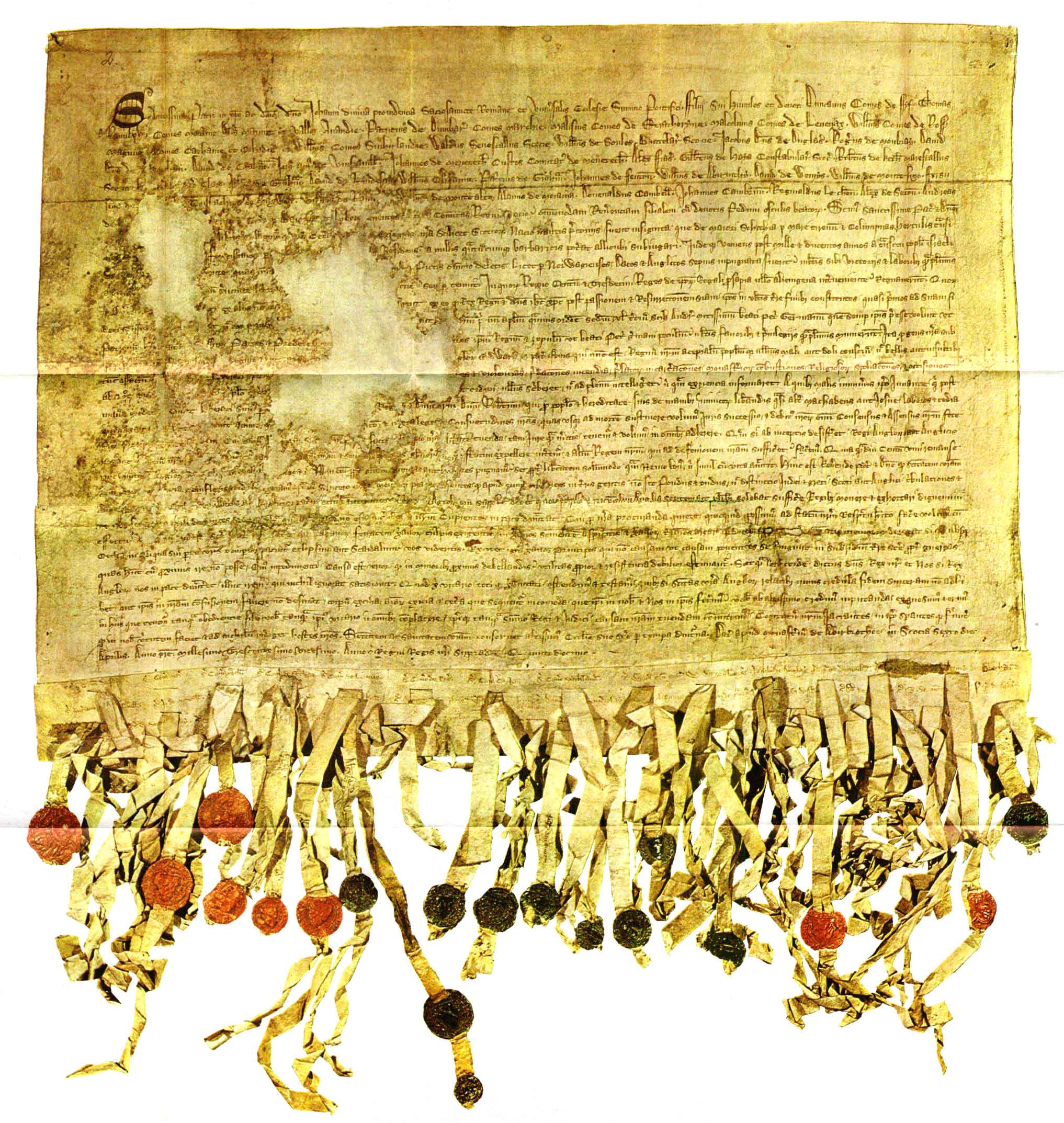
[The text of it may be as dry as an overcooked haggis, but the meaning of it is concise and unequivocal; there was a Scotland long before there was an England, it calls out, and ye can like it or lump it! Although it later forced England's Edward III to sign the Treaty of Northampton in March 1328, successive English rulers paid the declaration no heed, and the endurance of the Scottish national identity even less - always at their peril.]
402 CE - Roman general Stilicho defeated the Visigoths under Alaric I at the Battle of Pollentia by surprising them during their celebration of Easter - making this battle the very first 'War on Easter', if you will.
1320 - The Scottish nobility reaffirmed their independence by signing the Declaration of Arbroath, which was then submitted to Pope John XXII at Avignon; believed to have been drafted by Bernard of Kilwinning at Arbroath Abbey, its rhetoric represents a watershed in the First War of Scottish Independence.
1327 - The poet Petrarch first saw his idealized love, Laura (possibly Laura de Noves), in the church of Saint Clare in Avignon; he then proceeded to write 366 poems about her which, even for a smitten poet, is a lot. During the Renaissance they were collected - and are still available as - Il Canzoniere.
1385 - João, Master of the Order of Aviz, was declared King João I by Portugal's council, which met at Coimbra to settle the disputed secession; although the half-brother of his predecessor Ferdinand I, he was technically illegitimate (his mother being Pedro I's mistress Teresa Lourenço and not his consort Constance of Peñafiel). João I's ascension nevertheless ended the civil war known as the 1383-1385 Crisis, brought an end to the Portuguese Interregnum, and established the royal House of Aviz; accordingly, he was remembered within his own lifetime as João the Good.
1652 - Dutch sailor Jan van Riebeeck established a resupply camp at the Cape of Good Hope, which eventually became Cape Town.
1782 - Rama I succeeded King Taksin of Thailand, who was overthrown in a coup d'état after having been declared insane for his delusions of divinity, a practice sorely in need of restoration in certain circles today...
1814 - Napoleon abdicated, whereupon he was exiled to Elba; not very well, as it turns out, but it was a nice first try.
1830 - The Church of Jesus Christ of Latter-day Saints was organized by Joseph Smith, Jr. and others at Fayette, New York.
1895 - Oscar Wilde was arrested (at London's Cadogan Hotel) after losing a libel case against John Sholto Douglas, 9th Marquess of Queensberry.
1930 - Having left the Sabarmati Ashram in March, the Mahatma arrived at Dandi, where he raised a lump of mud and salt and declared: 'With this, I am shaking the foundations of the British Empire.' Thus began the Salt Satyagraha, and the even longer trek towards independence for India set in motion by the declaration of the Purna Swaraj in December 1929.
1947 - The first Tony Awards - given for excellence in the theatre - were presented by the American Theatre Wing at the Waldorf Astoria Hotel in New York City.
1965 - Intelsat I (nicknamed Early Bird) - the first communications satellite to be placed in geosynchronous orbit - was launched for COMSAT; deactivated in August 1969, it was briefly reactivated for its 25th Anniversary, and remains inoperational but aloft.
1968 - Racial violence erupted in dozens of cities across the United States in reaction to the assassination of Martin Luther King, Jr.; however, a double explosion which killed 41 and injured 150 in Richmond, Indiana's downtown district was related to a faulty natural gas line, and not to the riots then setting major urban centres ablaze.
1970 - Four California Highway Patrol officers - Walt Frago, Roger Gore, George Alleyn, and James Pence - were killed in a shoot out with Jack Twinning and Bobby Davis in the parking lot of a restaurant in the California town of Newhall, in what came to be called the Newhall massacre. Despite the aid of a bystander, former US Marine Gary Kness, Twinning and Davis were able to make their getaway - albeit only briefly; Davis was arrested shortly after stealing a camper van belonging to Daniel Schwartz, and Twinning killed himself to avoid capture the next morning following a hostage situation involving Stephen Hoag. Davis was found dead of an apparent suicide in his cell at Kern Valley State Prison in August 2009.
1973 - NASA launched its Pioneer 11 spacecraft to explore the outer solar system.
1994 - The Rwandan Genocide began when an aircraft carrying that country's president, Juvénal Habyarimana, and Burundian president Cyprien Ntaryamira was shot down near Kigali International Airport whereupon it crashed into the grounds of the Presidential Residence; many theories abound as to who is responsible, but the sad fact is that almost 1 million Rwandans paid the ultimate price - their own lives - for Hutu hatred of Tutsi. The conflict is eloquently described in Canadian Lieutenant-General Roméo Dallaire's memoir Shake Hands With the Devil, as well as in the 2004 film Hotel Rwanda.
2004 - Rolandas Paksas became the first president of Lithuania to be peacefully removed from office by impeachment.
2005 - Kurdish leader Jalal Talabani became President of Iraq, while Shiite Arab Ibrahim al-Jaafari was named prime minister the next day; al-Jaafari has since been replaced by Nouri al-Maliki.
2009 - A 6.3 magnitude earthquake struck near the Italian city of L'Aquila, killing 307; adding insult to injury, during an inspection of the damage by Silvio Berlusconi, the Italian president couldn't understand why those in temporary shelters were complaining, likening their plight to a 'camping weekend'. He then went on to sexually harass a woman doctor who was aiding in the relief.
*
share on: facebook
Monday, April 05, 2010
Pop History Moment: The Explosion At Ripple Rock
On this day in 1958 a sizable portion of the Canadian viewing public watched, transfixed, as one of the first coast-to-coast television broadcasts in the country's history showed them the destruction of Ripple Rock, near the Vancouver Island community of Campbell River...
Essentially an underwater mountain in the Seymour Narrows of British Columbia's Discovery Passage - at low tide a mere 2.7 meters (9 feet) underwater - Ripple Rock represented a major threat to shipping, and the area where it was situated was even described by Captain George Vancouver as 'one of vilest stretches of water in the world'. Since much of the province's mainland coastline isn't connected to the Port of Vancouver by road, residents of Haida Gwaii and cities like Prince Rupert then (as now) relied on coastal freighters for much of their food and other vital consumer items.
Ripple Rock's appetite for boats is borne out by the historical record; beginning in 1875 with the side-wheel steamer Saranac 20 large and 100 smaller vessels were either badly damaged or sunk by it at a cost of at least 110 lives. As early as 1931 a Marine Commission called for a solution to the problem; given the pace of bureaucracy, it wasn't until 1942 that the government approved its removal. The National Research Council of Canada undertook a feasibility study to consider the problem in 1953, and beginning in November 1955 a two and a half year effort to mine Ripple Rock with explosives via a 762 meter horizontal shaft began...
At 9:31:02 am 635,000 metric tons of rock and water were displaced by 1,270 metric tons of Nitramex 2H, which increased the clearing at low tide to about 14 meters (45 feet). Authorities cleared the blast zone to a radius of 3 km, and the camera operators who captured the historic images shown above were housed within a bunker when they did. The blast was felt as far away as Vancouver, and rained debris down from a maximum height of 300 m, some of which struck land on either side of the strait.
Fifty years later to the second the city of Campbell River commemorated the blast by recreating it with the aid of a special effects company; over the intervening years the event had been the subject of two songs - one by folk singer Stu Davis and another by Vancouver punk legends The Evaporators, whose 2004 third album Ripple Rock featured a song by that name.
*
share on: facebook
Gratuitous Brunette: Haruma Miura
In the interest of full disclosure I must say that I'd never heard of Haruma Miura until research uncovered his name, and further research revealed he'd be a suitable candidate for Gratuitous Brunette...
 Still, seeing as the Pop Culture Institute's agenda supports a fair and equitable globalization* it only seems right to highlight a multi-talented actor and singer (formerly with J-pop sensations Brash Brats) from Japan rather than using this space to witter on about some one-hit wonder from the Eighties who just happens to be from the UK.
Born on this day in 1990, Miura's career began when he was just 5; alas, my complete ignorance of Japanese culture - not to mention my inability to read the language - means that all I'm able to glean about him is from his woefully inadequate English-language Wikipedia page.
If you speak Japanese you might want to check out his official website, or if you are a fan of that manga-esque stuff that makes me feel slightly uneasy you might want to leave a comment.
*Translation: Don't care where it gets hits from.
*
share on: facebook
Still, seeing as the Pop Culture Institute's agenda supports a fair and equitable globalization* it only seems right to highlight a multi-talented actor and singer (formerly with J-pop sensations Brash Brats) from Japan rather than using this space to witter on about some one-hit wonder from the Eighties who just happens to be from the UK.Born on this day in 1990, Miura's career began when he was just 5; alas, my complete ignorance of Japanese culture - not to mention my inability to read the language - means that all I'm able to glean about him is from his woefully inadequate English-language Wikipedia page.
If you speak Japanese you might want to check out his official website, or if you are a fan of that manga-esque stuff that makes me feel slightly uneasy you might want to leave a comment.
*Translation: Don't care where it gets hits from.
*
share on: facebook
Remembering... Howard Hughes

While a more standard news outlet might report that on this day in 1976 Howard Hughes died, there's very little that's standard about the Pop Culture Institute; here we'd be more likely to debate precisely when the handsome and dashing aviator known as Howard Hughes died and was replaced by the agoraphobic Howard Hughes who was scared witless of germs. Nevertheless, it's a debate which could continue for years...
*
As long ago as the early 1930s Hughes was displaying symptoms of obsessive-compulsive disorder with regards to the size of peas on his dinner plate; as a film producer he was a micro-managing control freak (even more than usual), often overlooking the quality of the picture as a whole in favour of fixating on some minor flaw in costuming, for instance, as he did during production of The Outlaw. By 1947 he'd taken to locking himself away from the world, surrounded only by a few flunkies to whom he issued variable and complicated instructions; for the most part he would spend the last 30 years of his life in such a reclusive state, using his vast wealth to insulate himself from everyone and everything.
*
Certainly, he'd survived numerous plane crashes - including that of the XF-11 in July 1946 - which left Hughes addicted to various pain medications, but he may also have been susceptible to a hereditary mental illness which, given the judgements and pharmaceuticals of the day, no one at the time could have done anything to allay...
*
share on: facebook
Subscribe to:
Posts (Atom)