Tuesday, June 15, 2010

In Memoriam: Saul Steinberg

Photo Sharing and Video Hosting at Photobucket

In his most famous work - the March 29th, 1976, cover of The New Yorker (sometimes called View of the World or some derivation thereof) - Saul Steinberg both celebrates and chides the supposedly sophisticated Manhattanite's parochial view of the rest of the world. It was quite a bold statement to make in the Bicentennial Year, but if it offended any New Yorkers they refused to show it. The image was a best-selling poster for many years, and not just in the city itself either, but in that emotional diaspora which mysteriously exists even in the hearts of those who've never been there*.

And to think - it almost never came to be; born on this day in 1914, Steinberg's entry to the United States in 1942 was sponsored by the magazine that would be his home for the bulk of his professional life. Had founding editor Harold Ross not been successful, the man and all of his talent would likely have perished in the furnaces of Fascism.

The 85 covers and over 1200 drawings Saul Steinberg crafted for The New Yorker are elegance and simplicity themselves, confections made richer by a considerable dollop of wit; his distinctive style features strong inked lines and surreal visual elements, indicative of the man's redoubtable good nature and unique perspective on the world. Enjoy them all (and many, MANY more) in The Complete Cartoons of The New Yorker, edited by Robert Mankoff and featuring all 70,000+ cartoons, doodles, scribbles, and scratchings published in the pages of the magazine between 1925 and 2006.

*Although for the life of me I can't think of anyone I know who's like that. Nope... Not one.
*

share on: facebook

"Spaceman" by Bif Naked


Taken from Bif Naked's second studio album, 1998's I Bificus, Spaceman concerns a young woman recalling a childhood encounter with an extra-terrestrial; the song made it all the way to #2 on the Canadian charts, the album as much as its single establishing Bif's cred in her adoptive country, which is proud to call her its own.
*
share on: facebook

Pop History Moment: The Signing of Magna Carta

On this day in 1215, England's unpopular King John was forced to sign Magna Carta by what can best be described as a passel* of disaffected nobles; the document was affixed with the Great Seal in a meadow at Runnymede, outside London. Said to be the first piece of legislation designed to curb the powers of a monarch, it is today considered the basis of English common law and is symbolically the load-bearing wall of the British Constitution, even though it was copied almost verbatim from the earlier Charter of Liberties, issued by Henry I in 1100**.

Photo Sharing and Video Hosting at PhotobucketIts preamble - to be followed by 63 fun-filled clauses - reads: JOHN, by the grace of God King of England, Lord of Ireland, Duke of Normandy and Aquitaine, and Count of Anjou, to his archbishops, bishops, abbots, earls, barons, justices, foresters, sheriffs, stewards, servants, and to all his officials and loyal subjects, Greeting.

The document was signed by many prominent nobles and clergymen thusly:

KNOW THAT BEFORE GOD, for the health of our soul and those of our ancestors and heirs, to the honour of God, the exaltation of the holy Church, and the better ordering of our kingdom, at the advice of our reverend fathers Stephen, archbishop of Canterbury, primate of all England, and cardinal of the holy Roman Church, Henry archbishop of Dublin, William bishop of London, Peter bishop of Winchester, Jocelin bishop of Bath and Glastonbury, Hugh bishop of Lincoln, Walter Bishop of Worcester, William bishop of Coventry, Benedict bishop of Rochester, Master Pandulf subdeacon and member of the papal household, Brother Aymeric master of the knighthood of the Temple in England, William Marshal earl of Pembroke, William earl of Salisbury, William earl of Warren, William earl of Arundel, Alan de Galloway constable of Scotland, Warin Fitz Gerald, Peter Fitz Herbert, Hubert de Burgh seneschal of Poitou, Hugh de Neville, Matthew Fitz Herbert, Thomas Basset, Alan Basset, Philip Daubeny, Robert de Roppeley, John Marshal, John Fitz Hugh, and other loyal subjects...


Clearly, the whole 'separation of church and state' thing came later; in fact, any day now...

*If you know a better collective noun for a whole bunch of riled up aristocrats, feel free to suggest one...
**Also, the version still on the books in England and Wales isn't the one signed on this day at all, but one reaffirmed by Edward I in 1297.
*

share on: facebook

Duke Ellington's "Don't Get Around Much Anymore" by Ella Fitzgerald


When Ella Fitzgerald made her singing debut in November 1934 not even she could have known when she died - on this day in 1996, three years after her retirement - that her career would one day span 57 years, surviving and even thriving despite the vagaries of various culture wars and an increasingly capricious audience; when she stepped out onto the stage of Harlem's famed Apollo Theater on that fateful night all she wanted to do was dance. Intimidated by a previous dance act - the Edwards Sisters - Ella decided to sing instead; the rest, as we like to say around here, is pop culture...

Here she is, joined on piano by her fellow legend Duke Ellington, from a television special circa 1968; the song is one of his all-time classics, Don't Get Around Much Anymore*. In total, Ella and Duke recorded two live (Ella and Duke at the Cote D'Azur and The Stockholm Concert - both 1966) and two studio (1957's The Duke Ellington Songbook and 1967's Ella at Duke's Place) albums together, and this clip demonstrates the total ease with which they worked together.

*Also known as Never No Lament; lyrics by Bob Russell.
*

share on: facebook

POPnews (US) - June 15th

Photobucket
[Arlington House - formerly the estate of the family of Robert E. Lee and his wife Mary Anna Lee (nee Custis, a descendant of Martha Washington) - was seized by the US government in 1864, which claimed that taxes hadn't been paid on it; it was then decided to bury the Union dead on its grounds to ensure that Lee would never return there to live. While neither General Lee nor his wife ever sued for the return of their property their eldest son Custis Lee did; despite $26,800 having already been paid for the property, after having the land returned to him in 1877 Lee turned around and sold it to the US government for a tidy profit - $150,000! The Greek Revival mansion with its views of the Potomac River and the National Mall is now the centerpiece of an idyllic tribute to the country's most illustrious dead, including President John F. Kennedy, and even serves as a memorial to Robert E. Lee himself.]

1752 - Benjamin Franklin proved that lightning is electricity. 

1775 - George Washington was appointed commander-in-chief of the Continental Army. 

1804 - New Hampshire approved the Twelfth Amendment to the US Constitution, thereby ratifying it.

1836 - Arkansas became the 25th US state.

1846 - The Oregon Treaty established the 49th parallel as the border between the United States and Canada, from the Rocky Mountains to the Strait of Juan de Fuca.

1859 - Due to an ambiguity in the Oregon Treaty concerning the ownership of the San Juan Islands the 'Northwestern Boundary Dispute' - more colourfully known as the Pig War - erupted between American and British Columbian settlers on the treaty's 13th anniversary.

1864 - Arlington National Cemetery was established when 200 acres (0.8 km²) around Arlington House - formerly owned by Confederate general Robert E. Lee - were officially set aside for that use by US Secretary of War Edwin M. Stanton.

1867 - The Atlantic Cable Quartz Lode gold mine was located in Deer Lodge County, Montana.

1877 - Henry Ossian Flipper became the first African-American cadet to graduate from the United States Military Academy at West Point.

1904 - A fire aboard the steamboat General Slocum in New York City's East River killed more than 1000.

1920 - Three black employees of the James Robinson Circus - Elias Clayton, Elmer Jackson, and Isaac McGhie - were lynched in Duluth, Minnesota - not only for a crime they didn't commit but for a crime that was never committed by anyone; needless to say, no one was ever convicted for the very real crimes which actually were committed that night, although three men were later sent up to Stillwater State Prison for rioting. A nine-year-old boy named Abram Zimmerman witnessed the murders and eventually passed the memory onto his son, who in 1965 wrote a song about the event entitled Desolation Row. The city took nearly 40 years more to finally build its own tribute to the victims; when it was unveiled in October 2003, though, the Clayton Jackson McGhie Memorial became the largest anti-lynching monument in the United States.

1934 - The Great Smoky Mountains National Park - on the border between Tennessee and North Carolina - was established by President Franklin Delano Roosevelt.

1978 - Jordan's King Hussein married American Lisa Halaby, who took the name Noor-al-Hussein, or 'light of Hussein'.
*
share on: facebook

POPnews - June 15th

Photobucket
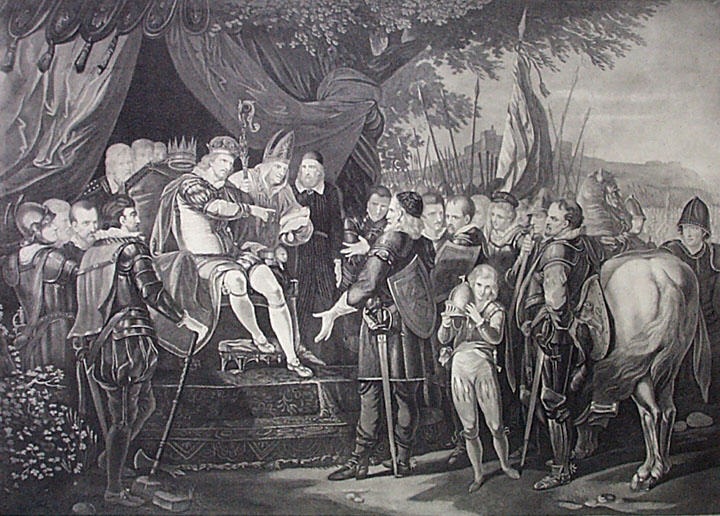
[The above scene of King John signing the Magna Carta was engraved by William Ryland after a picture by 18th Century neo-classicist painter John Hamilton Mortimer, whose romanticism was often wrought at the expense of accuracy; upon embiggening, please observe Exhibit A: a portrait of His Majesty looking altogether more handsome than he actually did in real life.]

923 CE - At the Battle of Soissons France's King Robert I was killed (legend has it by the usurper King Charles III himself); the so-called Charles the Simple was later arrested and imprisoned by Rudolph, Duke of Burgundy, who himself became king.

1184 - Norway's King Magnus V was killed at the Battle of Fimreite.

1215 - King John of England put his seal to the Magna Carta at the Thames-side meadow of Runnymede in order to thwart a rebellion by his aristocracy.

1219 - According to legend Dannebrog - the flag of Denmark and the oldest national flag in the world - fell from the sky during the Battle of Lyndanisse near Estonia's Toompea Castle, turning the Danes' luck.

1246 - With the death of Duke Frederick II, Austria's Babenberg dynasty ended.

1520 - Pope Leo X threatened to excommunicate Martin Luther in a papal bull entitled Exsurge Domine.

1667 - The first human blood transfusion was administered by Dr. Jean-Baptiste Denys.

1785 - Jean-François Pilâtre de Rozier - co-pilot of the first-ever manned flight - and his companion, Pierre Romain, became the first-ever casualties of an air crash when their hot air balloon exploded during an attempt to cross the English Channel.

1888 - Germany's Crown Prince Wilhelm became Kaiser Wilhelm II following the death of his father Frederick III, making him third in the so-called Year of Three Emperors; he was also to be the last emperor of the German Empire.

1905 - Britain's Princess Margaret of Connaught married Gustav, Crown Prince of Sweden.

1913 - The Battle of Bud Bagsak in the Philippines concluded with a decisive US victory for General John 'Black Jack' Pershing over the Moro Rebellion.

1919 - John Alcock and Arthur Brown completed the first nonstop transatlantic flight at Clifden, in Ireland's County Galway.

1944 - In Saskatchewan, the CCF Party of Tommy Douglas was elected, forming North America's first socialist government.

1945 - The General Dutch Youth League (ANJV) was founded in Amsterdam.

1954 - The UEFA (Union des Associations Européennes de Football) was formed in Basle, Switzerland.

1978 - Jordan's King Hussein married American Lisa Halaby, who took the name Queen Noor; at the time of their meeting Halaby - an architect and urban planner - was working on the Jordanian capital's Amman Intercontinental Airport.

1985 - Rembrandt's painting Danaë was attacked at St. Petersburg's Hermitage Museum by a man later judged insane, who threw sulfuric acid on the canvas and cut it twice with his knife. Restoration of the eight by ten foot masterpiece took nearly 12 years.

1991 - The first federal political party in Canada that supported Quebec nationalism, the Bloc Québécois, was founded by former Conservative MP Lucien Bouchard.

1996 - A terrorist bomb in the UK injured over 200 people and devastated a large part of Manchester's city centre.
*
share on: facebook

Monday, June 14, 2010

"Do You Really Want To Hurt Me" by Culture Club


Part of the appeal of Culture Club to little 12 year-old me was the fact that Boy George used to drive my father crazy; we'd been rocking out to this song on the radio for months before he finally saw a picture of the Boy, at which point my father's full-on closet-case hypocrisy revealed itself for what it was. Fortunately it happened in the TV room and not on the highway.

Do You Really Want to Hurt Me? was a huge smash all over the world, propelling the band to stardom and their debut album, Kissing to Be Clever, along with them; fame being what it is - namely a hideous bitch goddess - the band's success proved to be its undoing, not that the inevitable descent into tabloid ignominy wasn't as hugely entertaining as it was tragic. While revelations of George's heroin abuse didn't much interest me, the stories about his affair with bandmate Jon Moss* did add an element to the scandal which was then quite unique.

*The object and subject of one of my most long-standing schoolboy crushes.
*

share on: facebook

Happy Birthday Boy George

Photo Sharing and Video Hosting at Photobucket


I prefer to remember Boy George this way, before the toxic effects of fame really took effect...

Once upon a time he was a nelly bloke who wrote cryptic poems; now he's a rude bitch, mincing his way to oblivion.

Oh wait... I forget. Were we just talking about me or Boy George?
*

share on: facebook

In Memoriam: Ernesto 'Che' Guevara

How cool is that? A New Yorker cartoon featuring an iconic image of Che Guevara wearing a Bart Simpson t-shirt... It's so pop, I think I'm gonna pop!

Photo Sharing and Video Hosting at PhotobucketSeriously though, there are plutocrats and robber barons of all kinds who can't sleep at night (and not just because of their coke habit) who wish they could cram their memes as deep into the culture as this snapshot of a communist by Alberto Korda. I see Che t-shirts all over Vancouver, often layered with Calvin Klein, and the irony fairly makes me quiver.

Oh, and in case you're a plutocrat and a robber baron yourself, the story has a happy capitalist ending. Señor Korda shot his most famous image (some have called it the most famous image of the 20th century) for the Cuban newspaper Revolucion and never received a penny in royalties for it; entitled Guerrillero Heroico, it was taken in March 1960 at a memorial in Havana for the victims of the La Coubre explosion and not published internationally until seven years later.

A great many people have gotten rich with this image, just not the author or the subject... Vive la marketplace!

Born on this day in 1928, Guevara was executed by Mario Terán in October 1967, a day after his capture in Bolivia by CIA operative Félix Rodríguez.
*
share on: facebook

POPnews - June 14th

Photobucket
[As depicted by Jean Froissart in his famous Chronicles (which principally concerns itself with the events of the Hundred Years' War, albeit from a French perspective) peasants from Essex and Kent opposed to the poll tax stormed into the capital across London Bridge and temporarily seized the Tower of London - summarily executing Simon of Sudbury, the Lord Chancellor and Archbishop of Canterbury, as well as the Lord Treasurer Robert de Hales, both of whom were behind the tax's implementation and had taken refuge there in the (mistaken, as it turns out) belief they would be safe within its sturdy walls; whether or not the rebels had been let in to the Tower by sympathetic keepers remains one of history's great unanswered questions... Meanwhile, in nearby Westminster, another group was responsible for destroying John of Gaunt's Savoy Palace on the Strand.]

1381
- England's 15 year-old King Richard II met with the leaders of the Peasants' Revolt - including a face-to-face confrontation with Wat Tyler - on Blackheath, near London; at the meeting Tyler was mortally wounded by London mayor William Walworth, and without Tyler's leadership the revolt soon dispersed.

1645 - At the Battle of Naseby - the key battle of the first English Civil War - 12,000 Cavalier troops loyal to King Charles I were badly beaten by 15,000 Roundheads of the New Model Army commanded by Sir Thomas Fairfax and Oliver Cromwell.

1775 - At the outset of the American Revolution the Continental Army was established by the Continental Congress, marking the birth of the US Army.

1777 - The Stars and Stripes was adopted by Congress for use as the American Flag, today the source of the little-observed Flag Day.

1807 - Emperor Napoleon I's French Grande Armee defeated its Russian counterpart at the Battle of Friedland in Poland (near the modern-day Russian enclave of Kaliningrad Oblast) ending the War of the Fourth Coalition.

1821 - Badi VII, king of Sennar, surrendered his throne and realm to Ismail Pasha, general of the Ottoman Empire, ending the existence of that Sudanese kingdom.

1846 - The Bear Flag Revolt began when English-speaking settlers in Sonoma, California, started a rebellion against the Mexican government of Alta California and proclaimed the California Republic.

1919 - John Alcock and Arthur Whitten Brown departed St. John's, Newfoundland, on the first nonstop transatlantic flight.

1934 - James J. Braddock scored one of the most upsetting victories of his boxing career - not to mention riveted an America deep in the throes of the Great Depression - by defeating the 'Ozark Cyclone' John 'Corn' Griffin in three rounds. The bout marked the beginning of one of boxing's greatest comeback stories - for Braddock, that is; for Griffin... Not so much. In the days after the fight noted wag Damon Runyon dubbed Braddock 'Cinderella Man', much to his manager Joe Gould's delight; and to think it only took seventy years to be made into a movie!

1937 - The US House of Representatives passed the 1937 Marihuana Tax Act effectively rendering pot illegal.

1941 - The Soviet Union's so-called June Deportation - a series of mass deportations and murder of Estonians, Lithuanians and Latvians - began.

1951 - UNIVAC I was dedicated by the US Census Bureau.

1952 - The keel of the nuclear submarine USS Nautilus was laid by US President Harry S. Truman.

1954 - US President Dwight D. Eisenhower signed a bill into law placing the words 'under God' into the Pledge of Allegiance, thereby ruining the nation and all it once stood for.

1962 - Albert DeSalvo, better known as the Boston Strangler, murdered his first victim, Anna Slesers.

1966 - The Vatican announced the abolition of its Index Librorum Prohibitorum - an index of prohibited books originally instituted in 1557.

1967 - Mariner 5 was launched toward Venus.

1982 - The Falklands War ended when Argentine forces in the capital Stanley unconditionally surrendered to Britain.

2002 - The near-Earth asteroid 2002 MN came within 75,000 miles (120,000 km) of the Earth, which is about one-third of the distance between the Earth and the Moon.
*
share on: facebook

Sunday, June 13, 2010

"Sing, Sing, Sing" by Benny Goodman Orchestra


Musically, the 1930s truly was the age of giants. Here is the Benny Goodman Orchestra performing their signature tune Sing, Sing, Sing at the Hollywood Hotel in 1937; in addition to Benny Goodman himself on the licorice stick, Gene Krupa plays a mad beat (seemingly with two golden arms*) and Harry James a cool trumpet solo as well. It is said - and not just by me, either - that this song is the anthem of the Swing Era, a song which is continually being rediscovered by subsequent generations, one whose frantic patter has been quickening heartbeats for 70 years.

Goodman died on this day in 1986, but lives on thanks to the miracle of technology.

*Krupa, of course, being the subject of the 1955 film
The Man With the Golden Arm, starring Frank Sinatra as the man who liked him some drumming but liked him some heroin more.
*

share on: facebook

"Sharing The Night Together" by Dr. Hook


This smooth bit of AM Gold is in honour of Dennis Locorriere, who crooned Dr Hook to chart dominance in the Seventies; Sharing The Night Together appeared on the band's 1978 album Pleasure and Pain, eventually spending 22 weeks on the US charts, peaking at #6.

Now, when it comes to sharing nights together, that's what I call stamina...
*
share on: facebook

"Countless lives inhabit us..." by Fernando Pessoa as Ricardo Reis

Countless lives inhabit us.
I don’t know, when I think or feel,
Who it is that thinks or feels.
I am merely the place
Where things are thought or felt.

I have more than just one soul.
There are more I’s than I myself.
I exist, nevertheless,
Indifferent to them all.
I silence them: I speak.

The crossing urges of what
I feel or do not feel
Struggle in who I am, but I
Ignore them. They dictate nothing
To the I I know: I write.

* * *

Vivem em nós inúmeros;
Se penso ou sinto, ignoro
Quem é que pensa ou sente.
Sou somente o lugar
Onde se sente ou pensa.

Tenho mais almas que uma.
Há mais eus do que eu mesmo.
Existo todavia
Indiferente a todos.
Faço-os calar: eu falo.

Os impulsos cruzados
Do que sinto ou não sinto
Disputam em quem sou.
Ignoro-os. Nada ditam
A quem me sei: eu escrevo.
*
share on: facebook

In Memoriam: Fernando Pessoa

Photo Sharing and Video Hosting at Photobucket


Of all the oddball poets (admittedly, quite a large group) Fernando Pessoa's reputation as one of the oddest of them all is well-earned; while many writers ply their craft under false names, Pessoa assumed entire false identities, which he called heteronyms.

Personally, I had never even heard of him (obscure Portugese poets who've been dead for 70 years get so little press in Canada) until I was introduced to him by my friend Laura Cardoso, who was in the same writing group as me. She referenced him in a poem she wrote for me, in part because she'd noticed I did something similar.

Thanks to these heteronyms, it's virtually impossible to know anything about his real life, which may have been the point. One of these personae is obviously homoerotic; so is that Pessoa, attempting to flesh out that part of human experience, or is it a sad closet case's plea for help?

It may be both; it may be neither... Who the fuck knows with a poet, eh?
*
share on: facebook

"Buddy Holly" by Weezer


Birthday wishes go out today to Rivers Cuomo, uber-cute front man for alt-rock wunderkinds Weezer; here they perform their 1994 single Buddy Holly in the kind of pop cultur-iffic alt-universe of which we at the Pop Culture Institute can't get enough. Art house auteur Spike Jonze has dropped the band into an episode of Happy Days, complete with a cameo by original cast member Al Molinaro!

Released on what would have been Buddy Holly's 58th birthday (had the musician survived The Day the Music Died) the single appears on the band's debut album Weezer, sometimes called The Blue Album; despite what is in every sense an artistic tour de force*, though, according to Cuomo himself the song almost didn't make it onto the album.

*The single was produced by New Wave legend Ric Ocasek, after all!
*

share on: facebook

Pop History Moment: Elizabeth II Shot At

Photo Sharing and Video Hosting at PhotobucketOn this day in 1981 17-year-old Marcus Sarjeant shot at Queen Elizabeth II as she rode Burmese* during the annual Trooping the Colour ceremony in London. The Queen never lost her composure, and easily quieted her equally reliable mount.

The would-be assassin was readily apprehended, at which time it was revealed he had been shooting blanks; he was later sentenced to five years in prison, of which he served three, and was released in 1984.

'I did it because I wanted to be famous,' he said, apparently in his own defense.

*A gift to Her Majesty from the Royal Canadian Mounted Police in 1969, Burmese was bred at the RCMP Stud in Regina - home of the famed Musical Ride. Since 2005 the Queen can be seen riding Burmese in perpetuity; a statue in front of the Saskatchewan Legislature commemorates their special friendship. Burmese was retired in 1986, and died in 1990.
*
share on: facebook

POPnews - June 13th

Photobucket
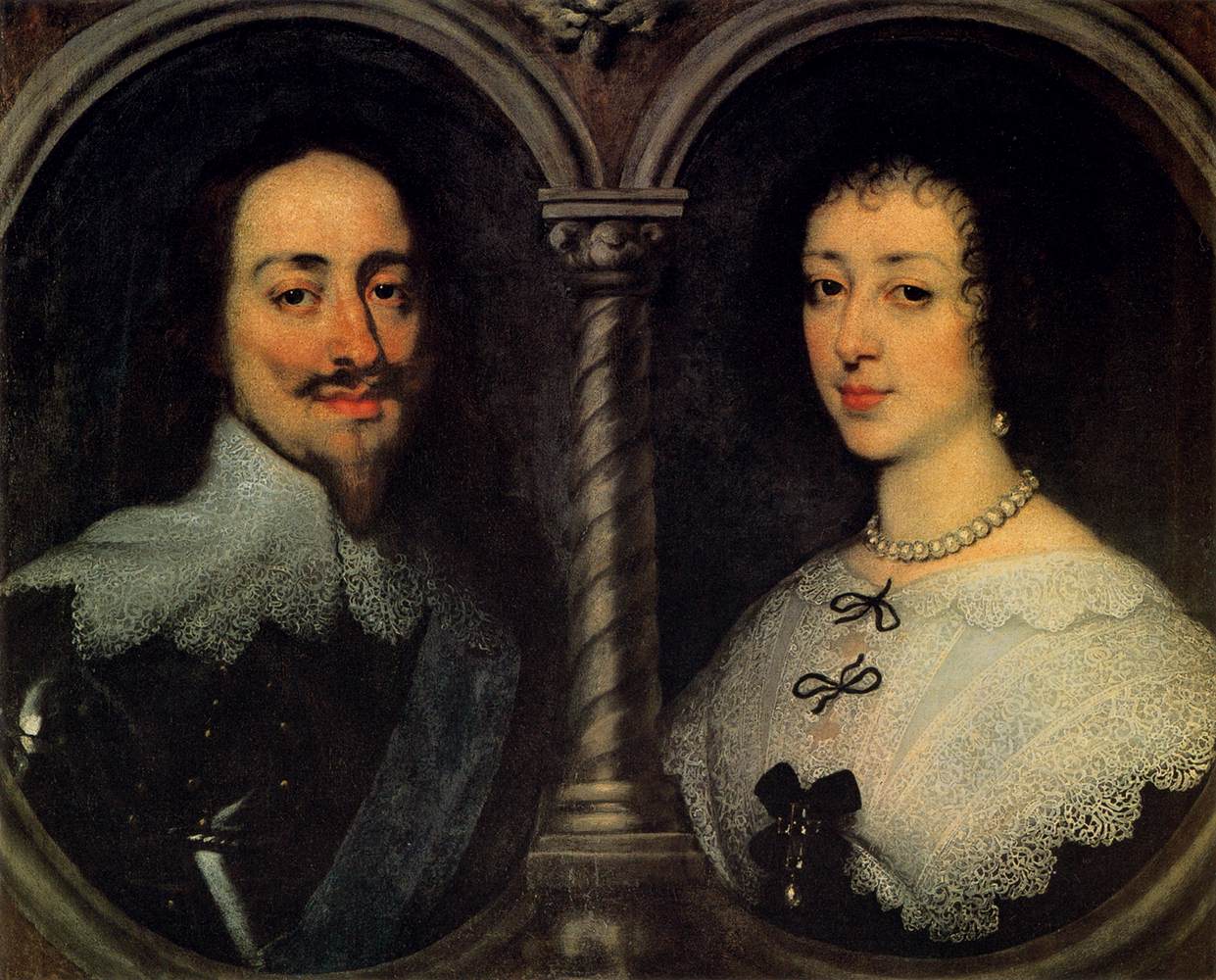
[The daughter of France's King Henri IV and his second wife Marie de Medici, through her daughter Henrietta, Duchess of Orléans Charles I's queen is related to French monarchs Louis XV, Louis XVI, Louis XVII, Louis XVIII & Charles X plus such modern-day luminaries as Diana, Princess of Wales , Prince William, Prince Harry, and Camilla, Duchess of Cornwall as well through the illegitimate children of her son, Charles II. Despite being such a pivotal figure in history - every bit as much as Queen Victoria if not more - Henrietta Maria has been written about very little, and understood even less...]

1525 - Martin Luther married Katharina von Bora, openly defying the celibacy doctrine decreed by the Roman Catholic Church on priests and nuns in the most boring way imaginable.

1625 - England's King Charles I married French princess Henrietta Maria; not only would she become the mother of two kings (Charles II and James II) she would also be the grandmother of two queens (Mary II and Queen Anne) as well as William III - who, according to rumour was both a king and a queen - besides.

Photobucket1777 - At the outset of the American Revolution the Marquis de Lafayette (who during the subsequent French Revolution renounced his title in a fit of Republicanism and became plain-old Gilbert de Motier) landed near Charleston in order to help the Continental Congress to train its army, which he did as an unpaid volunteer. Some idea of the closeness between the has-been Marquis and the would-be President George Washington can be gleaned from David A. Barry's book Adopted Son: Washington, Lafayette, and the Friendship That Saved the Revolution, which will have to do until I decide* to take up writing slash fiction.

*Or am driven, out of sheer desperation, more like...

1798 - The Mission San Luis Rey de Francia was founded in what is now Oceanside, California.

1881 - The USS Jeannette was crushed in an Arctic Ocean ice pack and sunk under the command of George W. DeLong; owned by James Gordon Bennett, Jr., owner of the New York Herald, the Jeannette had been sent North to look for an overdue expedition aboard the Vega.

1886 - A fire devastated much of Vancouver; on the same day Bavaria's King Ludwig II was found dead in Lake Starnberg, south of Munich. Most historians feel the two events aren't related - and even a paranoid bastard such as myself can't force any connection, but I'll probably keep trying anyway...

1898 - Yukon Territory was formed, with Dawson chosen as its capital; the capital was moved to Whitehorse following World War II, to little effect.

1927 - A ticker-tape parade was held for aviator Charles Lindbergh down Manhattan's Fifth Avenue upon his return to New York City from Paris following his historic transatlantic flight on May 20th.

Photobucket1935 - In one of the biggest upsets in championship boxing, the 10 to 1 underdog James J. Braddock (shown, at right) defeated Max Baer at the Madison Square Garden Bowl in Long Island City, New York, making him the heavyweight champion of the world. Braddock's life was reverently inhabited by Russell Crowe in Ron Howard's 2005 biopic Cinderella Man; he was joined by Paul Giamatti as Braddock's manager Joe Gould and for once Squinty McCokeface doesn't ruin the film by playing Braddock's long-suffering wife Mae, although the unflattering - and inaccurate - portrayal of Max Baer (otherwise well-played by Craig Bierko) nearly does. 

1942 - The US government opened its Office of War Information.

1955 - Mir Mine - the Soviet Union's first diamond mine - was discovered.

1966 - The US Supreme Court ruled, in Miranda v. Arizona, that the police must inform suspects of their rights before questioning them; Justice John Marshall Harlan II didn't agree, nor did Justice Tom C. Clark, or Justices Potter Stewart and Byron White for that matter. Oh that wacky Warren Court!

1967 - U.S. President Lyndon B. Johnson nominated Solicitor-General Thurgood Marshall to become the first black justice on the US Supreme Court following the retirement of Justice Tom C. Clark.

1977 - Convicted Martin Luther King Jr. assassin James Earl Ray was recaptured after escaping from Brushy Mountain State Penitentiary three days earlier. 

1982 - Fahd became King of Saudi Arabia upon the death of his brother, Khalid. 

1983 - Pioneer 10 became the first man-made object to leave the solar system when it left the orbit of Neptune. 

1991 - Boris Yeltsin became Russia's first popularly elected President.

1996 - The Montana Freemen surrendered after an 81-day standoff with FBI agents.

1997 - A jury sentenced Timothy McVeigh to the death penalty for his part in the 1995 Oklahoma City bombing.
*
share on: facebook

Saturday, June 12, 2010

"Born With a Broken Heart" by Kenny Wayne Shepherd


This song is a favourite of mine, which explains so much; shown here recorded before a live audience in 1996, Born With a Broken Heart is the first song on Kenny Wayne Shepherd's first album Ledbetter Heights, and showed that straight out of the gate the boy was a man.

The actual Ledbetter Heights - also known as 'St. Paul's Bottoms' - is a traditionally black neighbourhood and former red-light district in Shreveport*, an area which spawned blues god Huddie 'Leadbelly' Ledbetter and was later named after him in an effort to rehabilitate the district's image...
All of which begs the question: what kind of a sorry state would a neighbourhood have to be in that naming it after a blues musician would improve it?

*Kenny Wayne Shepherd's hometown, yo.
*
share on: facebook

Happy Birthday Kenny Wayne Shepherd

Photo Sharing and Video Hosting at PhotobucketA blues prodigy, self-taught by age 7, Kenny Wayne Shepherd recorded his first album Ledbetter Heights at age 17. In it, not only is his playing as sharp as a seasoned veteran's, his vocals growl and yelp and ache more like a man of 71 than 17. His second album, Trouble Is..., holds the record for the longest duration on the American Blues chart.

Today at 33 he is the author of five albums and tours extensively, often playing with the likes of B. B. King and Clarence 'Gatemouth' Brown. In 2006 he married Hannah, the eldest daughter of Mel Gibson and together they have two children.
*
share on: facebook

In Memoriam: Anne Frank

Both a remarkable young woman and her remarkable book were born on this day: the girl in 1929, and the book 13 years later, in 1942; that such a simple birthday present as a diary could one day become the single most damning piece of evidence against the atrocities of the Holocaust not only staggers the mind but also makes the heart soar...

Photo Sharing and Video Hosting at PhotobucketBorn in Frankfurt, Anne Frank and her family fled to Aachen in 1933 after Hitler's election, finally settling in Amsterdam the following year. For awhile it seemed their flight had been successful, but they were soon trapped in Holland following the Nazi Occupation in November 1940.

Anne Frank's diary was begun less than a month before her family went into hiding, in July 1942; its earliest entries, while detailing the minutiae of her life, also offer glimpses of a growing awareness that her life was in danger. For two long years her family and four of their friends hid in a room in the back of the Opekta Works factory on the Prinsengracht (now a museum) which her father owned, until being arrested by the Gestapo in August 1944 - on a tip from a person whose identity remains unknown to history even if the sting of their betrayal survives.

Alas, the third act of Anne's life was not to be; seven months after her arrest she died of typhus in the concentration camp at Bergen-Belsen, a few days after her older sister Margot. The exact date of their deaths remain unknown, but it was likely some time in March 1945, when an epidemic of the disease swept the camp. Since it was her dream to be a journalist one wonders how Anne, already a gifted and sensitive writer, would have described those last months of her young life, the liberation of the camps just six weeks after she died, or the ensuing Nuremberg trials when those responsible would be held accountable, having already written history's most damning account of Nazism by the age of 15.

Anne's father Otto Frank was the only survivor of the achterhuis, and upon his return to Amsterdam he was given Anne's diary, which was found and saved by Miep Gies, who'd aided the inmates during their hiding at great personal risk to herself. Today it is one of the world's most read books, and Gies is a national (indeed an international) heroine for having rescued it.

Anne's story was quickly adapted for the stage, and that play duly became a movie; the most chilling work on the life and death of Anne Frank, though, is Jon Blair's 1995 documentary Anne Frank Remembered; narrated by Kenneth Branagh and featuring excerpts of the diary read by Glenn Close, among the many treasures it contains* is the only known film footage of Anne Frank.

*Anne Frank Remembered also contains the longest interview Miep Gies ever gave about her involvement with the Franks, as well as their fellow captors, the Van Pels family - Hermann, Auguste, and 16-year-old Peter - and Fritz Pfeffer. It comes with the highest possible recommendation of the Pop Culture Institute.
*
share on: facebook