Monday, August 30, 2010
Happy Birthday Kitty Wells
As hard as it might be to believe, country music was once almost exclusively a man's game...
It was Kitty Wells who shattered that particular straw-covered glass ceiling in 1952, with a little ditty called It Wasn't God Who Made Honky Tonk Angels, a record which was controversial in its time for asserting that just maybe it wasn't women who were exclusively to blame for sin. No matter how the men may have grumbled, Wells' radio play and record sales were massive, which allowed her almost unimpeded access to their old boy's club. In 1956, Wells also became the first woman to release a solo country album, Kitty Wells' Country Hit Parade.
For the next decade her string of hits continued, encouraging a successive generation of female artists - including Tammy Wynette, Loretta Lynn, and Dolly Parton - to add a female perspective to the genre; many of her songs were written in response to those of men, as with the classic exchange of Paying For That Back Street Affair, which impertinently (and rightly so) responded to Webb Pierce's Back Street Affair*. Still, if there were hard feelings between them, they weren't evident in the duets they later recorded together; in fact, Wells eventually made duets with many of the men who may have been reticent towards her fame, including Pierce, Red Foley and Jim Reeves.
Today country music legend Kitty Wells turns 91; here she is on the Grand Ole Opry singing I Don't Claim To Be An Angel, no matter how strenuously those of us in the know might beg to differ...
*If only she were still recording, maybe she could make Toby Keith shut the Hell up.
*
share on: facebook


In Memoriam: Shirley Booth

My earliest exposure to the unique talents of Shirley Booth was on the original cast recording of A Tree Grows in Brooklyn, in which she played the character of Cissy; I was then about 22, a budding theatre queen, and had long* been a fan of Betty Smith's novel of the same name. Although the story is ostensibly about Francie, onstage the unlucky-in-love Aunt Cissy steals the show, mainly due to the strength of Booth's personality. To this day I have no idea why a character who's such a loser with men should so capture my imagination, but there you have it...
Booth's career was centered on the Broadway stage, yet because of the greater durability of movies and the wider reach of television, she is better known for the five movies she made and the five seasons in which she starred as the titular Hazel, the sitcom that cemented her reputation**. Still, for those who know Shirley Booth only as that brassy maid with a heart of gold (or was it the other way 'round?) it was probably the 1952 film Come Back, Little Sheba that made it all possible; Booth became the first person in history to win both a Tony Award for the stage version and an Oscar for the movie version, which was also her big screen debut. She later starred as Dolly Levi in the film version of The Matchmaker (supplanting the role's Broadway originator, Ruth Gordon) a full decade before Barbra Streisand hammed it up for director Gene Kelly in Hello, Dolly! and five years before Carol Channing's iconic portrayal in the stage musical.
Born on this day in 1898 - which for actress-y reasons she later changed to 1907 - Shirley Booth made her final curtain call in October 1992, having been retired since 1974.
*Well, for five years anyway, but when you're 22 five years is a very long time!
*
share on: facebook
Pop History Moment: The Funeral of Princess Marina
For centuries royalty only married each other, and the British were no exception; the history of that storied isle is cluttered with tales of foreign princesses and their equally exotic retinues washing ashore like veddy posh asylum seekers, each with an experience as individual as the kingdoms from whence they originally hailed...
 It's debatable who was the first foreign princess to take a chance on a British prince, but the last one we know for a fact was Princess Marina - who became Duchess of Kent upon her marriage to Prince George, the fourth son of George V and Queen Mary, in November 1934.
Princess Marina was born into the Greek Royal Family, who themselves were Danish, while Marina's mother was a Russian archduchess and granddaughter of Tsar Alexander II. With her model-thin body the newly-minted Duchess of Kent quickly earned a reputation as a fashion plate, while her doe-like demeanour endeared her to the British public, especially after the tragic wartime death of her husband in August 1942.
Princess Marina remained an active member of the British Royal Family throughout her widowhood, even attending the independence of Ghana (the first of the British Empire's colonies to attain nationhood) in March 1957. It's this sense of duty she instilled in her children - the present Duke of Kent, Princess Alexandra, and Prince Michael of Kent - who all support the Queen where and when they can; in fact, when the Duke of Kent attended Ghana's fiftieth anniversary celebrations in 2007 he could be said to have been representing both his mother and his queen.
Her Royal Highness was buried on this day in 1968, three days after her sudden death at Kensington Palace from a brain tumour; aged only 61, she died just hours after her condition was announced to the Nation. The ceremony - held at St. George's Chapel, Windsor - was attended by all the usual suspects, including her brother-in-law the Duke of Windsor, who flew in from France in order to get the cold shoulder from everyone else. The following year Princess Marina was immortalized in pop culture by The Kinks, whose song She's Bought A Hat Like Princess Marina appeared on their concept album Arthur (Or the Decline and Fall of the British Empire), released in October 1969.
*
share on: facebook
It's debatable who was the first foreign princess to take a chance on a British prince, but the last one we know for a fact was Princess Marina - who became Duchess of Kent upon her marriage to Prince George, the fourth son of George V and Queen Mary, in November 1934.Princess Marina was born into the Greek Royal Family, who themselves were Danish, while Marina's mother was a Russian archduchess and granddaughter of Tsar Alexander II. With her model-thin body the newly-minted Duchess of Kent quickly earned a reputation as a fashion plate, while her doe-like demeanour endeared her to the British public, especially after the tragic wartime death of her husband in August 1942.
Princess Marina remained an active member of the British Royal Family throughout her widowhood, even attending the independence of Ghana (the first of the British Empire's colonies to attain nationhood) in March 1957. It's this sense of duty she instilled in her children - the present Duke of Kent, Princess Alexandra, and Prince Michael of Kent - who all support the Queen where and when they can; in fact, when the Duke of Kent attended Ghana's fiftieth anniversary celebrations in 2007 he could be said to have been representing both his mother and his queen.
Her Royal Highness was buried on this day in 1968, three days after her sudden death at Kensington Palace from a brain tumour; aged only 61, she died just hours after her condition was announced to the Nation. The ceremony - held at St. George's Chapel, Windsor - was attended by all the usual suspects, including her brother-in-law the Duke of Windsor, who flew in from France in order to get the cold shoulder from everyone else. The following year Princess Marina was immortalized in pop culture by The Kinks, whose song She's Bought A Hat Like Princess Marina appeared on their concept album Arthur (Or the Decline and Fall of the British Empire), released in October 1969.
*
share on: facebook
"Monday, Monday" by The Mamas and The Papas
Monday, Monday wasn't the first hit for The Mamas and the Papas, but it was their biggest - at least in terms of chart position, eventually reaching #1 in the US; originally included on their album If You Can Believe Your Eyes and Ears in 1966, it was also the first song to attain such giddy heights by a group featuring both men and women, and won the band a Grammy Award in March 1967.
Cass Elliot, of course, died in July 1974, John Phillips* in March 2001, and Denny Doherty in January 2007, leaving Michelle Phillips as the band's only surviving member.
*Who was born on this day in 1935.
*
share on: facebook
In Memoriam: Molly Ivins
When Molly Ivins - born on this day in 1944 - succumbed to cancer in January 2007 we liberal loudmouths lost more than just a spokeswoman, we lost a friend...
 What gets me about Ivins' work is how she could spend a lifetime writing about not only politics but Texas politics and not 1) blow her head off with a rifle, 2) be more outraged than she is, or 3) lose her sense of humour.
I'd like to think her work has taught me an alternative way to express my outrage over corruption. While the Carl Hiaasen method is more fun (and undoubtedly attracts more attention, at least in the short term) Molly Ivins' homespun way of looking at the eternal spiral of greed and graft among our overlords is probably best designed for the long run. After all, given enough time even the worst outrages fade; what ought to remain is a reminder that even though names change, human nature doesn't.
In time there will be scandals that not even Molly Ivins herself could have predicted. Thankfully she left behind a recipe for us to deal with it without losing our heads.
*
share on: facebook
What gets me about Ivins' work is how she could spend a lifetime writing about not only politics but Texas politics and not 1) blow her head off with a rifle, 2) be more outraged than she is, or 3) lose her sense of humour.I'd like to think her work has taught me an alternative way to express my outrage over corruption. While the Carl Hiaasen method is more fun (and undoubtedly attracts more attention, at least in the short term) Molly Ivins' homespun way of looking at the eternal spiral of greed and graft among our overlords is probably best designed for the long run. After all, given enough time even the worst outrages fade; what ought to remain is a reminder that even though names change, human nature doesn't.
In time there will be scandals that not even Molly Ivins herself could have predicted. Thankfully she left behind a recipe for us to deal with it without losing our heads.
*
share on: facebook
POPnews - August 30th

[After being arrested, Fanny Kaplan gave the following statement:
1363 - The Battle of Lake Poyang began, pitting the forces of two Chinese rebel leaders - Chen Youliang of the Han and Zhu Yuanzhang of the Ming - against each other in what would become one of the largest naval battles in history, during the last decade of the ailing, Mongol-led Yuan Dynasty. Hostilities would last until October 4th, and within five years of his victory Zhu would become the Hongwu Emperor, first of the Ming Dynasty to rule after the fall of the Yuan.
1574 - Guru Ram Das became the Fourth Sikh Guru.
1791 - The HMS Pandora - sent to Pitcairn Island under the command of Captain Edward Edwards to arrest those responsible for the Mutiny on the Bounty - sank after running aground on the Great Barrier Reef the previous day.
1800 - Gabriel Prosser attempted to incite a slave rebellion in Richmond, Virginia, only to be thwarted by inclement weather; he was officially (if informally*) pardoned by Governor Tim Kaine on this day in 2007.
*Because the pardon being granted was posthumous it was also informal.1574 - Guru Ram Das became the Fourth Sikh Guru.
1791 - The HMS Pandora - sent to Pitcairn Island under the command of Captain Edward Edwards to arrest those responsible for the Mutiny on the Bounty - sank after running aground on the Great Barrier Reef the previous day.
1800 - Gabriel Prosser attempted to incite a slave rebellion in Richmond, Virginia, only to be thwarted by inclement weather; he was officially (if informally*) pardoned by Governor Tim Kaine on this day in 2007.
1813 - During the so-called Creek War a faction of Creek Red Sticks led by Peter McQueen and William Weatherford (known as Red Eagle) carried out the Fort Mims Massacre in Alabama.
1835 - Settlers from Tasmania founded Melbourne, Australia.
1836 - The Texas city of Houston was founded by Augustus Chapman Allen and John Kirby Allen.
1862 - After three days of fierce fighting Union forces under John Pope were defeated by the Confederates of Robert E. Lee at the Second Battle of Bull Run during the American Civil War.
1909 - The Burgess Shale fossils were discovered by Charles Doolittle Walcott near Field, British Columbia.
1918 - Bolshevik leader V. I. Lenin was shot and seriously wounded by Fanny Kaplan, who was formerly a member of the Socialist Revolutionary Party.
1922 - The Battle of Dumlupinar - the final engagement in the Greco-Turkish War (which was itself part of the larger Turkish War of Independence) - provided a decisive victory for Mustafa Kemal Atatürk over Greek commander Georgios Hatzianestis near the Turkish town of Kütahya following a four-day fight with heavy casualties on both sides.
1956 - The southbound lane of the Lake Pontchartrain Causeway opened.
1962 - Japan's Nihon Aircraft Manufacturing Corporation conducted a test of the NAMC YS-11, the country's only successfully manufactured aircraft following World War II; in total 182 of the turboprop airliners would be built before their production ceased in 1974, although the last one in domestic use wasn't grounded on September 2006.
1967 - Thurgood Marshall was confirmed as Chief Justice of the US Supreme Court.
1968 - Britain's Princess Marina was buried at Frogmore next to her husband following a funeral at St. George's Chapel, Windsor; she'd died of a brain tumour at her home in Kensington Palace on August 27th, only hours after the Nation first learned of her dire condition.
1976 - London's annual Notting Hill Carnival ended in a riot.
1982 - Following an invasion of Lebanon by the Israel Defense Forces - during an operation which has come to be known as the Siege of Beirut - Palestine Liberation Organization leader Yasir Arafat was forced to leave his headquarters in Beirut for the first time in a decade.
1984 - The Space Shuttle Discovery had its maiden launch; its most recent mission is ongoing as of this date, and two more are planned for it before the craft is retired along with the rest of the Space Shuttle fleet in 2010 to make way for NASA's next phase, Project Constellation.
1999 - East Timor voted in favour of independence from Indonesia.
*
share on: facebook
Sunday, August 29, 2010
"Send Me To The 'Lectric Chair" by Dinah Washington
Dinah Washington's 1957 album The Bessie Smith Songbook - from which this song, Send Me To The 'lectric Chair, is taken - cemented her reputation as Queen of the Blues. The Pop Culture Institute would like very much to recommend it to our readers, except it's still only available on cassette*; that in itself is pretty much the major cause of the blues around here today. Well, that and the fact that this gifted singer with the distinctive voice only lived to the age of 39.
Born on this day in 1929, Washington had joined Lionel Hampton's band by 1944, made herself a sensation by the mid-Fifties, and was dead of an accidental overdose by December 1963.
*Our older readers will remember cassettes as being the only way to efficiently steal music prior to MP3s.
*
share on: facebook
"Over The Great City" by Edward Carpenter
Over the great city,
Where the wind rustles through the parks and gardens,
In the air, the high clouds brooding,
In the lines of street perspective, the lamps, the traffic,
The pavements and the innumerable feet upon them,
I Am: make no mistake--do not be deluded.
Think not because I do not appear at the first glance--because the centuries have gone by and there is no assured tidings of me--that therefore I am not there.
Think not because all goes its own way that therefore I do not go my own way through all.
The fixed bent of hurrying faces in the street--each turned towards its own light, seeing no other--yet I am the Light towards which they all look.
The toil of so many hands to such multifarious ends, yet my hand knows the touch and twining of them all.
All come to me at last.
There is no love like mine;
For all other love takes one and not another;
And other love is pain, but this is joy eternal.
*
share on: facebook
Where the wind rustles through the parks and gardens,
In the air, the high clouds brooding,
In the lines of street perspective, the lamps, the traffic,
The pavements and the innumerable feet upon them,
I Am: make no mistake--do not be deluded.
Think not because I do not appear at the first glance--because the centuries have gone by and there is no assured tidings of me--that therefore I am not there.
Think not because all goes its own way that therefore I do not go my own way through all.
The fixed bent of hurrying faces in the street--each turned towards its own light, seeing no other--yet I am the Light towards which they all look.
The toil of so many hands to such multifarious ends, yet my hand knows the touch and twining of them all.
All come to me at last.
There is no love like mine;
For all other love takes one and not another;
And other love is pain, but this is joy eternal.
*
share on: facebook
In Memoriam: Edward Carpenter
By the dawn of the Victorian Age the Industrial Revolution had rapidly unmade the world as it had existed unchanged for centuries, causing a sea change in every aspect of Western life; the Victorians, then, became determined to solve the considerable troubles brought about by moving a large segment of the population from the countryside to cities to staff the Establishment's factories before those problems manifested themselves as a revolution. Edward Carpenter's essay Civilisation, its Cause and Cure was much-discussed following its publication, especially amongst the chattering classes, another group born in this era, making him a renowned social philosopher at a time in British history when social philosophy was an increasingly favoured pastime.
 Born on this day in 1844, Carpenter was initially on his way to a comfortable if boring life in academe and the church when his gradual dissatisfaction with such a life manifested itself in a growing bohemianism. Instrumental in the foundation of the Fabian Society (and its successor, the Labour Party) Carpenter was able to use his considerable powers of persuasion to bring his many famous friends around to his way of thinking with regards to vegetarianism, psychotherapy, and sexual liberation.
Carpenter certainly practiced what he preached; after 1898, he shared his life, his home, and his bed with George Merrill, and as early as 1908 Carpenter's writing had taken on the still-taboo subject of homosexuality. Although his later work probably affected his career in life - and even to a certain extent his legacy following his death in June 1929 - it was in death that Carpenter exerted his greatest influence; by giving generations of professional homosexuals the impetus for one of the greatest social changes in history - namely the erosion of homophobia - Carpenter's words have shaped today's gay community, a concept foreign to many of his contemporaries but one which he was among the first to elucidate.
*
share on: facebook
Born on this day in 1844, Carpenter was initially on his way to a comfortable if boring life in academe and the church when his gradual dissatisfaction with such a life manifested itself in a growing bohemianism. Instrumental in the foundation of the Fabian Society (and its successor, the Labour Party) Carpenter was able to use his considerable powers of persuasion to bring his many famous friends around to his way of thinking with regards to vegetarianism, psychotherapy, and sexual liberation.Carpenter certainly practiced what he preached; after 1898, he shared his life, his home, and his bed with George Merrill, and as early as 1908 Carpenter's writing had taken on the still-taboo subject of homosexuality. Although his later work probably affected his career in life - and even to a certain extent his legacy following his death in June 1929 - it was in death that Carpenter exerted his greatest influence; by giving generations of professional homosexuals the impetus for one of the greatest social changes in history - namely the erosion of homophobia - Carpenter's words have shaped today's gay community, a concept foreign to many of his contemporaries but one which he was among the first to elucidate.
*
share on: facebook
"If That's Your Boyfriend" by Me'Shell NdegéOcello
Birthday wishes go out today to Me'Shell NdegéOcello, who burst onto the scene in 1993; aside from her talent (and her talent for the controversial quip in interviews) the reason for her meteoric rise was likely due to the fact that she was the first act (other than Madonna) signed to Madonna's Maverick Records.
If That's Your Boyfriend (He Wasn't Last Night) first appeared on her 1993 album Plantation Lullabies; its funky, old-school sound was the ideal antidote to grunge, but backing it with a seriously stylish video was just gilding the lily.
*
share on: facebook
POPnews - August 29th

[The islands of the St. Kilda archipelago, off the west coast of Scotland, were purchased by Lord Dumfries in 1931, and bequeathed to the National Trust for Scotland in 1957. Although they'd been occupied for nearly 2,000 years, currently the only residents of the islands are seabirds (including Northern Gannets, Atlantic Puffins, Northern Fulmars, as well as the endemic species the St Kilda Wren), the St Kilda Field Mouse, and military personnel.]
1350 - During the Battle of Winchelsea (or, if you prefer a more Continental flavour, Les Espagnols sur Mer) the English navy of 50 under King Edward III and his heir the Black Prince defeated a Castilian fleet of 40 ships commanded by Don Carlos de la Cerda.
1475 - The Treaty of Picquigny ended a brief war over the supposed claim to the French throne by the English king... As a result France's Louis XI paid England's Edward IV a very kingly sum of 75,000 crowns and a yearly pension thereafter of 50,000 crowns. The French King also ransomed Queen Margaret of Anjou (wife of Henry VI) with 50,000 crowns and many other English lords as well; among them only Richard, Duke of Gloucester (later Richard III) refused the pension owing to his opposition to the treaty.
1498 - Vasco da Gama decided to depart Calicut and returned to Portugal.
1526 - At the Battle of Mohács the Ottoman Turks led by Suleiman the Magnificent defeated and killed Louis II - the last Jagiellonian king of Hungary and Bohemia - as well as his commander Pál Tomori.
1786 - Shays' Rebellion - an armed uprising of Massachusetts farmers - began in response to high debt and tax burdens.
1825 - The Kingdom of Portugal recognized the independence of Brazil when it signed a treaty to that effect with the United Kingdom; in reality, the Empire of Brazil had been independent of Portugal (with a Portugese prince serving as Emperor Pedro I) since September 1822, which is the date Brazilians celebrate on their Independence Day.
1842 - The signing of the Treaty of Nanking ended the First Opium War.
1882 - English cricket died, at least according to those who care about such things, like the renowned wits at The Sporting Times, who wrote the sport's obituary; when Australia beat England at Lord's Cricket Ground for the first time it was the scandal of its age. The Ashes, a biennial tournament between the two countries, commemorates this event.
1885 - The first motorcycle was patented by Gottlieb Daimler.
1907 - The Quebec Bridge - spanning the Saint Lawrence River west of Quebec City - collapsed during construction, killing 75 workers.
1911 - Ishi, considered the last Native American untouched by white culture, emerged from the woods near Oroville in northeastern California; most of his people, the Yahi, had been wiped out by the Three Knolls Massacre in 1865.
1930 - The last 36 resident of the Scottish offshore island of St. Kilda were relocated to Morvern; among the many works of art inspired by this event is a song by folk-rockers Runrig, whose song called Edge Of The World appears on their 1991 album The Big Wheel.
1943 - Following the imposition of martial law during the Nazi occupation of Denmark, the Danish Navy scuttled 32 of its larger vessels to prevent their falling under German control; half of the scuttled ships were eventually salvaged, though, but they deserve props for having at least made the effort.
1944 - The so-called Slovak National Uprising took place as 60,000 Slovak troops turned against Nazi occupation.
1966 - The Beatles gave their last scheduled concert at Candlestick Park in San Francisco, following which the controversy accompanying their opposition to the Vietnam War caused them to retreat back into the studio, where they recorded a string of hugely popular albums - including Sgt. Pepper's Lonely Hearts Club Band, Magical Mystery Tour, The Beatles (aka The White Album), Yellow Submarine, Abbey Road, and Let It Be - before finally breaking up in 1970.
1970 - At a rally in East Los Angeles held by the Chicano Moratorium against the Vietnam War, a police riot killed three people, including journalist Ruben Salazar.
1991 - Sicilian Libero Grassi, a clothier from Palermo, was killed by the Mafia after taking a stand against paying the extortion (or 'pizzo') demanded to protect his lucrative business, Sigma. Grassi's spirited defiance of organized crime in what is arguably its capital city - in addition to writing broadsides for the Giornale di Sicilia, he'd gone so far as to identify the men who'd been extorting him by name - made him a celebrity throughout Italy; so popular was he that as many as 10,000 people took to the streets to protest his killing. Salvatore 'Salvino' Madonia - whose father, Francesco Madonia, was patriarch of the area's Resuttana family - was later arrested, convicted, and jailed for his murder.
2005 - Hurricane Katrina struck the Gulf Coast of the United States; hardest hit was the Mississippi Delta, while much of New Orleans was devastated. The city has been in turmoil ever since...
2007 - A United States Air Force nuclear weapons incident took place at Minot Air Force Base and Barksdale Air Force Base.
*
1475 - The Treaty of Picquigny ended a brief war over the supposed claim to the French throne by the English king... As a result France's Louis XI paid England's Edward IV a very kingly sum of 75,000 crowns and a yearly pension thereafter of 50,000 crowns. The French King also ransomed Queen Margaret of Anjou (wife of Henry VI) with 50,000 crowns and many other English lords as well; among them only Richard, Duke of Gloucester (later Richard III) refused the pension owing to his opposition to the treaty.
1498 - Vasco da Gama decided to depart Calicut and returned to Portugal.
1526 - At the Battle of Mohács the Ottoman Turks led by Suleiman the Magnificent defeated and killed Louis II - the last Jagiellonian king of Hungary and Bohemia - as well as his commander Pál Tomori.
1786 - Shays' Rebellion - an armed uprising of Massachusetts farmers - began in response to high debt and tax burdens.
1825 - The Kingdom of Portugal recognized the independence of Brazil when it signed a treaty to that effect with the United Kingdom; in reality, the Empire of Brazil had been independent of Portugal (with a Portugese prince serving as Emperor Pedro I) since September 1822, which is the date Brazilians celebrate on their Independence Day.
1842 - The signing of the Treaty of Nanking ended the First Opium War.
1882 - English cricket died, at least according to those who care about such things, like the renowned wits at The Sporting Times, who wrote the sport's obituary; when Australia beat England at Lord's Cricket Ground for the first time it was the scandal of its age. The Ashes, a biennial tournament between the two countries, commemorates this event.
1885 - The first motorcycle was patented by Gottlieb Daimler.
1907 - The Quebec Bridge - spanning the Saint Lawrence River west of Quebec City - collapsed during construction, killing 75 workers.
1911 - Ishi, considered the last Native American untouched by white culture, emerged from the woods near Oroville in northeastern California; most of his people, the Yahi, had been wiped out by the Three Knolls Massacre in 1865.
1930 - The last 36 resident of the Scottish offshore island of St. Kilda were relocated to Morvern; among the many works of art inspired by this event is a song by folk-rockers Runrig, whose song called Edge Of The World appears on their 1991 album The Big Wheel.
1943 - Following the imposition of martial law during the Nazi occupation of Denmark, the Danish Navy scuttled 32 of its larger vessels to prevent their falling under German control; half of the scuttled ships were eventually salvaged, though, but they deserve props for having at least made the effort.
1944 - The so-called Slovak National Uprising took place as 60,000 Slovak troops turned against Nazi occupation.
1966 - The Beatles gave their last scheduled concert at Candlestick Park in San Francisco, following which the controversy accompanying their opposition to the Vietnam War caused them to retreat back into the studio, where they recorded a string of hugely popular albums - including Sgt. Pepper's Lonely Hearts Club Band, Magical Mystery Tour, The Beatles (aka The White Album), Yellow Submarine, Abbey Road, and Let It Be - before finally breaking up in 1970.
1970 - At a rally in East Los Angeles held by the Chicano Moratorium against the Vietnam War, a police riot killed three people, including journalist Ruben Salazar.
1991 - Sicilian Libero Grassi, a clothier from Palermo, was killed by the Mafia after taking a stand against paying the extortion (or 'pizzo') demanded to protect his lucrative business, Sigma. Grassi's spirited defiance of organized crime in what is arguably its capital city - in addition to writing broadsides for the Giornale di Sicilia, he'd gone so far as to identify the men who'd been extorting him by name - made him a celebrity throughout Italy; so popular was he that as many as 10,000 people took to the streets to protest his killing. Salvatore 'Salvino' Madonia - whose father, Francesco Madonia, was patriarch of the area's Resuttana family - was later arrested, convicted, and jailed for his murder.
2005 - Hurricane Katrina struck the Gulf Coast of the United States; hardest hit was the Mississippi Delta, while much of New Orleans was devastated. The city has been in turmoil ever since...
2007 - A United States Air Force nuclear weapons incident took place at Minot Air Force Base and Barksdale Air Force Base.
share on: facebook
Saturday, August 28, 2010
Pop History Moment: Dr. King Had A Dream
I often wonder what Dr. King would think if he were alive today; blacks participating in all walks of life, being the President, even... And yet the comment roll at YouTube beneath this particular video would indicate that his dream is still something of a nightmare.
The clip is long - over 17 minutes - and if you think you don't need to watch it, click the YouTube icon instead, and read what some wonderful people have written about Dr. King and the message - the famous I Have a Dream speech - he delivered that steamy afternoon in August 1963 on the steps of the Lincoln Memorial during the March on Washington.
*
share on: facebook
Robertson Davies: The Writer's Writer
Robertson Davies is one of those writers I almost feel obligated to read, being a Canadian and being a writer and all; in fact, my fellow writers often give me grief about never having read one of his books. Still, every writer has their blind spots - I know people who claim to be novelists who've never read Dickens - and in my case it's Robertson Davies.
 Like vitamins, exercise, or other things you know to be good for you but eschew them anyhow, Robertson Davies has somehow never made his way into my intellectual routine, despite the benefits I may be missing because of it. The only reason I can think of for why this is so is that Davies always seemed like an old man to me, and I guess I figured his books would likewise be for old men. I always assumed I'd get around to reading them when I was old... So, any day now then.
The other thing that turned me off is probably his penchant for writing in trilogies; reading a book, even a long one, is one thing, but reading a book that would then lead into a second and a third seems like more commitment than an addle-brained magpie like me can be expected to make.
While Davies was in his forties when The Salterton Trilogy appeared, and in his sixties when The Deptford Trilogy (arguably his most famous) was being published, he was already into his seventies when The Cornish Trilogy (his last complete trilogy) dominated Canada's literary landscape. These were the ones which were ubiquitous during my school career, whether The Rebel Angels (1981), What's Bred in the Bone (1985), or The Lyre of Orpheus (1988) - and they're still readily available today. Rare is the yard sale I don't run across at least one of these titles in a well-worn, oft-read, much-loved paperback - which is all the testament I should need to convince me to read them.
Davies' writing career (and life) ended with a duo, the unfinished The Toronto Trilogy... In addition to novels, he also wrote short stories, essays, criticism, plays, journalism, and opera libretti as well as contributing to academe during his long career in words. Born on this day in 1913, Robertson Davies died in December 1995, while at work a follow-up to Murther and Walking Spirits (1991) and The Cunning Man (1994), in other words the third book of the Toronto Trilogy that wasn't to be...
*
share on: facebook
Like vitamins, exercise, or other things you know to be good for you but eschew them anyhow, Robertson Davies has somehow never made his way into my intellectual routine, despite the benefits I may be missing because of it. The only reason I can think of for why this is so is that Davies always seemed like an old man to me, and I guess I figured his books would likewise be for old men. I always assumed I'd get around to reading them when I was old... So, any day now then.The other thing that turned me off is probably his penchant for writing in trilogies; reading a book, even a long one, is one thing, but reading a book that would then lead into a second and a third seems like more commitment than an addle-brained magpie like me can be expected to make.
While Davies was in his forties when The Salterton Trilogy appeared, and in his sixties when The Deptford Trilogy (arguably his most famous) was being published, he was already into his seventies when The Cornish Trilogy (his last complete trilogy) dominated Canada's literary landscape. These were the ones which were ubiquitous during my school career, whether The Rebel Angels (1981), What's Bred in the Bone (1985), or The Lyre of Orpheus (1988) - and they're still readily available today. Rare is the yard sale I don't run across at least one of these titles in a well-worn, oft-read, much-loved paperback - which is all the testament I should need to convince me to read them.
Davies' writing career (and life) ended with a duo, the unfinished The Toronto Trilogy... In addition to novels, he also wrote short stories, essays, criticism, plays, journalism, and opera libretti as well as contributing to academe during his long career in words. Born on this day in 1913, Robertson Davies died in December 1995, while at work a follow-up to Murther and Walking Spirits (1991) and The Cunning Man (1994), in other words the third book of the Toronto Trilogy that wasn't to be...
*
share on: facebook
Roger Tory Peterson Is For The Birds
I suppose, like many people, I've been a bird-watcher all my life; it was when I was about eight, though, that passively watching birds - as in, 'Oh look, there's a bird' - became a lifelong fascination with them, resulting in many hours since spent observing their behaviour and paying attention to their variety. Hours, I don't mind saying, which have been among the best and most wisely spent of my life.
 That was about the time the books of Roger Tory Peterson came into my life, via that shelf in my grandfather's study where they were kept. They were books which I soon spent altogether more time with than my grandfather did, and so in time his books became mine, since he was always inordinately generous that way.
Peterson's avidity in the field of ornithology is evident not just in the enthusiasm with which he presents his subjects but in the accessibility he grants them as well; many so-called experts like to cloak their disciplines in layers of jargon, or otherwise render them impenetrable to outsiders, so as to keep out the riff-raff I imagine. Peterson, though, seemed to understand that the more people looked at birds the better chance these delicate creatures would ultimately have at survival in our midst. As urban sprawl and pollution render the entire world a kind of coal mine, all birds eventually become the canaries in it, as witnessed by the vast die off of species in the middle of the 20th Century due to the widespread use of DDT.
On what would have been the hundred and second birthday of Roger Tory Peterson, the Pop Culture Institute would like to suggest that you take the time to watch a bird today, even if it's only an urban species like a pigeon, crow, or seagull. I promise you the result will be a calmer soul and a refreshed perspective on our place - and theirs - in this world.
*
share on: facebook
That was about the time the books of Roger Tory Peterson came into my life, via that shelf in my grandfather's study where they were kept. They were books which I soon spent altogether more time with than my grandfather did, and so in time his books became mine, since he was always inordinately generous that way.Peterson's avidity in the field of ornithology is evident not just in the enthusiasm with which he presents his subjects but in the accessibility he grants them as well; many so-called experts like to cloak their disciplines in layers of jargon, or otherwise render them impenetrable to outsiders, so as to keep out the riff-raff I imagine. Peterson, though, seemed to understand that the more people looked at birds the better chance these delicate creatures would ultimately have at survival in our midst. As urban sprawl and pollution render the entire world a kind of coal mine, all birds eventually become the canaries in it, as witnessed by the vast die off of species in the middle of the 20th Century due to the widespread use of DDT.
On what would have been the hundred and second birthday of Roger Tory Peterson, the Pop Culture Institute would like to suggest that you take the time to watch a bird today, even if it's only an urban species like a pigeon, crow, or seagull. I promise you the result will be a calmer soul and a refreshed perspective on our place - and theirs - in this world.
*
share on: facebook
Sir John Betjeman: A Rebuttal by David Brent
Actually, that's Ricky Gervais as David Brent, from BBC2's smash hit sitcom The Office, offering a typically naff rebuttal to Sir John Betjeman's immortal poem Slough. Oddly enough, The Office holds a couple of unique distinctions here at the Pop Culture Institute; not only is it one of the few Britcoms I can't abide, it's also one of the rare shows whose American version I like better. The main reason for this is that I've worked for people like David Brent, and so each episode is like a queasy trip back in time for me, to a place where my work life was dominated by a ghastly twat.
To be fair, Slough only came 42 out of 50 in the book Crap Towns, meaning places like Oxford, Brighton, and even London rated worse.
*
share on: facebook
"Slough" by John Betjeman
Come friendly bombs and fall on Slough!
It isn't fit for humans now,
There isn't grass to graze a cow.
Swarm over, Death!
Come, bombs and blow to smithereens
Those air-conditioned, bright canteens,
Tinned fruit, tinned meat, tinned milk, tinned beans,
Tinned minds, tinned breath.
Mess up the mess they call a town -
A house for ninety-seven down
And once a week a half a crown
For twenty years.
And get that man with double chin
Who'll always cheat and always win,
Who washes his repulsive skin
In women's tears:
And smash his desk of polished oak
And smash his hands so used to stroke
And stop his boring dirty joke
And make him yell.
But spare the bald young clerks who add
The profits of the stinking cad;
It's not their fault that they are mad,
They've tasted Hell.
It's not their fault they do not know
The birdsong from the radio,
It's not their fault they often go
To Maidenhead
And talk of sport and makes of cars
In various bogus-Tudor bars
And daren't look up and see the stars
But belch instead.
In labour-saving homes, with care
Their wives frizz out peroxide hair
And dry it in synthetic air
And paint their nails.
Come, friendly bombs and fall on Slough
To get it ready for the plough.
The cabbages are coming now;
The earth exhales.
*
share on: facebook
It isn't fit for humans now,
There isn't grass to graze a cow.
Swarm over, Death!
Come, bombs and blow to smithereens
Those air-conditioned, bright canteens,
Tinned fruit, tinned meat, tinned milk, tinned beans,
Tinned minds, tinned breath.
Mess up the mess they call a town -
A house for ninety-seven down
And once a week a half a crown
For twenty years.
And get that man with double chin
Who'll always cheat and always win,
Who washes his repulsive skin
In women's tears:
And smash his desk of polished oak
And smash his hands so used to stroke
And stop his boring dirty joke
And make him yell.
But spare the bald young clerks who add
The profits of the stinking cad;
It's not their fault that they are mad,
They've tasted Hell.
It's not their fault they do not know
The birdsong from the radio,
It's not their fault they often go
To Maidenhead
And talk of sport and makes of cars
In various bogus-Tudor bars
And daren't look up and see the stars
But belch instead.
In labour-saving homes, with care
Their wives frizz out peroxide hair
And dry it in synthetic air
And paint their nails.
Come, friendly bombs and fall on Slough
To get it ready for the plough.
The cabbages are coming now;
The earth exhales.
*
share on: facebook
In Memoriam: John Betjeman
To people who aren't poets, poets are either semi-divine - and therefore revered for their ability with words - or else assumed to be pompous and/or stuffy*; Sir John Betjeman, who served as Britain's Poet Laureate and was knighted in 1960 (which honour was later upgraded in 1969), described himself in Who's Who as a 'poet and hack', a description many of the poets of my acquaintance would readily apply to themselves. The ones who wouldn't are self-important tosspots anyway, good only for their entertainment (and potentially food) value.
 Born on this day in 1906, Betjeman spent his life turning his back on the comfort of a middle-class upbringing, despite the impossibility of doing just that in a country obsessed with class - a country in which a posh person could utter a yob sentiment, but if it was made in a posh accent would be utterly discounted by the same people at whom it was aimed (or, more likely, considered ironic and result in either a thumping or a development deal, depending on location). It's no wonder poetry is still so popular in a country where what one says matters less than how it's said.
Somehow Betjeman managed to obtain considerable popularity in his dotage thanks to numerous appearances on television, by managing to become a parody of the slightly dotty professor, an avuncular figure whose fruitless opposition to the indignities then being visited upon the English countryside became must-watch programmes amongst the selfsame smug nouveau-Londoners whose zeal for urban sprawl were largely responsible for that degradation in the first place.
*
Poems like Slough offered a visceral reaction to the many horrors of post-war Britain committed by urban planners, whose misanthropy is evident in every block of flats, community centre, and gasworks they got off on tearing down an elegant row of Victorian houses to build. Although Betjeman eventually apologized to the people of Slough for having referred to their city using a peculiar poetic device known as 'the truth', it's not possible for a town which is home to 850 factories to be anything but a visual abortion, no matter how many chav-bait saplings one plants.
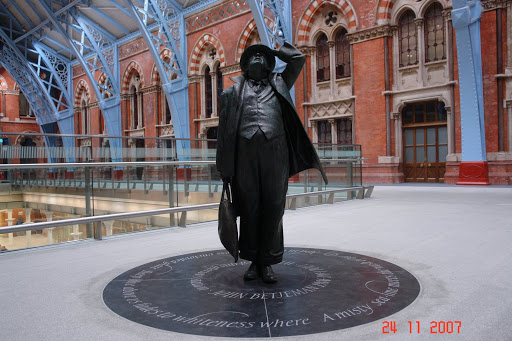
Betjeman died in May 1984, survived by his domestic partner Lady Elizabeth Cavendish; his most prominent memorial today is a statue of him outside London's St Pancras Station, the kind of elegant Victorian pile of which he whole-heartedly approved.
*Or, conveniently, whatever third option coincides with your own view.
*
share on: facebook
 Born on this day in 1906, Betjeman spent his life turning his back on the comfort of a middle-class upbringing, despite the impossibility of doing just that in a country obsessed with class - a country in which a posh person could utter a yob sentiment, but if it was made in a posh accent would be utterly discounted by the same people at whom it was aimed (or, more likely, considered ironic and result in either a thumping or a development deal, depending on location). It's no wonder poetry is still so popular in a country where what one says matters less than how it's said.
Somehow Betjeman managed to obtain considerable popularity in his dotage thanks to numerous appearances on television, by managing to become a parody of the slightly dotty professor, an avuncular figure whose fruitless opposition to the indignities then being visited upon the English countryside became must-watch programmes amongst the selfsame smug nouveau-Londoners whose zeal for urban sprawl were largely responsible for that degradation in the first place.
*
Poems like Slough offered a visceral reaction to the many horrors of post-war Britain committed by urban planners, whose misanthropy is evident in every block of flats, community centre, and gasworks they got off on tearing down an elegant row of Victorian houses to build. Although Betjeman eventually apologized to the people of Slough for having referred to their city using a peculiar poetic device known as 'the truth', it's not possible for a town which is home to 850 factories to be anything but a visual abortion, no matter how many chav-bait saplings one plants.
Betjeman died in May 1984, survived by his domestic partner Lady Elizabeth Cavendish; his most prominent memorial today is a statue of him outside London's St Pancras Station, the kind of elegant Victorian pile of which he whole-heartedly approved.
*Or, conveniently, whatever third option coincides with your own view.
*
share on: facebook
Pop Culture In Retrograde: Cigarette Advertising
This post was first published on this day in 2008; I could have rewritten it to bring it up to date, but having just reread it I kind of like the flow of it so I didn't! ~ MSM
Every so often I run across something on YouTube so out of touch with our times I feel strangely compelled to post it; that's when the wheels start grinding, and usually by the time I figure out how to justify it, I've seen something shiny and moved on, or else otherwise lost my window of opportunity.
Well, since I've gone on my reduced doobage diet, those same wheels hardly ever grind. So while physically I could still lose a foot race on level ground to a whale, mentally I'm back to running circles around a cheetah. That's why, when looking for a video to replace last year's Nancy Kulp birthday tribute, I came across this bit of brain toxin; simultaneously appalled and delighted, I knew about three seconds in I just had to inspire the same reaction in my readers. Not content to merely post it, I had to also create a new feature to showcase it; entitled Pop Culture In Retrograde, I hope to use the new feature to discuss those things (such as bigotry, the Republican Party, and in this instance tobacco) rendered disgusting in the minds of thinking people by an increasing social sophistication.
Back in the day, as we see, tobacco producers were allowed to sell poison using the medium of television; everyone, it seems, was in on it - including the cast of The Beverly Hillbillies, at the time one of the most popular sitcoms on the air. Here we see Nancy Kulp as Miss Jane Hathaway inculcating in the brainless rube Jethro (Max Baer, Jr.) a filthy, disgusting habit with the permission of his TV father Jed Clampett (Buddy Ebsen), in much the same way Winston has done on a daily basis since the brand was introduced in 1954.
Nowadays, of course, people have come to their senses; next on the agenda, the elimination of alcohol, cars, and tyranny from everyday use...
*
share on: facebook
In Memoriam: Nancy Kulp
Nancy Kulp moved to Hollywood in 1951 to work in publicity; instead, she went into the movies. By 1962 she found herself on The Beverly Hillbillies - the number one sitcom in the country, and for which she and her work were nominated for an Emmy in 1967. How's that for publicity?
 Kulp will always be remembered for her winking portrayal of sex-starved spinster Miss Jane Hathaway; with her lockjawed accent and the prim cut of her suit she made an excellent foil for the gang of rubes at the center of the action. Watching her mooning around after Jethro is surely one of the funniest things that was ever on television.
After the show was taken off the air in 1971, Kulp continued acting for awhile, ran unsuccessfully for office in 1984, tried her hand as an acting coach, and eventually retired. Born on this day in 1921, she died of cancer in Palm Springs in February 1991.
Kulp was married to Charles Dacus for a decade from April 1st, 1951; little else is known about him. Boze Hadleigh claims to have interviewed Kulp in 1987, an interview in which she owns up to her 'bisexuality'; Hadleigh, however, has a reputation as a fabulist, so his account must be taken as such.
*
share on: facebook
Kulp will always be remembered for her winking portrayal of sex-starved spinster Miss Jane Hathaway; with her lockjawed accent and the prim cut of her suit she made an excellent foil for the gang of rubes at the center of the action. Watching her mooning around after Jethro is surely one of the funniest things that was ever on television.After the show was taken off the air in 1971, Kulp continued acting for awhile, ran unsuccessfully for office in 1984, tried her hand as an acting coach, and eventually retired. Born on this day in 1921, she died of cancer in Palm Springs in February 1991.
Kulp was married to Charles Dacus for a decade from April 1st, 1951; little else is known about him. Boze Hadleigh claims to have interviewed Kulp in 1987, an interview in which she owns up to her 'bisexuality'; Hadleigh, however, has a reputation as a fabulist, so his account must be taken as such.
*
share on: facebook
Pop History Moment: The Death of William of Gloucester

By all accounts, it was a charmed life...
He was baptised William Andrew Henry Frederick in the Private Chapel at Windsor Castle by Cosmo Lang, the Archbishop of Canterbury; his uncle George VI and grandmother Queen Mary were among his godparents, joining The Viscount Gort, Lord William Montagu-Douglas-Scott, Princess Helena Victoria of Schleswig-Holstein, and Lady Mary Hawkins. As a small boy Prince William went to live in Australia when his father, the Duke of Gloucester, was sent there to serve as Governor-General; he later served both at the wedding and coronation of his second cousin, Elizabeth II.
Educated at Eton College, and Magdalene College, Cambridge, Prince William earned a BA in history; he was later awarded an MA. After spending a year at Stanford University, he joined Lazards Bank. Subsequently he went to work for the Foreign and Commonwealth Office, under which aegis he was posted to Lagos and Tokyo. As his father's health began to fail in the early 1970s His Royal Highness returned to Britain to assume management of their home, Barnwell Manor. It was around this time the Prince was diagnosed with the family illness, porphyria.
An accomplished pilot, on this day in 1972 His Royal Highness appeared at an airshow at Halfpenny Green, an aerodrome near Wolverhampton, in the West Midlands. There his Piper Cherokee crashed in front of 30,000 spectators; also killed in the crash was the Prince's co-pilot Vyrell Mitchell.
Proof that no one's life is charmed, no matter how it looks from the outside.
*
share on: facebook
Subscribe to:
Posts (Atom)