Thursday, November 11, 2010


"In Flander's Fields" by John McCrae
In Flanders Fields the poppies blow
Between the crosses row on row,
That mark our place; and in the sky
The larks, still bravely singing, fly
Scarce heard amid the guns below.
We are the Dead. Short days ago
We lived, felt dawn, saw sunset glow,
Loved and were loved, and now we lie
In Flanders fields.
Take up our quarrel with the foe:
To you from failing hands we throw
The torch; be yours to hold it high.
If ye break faith with us who die
We shall not sleep, though poppies grow
In Flanders fields.
*
share on: facebook
Between the crosses row on row,
That mark our place; and in the sky
The larks, still bravely singing, fly
Scarce heard amid the guns below.
We are the Dead. Short days ago
We lived, felt dawn, saw sunset glow,
Loved and were loved, and now we lie
In Flanders fields.
Take up our quarrel with the foe:
To you from failing hands we throw
The torch; be yours to hold it high.
If ye break faith with us who die
We shall not sleep, though poppies grow
In Flanders fields.
*
share on: facebook
"For the Fallen" by Lawrence Binyon
With proud thanksgiving, a mother for her children,
England mourns for her dead across the sea.
Flesh of her flesh they were, spirit of her spirit,
Fallen in the cause of the free.
Solemn the drums thrill: Death august and royal
Sings sorrow up into immortal spheres.
There is music in the midst of desolation
And a glory that shines upon our tears.
They went with songs to the battle, they were young,
Straight of limb, true of eye, steady and aglow.
They were staunch to the end against odds uncounted,
They fell with their faces to the foe.
They shall grow not old, as we that are left grow old;
Age shall not weary them, nor the years condemn.
At the going down of the sun and in the morning
We will remember them.
They mingle not with their laughing comrades again;
They sit no more at familiar tables at home;
They have no lot in our labour of the day-time;
They sleep beyond England's foam.
But where our desires are and our hopes profound,
Felt as a well-spring that is hidden from sight,
To the innermost heart of their own land they are known
As the stars are known to the Night;
As the stars that shall be bright when we are dust,
Moving in marches upon the heavenly plain,
As the stars that are starry in the time of our darkness,
To the end, to the end, they remain.
*
share on: facebook
England mourns for her dead across the sea.
Flesh of her flesh they were, spirit of her spirit,
Fallen in the cause of the free.
Solemn the drums thrill: Death august and royal
Sings sorrow up into immortal spheres.
There is music in the midst of desolation
And a glory that shines upon our tears.
They went with songs to the battle, they were young,
Straight of limb, true of eye, steady and aglow.
They were staunch to the end against odds uncounted,
They fell with their faces to the foe.
They shall grow not old, as we that are left grow old;
Age shall not weary them, nor the years condemn.
At the going down of the sun and in the morning
We will remember them.
They mingle not with their laughing comrades again;
They sit no more at familiar tables at home;
They have no lot in our labour of the day-time;
They sleep beyond England's foam.
But where our desires are and our hopes profound,
Felt as a well-spring that is hidden from sight,
To the innermost heart of their own land they are known
As the stars are known to the Night;
As the stars that shall be bright when we are dust,
Moving in marches upon the heavenly plain,
As the stars that are starry in the time of our darkness,
To the end, to the end, they remain.
*
share on: facebook
POPnews - November 11th

[As Britain's - and indeed the Commonwealth's - principal mourner, Her Majesty The Queen has presided over numerous ceremonies in honour of those who've died serving their respective countries in times of war... Yet even the Royal Family has not been immune from such tragedies, as her uncle HRH The Duke of Kent died while in the commission of his duty in August 1942.]
1724 - Joseph Blake (alias Blueskin) was hanged at London's Tyburn gallows; a highwayman known for attacking 'Thief-Taker General' (and thief) Jonathan Wild at the Old Bailey, Blake was later immortalized in Blueskin's Ballad by John Gay.
1750 - The College of William and Mary's F.H.C. Society - also known as the Flat Hat Club - was formed at Raleigh Tavern in Williamsburg, Virginia, making it the first-ever fraternity in the United States.
1778 - Seneca Indians in central New York state killed more than forty people, in what came to be known as the Cherry Valley Massacre.
1805 - At the Battle of Dürenstein 8000 French troops commanded by Édouard Mortier attempted to slow the retreat of a vastly superior Russian and Austrian force under Mikhail Illarionovich Kutuzov.
1831 - Nat Turner was hanged at Jerusalem, Virginia, for having incited a violent slave rebellion the previous August.
1839 - The Virginia Military Institute was founded.
1864 - Union General William Tecumseh Sherman began burning Atlanta to the ground in preparation for his famous March to the Sea; these events form the core of Margaret Mitchell's 1936 novel Gone With the Wind and the 1939 movie of the same name*.
*The most technically difficult sequence in the film has earned a place in film lore; the vast set-piece of the burning of Atlanta is indicated in the screenplay by just two words: 'Atlanta burns'. To this day, anything overly ambitious demanded by the director of a film will have the technicians on set grumbling these same two words until such time as they (inevitably) manage to achieve it.
1880 - Australian bushranger Ned Kelly was hanged at Melbourne Gaol.
1887 - Construction of the Manchester Ship Canal was begun at Eastham.
1889 - Washington became the 42nd US state.
1918 - At the eleventh hour on the eleventh day of the eleventh month an armistice between Germany and Allied forces was signed, in a railway carriage near France's Compiègne Forest, ending World War I (then known as the Great War); on the same day Austrian Emperor Charles I relinquished all political power, but did not abdicate.
1919 - The Centralia Massacre in Centralia, Washington, resulted in the deaths of four members of the American Legion and the lynching of a local leader of the IWW.
1921 - The Tomb of the Unknowns was dedicated by US President Warren G. Harding at Arlington National Cemetery.
1926 - Route 66 was established between Chicago and Los Angeles.
1966 - NASA launched Gemini 12.
1975 - Australia's Governor-General Sir John Kerr dismissed the government of Gough Whitlam and commissioned Malcolm Fraser as caretaker Prime Minister, announcing a general election to be held in early December; the country's gravest constitutional crisis to date is now more commonly known as The Dismissal.
1992 - The Church of England voted to allow women priests.
2004 - New Zealand's Tomb of the Unknown Warrior was dedicated at the National War Memorial in Wellington.
2008 - The RMS Queen Elizabeth 2 (QE2) set sail on her final voyage, to Dubai.
*
share on: facebook
Wednesday, November 10, 2010
"The Wreck Of The Edmund Fitzgerald" by Gordon Lightfoot
On this day in 1975 the 729-foot-long freighter SS Edmund Fitzgerald sank during a storm on Lake Superior, killing all 29 crew on board...
The event was famously sung about by Gordon Lightfoot in his classic song The Wreck Of The Edmund Fitzgerald.
*
share on: facebook
Remembering... Norman Mailer
When I was a little queerling (this was fifteen years ago now - okay, twenty...) Norman Mailer was considered the enemy of the gay community; always a macho posturer, Mailer had once allegedly made some offhand comment about how gay men had somehow taken the easy way out by opting not to be with women. Given the humourless tone of gay officialdom in those days (unlike today, he wrote, rolling his eyes so hard he almost gave himself a stroke) Mailer's comment wasn't even permitted enough context in which to grow, let alone be understood...
 Fast forward a dozen years, when what should cross my desk but an old paperback copy of Advertisements for Myself (1959), a collection of many of Mailer's earliest essays. Among them was an article he wrote in 1955 entitled The Homosexual Villain regarding a pair of homophobic characters (among others) he had written - General Cummings, in his famous bestseller The Naked and the Dead (1948) and Teddy Pope in his forthcoming book The Deer Park (1955); the essay was unique in at least two respects.
Firstly, it was written specifically for the pioneering gay publication One (which had split from the early gay rights group the Mattachine Society in 1952) and when the article appeared Mailer's was far and away the most famous name ever to appear in its masthead. Secondly, the essay offered a profound apology for the laziness that went into making these characters, and for his own attitude, which had previously equated homosexuality with evil reflexively and without any introspection.
At the time, Mailer was the pre-eminent man of American letters, whose lofty fame offered an inbuilt protection from attacks by the lowly and oppressed. Although he later disdained the article as the worst he'd ever written the fact is that at least he wrote it; not only that, when the time came, he republished it. His own bravado meant that he was willing to say something poorly rather than not saying anything at all. Mailer's excoriation of homophobia - however mild - was well-publicized, and stands today as one of the earliest works by a straight man defending his gay brothers.
Mailer had a conflicted relationship to homosexuality at best; he was relatively comfortable with individual homosexuals and was an early defender of James Baldwin, to the extent of supplying Baldwin's explicitly gay novel Giovanni's Room (1956) with a quote for its jacket; he later even admitted to being a 'latent homosexual' himself, qualifying the statement by saying that he 'chose to be heterosexual' - a pretty provocative statement, then as now.
The fact is, he may have only said it to rile up the women's libbers, whose goat he loved to get at the height of their 1970s humourlessness. That they had already branded him an utterly masculine writer - 'without any spark of the female in him' - ought to have made him a kind of icon for the all-male world, rather than its sworn enemy. Unfortunately, centuries of relentless anti-gay violence have rendered the gay community immune to any comment by straight men, a situation which endured up to an indeed beyond this day in 2007, the day Norman Mailer died...

*
share on: facebook
Fast forward a dozen years, when what should cross my desk but an old paperback copy of Advertisements for Myself (1959), a collection of many of Mailer's earliest essays. Among them was an article he wrote in 1955 entitled The Homosexual Villain regarding a pair of homophobic characters (among others) he had written - General Cummings, in his famous bestseller The Naked and the Dead (1948) and Teddy Pope in his forthcoming book The Deer Park (1955); the essay was unique in at least two respects.Firstly, it was written specifically for the pioneering gay publication One (which had split from the early gay rights group the Mattachine Society in 1952) and when the article appeared Mailer's was far and away the most famous name ever to appear in its masthead. Secondly, the essay offered a profound apology for the laziness that went into making these characters, and for his own attitude, which had previously equated homosexuality with evil reflexively and without any introspection.
At the time, Mailer was the pre-eminent man of American letters, whose lofty fame offered an inbuilt protection from attacks by the lowly and oppressed. Although he later disdained the article as the worst he'd ever written the fact is that at least he wrote it; not only that, when the time came, he republished it. His own bravado meant that he was willing to say something poorly rather than not saying anything at all. Mailer's excoriation of homophobia - however mild - was well-publicized, and stands today as one of the earliest works by a straight man defending his gay brothers.
Mailer had a conflicted relationship to homosexuality at best; he was relatively comfortable with individual homosexuals and was an early defender of James Baldwin, to the extent of supplying Baldwin's explicitly gay novel Giovanni's Room (1956) with a quote for its jacket; he later even admitted to being a 'latent homosexual' himself, qualifying the statement by saying that he 'chose to be heterosexual' - a pretty provocative statement, then as now.
The fact is, he may have only said it to rile up the women's libbers, whose goat he loved to get at the height of their 1970s humourlessness. That they had already branded him an utterly masculine writer - 'without any spark of the female in him' - ought to have made him a kind of icon for the all-male world, rather than its sworn enemy. Unfortunately, centuries of relentless anti-gay violence have rendered the gay community immune to any comment by straight men, a situation which endured up to an indeed beyond this day in 2007, the day Norman Mailer died...
*
share on: facebook
'Torchin' For Bill" by Ann Reinking
Here we see birthday gal Ann Reinking vamping it up as 'Troubles' Moran, in a little number called Torchin' for Bill, from the 1978 movie Movie Movie, directed by Stanley Donen and starring George C. Scott, his wife Trish Van Devere, and featuring a very scrummy young Harry Hamlin.
Movie Movie doesn't appear to be available on DVD DVD - sorry, I couldn't help myself - and more's the pity, since from watching this clip I am so plotzing! I think I ultimately chose it for its obscurity and the fact that it carries echoes of another favourite of ours, Marlene Dietrich's performance of Hot Voodoo from Blonde Venus.
*
share on: facebook
Happy Birthday Ann Reinking
Born on this day in Seattle in 1949, Ann Reinking originally trained for the ballet; she later took Broadway by storm, though, both as a dancer and as a choreographer - first as protege, then later as lover, and finally as heir of Bob Fosse...
 Beginning with a part in the chorus in Coco (1969) Reinking gradually rose through the ranks through a combination of hard work, talent, and bendiness. Early roles in Pippin (1972), Over Here! (1974), and Goodtime Charley (1975) led to bigger roles in the original run of Chicago (1975), A Chorus Line (1975), and a revival of Sweet Charity (1986).
Reinking made her film debut in All That Jazz (1979), which was a thinly veiled account of the life of Bob Fosse; she also appeared onscreen in Annie (1982) and Micki and Maude (1984).
As curator of Fosse's legacy, Reinking's greatest triumph to date remains her choreography (in the style of Fosse) and performance as Roxie Hart (based on real-life murderer Beulah Annan), opposite Bebe Neuwirth as Velma Kelly in the revival of Chicago (1996), which is still running on Broadway in addition to West End and touring productions. In 1999 Reinking conceived, co-directed, and co-choreographed the musical revue Fosse; in addition to a Tony Award and a Drama Desk award for Chicago, Reinking has also won a Bob Fosse Award for her work as a choreographer.
*
share on: facebook
Beginning with a part in the chorus in Coco (1969) Reinking gradually rose through the ranks through a combination of hard work, talent, and bendiness. Early roles in Pippin (1972), Over Here! (1974), and Goodtime Charley (1975) led to bigger roles in the original run of Chicago (1975), A Chorus Line (1975), and a revival of Sweet Charity (1986).Reinking made her film debut in All That Jazz (1979), which was a thinly veiled account of the life of Bob Fosse; she also appeared onscreen in Annie (1982) and Micki and Maude (1984).
As curator of Fosse's legacy, Reinking's greatest triumph to date remains her choreography (in the style of Fosse) and performance as Roxie Hart (based on real-life murderer Beulah Annan), opposite Bebe Neuwirth as Velma Kelly in the revival of Chicago (1996), which is still running on Broadway in addition to West End and touring productions. In 1999 Reinking conceived, co-directed, and co-choreographed the musical revue Fosse; in addition to a Tony Award and a Drama Desk award for Chicago, Reinking has also won a Bob Fosse Award for her work as a choreographer.
*
share on: facebook
In Memoriam: William Hogarth
The modern world owes much to William Hogarth; considered the first artist to create sequential drawings in pursuit of a storytelling aim, he can be considered as the father of the comic strip and thence the graphic novel. As skilled a painter as he was an engraver, his works staked out a place in the middle class where they could both entertain and enlighten the whole of the social strata...
 Born in London on this day in 1697, it was William Hogarth's good fortune to be born in interesting times. The rise of industrialization and urbanization gave his biting satire much on which to chew; they were prosperous times as well, and a burgeoning leisure class was willing to pay good money to be immortalized by him, even if it meant also being lampooned into the deal. When he was paid the then-exorbitant sum of £200 for a single portrait in 1746 - which represented several years' wages for a working man - it wasn't a royal or other aristocrat who ponied up the dough but one of the new aristocrats - an actor, David Garrick.
Hogarth's works (as all great art must) both commented upon and influenced society and its attendant culture; A Harlot's Progress and its companion A Rake's Progress (both 1731) demonstrate the corrosive effects of capitalism upon morality, while also functioning as a stern rebuke of the dangers inherent in a dissipated sexuality. Beer Street and Gin Lane (1751) shows the difference between the happy English society that was and the miserable one that replaced it when the public's favour shifted from beer to gin; in the same year The Four Stages of Cruelty limned one of Hogarth's favourite subject, namely man's inhumanity to man (and, by extension, animal and planet).
About the only field of endeavour in which he was not successful was as a history painter, although, in the years since his death in October 1764 these paintings of his have come to be well-appreciated, proving that not only were his works timeless but ahead of their time as well.
*
share on: facebook
Born in London on this day in 1697, it was William Hogarth's good fortune to be born in interesting times. The rise of industrialization and urbanization gave his biting satire much on which to chew; they were prosperous times as well, and a burgeoning leisure class was willing to pay good money to be immortalized by him, even if it meant also being lampooned into the deal. When he was paid the then-exorbitant sum of £200 for a single portrait in 1746 - which represented several years' wages for a working man - it wasn't a royal or other aristocrat who ponied up the dough but one of the new aristocrats - an actor, David Garrick.Hogarth's works (as all great art must) both commented upon and influenced society and its attendant culture; A Harlot's Progress and its companion A Rake's Progress (both 1731) demonstrate the corrosive effects of capitalism upon morality, while also functioning as a stern rebuke of the dangers inherent in a dissipated sexuality. Beer Street and Gin Lane (1751) shows the difference between the happy English society that was and the miserable one that replaced it when the public's favour shifted from beer to gin; in the same year The Four Stages of Cruelty limned one of Hogarth's favourite subject, namely man's inhumanity to man (and, by extension, animal and planet).
About the only field of endeavour in which he was not successful was as a history painter, although, in the years since his death in October 1764 these paintings of his have come to be well-appreciated, proving that not only were his works timeless but ahead of their time as well.
*
share on: facebook
POPnews - November 10th
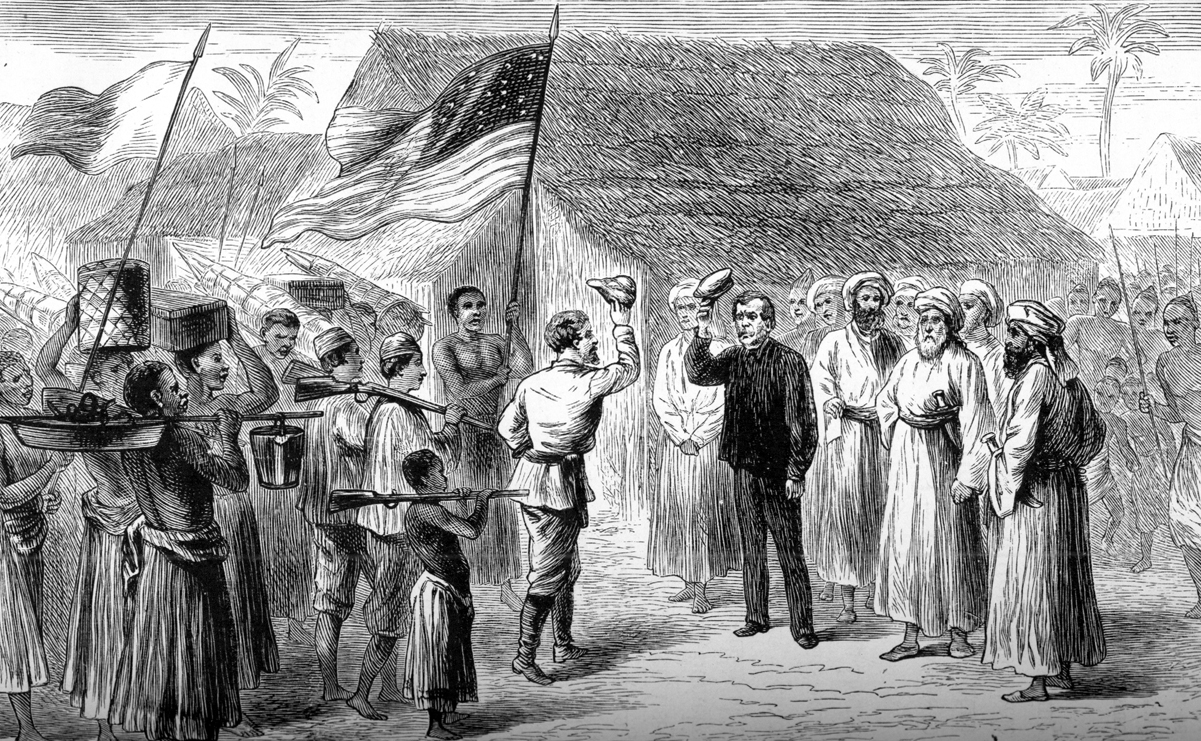
[When David Livingstone was discovered alive by Henry Stanley - on this day in 1871 - their initial meeting was responsible for one of the Victorian era's most indelible catch-phrases...]
1444 - At the Battle of Varna the crusading forces of King Vladislaus III of Varna* and János Hunyadi were crushed by a Turkish army commanded by Sultan Murad II, during which action His Majesty was also killed - thus ending the Crusade of Varna, and eventually leading to the fall of Constantinople in May 1453.
*AKA Ulaszlo I of Hungary and/or Wladyslaw III of Poland!
1520 - Following his successful invasion of Sweden in September, soldiers loyal to Denmark's King Christian II executed some 82 high-ranking Swedes (many of them members of the Sture Party) over a three-day period, in what came to be known as the Stockholm Bloodbath.
1766 - The last colonial governor of New Jersey, William Franklin, signed the charter of Queen's College (which was later renamed Rutgers University).
1775 - The United States Marine Corps was founded.
1793 - A Goddess of Reason was proclaimed by the French Convention at the suggestion of Pierre Gaspard Chaumette; a statue of the goddess - modeled on and by Thérèse Momoro, wife of the printer Antoine-François Momoro - was then placed on the high altar of Notre Dame de Paris.
1821 - The so-called Gesture of Rufina Alfaro set into motion a revolt which eventually led to Panama's independence from Spain (which occurred just in time for Panama to immediately thereafter become part of Colombia).
1847 - The passenger ship Stephen Whitney was wrecked in thick fog off the southern coast of Ireland, killing 92 of the 110 on board; the disaster resulted in the construction of the Fastnet Rock lighthouse.
1865 - Major Henry Wirz - the Confederate superintendent of Camp Sumter - became the only American Civil War soldier executed for war crimes.
1871 - Henry Morton Stanley located the missing explorer and missionary, Dr. David Livingstone, in Ujiji near Lake Tanganyika, uttering the now-famous phrase 'Dr. Livingstone, I presume?'
1898 - The Wilmington Insurrection of 1898 - the only instance of a municipal government being overthrown in US history - began in Delaware; originally considered a race riot, it is now more appropriately termed a coup d'etat.
1924 - Dean O'Banion, leader of the North Side Gang, was assassinated in his flower shop by members of Johnny Torrio's gang, sparking a bloody gang war which would dominate life in Chicago for the remainder of the 1920s.
1928 - Michinomiya Hirohito was crowned the 124th Emperor of Japan; since his January 1989 death he's been known by his posthumous name, Emperor Shōwa.
1938 - The founder of the Republic of Turkey, Mustafa Kemal Atatürk, died.
1944 - 3,800 tons of ordnance on the ammunition ship USS Mount Hood (AE-11) exploded while the vessel was docked in Seeadler Harbor at Papua New Guinea's Manus Island; all 350 men aboard ship were killed in the blast, as well as 82 members of the crew serving on the USS Mindanao (ARG-3), and some 22 other boats moored nearby were either sunk or severely damaged.
1954 - US President Dwight D. Eisenhower dedicated the USMC War Memorial (also known as the Iwo Jima Memorial) in Arlington National Cemetery.
1958 - The Hope Diamond was donated to the Smithsonian Institution by New York diamond merchant Harry Winston.
1969 - Sesame Street - created by Joan Ganz Cooney and Jim Henson - made its television debut on National Educational Television, the precursor to PBS.
1995 - In Nigeria, playwright and environmental activist Ken Saro-Wiwa, along with eight others from the Movement for the Survival of the Ogoni People (Mosop), were hanged by government forces.
2007 - The ¿Por qué no te callas? incident occurred, pitting Spain's King Juan Carlos I against Venezuelan president Hugo Chávez. Try and guess whose side the Pop Culture Institute was on during this particular contretemps...
*
share on: facebook
Tuesday, November 09, 2010
Pop History Moment: Kristallnacht

On this day in 1938 Nazi Germany's war on its Jews began in earnest, with a frenzy of looting and burning now known as Kristallnacht, or the Night of Broken Glass; this allegedly spontaneous outburst of anti-Semitism that purportedly took Nazi authorities by surprise was in fact organized by them as early as 1937, to be carried out by Hitler Youth and other such organizations when a suitable provocation could be found to justify it.
As a scapegoat, the Nazis chose Herschel Grynszpan, whose attack on a Paris-based German diplomat named Ernst vom Rath two days earlier - which was itself prompted by the inclusion of his family in mass expulsions from Germany which had taken place on October 18th - was used to justify the Nazi's extremism. In a classic bully move Grynszpan was not only roundly condemned as a murderer by the Nazi press but by extension all Jews became murderers; in this manner did the murderous Nazis routinely deflect such charges from themselves.
In all, more than 200 synagogues were destroyed and thousands of homes were similarly looted or burned, 92 Jews were murdered outright and as many as 30,000 were sent to concentration camps before the destruction ended the following day; reports vary, but the Führer himself may have even personally led the assault in München. According to eyewitness accounts, members of the public also assisted in the destruction* by throwing old newspapers, kerosene-soaked rags, and other such flammable items on their nearest conflagrations-in-waiting. Others looked on in horror, unable to act as their neighbours - many of whom had fought for their country in World War I - were displaced from their homes or arrested.
The events of Kristallnacht were widely condemned by the British and American media of the time, although their outrage in this instance didn't exactly move their governments to accept more Jewish immigrants, owing to the widespread anti-Semitism of the times.
Only recently, as the 70th anniversary of the event approached, an Israeli journalist named Yaron Svoray, himself an acclaimed hunter of Nazis and neo-Nazis, discovered a midden in the Brandenburg district north of Berlin - itself the size of four soccer pitches - which contains much of the night's plunder.
The story of the night's events are told in the slim yet thrilling volume, Kristallnacht: Prelude to Destruction by Martin Gilbert.
*Likely the same people whom, after the war, claimed not to know Hitler was genocidal - the same ones whose children and grandchildren now claim the Holocaust never happened, despite a mountain of evidence to the contrary.
*
share on: facebook
The History of Sex: Hedy Lamarr
The legendary beauty of Hedy Lamarr has never been questioned; in the years since her death, though, it's the beauty of her mind that's come increasingly to the fore...
 Early in her career she starred in what is popularly considered the cinema's first nude scene - in the Czech film Ecstasy (1933) - which is actually notorious as the first to depict sexual intercourse and female orgasm on screen, not nudity (although it does have a prime example of that). Later, at the height of her fame, she and her second husband Gene Markey patented spread spectrum, an essential component of today's mobile phone technology, which plans she developed with her first husband, the Austrian arms manufacturer Friedrich Mandl.
Born on this day in 1913, she made her film debut in 1930; Lamarr, who was Jewish, escaped her fascist first husband and the Nazi threat in 1937, dripping in the jewels he'd given her and with the plans they'd worked out together. Legend has it that during her flight she hid in a brothel, even going so far as to have sex with a client there in order to conceal her identity. Arriving in London, she obtained her famous surname from Louis B. Mayer, who named her after the tragic silent movie actress Barbara LaMarr; previously she'd been known professionally as Hedy Kiesler.
Newly renamed, Hedy Lamarr's first American movie was Algiers (1938) opposite Charles Boyer; her biggest film role was as Delilah in Cecil B. DeMille's Samson and Delilah (1949) with Victor Mature. She also appeared in Tortilla Flat (1942), based on the novel by John Steinbeck. Frequently cast against type, she often portrayed devastatingly beautiful temptresses.
Having made off with hearts (and technology, and jewellery), Lamarr was subsequently arrested for shoplifting, first in 1965, and again in 1991; she died in January 2000.
*
share on: facebook
Early in her career she starred in what is popularly considered the cinema's first nude scene - in the Czech film Ecstasy (1933) - which is actually notorious as the first to depict sexual intercourse and female orgasm on screen, not nudity (although it does have a prime example of that). Later, at the height of her fame, she and her second husband Gene Markey patented spread spectrum, an essential component of today's mobile phone technology, which plans she developed with her first husband, the Austrian arms manufacturer Friedrich Mandl.Born on this day in 1913, she made her film debut in 1930; Lamarr, who was Jewish, escaped her fascist first husband and the Nazi threat in 1937, dripping in the jewels he'd given her and with the plans they'd worked out together. Legend has it that during her flight she hid in a brothel, even going so far as to have sex with a client there in order to conceal her identity. Arriving in London, she obtained her famous surname from Louis B. Mayer, who named her after the tragic silent movie actress Barbara LaMarr; previously she'd been known professionally as Hedy Kiesler.
Newly renamed, Hedy Lamarr's first American movie was Algiers (1938) opposite Charles Boyer; her biggest film role was as Delilah in Cecil B. DeMille's Samson and Delilah (1949) with Victor Mature. She also appeared in Tortilla Flat (1942), based on the novel by John Steinbeck. Frequently cast against type, she often portrayed devastatingly beautiful temptresses.
Having made off with hearts (and technology, and jewellery), Lamarr was subsequently arrested for shoplifting, first in 1965, and again in 1991; she died in January 2000.
*
share on: facebook
"Looking Out My Back Door" by Creedence Clearwater Revival
Late birthday boy Tom Fogerty started Creedence Clearwater Revival with his older brother John Fogerty in 1968, and although tension between them would prompt Tom to leave the band in 1971, in the intervening years they were responsible for a string of hits with a distinctive swamp rock sound, including Bad Moon Rising, Down on the Corner, Fortunate Son, and Travelin' Band.
One such song was Lookin' Out My Back Door, from their 1970 sixth album Cosmo's Factory; although the band's reputation has led many critics since to consider the song a paean to drug use for its illusory imagery, the song's author John Fogerty claims he was inspired by having read Dr. Seuss's book, And to Think That I Saw It on Mulberry Street to his young son. Of course, there's no reason to think this has to be a case of either/or.
Born on this day in 1941, Tom Fogerty died of AIDS-related complications to tuberculosis in September 1990, having received tainted blood transfusions during back surgery in the early 1980s.
*
share on: facebook
Remembering... Earl Thompson
On this day in 1978 a promising literary career ended, just as it was gaining momentum...
 Although Earl Thompson only published three novels while alive - A Garden of Sand, Tattoo, and Caldo Largo - and a fourth one (The Devil To Pay) posthumously, what novels they were! So bristling with rage and contemptuous of taboo are they that I hesitate to say how autobiographical in nature they are. I began A Garden of Sand at the behest of Mr. Christiansen*, and was at first enthralled by its sterling depiction of Depression-era Wichita; very quickly, though, I found myself drawn into the characters' inner lives in a way I hadn't been since I started reading Steinbeck.
*One of the members of the brain trust here at the Pop Culture Institute.
*
share on: facebook
Although Earl Thompson only published three novels while alive - A Garden of Sand, Tattoo, and Caldo Largo - and a fourth one (The Devil To Pay) posthumously, what novels they were! So bristling with rage and contemptuous of taboo are they that I hesitate to say how autobiographical in nature they are. I began A Garden of Sand at the behest of Mr. Christiansen*, and was at first enthralled by its sterling depiction of Depression-era Wichita; very quickly, though, I found myself drawn into the characters' inner lives in a way I hadn't been since I started reading Steinbeck.*One of the members of the brain trust here at the Pop Culture Institute.
*
share on: facebook
Introducing Dorothy Dandridge
The history of show business is littered with the remains of those who were unable to deal with its attendant pressures; despite what it may look like to those of us on the outside, such adulation comes with a price too steep for many to pay, and so they pay with their lives...
 Dorothy Dandridge was one such casualty of fame; a raving beauty, gifted actress, and acclaimed cabaret performer, her 25 years in the public eye exacted the ultimate toll on her. She died in September 1965 at the age of only 42; whether she was murdered or overdosed - or whether that overdose was intentional or accidental - hardly matters now. Only the loss remains; that, and the legacy she left behind.
Born on this day in 1922, Dorothy and her older sister Vivian (along with Etta Jones) performed on the Chitlin' circuit, a kind of black vaudeville, first as the Wonder Children and later as the Dandridge Sisters. Dorothy's mother Ruby was a lesbian, involved with a woman named Geneva Williams; scurrilous rumours abound that Williams molested her lover's daughters. Whether or not that was true, she was a stern taskmaster, working the girls hard both onstage and at home.
Hard work landed Dorothy successively larger roles in various movies, but it wasn't until she was 32 that Dandridge got her big break in Otto Preminger's Carmen Jones (1955); for her troubles she was nominated for an Oscar, only the third African-American so honoured and the first in the Best Actress category. She lost the award to Grace Kelly.
The final ten years of Dorothy Dandridge's life were a study in contrasts; she broke many barriers and received much acclaim in front on audiences and cameras, but suffered from a downward spiral of addiction and abuse in private. Following her death she seemed destined to fade into oblivion, and would have too, if not for the cherished place she held in the hearts of two successive generations of black actors like Cicely Tyson, Jada Pinkett, Janet Jackson and Angela Bassett.
Halle Berry didn't so much play her as channel her in the HBO film Introducing Dorothy Dandridge and the Emmy she won for the searing performance both revived interest in and in a way vindicated the memory of a gifted performer and a sensitive soul lost to fame.
*
share on: facebook
Dorothy Dandridge was one such casualty of fame; a raving beauty, gifted actress, and acclaimed cabaret performer, her 25 years in the public eye exacted the ultimate toll on her. She died in September 1965 at the age of only 42; whether she was murdered or overdosed - or whether that overdose was intentional or accidental - hardly matters now. Only the loss remains; that, and the legacy she left behind.Born on this day in 1922, Dorothy and her older sister Vivian (along with Etta Jones) performed on the Chitlin' circuit, a kind of black vaudeville, first as the Wonder Children and later as the Dandridge Sisters. Dorothy's mother Ruby was a lesbian, involved with a woman named Geneva Williams; scurrilous rumours abound that Williams molested her lover's daughters. Whether or not that was true, she was a stern taskmaster, working the girls hard both onstage and at home.
Hard work landed Dorothy successively larger roles in various movies, but it wasn't until she was 32 that Dandridge got her big break in Otto Preminger's Carmen Jones (1955); for her troubles she was nominated for an Oscar, only the third African-American so honoured and the first in the Best Actress category. She lost the award to Grace Kelly.
The final ten years of Dorothy Dandridge's life were a study in contrasts; she broke many barriers and received much acclaim in front on audiences and cameras, but suffered from a downward spiral of addiction and abuse in private. Following her death she seemed destined to fade into oblivion, and would have too, if not for the cherished place she held in the hearts of two successive generations of black actors like Cicely Tyson, Jada Pinkett, Janet Jackson and Angela Bassett.
Halle Berry didn't so much play her as channel her in the HBO film Introducing Dorothy Dandridge and the Emmy she won for the searing performance both revived interest in and in a way vindicated the memory of a gifted performer and a sensitive soul lost to fame.
*
share on: facebook
Happy Birthday Tony Slattery
Comedian Tony Slattery - born this day in 1959 - has always been frank about the source of his darkness and his light: a lifelong struggle with bipolar disorder, as confessed on-air to Stephen Fry in the landmark documentary The Secret Life Of The Manic Depressive.
Okay, so this is one of his darker moments; it's here because it also happens to be one of his cuter moments as well. Taken from the Cambridge Footlights Revue in the 1980s, the same show that unleashed the comic talents of Fry, Hugh Laurie, and Emma Thompson - among many others - is a happy little ditty called Shoot Somebody Famous.
*
share on: facebook
Remembering... Marie Dressler
MGM studio boss Louis B. Mayer called her 'the most adored person ever to set foot in the Metro-Goldwyn-Mayer studio', and he was a man who'd never blow smoke unless he could find a way to put it on film and charge two-bits admission!
 Born in Coburg, Ontario, on this day in 1868, Marie Dressler was a big girl who grew into a big woman with an even bigger talent; although her initial ambition was to appear in the opera, it was undoubtedly her splendid sense of comic timing that brought her instead to vaudeville. There she befriended Mack Sennett and Edward Everett Horton, both of whom would later feature prominently alongside her in the early history of Hollywood.
Already popular in silent films - a medium famous for its FACES! - by the time she appeared in talking pictures she had her routine by rote, and indeed much of it involved making faces. In films like Anna Christie (1931) her mug-happy antics threatened to wipe even a ham like Greta Garbo off the screen.
Dressler was awarded an Oscar for her appearance in Min and Bill (1931) with Wallace Beery; onscreen they shared not so much chemistry as physics. Altogether she would make 40 films; her penultimate, Dinner at Eight (1933), shows Dressler at the top of her game, despite her obvious illness. Castmates later reported finding her vomiting violently or else coughing up blood in her dressing room, only to emerge and film take after take of a flawless performance fraught with comedy and drama in equal parts...
Dressler's memoirs were entitled The Life Story of an Ugly Duckling, but the Pop Culture Institute would like to offer a posthumous revision: A Swan By Any Other Name.
*
share on: facebook
Born in Coburg, Ontario, on this day in 1868, Marie Dressler was a big girl who grew into a big woman with an even bigger talent; although her initial ambition was to appear in the opera, it was undoubtedly her splendid sense of comic timing that brought her instead to vaudeville. There she befriended Mack Sennett and Edward Everett Horton, both of whom would later feature prominently alongside her in the early history of Hollywood.Already popular in silent films - a medium famous for its FACES! - by the time she appeared in talking pictures she had her routine by rote, and indeed much of it involved making faces. In films like Anna Christie (1931) her mug-happy antics threatened to wipe even a ham like Greta Garbo off the screen.
Dressler was awarded an Oscar for her appearance in Min and Bill (1931) with Wallace Beery; onscreen they shared not so much chemistry as physics. Altogether she would make 40 films; her penultimate, Dinner at Eight (1933), shows Dressler at the top of her game, despite her obvious illness. Castmates later reported finding her vomiting violently or else coughing up blood in her dressing room, only to emerge and film take after take of a flawless performance fraught with comedy and drama in equal parts...
Dressler's memoirs were entitled The Life Story of an Ugly Duckling, but the Pop Culture Institute would like to offer a posthumous revision: A Swan By Any Other Name.
*
share on: facebook
In Memoriam: Edward VII
An ageing heir to the throne, unpopular as his mother was revered, who attracted the public's ire by preferring the company of his mistress to that of his younger wife - herself a neurotic beauty viewed by the public as an almost holy icon... There are few writers as bereft of original ideas as History.
 Yet for a man who was viewed as a dissipated dilettante right up until the moment he became King, the life and times of Edward VII offers many potential lessons to his modern-day counterpart. Though his apprenticeship was long and his subsequent reign short, he accomplished much in the just over nine years allotted to him on the throne, not least of which was the rehabilitation of his own image. The age in which he reigned was given his name - the Edwardian - and it stands as a last golden hour before the horrors of the 20th Century beset Europe.
Yet for a man who was viewed as a dissipated dilettante right up until the moment he became King, the life and times of Edward VII offers many potential lessons to his modern-day counterpart. Though his apprenticeship was long and his subsequent reign short, he accomplished much in the just over nine years allotted to him on the throne, not least of which was the rehabilitation of his own image. The age in which he reigned was given his name - the Edwardian - and it stands as a last golden hour before the horrors of the 20th Century beset Europe.Born on this day in 1841 at Buckingham Palace, the second child of Queen Victoria and Albert, Prince Consort, he was created Prince of Wales a month later - a title he would hold for nearly sixty years. He was known within the family as Bertie as his name at birth was Albert Edward.
His marriage in March 1863 to his fourth cousin Princess Alexandra of Denmark (daughter of the future Christian IX) was arranged in the fashion of the day, supervised by his elder sister Victoria, Princess Royal, the future Queen of Prussia. In no time at all a fashionable social set formed around them, with its twin foci at their London residence, Marlborough House and in the Norfolk countryside at Sandringham House. After December 1861, and because of his mother's melodramatic widowhood (during which she refused to appear in public) he endeavoured to carry out many of the royal duties the grieving Queen would not. In this sense he can be said to have saved the monarchy by keeping it from becoming too remote. The Princess of Wales, too, carried out many engagements on behalf of children and the sick; she was also a renowned patroness of the arts.
Always a ladies man, the Prince maintained a stable of mistresses throughout his lifetime, including actress Lillie Langtry, Lady Jennie Churchill (mother of Winston and wife of Lord Randolph), Daisy Greville, Countess of Warwick, actress Sarah Bernhardt, dancer La Belle Otero, and wealthy humanitarian Agnes Keyser; the one who was at his side when he died, however, was Alice Keppel, whose great-granddaughter Camilla Parker Bowles succeeded in snaring herself a royal mate where she had failed.
*
share on: facebook
"Follow Me" by Uncle Kracker
Birthday wishes go out today to Uncle Kracker, who in 2001 scored a massive hit with the song Follow Me, from his debut album Double Wide; although initially best known in the Detroit area as a turntablist and rap artist who worked in Kid Rock's posse, as this single demonstrates, by the time he'd begun recording Uncle Kracker had abandoned hip-hop in favour of a country sound.
On a personal note, Uncle Kracker is at least partially responsible for what was at the time the most offensive joke I'd ever told*; upon hearing the news that he was marrying, I let fly with the brilliant quip that her professional name was likely to be Aunt Spread. Upon closer reflection, that was probably not a good thing to say in a room full of extremely earnest female writers, as I did. On the plus side, it got me out of there, so it wasn't all for naught.
*That was 2002; I've since surpassed it *at least* half a dozen times.
*
share on: facebook
POPnews - November 9th

[After it was destroyed by war in 1993, Stari Most was rebuilt almost immediately, and reopened in July 2004.]
694 CE - Egica - Visigoth King of Hispania - showed his utter ignorance in matters spiritual at the Seventeenth Council of Toledo when he accused Jews of aiding Muslims, and thereafter sentenced all Jews to slavery for something that not only never happened but never could or would happen.
1688 - William of Orange captured Exeter during Britain's Glorious Revolution.
1851 - Kentucky marshals abducted abolitionist minister Calvin Fairbank from Jeffersonville, Indiana, and returned him to Kentucky to stand trial for helping a slave named Tamar to escape from her owner, A. L. Shotwell of Louisville, who had recently hired her out to a Judge Purtle of that city. The following year Fairbank would be sentenced to 15 years hard labour, but was eventually pardoned in 1864.
1867 - The Tokugawa Shogunate handed power back to the Emperor of Japan, bringing about the so-called Meiji Restoration.
1872 - A fire destroyed much of Boston; ignited around 7:20 PM, within 12 hours it had destroyed 65 acres of the city's downtown including 776 buildings, and was responsible for at least 20 deaths, although a citizen's brigade managed to save the Old South Meeting House.
1888 - Jack the Ripper killed Mary Jane Kelly, his last known victim.
1906 - Theodore Roosevelt became the first sitting US President to make an official trip outside the country when he went to inspect progress on the Panama Canal.
1907 - The Cullinan Diamond was presented to Britain's King Edward VII on his birthday; at 530.2 carats, it was not only the largest finished diamond in the world until the 1985 discovery of the Golden Jubilee Diamond, it's also officially the best birthday present ever given.
1918 - Germany's Kaiser Wilhelm II abdicated - effectively ending the German Revolution - following which the country was proclaimed a republic.
1921 - Albert Einstein was awarded the Nobel Prize in Physics for his work with the photoelectric effect.
1923 - In Munich, Germany, police and government troops crushed the Beer Hall Putsch; the failed coup was the work of the Nazis, led by Adolf Hitler, Erich Ludendorff, and members of the Kampfbund.
1938 - Kristallnacht, Nazi Germany's first large-scale act of physical anti-Jewish violence, began.
1961 - Brian Epstein attended a gig by a new band called The Beatles at Liverpool's Cavern Club; by December he was managing the band and history (not to mention some bloody great pop music) was being made.
1965 - 22-year-old Catholic Worker member Roger Allen LaPorte, protesting against the Vietnam War, set himself on fire in front of the United Nations building - one week to the day after Norman Morrison did the same thing in front of The Pentagon.
1967 - The first issue of Rolling Stone magazine was published.
1979 - Four men now better known as the Bridgewater Four - Patrick Molloy, Jim Robinson and cousins Michael Hickey and Vincent Hickey - were found guilty of murdering 12 year-old paperboy Carl Bridgewater, which crime occurred outside Stourbridge in September 1978; their convictions would be overturned by the Court of Appeal in 1997 after it came to light that police fabricated evidence in order to extract a confession from Molloy - a confession around which the entire case against the four was.
1985 - Garry Kasparov became the youngest world chess champion by beating Anatoly Karpov.
1989 - Communist-controlled East Germany opened checkpoints in the Berlin Wall, allowing its citizens to travel to West Germany for the first time since 1961, at which point the city's citizenry began the demolition that resulted in the Fall of the Berlin Wall.
1993 - Stari Most, the 'old bridge' built spanning the river Neretva in the Bosnian city of Mostar in 1566, collapsed after several days of bombing.
*
share on: facebook
Subscribe to:
Posts (Atom)