Wednesday, February 23, 2011
"The Final Countdown" by Europe
Birthday wishes go out today to John Norum, guitarist and founding member of Europe, whose 1986 song The Final Countdown was the first of five singles released from their third album, coincidentally also called The Final Countdown. It was followed by Love Chaser, Rock the Night, Carrie and Cherokee, although none of them would achieve the heights their lead-in managed...
When not tearing the rooves off various stadia, Norum maintains a solo career; at various times in his career he's also played with Eddie Meduza & The Roaring Cadillacs, Dokken, Don Dokken's solo band, and done side collaborations with other artists including Glenn Hughes. The older brother of pop singer Tone Norum, he's also the widower of Michelle Meldrum, founder and lead guitarist of the Swedish-American heavy metal band Meldrum.
Probably the best way to keep track of Norum's many perambulations is via his own website...
*
share on: facebook


"New Song" by Howard Jones
Birthday wishes go out today to Howard Jones, the cute as a button Eighties-era singer songwriter whose synthified and often percussion-free pop songs were as distinctive as his spiky hair... The example on offer here, entitled New Song, was initially released in September 1983 as his debut single, from the album Human's Lib; it was followed by What Is Love and its equally jaunty fellow classics Like To Get To Know You Well, Things Can Only Get Better, and Life In One Day.
*
share on: facebook
Pop History Moment: The US Marines Recaptured Iwo Jima

On this day in 1945 the 28th Regiment of the 5th Marines took Mount Suribachi as the battle for control of Japanese-held Iwo Jima raged on; this famous photo of the event, taken by Joe Rosenthal, won the year's Pulitzer Prize for Photography, and has been reprinted many times around the world.
Of the six men depicted in the picture, three (Franklin Sousley, Harlon Block, and Michael Strank) did not survive the battle; the three survivors (John Bradley, Rene Gagnon, and Ira Hayes) became celebrities upon the publication of the photo, which was later used by Felix de Weldon as a model for the USMC War Memorial, located adjacent to Arlington National Cemetery just outside Washington, DC.
*
share on: facebook
POPnews - February 23rd
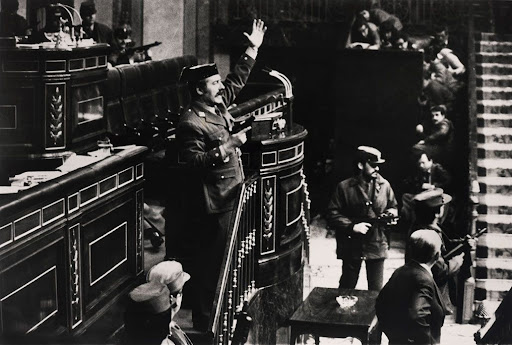
[While the country's transition to democracy now seems to be a done deal, on this day in 1981 the process was still underway, and post-Franco Spain was a very shaky thing indeed; fortunately, Antonio Tejero's grand-standing manoeuvre - bursting into the country's Congress of Deputies shortly after 6 pm accompanied by 200 submachine gun-wielding Guardias Civiles during the process of electing the new Prime Minister Leopoldo Calvo Sotelo - was met with defiance by those who mattered most. Having been ordered to the floor with the rest of their colleagues by a pistol-waving Tejero, acting Minister of Defence Manuel Gutiérrez Mellado stood up and ordered Tejero to desist, while acting PM Adolfo Suárez remained seated instead of crouching on the floor, and communist leader Santiago Carrillo calmly lit a cigarette and did not seem to be disturbed by the events. Despite a tense stand-off lasting some seven hours, by the time the King took to the airwaves to denounce the action it had already failed.]
1820 - The Cato Street Conspiracy - a plot to murder all of Britain's cabinet ministers - was exposed.
1836 - The Siege of the Alamo began in San Antonio, Texas.
1861 - US President-elect Abraham Lincoln arrived in Washington, DC, having evaded an assassination attempt in Baltimore.
1870 - Hiram Rhodes Revels, a Republican from Mississippi, was sworn into the Senate, becoming the first African American ever to sit in either house of the US Congress.
1898 - Émile Zola was imprisoned in France after writing J'accuse, a letter accusing the French government of anti-Semitism and wrongfully imprisoning Captain Alfred Dreyfus.
1903 - Cuba leased Guantánamo Bay to the United States 'in perpetuity'.
1905 - Chicago attorney Paul Harris and three other businessmen met for lunch to form the Rotary Club, the world's first service club.
1909 - The AEA Silver Dart made the first powered flight in Canada and thus the British Empire.
1917 - The first of an ongoing series of demonstrations in Saint Petersburg marked the beginning of Russia's February Revolution.
1918 - The Red Army's first victory over the forces of Germany's Kaiser Wilhelm II near Narva and Pskov was celebrated from 1923 onward as 'Red Army Day'; it was renamed Defender of the Fatherland Day after the fall of the Soviet Union in 1991, and is colloquially known as 'Men's Day'.
1927 - The Federal Radio Commission (later renamed the Federal Communications Commission) began to regulate the use of radio frequencies in the United States.
1934 - Léopold III became King of the Belgians following the death of his father Albert I.
1941 - Plutonium was first produced and isolated by Dr. Glenn T. Seaborg.
1947 - The International Organization for Standardization (ISO) was founded.
1981 - Antonio Tejero - leader of the Tejerazo - attempted a coup d'état now known as 23-F by capturing the Spanish Congress of Deputies; the abortive revolution had been mostly put down by the time King Juan Carlos I appeared on television at 1:14 AM the next day to denounce the action.
1983 - The Spanish Socialist government of Felipe González and Miguel Boyer nationalized Rumasa, a holding company founded by entrepreneur José María Ruiz Mateos.
1991 - Thailand's General Sunthorn Kongsompong led a bloodless coup d'état, deposing Prime Minister Chatichai Choonhavan.
1997 - A fire broke out onboard the space station Mir.
1999 - An avalanche destroyed the Austrian village of Galtür, killing 31.
*
share on: facebook
Tuesday, February 22, 2011
"Bayan Ko" by Lea Salonga
Birthday wishes go out today to Lea Salonga, the Filipina actress and singer best known for creating the role of Kim in Claude-Michel Schönberg and Alain Boublil's* musical Miss Saigon**, for which she won a Tony Award; she was also the singing voice of Princess Jasmine in the 1992 film Aladdin and sang for Mulan in both Mulan (1998) and Mulan II (2004).
On a more sombre note, she is shown here singing Bayan Ko at the funeral of former Philippine president Corazon Aquino at Manila Cathedral in August 2009. The patriotic hymn was very much a feature of the days surrounding Aquino's death, and surely there was no one better to sing it here than Salonga.
*Music by Schönberg, lyrics by Boublil and Richard Maltby, Jr.
**Already well-known for their adaptation of Victor Hugo's 1862 novel Les Misérables, Schönberg and Boublil relocated the story of Giacomo Puccini's 1904 opera Madame Butterfly to the Vietnam War in the 1970s.
*
share on: facebook
"Suddenly Seymour" by Ellen Greene
I was among the millions of regular viewers watching The Tonight Show Starring Johnny Carson one random evening in February 1987 when Ellen Greene emerged gingerly onstage from behind the famous curtain and, after a charmingly starstruck interview with the great man himself, proceeded to blow the roof off the joint with her rendition of Suddenly Seymour... Much of the strength in her performance of the show-stopping number from Little Shop of Horrors is due to an incredible talent, but it didn't hurt that Greene had sung the song so many times during her stint in the musical's Broadway run.
The work of the late composer Alan Menken and his widower, the lyricist Howard Ashman, Greene is here accompanied by Michael Leslie - who once played the voice of Audrey II, the killer plant voiced in the movie version by Levi Stubbs; the video is posted here now on the occasion of Miss Greene's birthday, which the Pop Culture Institute is pleased to celebrate.
*
share on: facebook
In Memoriam: George Washington
There are many myths regarding the life and character of George Washington, the majority of which seem to spring from his youth and early adulthood; the most famous of these - the old saw about chopping down the cherry tree, invented posthumously by Parson Weems - says as much about Weems' aspirations for the leadership of his country as it does about the necessity of myth in the shaping of any nation...
 Born on this day in 1732 at Pope's Creek Plantation, to Augustine Washington and his second wife Mary Ball, young George spent much of his childhood at Ferry Farm. His father dead by the time George was 11, he was taken under the wing of an elder brother named Lawrence, whose move to Mount Vernon (inherited from his father) meant that George received a similar windfall in his inheritance of Ferry Farm.
At seventeen Washington was made official surveyor for Virginia's Culpeper County, a lucrative post which allowed him to purchase even more land. Such successes as he'd already experienced - even from an early age, Washington was a skilled landowner - were offset, though, by the loss of his brother and mentor to tuberculosis in 1753; an even greater tragedy, however, was avoided when George survived a bout of smallpox contracted while attending his brother's convalescence in Barbados.
It was the military and political career of George Washington which established the central tenet of the American Dream - one later ruined by the likes of exceptionalists - that as good as things are they could always stand to be better. Washington's early career and indeed his handling of much of the American Revolution was fraught with the kind of failures that would have made a lesser man give up; Washington, on the other hand, took the time to learn from his mistakes and, given his innate humility, didn't take failures as bruises on his ego but as opportunities to learn. It was just such a trait which would have made him an excellent President at any time in history, but made him the ideal one by which all of his successors would be compelled to measure themselves.
*
share on: facebook
 Born on this day in 1732 at Pope's Creek Plantation, to Augustine Washington and his second wife Mary Ball, young George spent much of his childhood at Ferry Farm. His father dead by the time George was 11, he was taken under the wing of an elder brother named Lawrence, whose move to Mount Vernon (inherited from his father) meant that George received a similar windfall in his inheritance of Ferry Farm.
At seventeen Washington was made official surveyor for Virginia's Culpeper County, a lucrative post which allowed him to purchase even more land. Such successes as he'd already experienced - even from an early age, Washington was a skilled landowner - were offset, though, by the loss of his brother and mentor to tuberculosis in 1753; an even greater tragedy, however, was avoided when George survived a bout of smallpox contracted while attending his brother's convalescence in Barbados.
It was the military and political career of George Washington which established the central tenet of the American Dream - one later ruined by the likes of exceptionalists - that as good as things are they could always stand to be better. Washington's early career and indeed his handling of much of the American Revolution was fraught with the kind of failures that would have made a lesser man give up; Washington, on the other hand, took the time to learn from his mistakes and, given his innate humility, didn't take failures as bruises on his ego but as opportunities to learn. It was just such a trait which would have made him an excellent President at any time in history, but made him the ideal one by which all of his successors would be compelled to measure themselves.
*
share on: facebook
POPnews - February 22nd

[So important to Filipinos were the EDSA I and EDSA II Revolutions that Jaime Cardinal Sin, the iconic Archbishop of Manila, had a shrine and church built to commemorate them at the corner of Ortigas Avenue and Epifanio de los Santos Avenue in Quezon City, adorned by this statue of the Blessed Virgin Mary.]
1797 - The Last Invasion of Britain began when 1400 soldiers of La legion noire in four French warships under the command of the Irish-American Colonel William Tate came ashore near the Welsh village of Fishguard.
1819 - Spain sold Florida to the United States for $5 million, in accordance with the terms of the Adams-Onis Treaty.
1856 - The Republican Party held its first national convention, in Pittsburgh.
1862 - Jefferson Davis was officially inaugurated for a six-year term as the President of the Confederate States of America in Richmond, Virginia; he had previously been inaugurated as a provisional president four days earlier at Montgomery, Alabama.
1879 - F. W. Woolworth opened his first Woolworth's 5-and-10 cent store in Utica, New York; among the innovations introduced by Woolworth was the fixed-price, eliminating the need to haggle. Although the Utica store failed within weeks, another, opened in Lancaster, Pennsylvania, was successful enough to launch his mercantile empire.
1889 - US President Grover Cleveland signed a bill admitting North Dakota, South Dakota, Montana and Washington into the Union.
1924 - US President Calvin Coolidge delivered the first radio address from the White House.
1943 - Three of the members of the White Rose movement - students Sophie Scholl, her brother Hans Scholl, and Christoph Probst - were executed by the Nazis for resisting the regime of Adolf Hitler and distributing anti-Nazi propaganda at the University of Munich; they would later be followed by fellow-members Alex Schmorell, Willi Graf, and their philosophy professor, Kurt Huber.
1948 - A Communist coup toppled the democratically-elected government of Czechoslovakia.
1958 - The President of Egypt, Gamal Abdel Nasser, and the President of Syria, Shukri al-Kuwatli, signed a pact intended to unite their two countries as the United Arab Republic.
1959 - Lee Petty won the first Daytona 500.
1974 - Samuel Byck attempted to fly a plane into the White House to kill US President Richard Nixon. The only problem? None of the First Family happened to be in residence at the time.
1979 - Saint Lucia gained its independence from Britain and its membership in the Commonwealth of Nations; the celebration was attended by the Queen's cousin, Princess Alexandra, the Hon. Lady Ogilvy.
1980 - At the Olympic Winter Games held in Lake Placid, New York, the so-called Miracle on Ice occurred when the US hockey team defeated the Soviets 4-3, in what is considered to be one of the greatest upsets in sports history; even though, as a Canadian, I've always been more partial to Game Eight of the 1972 Summit Series.
1983 - The notorious Broadway flop, Arthur Bicknell's Moose Murders, opened and closed on the same night at the Eugene O'Neill Theatre.
1986 - EDSA I - more commonly known as the People Power Revolution - toppled Ferdinand Marcos from power in the Philippines and replaced him with Corazón Aquino, widow of his former chief rival Benigno Aquino.
1995 - The Corona reconnaissance satellite program - in existence from 1959 to 1972 - was declassified.
2002 - Angolan political and rebel leader Jonas Savimbi was killed in a military ambush.
2006 - At least six men staged Britain's biggest robbery ever, stealing £53m (about $92.5 million US or €78 million) from a Securitas depot in Tonbridge.
*
share on: facebook
Monday, February 21, 2011
Pop History Moment: Televangelist Jimmy Swaggart Disgraced

On this day in 1988 Jimmy Swaggart - at the time America's leading television evangelist - resigned from his ministry with the Assemblies of God after revelations he had been consorting with a prostitute named Debra Murphree; she later revealed that, while he had been a paying customer of hers, they'd never engaged in sexual conduct, although later still she failed a polygraph test fairly thoroughly. Their illicit relationship came to light after Swaggart's condemnations of fellow disgraced televangelists Jim Bakker and Marvin Gorman, following which Gorman hired a private detective to follow Swaggart to the Travel Inn on Airline Highway in New Orleans. Because that's what Jesus would do.
'I have sinned against you, my Lord,' Swaggart tearfully confessed to his congregation, 'And I would ask that your precious blood would wash and cleanse every stain until it is in the seas of God's forgiveness.' The fact that he should be entitled to forgiveness when so many far more blameless people had been subject to the excoriation of his myriad judgements didn't seem to strike him as ironic.
Despite the fact that the whole sordid mess exposed the hypocrisy and charlatanism of televangelism the profession still inexplicably flourishes...
*
'I have sinned against you, my Lord,' Swaggart tearfully confessed to his congregation, 'And I would ask that your precious blood would wash and cleanse every stain until it is in the seas of God's forgiveness.' The fact that he should be entitled to forgiveness when so many far more blameless people had been subject to the excoriation of his myriad judgements didn't seem to strike him as ironic.
Despite the fact that the whole sordid mess exposed the hypocrisy and charlatanism of televangelism the profession still inexplicably flourishes...
*
share on: facebook
Pop History Moment: Nixon Opens China

On this day in 1972 US President Richard Nixon arrived in China at the start of a week-long summit aimed at ending 20 years of frosty relations between the two countries. It can be said to be somewhat successful as now, thirty years later, America's manufacturing base is dwindling to nil and China holds a sizable portion of that nation's debt.
Stay tuned to see how it all plays out...
*
Stay tuned to see how it all plays out...
*
share on: facebook
"Love Me Or Leave Me" by Nina Simone
Not only was the late Nina Simone (who was born on this day in 1933) difficult to categorize as an artist, as a woman she was similarly defiant - recalcitrant even; the effect of growing up when she did, as a black woman in the United States, appears to have left her increasingly embittered and hostile as she grew older. Although surrounded by fans - many of them gay men - until her death in April 2003, her hostility towards those fans made their devotion a challenge.
Still, sometimes someone needs to be a jerk (especially when being nice isn't yielding appreciable results) and Nina Simone threw herself into this aspect of her activism with zeal. With such songs in her repertoire as Mississippi Goddam, Strange Fruit, Don't Let Me Be Misunderstood, To Be Young, Gifted and Black, and Sinnerman Simone savaged blacks and whites alike for their role in the perpetuation of racism.
Yet as both a singer and a pianist she was also a gifted interpreter of jazz standards, such as I Put a Spell on You, Little Girl Blue, and You'll Never Walk Alone.
*
share on: facebook
The Death of Tim Horton
Like many Canadians of a certain vintage*, I first became aware of Tim Horton when visiting one of the many stores across the country that bear his name... To an earlier generation, though, Horton's name would have been familiar for the amazing 24 seasons** he played in the National Hockey League, during which time his defensive skills benefited the Toronto Maple Leafs, New York Rangers, Pittsburgh Penguins, and Buffalo Sabres.
 Generally acknowledged as the strongest man in hockey, he appeared in 486 consecutive regular-season games between February 1961 and February 1968 - an NHL record for a defenceman until it was broken by Kārlis Skrastiņš in February 2007. That he began this epic run in the midst of his 11th season makes it even more epic, in my opinion, but that it also came after suffering a broken leg and jaw*** - having been checked by Bill Gadsby of the New York Rangers during a game in March 1955 - must have made Horton seem immortal among his colleagues...
Horton may have begun to believe the hype himself, because on this day in 1974 - while traveling through St. Catharines along Queen Elizabeth Way from Toronto to his home in Buffalo following a game - he lost control of his De Tomaso Pantera sports car (a gift from Sabres' GM George 'Punch' Imlach), struck a concrete culvert at Twelve Mile Creek, and flipped the vehicle. Horton wasn't wearing a seatbelt, and was ejected; he was later pronounced dead on arrival at a nearby hospital. Eyewitnesses estimate he'd been traveling at a speed of 160 kph (100 mph), and he may have also been multiply intoxicated, having been given Dexamyl for a recent injury. An autopsy report, released in 2005, also indicated his blood alcohol level was twice the legal limit.
And so ended one of the greatest careers in hockey... His early death meant that he wasn't present when, in 1977, he was posthumously inducted into the Hockey Hall of Fame; it also prevented Horton from seeing the company he'd started in 1964 become Canada's largest restaurant chain, with more than 2700 franchises here and 80 across the American Northeast as well.
*Forty and younger, thank you very much!
**Including four Stanley Cup championships!
***The kind of injuries generally considered catastrophic enough to end a career.
*
share on: facebook
Generally acknowledged as the strongest man in hockey, he appeared in 486 consecutive regular-season games between February 1961 and February 1968 - an NHL record for a defenceman until it was broken by Kārlis Skrastiņš in February 2007. That he began this epic run in the midst of his 11th season makes it even more epic, in my opinion, but that it also came after suffering a broken leg and jaw*** - having been checked by Bill Gadsby of the New York Rangers during a game in March 1955 - must have made Horton seem immortal among his colleagues...Horton may have begun to believe the hype himself, because on this day in 1974 - while traveling through St. Catharines along Queen Elizabeth Way from Toronto to his home in Buffalo following a game - he lost control of his De Tomaso Pantera sports car (a gift from Sabres' GM George 'Punch' Imlach), struck a concrete culvert at Twelve Mile Creek, and flipped the vehicle. Horton wasn't wearing a seatbelt, and was ejected; he was later pronounced dead on arrival at a nearby hospital. Eyewitnesses estimate he'd been traveling at a speed of 160 kph (100 mph), and he may have also been multiply intoxicated, having been given Dexamyl for a recent injury. An autopsy report, released in 2005, also indicated his blood alcohol level was twice the legal limit.
And so ended one of the greatest careers in hockey... His early death meant that he wasn't present when, in 1977, he was posthumously inducted into the Hockey Hall of Fame; it also prevented Horton from seeing the company he'd started in 1964 become Canada's largest restaurant chain, with more than 2700 franchises here and 80 across the American Northeast as well.
*Forty and younger, thank you very much!
**Including four Stanley Cup championships!
***The kind of injuries generally considered catastrophic enough to end a career.
*
share on: facebook
One Wonders: Who Taught You To Hate Yourself?
My all-time favourite Malcolm X speech asks the single most important question - rhetorical or otherwise - ever spoken: Who Taught You To Hate Yourself? Truer words were never spoken...
The Pop Culture Institute is proud to present it here during Black History Month, but would post it any day of the year, and that's the truth.
So... Who taught you to hate yourself?
*
share on: facebook
Pop History Moment: The Assassination of Malcolm X
The universe has a way of balancing things - light and dark, hot and cold, black and white... The American Civil Rights Movement was once possessed of a similar equilibrium; as Dr. King was preaching nonviolence and unity to a nation still violently enamoured of segregation, Malcolm X was raising consciousness with talk of revolution and rage.
 Of course, neither way was entirely wrong or right, which is yet another of those balancing acts that occurs in life. As a white man I can comfortably say that Dr. King's message (and methods) are more to my liking, but that as a gay man in a straight society I understand where Malcolm's anger came from; while I may fear the expression of it (especially when it might be needlessly directed at me) when it must be expressed I can only hope that it can be done in a healing, rather than hurting, manner.
That equilibrium, then, which pitted the southern Baptist way of Dr. King against the Harlemized militancy of the Nation of Islam, teetered irrevocably on this day in 1965, when, shortly after he began addressing a crowd of 400 at the Audubon Ballroom a commotion erupted on the floor of the auditorium below him. As Malcolm attempted to ascertain what the problem was, he was approached by a man who shot him at point blank range with a sawed-off shotgun; two other men fired on him with handguns. In total, he was hit 16 times.
As Malcolm was rushed to Columbia Presbyterian Hospital (where he would be pronounced dead on arrival) his assailants were beaten and berated by the crowd that had been robbed of the opportunity to hear their hero speak, even as the man himself had been robbed of the right to speak to them. His assailant, Talmadge Hayer, was caught at the scene of the crime to which he later confessed; Norman 3X Butler and Thomas 15X Johnson were later detained, and although Hayer resolutely maintained their innocence (even backing up his claim with the Hayer affidavits while simultaneously implicating Leon David and Wilbur McKinley), it was Hayer, Butler, and Johnson who served the time. None of which matters much, since ultimately it was Malcolm X who paid the penalty...
In death Malcolm X has hopefully experienced the peace that, to his way of thinking and in his experience, would never have been available to him in life as a black man in America; that he had to die to do it is a shame and a disgrace which must never be forgotten.
Two documents best depict the life and times of Malcolm X: the first, a posthumous memoir The Autobiography of Malcolm X (co-written by Alex Haley) has always faced challenges as to its veracity; the second, Spike Lee's masterful 1992 film Malcolm X (starring Denzel Washington and Angela Bassett and based on the earlier book) is considered a landmark of the biopic genre.
*
Of course, neither way was entirely wrong or right, which is yet another of those balancing acts that occurs in life. As a white man I can comfortably say that Dr. King's message (and methods) are more to my liking, but that as a gay man in a straight society I understand where Malcolm's anger came from; while I may fear the expression of it (especially when it might be needlessly directed at me) when it must be expressed I can only hope that it can be done in a healing, rather than hurting, manner.That equilibrium, then, which pitted the southern Baptist way of Dr. King against the Harlemized militancy of the Nation of Islam, teetered irrevocably on this day in 1965, when, shortly after he began addressing a crowd of 400 at the Audubon Ballroom a commotion erupted on the floor of the auditorium below him. As Malcolm attempted to ascertain what the problem was, he was approached by a man who shot him at point blank range with a sawed-off shotgun; two other men fired on him with handguns. In total, he was hit 16 times.
As Malcolm was rushed to Columbia Presbyterian Hospital (where he would be pronounced dead on arrival) his assailants were beaten and berated by the crowd that had been robbed of the opportunity to hear their hero speak, even as the man himself had been robbed of the right to speak to them. His assailant, Talmadge Hayer, was caught at the scene of the crime to which he later confessed; Norman 3X Butler and Thomas 15X Johnson were later detained, and although Hayer resolutely maintained their innocence (even backing up his claim with the Hayer affidavits while simultaneously implicating Leon David and Wilbur McKinley), it was Hayer, Butler, and Johnson who served the time. None of which matters much, since ultimately it was Malcolm X who paid the penalty...
In death Malcolm X has hopefully experienced the peace that, to his way of thinking and in his experience, would never have been available to him in life as a black man in America; that he had to die to do it is a shame and a disgrace which must never be forgotten.
Two documents best depict the life and times of Malcolm X: the first, a posthumous memoir The Autobiography of Malcolm X (co-written by Alex Haley) has always faced challenges as to its veracity; the second, Spike Lee's masterful 1992 film Malcolm X (starring Denzel Washington and Angela Bassett and based on the earlier book) is considered a landmark of the biopic genre.
*
share on: facebook
POPnews - February 21st

[Incas, the last known Carolina parakeet, ironically died in the same cage where Martha, the world's last known Passenger Pigeon, had cooed her last four years earlier in September 1914.]
1245 - Thomas, the first known Bishop of Finland, was granted resignation by Pope Innocent IV having confessed to torture and forgery; after donating his books to a Dominican convent in Sigtuna he retired to a similar institution in Visby to live out the remaining three years of his life.
1543 - At the Battle of Wayna Daga a combined army of Ethiopian and Portuguese troops commanded by Ethiopia's Emperor Galawdewos defeated the Muslim army of Ahmad ibn Ibrihim al-Ghazi.
1613 - Mikhail I was unanimously elected Tsar by a national assembly, beginning the Romanov dynasty of Imperial Russia, although it took them five weeks to find the teenager and his mother at the Ipatiev Monastery near Kostroma.
1848 - Karl Marx and Friedrich Engels published the Communist Manifesto; it took the world just under a hundred and fifty years to discover that, however laudable their aims might have been in principle, the book's tenets are utterly unworkable in practice.
1874 - George Staniford and Benet A. Dewes published the first issue of the Oakland Daily Tribune.
1878 - The first telephone book was issued, in New Haven, Connecticut; it was all of a single page, and listed just 50 numbers.
1885 - The newly completed Washington Monument was dedicated in the presence of US President Chester A. Arthur and Civil War hero William Tecumseh Sherman.
1916 - The First World War's pivotal Battle of Verdun began; lasting until mid-December, it was a crucial engagement along the Western Front between France and Germany.
1918 - The last Carolina parakeet died in captivity at the Cincinnati Zoo, although it wouldn't be until 1939 that the species was considered extinct.
1919 - The German socialist Kurt Eisner was assassinated by Anton Graf von Arco auf Valley; his death resulted in the establishment of the Bavarian Soviet Republic and parliament and government of Bavaria fleeing Munich.
1945 - The Empire of Japan's Kamikaze planes sank the escort carrier USS Bismarck Sea and badly damaged the USS Saratoga near Iwo Jima, where the two craft had been assisting the American invasion of that island.
1948 - NASCAR was incorporated.
1952 - In Dhaka, capital of East Pakistan (present-day Bangladesh), police opened fire on a procession of students who were demanding the establishment of Bengali as the country's official language, killing four people and starting a country-wide protest which eventually led to the recognition of Bengali as one of the national languages of Pakistan; the day has since been declared International Mother Language Day by UNESCO.
1958 - The Peace symbol was designed and completed by Gerald Holtom; it had been commissioned by the Campaign for Nuclear Disarmament, in protest against the Atomic Weapons Research Establishment, and remains a powerful emblem of both the 1960s and the anti-war movement to this day.
1971 - The Convention on Psychotropic Substances was signed at Vienna.
1972 - US President Richard Nixon made an historic visit to the People's Republic of China in an attempt to normalize Sino-American relations.
1973 - Over the Sinai Desert, a pair of Israeli F-4 Phantom II fighter aircraft shot down Libyan Arab Airlines Flight 114 jet killing 108 of the 113 passengers and crew on board over the jetliner's refusal to leave Israeli airspace.
1995 - Steve Fossett landed in Leader, Saskatchewan, making him the first person to make a solo flight across the Pacific Ocean in a balloon.
2004 - Europe's first political party organization, the European Greens, was established in Rome.
*
share on: facebook
Sunday, February 20, 2011
POPnews - February 20th

[The fact that most of the Canadian engineers who worked on Canada's Avro Arrow supersonic jet fighter just happened to end up working for NASA on the American space program is no proof whatsoever that they were poached by the US government or that Canada's Conservative Prime Minister John Diefenbaker canceled the program on direct orders from the White House - effectively selling out Canada to the United States, which is at the core of that party's ideology. It's all just a huge coincidence, I'm sure.]
1547 - England's King Edward VI was crowned at Westminster Abbey.
1792 - The Postal Service Act, establishing the US Post Office, was signed into law by President George Washington.
1798 - Louis Alexandre Berthier removed Pope Pius VI from power after declaring the Roman Republic.
1810 - Andreas Hofer, Tyrolean patriot and the leader of a rebellion against Napoleon's forces in Austria, was executed.
1835 - An earthquake destroyed the Chilean city of Concepción.
1864 - The Battle of Olustee - the largest battle fought in Florida during the American Civil War - pitted the Union's General Truman Seymour against Confederate General Joseph Finegan, whose victory was nevertheless the third bloodiest of the war.
1872 - New York's Metropolitan Museum of Art opened at 681 Fifth Avenue in New York City; its original collection was the personal gift of a railroad executive, John Taylor Johnston.
1909 - The Futurist Manifesto of Filippo Tommaso Marinetti was first published in the French journal Le Figaro; it promoted the cause of Futurism, a kind of short-sighted progressivism which called for everything from the past to be discarded in favour of the new and modern.
1913 - Work began on Australia's new Federal Capital at Canberra, when King O'Malley drove in the first survey spike.
1921 - The Four Horsemen of the Apocalypse, starring Rudolph Valentino, premiered.
1931 - The US Congress approved the construction of the San Francisco - Oakland Bay Bridge by the state of California.
1933 - Congress proposed the Twenty-first Amendment to the US Constitution that would ultimately end Prohibition in that country.
1935 - Caroline Mikkelsen became the first woman to set foot in Antarctica.
1943 - The Parícutin volcano began to form in Mexico.
1952 - Emmett Ashford became the first African-American umpire in organized baseball when he was authorized as a substitute umpire in the Southwestern International League; Ashford later worked in the Pacific Coast League and reached the pinnacle of his career when he officiated at the 1970 World Series.
1959 - Canada's Avro Arrow program was controversially canceled by Prime Minister John Diefenbaker.
1962 - While aboard the Mercury Program's Friendship 7, John Glenn became the first American to orbit the earth, making three orbits in 4 hours and 55 minutes.
1991 - An enormous statue of Albanian dictator Enver Hoxha was pulled down in Tirana.
2003 - During a Great White concert in the Rhode Island city of West Warwick, a pyrotechnics display set the club ablaze - killing 100 and injuring over 300 others.
*
share on: facebook
Saturday, February 19, 2011
"Mirror In The Bathroom" by The (English) Beat
Birthday wishes go out today to Dave Wakeling, who as a member of The Beat* was at the forefront of the ska revival that came between the punk of the late 1970s and the synth-pop of the early 1980s. Wakeling later had a modicum of success as one half (with Ranking Roger) of General Public.
Mirror in the Bathroom originally appeared on the band's 1980 debut album, I Just Can't Stop It; the video - one of the earliest - shows the band in action as well as scenes of stupendous ordinariness from Thatcher's Britain.
*Known everywhere but in the UK as The English Beat.
share on: facebook
POPnews - February 19th

[Mr. Rogers' Neighborhood is the longest-running series in the history of American public television; originally aired on National Educational Television, it transferred to PBS in 1970. Produced until August 2001, PBS removed it from its official programming schedule in September 2008, although some renegade stations continue to air the goings-on in the Neighborhood of Make-Believe, where the despotic rule of King Friday XIII still teaches the children of liberals to recognize actual tyranny when they see it - unlike the lessons they might glean from Fox News.]
197 CE - Roman Emperor Septimius Severus defeated the usurper Clodius Albinus at the Battle of Lugdunum (near modern-day Lyon); it was the bloodiest battle ever fought between Roman armies, but the Emperor's victory over his foe - who was killed in battle - assured him an uncontested throne.
1594 - Having already inherited the throne of the Polish-Lithuanian Commonwealth through his mother Catherine Jagellonica, Sigismund III of the House of Vasa was crowned King of Sweden, succeeding his father John III.
1600 - The Peruvian stratovolcano Huaynaputina exploded in the most violent eruption in the recorded history of South America.
1674 - England and the Netherlands signed the Peace of Westminster, ending the Third Anglo-Dutch War; one provision of note in the agreement transferred control of the Dutch colony of New Amsterdam to England, at which time it was renamed New York.
1807 - Former US Vice President Aaron Burr was arrested for treason in Alabama and confined to Fort Stoddert for his part in the Burr Conspiracy.
1819 - British explorer William Smith discovered the South Shetland Islands, claiming them in the name of King George III.
1846 - Following its annexation by the United States, the Republic of Texas formally transferred power, and the State of Texas was born.
1847 - The Donner Party was rescued.
1864 - The Knights of Pythias were founded in Washington, DC, by Justus H. Rathbone.
1878 - Thomas Edison patented the phonograph.
1913 - For the first time prizes were included in boxes of Cracker Jack.
1937 - During a public ceremony at the Viceregal Palace (the former Imperial Residence) in the Ethiopian capital of Addis Ababa, two Eritrean nationalists named Abraha Deboch and Mogus Asgedom attempted to kill viceroy Rodolfo Graziani with a number of grenades; following the failure of the plot to kill Graziani he became known as 'the Butcher of Ethiopia'.
1942 - US President Franklin D. Roosevelt signed executive order 9066, allowing the US military to relocate Japanese-Americans to internment camps.
1963 - The publication of Betty Friedan's book The Feminine Mystique launched the reawakening of the Feminist Movement in the United States as women's organizations and consciousness-raising groups began to spread.
1968 - Mister Rogers' Neighborhood made its television debut; in all, 895 episodes were made before the show went off the air in 2001. An earlier incarnation, called simply Mister Rogers, began airing on the CBC in 1962; one of the puppeteers on that show was Ernie Coombs, better known (at least among Canadians) as Mr. Dressup.
1985 - The British soap EastEnders made its television debut in the UK as part of a rebranding effort by BBC1; it was an instant success.
1986 - The Soviet Union launched the Mir space station; it remained aloft until March 2001, at which point it de-orbited.
2001 - A museum dedicated to its bombing opened at the Alfred P. Murrah Federal Building in downtown Oklahoma City; a national monument was opened on the site of the 1995 attack in October 1997.
2006 - The Rolling Stones gave a free concert on Copacabana Beach in Rio de Janeiro for an estimated 1.3 million people.
*
share on: facebook
Friday, February 18, 2011
POPnews - February 18th

[Despite every effort to keep their wedding secret, pop singers Maurice Gibb and Lulu were mobbed by a crowd numbering nearly a thousand - mostly girls and young women - who swarmed around the green Rolls-Royce delivering the bride to St James' Church in Gerrards Cross, west of London; several children were reported injured in the ensuing scuffle by onlookers eager to catch a glimpse of the bride.]
1478 - George, the third Duke of Clarence, having been convicted of treason against his older brother King Edward IV of England, was privately executed in the Tower of London; the event is most famously (if inaccurately) depicted in William Shakespeare's play Richard III.
1797 - Trinidad was surrendered to a British fleet under the command of Sir Ralph Abercromby.
1861 - Jefferson Davis was inaugurated as the provisional President of the Confederate States of America in Montgomery, Alabama.
1865 - Union forces under Major General William T. Sherman set the South Carolina State House on fire during the burning of Columbia.
1885 - Mark Twain's Adventures of Huckleberry Finn was published in America for the first time, having been available in the UK and Canada since December 1884.
1901 - Winston Churchill made his maiden speech in the House of Commons as the Member for Oldham.
1930 - While studying photographs he'd taken in January, Clyde Tombaugh discovered Pluto.
1932 - The Empire of Japan declared Manzhouguo (an obsolete Chinese name for Manchuria) independent from the Republic of China; there they established a puppet regime - better known as Manchukuo - under the nominal leadership of former Chinese Emperor Puyi.
1943 - The Gestapo arrested the members of the White Rose movement - among them Sophie Scholl, her brother Hans Scholl, Alex Schmorell, Willi Graf, and Christoph Probst; all were summarily tried before the Volksgerichtshof, found guilty by Chief Justice Roland Freisler, and executed for distributing anti-Nazi propaganda at Munich University. Other members included the Scholl's sister Inge, who managed to escape the pogrom and lived until September 1998, and their philosophy professor Kurt Huber, who didn't. Huber, like the others, was also arrested, tried, and executed by guillotine at Stadelheim Prison.
1948 - Eamon de Valera resigned as Taoiseach of Ireland.
1957 - Dedan Kimathi, a leader in Kenya's Mau Mau Uprising, was executed by the British colonial government.
1965 - The Gambia became independent from the United Kingdom in the presence of Their Royal Highnesses the Duke and Duchess of Kent; initially a monarchy within the Commonwealth, in April 1970 the country became a republic under the auspices of that organization.
1969 - Lulu married Maurice Gibb of the Bee Gees in a ceremony in Gerrards Cross; they divorced amicably in 1973.
1970 - The Chicago Seven were found not guilty of conspiring to incite riots at the 1968 Democratic National Convention.
1983 - Thirteen people died and one was seriously injured in Seattle's Wah Mee Massacre, said to be the largest robbery-motivated mass-murder in US history.
1996 - London was rocked by IRA bombs.
2001 - FBI agent Robert Hanssen was arrested after he was caught spying for the Soviet Union, although his arrest wouldn't be announced for two days; he was ultimately convicted and sentenced to life in prison.
2003 - Nearly 200 people died in the Daegu subway fire in South Korea.
2005 - The United Kingdom banned fox hunting, hare coursing, and other sports in which domestic animals are used to hunt wild mammals.
*
share on: facebook
Thursday, February 17, 2011
"I'm Gonna Be Strong" by Gene Pitney
Gene Pitney's influence as a songwriter casts a very long shadow indeed over American popular music; so why, then, have I chosen to feature him performing a song he didn't write on what should have been his 71st birthday? Well, because that's just what I'm like!
I'm Gonna Be Strong was originally written by Barry Mann and Cynthia Weil for Frankie Laine in 1963; it was Pitney, though, who made it a hit in 1964, using the same skills which made Town Without Pity such an era-defining smash in 1961. The first time I heard this song, of course, was when Cyndi Lauper included a version of it on her 1994 greatest hits compilation Twelve Deadly Cyns...and Then Some; as is usually the case with material as strong as this, it loses nothing in translation.
Pitney died in April 2006, in the midst of a UK tour.
*Which she'd earlier recorded with her band Blue Angel in 1980.
*
share on: facebook
Subscribe to:
Posts (Atom)