Sunday, February 06, 2011

In Memoriam: Babe Ruth

While a few of his records have fallen in the eight or nine decades since he first set them, the fact that today's super athletes with their workouts, macrobiotic diets, and/or use of anabolic steroids have only just recently begun equaling the big league achievements of one George 'Babe' Ruth is as much a testament to the prowess of the man as the fact that he was a fat, drunk, cigar-smoking womanizer when he made them in the first place.

PhotobucketBorn in Baltimore on this day in 1895, his was a rough childhood*, spent in a house filled with death in a neighbourhood known as Pigtown; only one other of his seven siblings survived childhood, and his mother died when he was in his teens. Of course, he was out of the house by then, having been placed in an orphanage by his father in 1902.

While he was trained as a tailor in the orphanage, it was at baseball that he truly excelled, and while there he was encouraged in his gift by Brother Matthias Boutlier. When he was sixteen, while pitching for St. Mary's Industrial School at a game against Mount St. Mary's University, Ruth was discovered by Joe Engel, an opposing player who informed the then-minor league Baltimore Orioles' manager Jack Dunn of his pitching ability.

Three years later, after watching Ruth pitch for himself, Dunn not only signed the promising teenager but became his legal guardian, since in those days the legal majority required to sign a contract was 25. Not only was Ruth's career born, but Dunn's 'newest babe' earned himself a lifelong nickname as well. In July 1914, Dunn traded Ruth and two other players to the Boston Red Sox, having been turned down by both the Philadelphia Athletics and the Cincinnati Reds two days earlier.

Ruth, of course, made his name in Boston - where the talented pitcher emerged as an even more powerful hitter - but it was his trade from Boston to the New York Yankees in December 1919 that gave birth to Ruth as a legend, thanks to the Curse of the Bambino, as well as a bona fide celebrity. Beginning in 1920 the once-powerful Red Sox went into something of a slump, whereas the lacklustre Yankees became the winningest team in American baseball, the winner of 26 World Series championships and 39 American League Pennants**.

Ruth's last championship hit, on October 1st at Wrigley Field against the Chicago Cubs in Game Three of the 1932 World Series was also one of his (and the game's) greatest; known as Babe Ruth's Called Shot, it's the famous moment when he apparently pointed to the center field bleachers and then proceeded to fire a 440 foot home-run there off pitcher Charlie Root***. By 1934 - the same year his image 'graced' the baseball card shown above - though, the steam had just about run out of Ruth and his career... He'd been considering a number of offers to become a manager, but in almost every case his wife Claire Merritt Hodgson - whom he'd married after his estranged first wife, Helen Woodford, died in a house fire in January 1929 - was the undoing of the deal. In the end, Ruth returned to the city where he'd found his early fame, playing his final season for the Boston Braves in 1935.

Babe Ruth, of course, was one of the greatest players American baseball has ever produced, and as such earned the 95% vote that ensured his induction as one of the first five members of the Baseball Hall of Fame in January 1936. As much a showman as an athlete, he made numerous appearances on radio and in silent films; he even starred in a one-man show on Broadway! The greatest of his celluloid appearances, though, was undoubtedly the three scenes in which he played himself in the 1942 film Pride of the Yankees opposite Gary Cooper, who played Ruth's team-mate Lou Gehrig. Ruth's last appearances at Yankee Stadium - one in April 1947 at 'Babe Ruth Day', at which he gave a heartfelt speech before a capacity crowd of 60,000, and the other at the Yankees' 25th Opening Day in June 1948 when his number, 3, was retired - contained many echoes of Cooper/Gehrig's triumphant moment in that film. Ruth himself was played by William Bendix in the 1948 biopic The Babe Ruth Story, attending its premiere in July 1948 despite being gravely ill.

Babe Ruth died just days later, August 16th, aged 53; he was buried at Cemetery of the Gate of Heaven in Hawthorne, New York.

*One which played a crucial role in shaping the philanthropist he would become, long before he'd established the Babe Ruth Foundation.
**T
he only other professional sports team in North America that even comes close is the Montreal Canadiens hockey franchise, who've won the Stanley Cup 24 times since 1909.
***
Root went to his grave adamant it hadn't happened.
*

share on: facebook

World City-Zen: Singapore

Photobucket

On this day in 1819 Sir Thomas Stamford Raffles founded an outpost on the island of Singapore with the permission of Hussein Shah of Johor; having read out the treaty they'd signed in the languages of all those present (and otherwise dispensed with the masterful pomp the British have always done so well) Raffles left Singapore the following day, leaving Major William Farquhar in charge.

Of course, this wasn't the first town to be established on the site; the first official one arose during the reign of Parameswara of the Srivijaya Empire, who also founded Melaka (and the Sultanate of Malacca) around 1402, having been deposed by the Majapahit Empire. There are Chinese records of the island as early as the 2nd Century CE, when the town there was called Temasek, and of a town called Singapura - which means 'Lion City' in Sanskrit, even though lions have never been native to the island - some nine centuries later, which was little more than a fishing village at the mouth of the Singapore River.

Endowed as it is with a natural deep water port, abundant fresh water, and (in those days) wood with which to repair the ships of the Royal Navy, the establishment of Singapore by the British East India Company meant that it would no longer merely be the fulcrum of trade between China and India but serve as a global trading post. To a certain extent it still fulfills that role to this day...

Raffles returned to Singapore with his wife, Sophia, and only surviving child* (a daughter named Ella) in 1822, during which time he clashed with and then replaced Farquhar with John Crawfurd over Raffles' Jackson Plan, an ingenious and scientific (if racist) bit of city planning which Raffles drew up with the recommendations of a committee and which he named after the colony's engineer, Phillip Jackson; from that plan arose a very mighty city indeed. During his eight months in Singapore Raffles also drew up the colony's first constitution. He returned to England in August 1824 and died in July 1826.

One of four true city-states in the world - the others being the Principality of Monaco, San Marino, and Vatican City - Singapore is a member of the Commonwealth of Nations, and joined the United Nations in September 1965. Its reputation globally over the past twenty years is principally derived from its tough law and order stance on nuisance crimes, the most notable example of which was the caning of Michael P. Fay in May 1994. Still, living as I do in a place where it seems like every third person pollutes by way of tagging, litter and/or spitting, I can sort of see their point.

The main reason to visit Singapore, at least for a lover of cities such as myself, is to view its acclaimed architecture, incorporating a bewildering array of Asian and Colonial European as well as modern styles of skyscraper, most of which have only risen since the 1970s. The place to stay while visiting Singapore is the ultra-luxurious Raffles Hotel, built in 1887 and named after the founder of the modern city.

*His sons Ludwig and Stamford Marsden and daughter Charlotte having died of dysentery at Bencoolen, where Raffles was Governor-General.
*

share on: facebook

"Never Gonna Give You Up" (Pop-Up Version) by Rick Astley


Birthday wishes go out today to Rick Astley, and a special treat - the version of the video as it appeared on VH-1's Pop-Up Video! If you're like me, you were one of approximately 18 million people who fell victim to rickrolling since May 2007; the fact that he was far from offended - in fact, he was greatly amused to have been the subject of his very own Internet phenomenon - singles him out as pure class.

Here then is the song that got the rick rolling, as it were: Never Gonna Give You Up, which originally appeared on his 1987 album Whenever You Need Somebody.
*

share on: facebook

Pop History Moment: The Accession of Elizabeth II

Photobucket

Over time the story has taken on all the elements of a fairytale; a beautiful young Princess leaves her cold, damp Kingdom behind in the depths of winter to fulfill the duties her ailing father cannot. In warm, sunny Kenya, in a treetop (indeed, at a resort hotel called Treetops) she learns of her father's early death. Because he died in his sleep, the exact moment of his death is unknown; because she was out of the country and not by his side when it happened, she can never know exactly the moment she became Queen.

Yet she has set off for Australia fully expecting to never see him again; his haggard appearance of late had given a far more deferential chattering class than we are used to today reason to whisper amongst themselves that the King was unwell. A heavy smoker, George VI had already foregone the use of his left lung due to surgical pneumonectomy; despite removal of the malignant tumour the cancer has worked its way through him. Not that the public (or, in fact, the King himself) knew any of this; all they knew is what they saw, and what they saw at the airport on the last day of January as he gamely waved her off had worried them as much as the unusually chilly weather, coal shortages, and continued post-war rationing.

The new Queen flew directly back to London, her staff having sensibly packed mourning dress in anticipation, and she approached the sad duties ahead of her as she would so many others to come: stoically, and with a dignity rare in one of her years.
*
share on: facebook

POPnews - February 6th

Photobucket
[Given the scrupulously honest dealings the British have had with indigenous peoples in other parts of the world, it would have surprised me more if they hadn't tried to pull something on the Maoris of New Zealand on this day in 1840, with the signing of the Treaty of Waitangi; they did, so my worldview is safe! It seems the wordings of the English and Maori versions differ, to such an extent that a legion of lawyers have been kept busy ever since trying to sort it out, which may be the greatest evil of all; since 1975 this has been the responsibility of the Waitangi Tribunal. Despite the inequities which remain between whites and indigenous peoples there, Waitangi Day is still celebrated as a national holiday in New Zealand, marked by the awarding of the Order of New Zealand honours.]

1685 - James II of England and VII of Scotland became King upon the death of his brother Charles II, unleashing a sectarian shit-storm of epic proportions which only ended when William of Orange succeeded in hounding him out of the country in December 1688 during the so-called Glorious Revolution.

1740 - Pope Clement XII died; he was succeeded by Benedict XIV on August 17th.

1788 - Massachusetts became the sixth US state.

1815 - The first American railroad charter was granted, to John Stevens for his New Jersey Railroad.

1819 - Sir Thomas Stamford Raffles founded Singapore.

1840 - The Treaty of Waitangi - drafted by William Hobson with the help of his secretary, James Freeman and Resident Minister James Busby - was signed by the British and the Māori at Busby's house (now known as Treaty House) marking the foundation of New Zealand.

1843 - The first ever minstrel show - starring a troupe calling itself the Virginia Minstrels - opened at the Bowery Amphitheatre in New York City.

1862 - During the American Civil War Union general Ulysses S. Grant gave the United States its first victory when he captured Fort Henry, Tennessee, following the Battle of Fort Henry.

1922 - Achille Ratti became Pope Pius XI.

1934 - A botched coup attempt by right-wing extremists at the Palais Bourbon failed to topple France's Third Republic.

1936 - The fourth Olympic Winter Games opened in Germany, at Garmisch-Partenkirchen.

1952 - England's King George VI died in his sleep at Sandringham House; he was succeeded by his daughter, who became Elizabeth II while staying at Treetops Hotel in Kenya.

1958 - Seven players for Manchester United were killed - Geoff Bent, Roger Byrne, Eddie Colman, Mark Jones, David Pegg, Tommy Taylor, and Liam 'Billy' Whelan instantly, Duncan Edwards of his injuries 15 days later - in the Munich air disaster, along with co-pilot Kenneth 'Ken' Rayment, cabin steward Tom Cable, three members of Man United's staff, eight journalists, and two supporters; there were also 21 survivors.

1971 - Astronaut Alan Shepard hit a golf ball on the Moon.

1987 - Justice Mary Gaudron became the first woman appointed to the High Court of Australia.

1989 - The so-called Roundtable Talks began in Poland, oddly enough resulting in the Polish Roundtable Agreement; by May 1990, similar talks would be held in Hungary, Czechoslovakia, East Germany, and Bulgaria, thus marking the onset of the overthrow of communist rule in Eastern Europe.

1993 - Tennis star Arthur Ashe died of complications arising from AIDS, which he contracted from a tainted blood sample received during open heart surgery in 1983.

1998 - Corsican prefect Claude Erignac was assassinated in Ajaccio, presumably by Yvan Colonna.

2005 - Britain's Tony Blair became the Labour Party's longest-serving Prime Minister with his 2,838th day on the job - surpassing Harold Wilson, who was PM twice from 1964–1970 and 1974-1976.
*
share on: facebook

Saturday, February 05, 2011

"Hell Hole" by Spinal Tap


A couple of years ago now*, in honour of Christopher Guest's birthday, only the video for Spinal Tap's Hell Hole** seemed appropriate, especially in light of the problems my friends and I were facing at the time... Thankfully, we've all come through it all in triumph - just in time for the new Great Depression to kick in***!

Well, it's a mean old world - and as the racists and conservatives lose ground they're determined to make it even meaner (because that's what Jesus would do) - but I for one refuse to engage them on their terms. Oh, I'll still insult them and swear at them and demean them, but I'll do so on my terms and not theirs - proactively, rather than reactively, if you will.

The lesson in there for all of us is that it's not the horrible, ugly, unfair things that happen in life that matter, it's how we choose to deal with them that define us. Personally, I choose to deal with them childishly, and in doing so keep myself young, all in an effort to live long enough to dance on their hateful graves...

*This post was first published in 2008.
**Which originally appeared on their
1984 album
This Is Spinal Tap.
***Kidding! Kinda...
*

share on: facebook

In Memoriam: Adlai Stevenson

For his intellectual demeanor, eloquent oratory, and promotion of liberal causes Adlai Stevenson II was twice the Democratic Party's nominee for President, in 1952 and 1956; he tried for a third time in 1960, but was thwarted by the eventual winner, John F. Kennedy. While his grandfather, Adlai E. Stevenson I, was Vice President under Grover Cleveland from 1893-1897, attaining the Executive Branch proved problematic to the second man to bear that name - who, since he was intellectual, eloquent, and liberal was seemingly no match for the avuncular Republican war hero Dwight D. Eisenhower.

PhotobucketBorn on this day in 1900, Stevenson belonged to a well-connected political family in Illinois; his father Lewis Green Stevenson never held an elected office, but did serve as Secretary of State of Illinois and was a contender for the Democratic vice-presidential nomination in 1928 - an honour eventually awarded to Joseph Taylor Robinson, who was chosen as Al Smith's running mate*. Also, Stevenson's maternal great-grandfather (and, according to him, his 'favourite ancestor') was Jesse Fell, who'd been a close friend and campaign manager for Abraham Lincoln.

Despite having such bad luck with the presidency, Stevenson did manage to be elected governor of Illinois in 1948, in an upset victory over Dwight H. Green; the following year his wife, Ellen Borden, handed him another kind of upset by divorcing him after twenty-one years of marriage. The couple had three sons.

Considered by some to be a natural for Kennedy's Secretary of State, that job went instead to Dean Rusk, while Stevenson was made US Ambassador to the United Nations. He was still serving in that position under Kennedy's successor Lyndon Johnson when, in July 1965, while walking with Marietta Tree through London's Grosvenor Square, Stevenson suffered a heart attack. He died later that day at St George's Hospital.

The eldest of his sons, Adlai E. Stevenson III, would not only go into the family business by serving as a Senator from Illinois (1970-81), he would also continue another family tradition, by naming his son Adlai Stevenson IV - who himself has been both a television reporter and a business executive in Chicago and used to refer to himself as 'Adlai Stevenson the Last' - while his son Adlai Stevenson V, born in 1994, is still in high school. Usually the polite thing to say in these circumstances is 'there'll never be another Adlai Stevenson', but given the past I'd say there's a pretty good chance there will be!

*Smith and Robinson lost the election to Herbert Hoover and Charles Curtis 444 electoral votes to 87.
*

share on: facebook

Friday, February 04, 2011

Pop History Moment: The Death of Karen Carpenter

For the most part our expectations of cultural figures - models, actors, singers - are quite low; we like them to do their job, make a good job of it when they do, be consistent (even if their thing is being inconsistent), and most importantly keep a sense of humour about themselves. All the rest - the cockamamie health and beauty regimens, the ill-considered political opinions and religious practices, in fact the whole parcel of their inevitable tabloid travails - are all well and good but are just as likely to drive the public away as to evoke widespread empathy...

PhotobucketEvery so often, of course, the life of a celebrity (because it is lived so famously) can teach the world a lesson or two in a way that an ordinary life cannot*. Such is the case with the sad demise of Karen Carpenter...

Apart from statistics nobody can say for sure how many women (or men, for that matter) starved themselves to death because of anorexia nervosa before Carpenter herself succumbed to the ravages of the disease herself on this day in 1983; the problem with statistics, of course, is that even when the numbers represent people they are not people. Karen Carpenter, however, was not just a person but a person whose soul seemed to shine through her delivery of a lyric. By endearing herself to great numbers of the public throughout the Seventies as both vocalist and drummer with The Carpenters, she may have inadvertantly helped those same people to understand a disease they might have previously thought was neurotic or self-inflicted or whatever** - that is, if they thought (or even knew) about it at all.

Of course, what makes the case of Karen Carpenter so sad is that she'd actually turned a corner on her disease, and may have in fact eventually made a full recovery, if only anorexia weren't so hard on all the body's systems, including the heart. Ultimately, it was a cardiac arrest that claimed her, although anorexia had weakened her to such an extent that even if her heart hadn't failed her her liver or kidneys might have anyway. She was 32.

*Which may just be the greatest value of celebrity culture.
**A fairly judgemental stance utterly lacking in compassion, in this blogger's view.
*
share on: facebook

"Torn" by Natalie Imbruglia


Birthday wishes go out today to Natalie Imbruglia, whose song Torn was the big song the week I moved to Vancouver, in June 1998; despite its semi-saddo lyrics, the track has always imbued me with the hope I first had in moving here. Well, that initial hope is long gone, but the song - and its video - are still here!*

Imbruglia came to fame** on the Australian soap opera Neighbours, playing Beth Brennan Willis; despite the wooden melodrama favoured by that show, Imbruglia's performance in this video is anything but (even though, technically, it has been known to inspire wood).

Torn originally appeared on the 1997 album Left of the Middle, which was such a monster hit that its successors White Lilies Island (2001) and Counting Down the Days (2005) couldn't possibly measure up - and they didn't. In the years since, Imbruglia has busied herself by appearing as Rowan Atkinson's love interest in the 2003 film Johnny English***, as well as being spokesmodel for cosmetics giant L'Oréal. She also married and divorced Silverchair frontman Daniel Johns before releasing her fourth album, Come to Life, in October 2009.

*Kidding! Kinda... Anyway, these days there's a new kind of hope, at least.
**As did
Russell Crowe, Jason Donovan, Guy Pearce, Holly Valance, and of course Kylie Minogue!
***A copy of which, naturally enough, finds itself in the permanent collection here at the Pop Culture Institute.
*

share on: facebook

Facebook Is 7!

Photobucket
It was on this day in 2004 that new media whiz-kid Mark Zuckerberg rolled out Facebook, the immensely popular social networking site which was originally intended to keep students and faculty of Harvard connected. As membership was opened up, more and more people signed on, and today more than 500 million users over the age of 13* use the site to meet, socialize, stay in touch, over-share, and occasionally perpetuate the injudicious cruelties of high school against each other every single day.

All of which has not been without controversy... There are those who refuse to use it because of the site's business practices, which I try not to think about since doing so could potentially make my eyes roll to such an extent that I might self-induce a stroke. These are the same people who put gas in their car, pay their cable bill, and eat fast food with nary a thought. Still others have banned the site in their work places due to concerns over productivity, rather than banning, say, middle managers from having access to PowerPoint. It has also been intermittently banned by those harbingers of freedom Syria and Iran, so if you're forbidden from Facebooking at work, you are entirely within your rights to liken your employers to Bashar al-Assad and Mahmoud Ahmadinejad.

All I can say is, I can't even remember how I used to procrastinate before Facebook... Even the regular Internet - you remember, the one with all the porn on it - was never as distracting as this!

*The Pop Culture Institute can in no way endorse these numbers as, from personal experience, we know of people with multiple profiles as well as users under the age of 13, but in the interest of kissing ass is happy to parrot the numbers Facebook has provided.
*
share on: facebook

Pop History Moment: The Kidnapping of Patty Hearst

In one of the more curious confluences of my life, the kidnapping of Patty Hearst provided me with the impetus for this blog; all the writing, all the research, everything I've done on it, for it, and to it over the past four years came about because, on this day in 2007 (actually February 7th) I was thinking about what kind of posts to include on the Pop Culture Institute, and I had the brilliant - yet unoriginal - idea to write about history in a glib and revisionist (in other words, contemporary) style. Turning to the BBC's exemplary website On This Day I latched on to the one interesting article I found there for this day, and I was off.

Photobucket - Video and Image HostingNow, more than 4000 posts later, I've come back around through the year - four times! - to the one that started it all. Given the importance of it, and its place in the history not just of this blog but of the world, I have nonetheless deleted it because it was crap, and started all over with the one you find below. Despite my evident and oft-stated reverence for the past, when it comes to the improvement of this blog nothing like sentimentality over a few hastily assembled words is going to stand in my way.


* * *

A n y w a y... It was on this day in 1974 when 19 year-old newspaper heiress Patty Hearst (granddaughter of tycoon William Randolph Hearst) was kidnapped from the San Francisco apartment she shared with her fiancé Steven Weed. She was taken by a left-wing urban guerrilla group calling itself the Symbionese Liberation Army (SLA); their original aim had been to trade her freedom for that of some of the group's members who'd been imprisoned. When the request was refused, they compelled the Hearst family to distribute $6 million dollars in food to the poor of the Bay Area, only to renege on their end of the bargain to release her when the food distributed was considered to be of poor quality. Even Hearst herself was heard on an audio recording criticizing the quality of her father's efforts.

The subsequent imprisonment of Patty Hearst remains controversial to this day, largely due to Hearst's own claims of having been brainwashed by the SLA, not to mention the skepticism of many to believe in what is called Stockholm Syndrome, but also because she was held by the them in the San Francisco area for more than a year - during which time she took part in a highly publicized April 1974 bank robbery - before the police managed to capture her. During that time, Hearst had taken as her nom de guerre Tania.

Hearst was finally arrested for bank robbery in September 1975, and her trial began in January 1976; poorly defended by F. Lee Bailey, she was sentenced to seven years in prison in March 1976, but had served only 22 months when the remainder of her sentence was commuted by President Jimmy Carter. Hearst was released from prison in February 1979, just three days shy of the fifth anniversary of her capture, published a memoir of her time with the SLA (Every Secret Thing) in 1982, appeared as the mother of a brainwashed kidnap victim in John Waters' camp classic Cecil B. DeMented (2000), and was fully pardoned by President Bill Clinton in January 2001, on the last day of his presidency - the same day he issued his more notorious pardon, that of Marc Rich.
*
share on: facebook

"Naked Girl Falling Down The Stairs" by The Cramps


On this day in 2009 Lux Interior, vocalist for The Cramps, died of a heart condition called aortic dissection; along with his wife of 37 years Poison Ivy, the pair were the only permanent members of the band whose skillful blending of punk, garage, and rockabilly not only helped to bring about psychobilly but made them fixtures in the scene that coalesced around Manhattan's CBGB night club in the 1970s.

Naked Girl Falling Down the Stairs originally appeared on the band's eleventh album Flamejob in 1994; the track also features the work of Slim Chance on bass and Harry Drumdini on - what else? - drums.
*
share on: facebook

POPnews - February 4th

Photobucket
[In this early colour photograph we see, seated from left, British Prime Minister Winston Churchill, US President Franklin D. Roosevelt, and Russian Premier Joseph Stalin during a photo call at the Yalta Conference. The representatives of the so-called Big Three are here joined by the Royal Navy's Admiral of the Fleet Sir Andrew Cunningham, Marshal of the RAF Sir Charles Portal (both standing behind Churchill) and the US Navy's Fleet Admiral William D. Leahy (standing behind Roosevelt). The stated purpose of the Yalta Conference was to to discuss the re-establishment of nations conquered by Germany.]

211 CE - Roman Emperor Septimius Severus died, leaving the Roman Empire in the hands of his two quarrelsome sons, Caracalla and Geta.

708 CE - Pope Sisinnius died; he was succeeded by Constantine, who ascended to the papal throne on April 25th.

960 CE - The coronation of Zhao Kuangyin as Emperor Taizu of Song initiated China's Song Dynasty, which would last more than three centuries.

1789 - George Washington was unanimously 'elected' the first President of the United States; he remains the only President to receive 100% of the Electoral College votes, which he did twice - the second time was on the same day in 1792.

1794 - Slavery was outlawed in all French territories and possessions, apparently.

1810 - The Royal Navy seized Guadeloupe from the French; British occupation would last until 1816, although for fifteen months from March 1813 the island was officially the property of Sweden (although it would remain under British administration).

1825 - The Ohio Legislature authorized the construction of both the Ohio and Erie Canal and the Miami and Erie Canal.

1859 - The Codex Sinaiticus was discovered in Egypt.

1861 - The Confederate States of America was formed in Montgomery, Alabama.

1899 - The Philippine-American War is traditionally held to have begun.

1945 - The Yalta Conference began. The meeting of Allied leaders at the Livadia Palace in the Crimea would last until February 11th; it was preceded by the Tehran Conference and followed by the Potsdam Conference.

1948 - Ceylon (later renamed Sri Lanka) declared its independence within the British Commonwealth.

1957 - The USS Nautilus (SSN-571) - the world's first nuclear-powered submarine, launched by First Lady Mamie Eisenhower in January 1954 - logged its 60,000th nautical mile, matching the endurance of the fictional Nautilus described in Jules Verne's 1869 novel 20,000 Leagues Under the Sea.

1969 - Yasser Arafat assumed the chairmanship of the Palestinian Liberation Organization.

1980 - Ayatollah Ruhollah Khomeini named Abolhassan Banisadr as president of Iran.

1991 - The Baseball Hall of Fame voted to ban Pete Rose from induction.

1992 - Hugo Chávez Frías led a coup against Venezuelan President Carlos Andrés Pérez.

1999 - Hugo Chávez was elected President of Venezuela.

2004 - Facebook was founded by Mark Zuckerberg.
*
share on: facebook

Thursday, February 03, 2011

Happy Birthday Your Serene Highness

Well, the Internet Photo Gods have forced me to play dirty... In failing - yet again! - to provide me with a picture for this post I was forced to subvert their considerable will and derive my own*; such is my zeal for royal stories that only my own poverty prevented me from getting on a plane and buggering off to Liechtenstein to get a proper one**...

PhotobucketNot that I would have necessarily been able to get one even then; despite what could be an enormous global profile, the wife of Liechtenstein's Prince Maximilian - they were married in both Vaduz and at Manhattan's Church of St. Vincent Ferrer in January 2000, and have one son, Prince Alfons, born in May 2001 - maintains the discreet semi-anonymity of the true socialite. While such decorum is the norm in almost every royal house in the world, if ever there was a non-Windsor capable of a Windsor-style (not to mention Windsor-sized) splash it's Princess Angela.

The world's only Blatino Princess (despite what you might hear to the contrary from the bodegas of East LA to voguing competitions across Harlem) the Panamanian Angela Brown - who parlayed a degree from New York City's Parsons School of Design (as well as one of that institution's Oscar de la Renta Gold Thimble Awards) into a title with the Princely Family of Liechtenstein - is a woman with clear celebrity potential. Think of the Rania-like charitable appeals such a woman could launch, the enormous positive impact she could have in a post-Obama world, the enormous good it could do for Liechtenstein, the Diana-esque sensation she could make...

If you cannot, Your Serene Highness, I certainly can***. Call me...

*It's happened only one other time, February 29th 2008, on the birthday of James Ogilvy - but if I keep having trouble finding pictures I may have to begin resorting to this extreme measure more frequently.
**Now that I think of it, I could have contacted the Swiss Consulate in Vancouver...
**Also, I work cheap. I mean fifty grand a year and expenses cheap - especially with a job title like 'Blogger-Royal' and a grace-and-favour apartment at Schloss Vaduz. Plus I'm enormously deferential and a major-league brown-noser - in other words, the ideal courtier!
*

share on: facebook

"Peggy Sue" by Buddy Holly


Buddy Holly was top of the bill on The Winter Dance Party, already a seasoned veteran at the age of 22; in addition to Peggy Sue - shown here in a dire piece of kinescope from a December 1957 episode of The Arthur Murray Party, which was nevertheless the best clip available to me - Holly was known for the singles That'll Be the Day, Rave On, Oh Boy!, and Maybe Baby.

His death cut short a promising career, a career which is nonetheless still being accorded accolades to this day, including the obligatory biopic, 1978's dubiously truthful The Buddy Holly Story, which starred the dubiously human Gary Busey.
*
share on: facebook

"Chantilly Lace" by The Big Bopper


At the ripe old age of 28, he was the eminence grise of The Winter Dance Party, and poised to take the music industry by storm as well, having already thought of the idea to wed music and pictures in a form we would today recognize as the video.

Equally attuned to the show as well as the business of show business, J. P. Richardson once broadcast continuously for five days, two hours and eight minutes, playing 1,821 records and taking showers during five-minute newscasts; during the marathon, he lost 35 pounds (16 kg). Radio station KTRM paid its star DJ $746.50 for his overtime and when it was all over he slept for 20 hours.

His enormous stamina temporarily sapped by a cold, and tired of having to squeeze his defensive lineman's frame into a narrow bus seat, he bargained his way onto the Beechcraft Bonanza that would claim his life on this day in 1959, along with the lives of his friends Buddy Holly and Ritchie Valens. The subsequent crash meant his wife would have no husband, his daughter no father, and his unborn son a career for life.

Born two months after the Big Bopper met his end, Jay P. Richardson now tours the country as the Big Bopper Jr., including an annual gig at the Surf Ballroom, where his father had last performed. The crown jewel of his set - Chantilly Lace, which was the third most played song of 1958 - is seen here performed by the old man himself on American Bandstand, complete with an introduction by Dick Clark!
*
share on: facebook

"La Bamba" by "Ritchie Valens"


His career while he was alive lasted just eight months, not long enough to gain him much in the way of on-air exposure; which is why I've had to resort to a clip from the 1987 biopic La Bamba in this instance.

Nevertheless, the impact Ritchie Valens made with just three hit singles - Come On, Let's Go, Donna, and La Bamba - is still being felt today, as he was the first performer to bring a Latin feel to rock and roll. So while no one seems to have his appearance on American Bandstand or The Ed Sullivan Show available, at least we have a couple of minutes of easy on the eyes Lou Diamond Phillips - expertly lip-syncing La Bamba, to the musical accompaniment of Los Lobos - for a genuine pop culture experience...

Only 17 on this day in 1959 - The Day the Music Died - Valens has been posthumously awarded a star on the Hollywood Walk of Fame, and has been inducted into the Rock and Roll Hall of Fame as well as the Rockabilly Hall of Fame.
*
share on: facebook

Pop History Moment: The Day The Music Died

Photobucket

Whomever it was planned the itinerary of The Winter Dance Party should have had their head examined; the tour of early rock and roll notables was to cover 24 cities in 21 days, but leapfrogged all over the map, making travel between locations a logistical nightmare. The solution was obvious to Buddy Holly, who arranged for a Beechcraft Bonanza to fly between gigs, rather than spending hours a day in a bus traveling back and forth across the freezing Midwest. Holly was a driven, ambitious sort who didn't have time to waste.

After playing an extra gig at the Surf Ballroom in Clear Lake, Iowa, Holly was anxious to do some laundry, and since the laundromat in Clear Lake was closed he was in a hurry to get to the next one, in Moorhead, Minnesota so he could at least have clean socks to wear. Having chartered the plane and acquired the services of a pilot, Roger Peterson, Holly arranged for Waylon Jennings to accompany him.

J.P. 'The Big Bopper' Richardson had gotten a cold while on tour, and so asked Jennings if he could take his seat on the plane, to which request Jennings acquiesced; it would prove to be one of his smarter career choices. When Ritchie Valens heard that Holly and his bandmate Tommy Allsup were going up in a small plane, on a lark Valens decided he wanted to go; there was a coin toss as they were set to leave the Surf Ballroom for the airport, which Valens 'won'. A final seat was promised to Dion DiMucci of Dion & The Belmonts, who balked at paying the steep $36 charter fee, and stayed behind.

Shortly after 1 AM on this day in 1959 the plane took off from the Mason City Municipal Airport bound for Fargo, North Dakota, (just across the Red River from Moorhead, and the nearest airport). The pilot hadn't filed a flight plan, intending to do it while in the air. Two hours later, when they had yet to arrive, they and their aircraft were reported missing. The following morning a local pilot by the name of Jerry Dwyer (owner of the missing plane) set off in search of them, but he didn't have to go far.

He found the wreckage eight miles northwest of the airport in a cornfield belonging to Albert Juhl, debris and passengers scattered over 570 feet, the pilot - also dead - trapped inside. Ironically, the night before, Dwyer had seen the lights of the plane descending nearby, but unaware that it was his plane thought nothing of it.

No one will ever know why Peterson, who had recently failed his instrumentation test and wasn't rated to fly at night, agreed to pilot the flight; maybe it was youthful braggadocio, perhaps he was simply starstruck, or he may have been looking for a story to tell his grandkids. What we do know well enough is that four young men died that night, due to 'pilot error'.
*
share on: facebook

POPnews - February 3rd

Photobucket
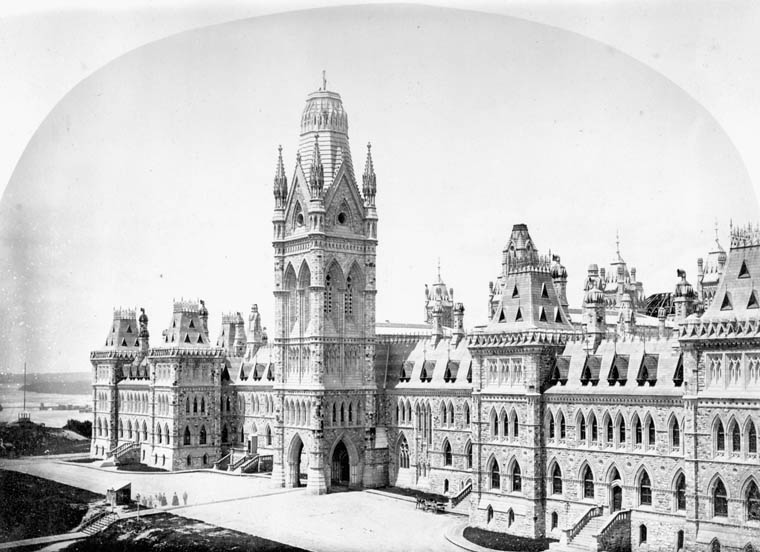
[Following the devastating fire which destroyed the Centre Block of Canada's first Parliament building (shown above) the cornerstone of the current structure was laid by Governor-General Prince Arthur, Duke of Connaught in September 1916, and was completed in 1927, with the construction of the Peace Tower. More recent additions to Parliament Hill have included the Centennial Flame and an equestrian statue of Elizabeth II, Queen of Canada, astride her famously Canadian mount Burmese.]

1112 - Barcelona's Ramon Berenguer III and Douce I of Provence were married, uniting the fortunes of those two states.

1488 - Portugal's Bartolomeu Dias landed in Mossel Bay after rounding the Cape of Good Hope, becoming the first known European to travel so far south.

1509 - The sea-going Battle of Diu - pitting the forces of viceroy Dom Francisco de Almeida against those of (among others) Mahmud I, Sultan of Gujarat, during the Portuguese-Mamluk War - resulted in a victory for Portugal, as well as greatly increased European trade in Asia.

1787 - The Shays' Rebellion, an armed rebellion in Western Masachusetts led by Daniel Shays, was crushed; the so-called Shaysites were essentially farmers opposed to crippling taxes.

1809 - The Illinois Territory was created.

1834 - Wake Forest University was established in Winston-Salem, North Carolina.

1867 - Prince Mutshito became Emperor Meiji of Japan.

1870 - The Fifteenth Amendment to the US Constitution was ratified, granting voting rights to citizens regardless of race.

1900 - Governor William Goebel died in Frankfort, Kentucky, having been shot on January 30th shortly after his election; he was sworn in the following day on his death bed, and remains the only US governor to be assassinated - although no culprit was ever found and no one ever claimed responsibility. Goebel was succeeded by his Lieutenant-Governor, J. C. W. Beckham.

1913 - The Sixteenth Amendment to the US Constitution was ratified, authorizing a federally imposed and collected Income Tax.

1916 - Fire destroyed the old Centre Block of Canada's Parliament Buildings in Ottawa, built in 1878; the Library of Parliament was spared the devastation by its massive iron doors, as were the East and West Blocks by their distance from the conflagration.

1918 - The Twin Peaks Tunnel - which, at 3,633 meters (11,920 feet), is still the longest streetcar tunnel in the world - opened for service in San Francisco.

1931 - The Napier Earthquake - still the worst natural disaster in the history of modern New Zealand - killed 258.

1947 - Percival Prattis - executive editor of the Pittsburgh Courier - became the first African-American issued a pass to the press gallery at the US Capitol, apparently.

1958 - The Benelux Economic Union was founded, which created a testing ground for a later European Economic Community.

1966 - The Soviet Union's unmanned Luna 9 spacecraft made the first controlled rocket-assisted landing on the Moon, touching down in the Oceanus Procellarum.

1967 - Ronald Ryan became the last person executed in Australia, when he was hanged at Pentridge Prison, near Melbourne.

1989 - Paraguay's ailing dictator Alfredo Stroessner - in power since 1954 - was ousted in a coup led by his former ally Andrés Rodríguez.

1998 - Karla Faye Tucker became the first woman executed in Texas since 1984; try and guess who signed the order, refused to commute her sentence, then mocked her on national television.
*

share on: facebook

Wednesday, February 02, 2011

Happy Birthday Lauren Lane

Fond as I am of Fran Drescher - which is pretty fond - I'd be lying if I said that the star is ever the most interesting character in a sitcom, and as interesting as Fran Drescher is - which is pretty interesting - that's true even of The Nanny; by design it's the secondary characters who get the best lines, provide the most humour, in fact keep the whole enterprise going by giving the star someone to react against. Many otherwise promising star vehicles have failed for precisely this reason...

PhotobucketFor six hilarious seasons, Lauren Lane fulfilled just such a role on The Nanny, which helped keep the show's hilarity ensuing at a consistently antic pace; as C. C. Babcock, Lane was the blonde WASP-y foil to the extremely ethnic brunette Fran Fine - plus Daniel Davis' Niles, Charles Shaughnessy's Maxwell Sheffield and Renee Taylor's Sylvia Fine besides. In fact, in some episodes it seemed like her mellifluous 'Hello, hello' was the only thing capable of cutting through the chainsaw-like drone of that laugh. In the process Lane had ample opportunity to shine in both the high comedy of banter and the low comedy of pratfalls, proving herself as versatile a performer as could be found in that truly talented company.

Even if her entire career hinged on those 146 episodes alone, Lane's would be one of the most esteemed in all of American television, but she's has also appeared on such shows as Hunter and she had an extended guest run on the 1991-2 season of L.A. Law, as well as in movies.

Since The Nanny went off the air, Lane has been teaching in the theatre department at Texas State University in San Marcos, hopefully instilling in a new generation some of the skill and magic for which she herself has been responsible...
*

share on: facebook