Tuesday, April 06, 2010

POPnews - April 6th

Photobucket
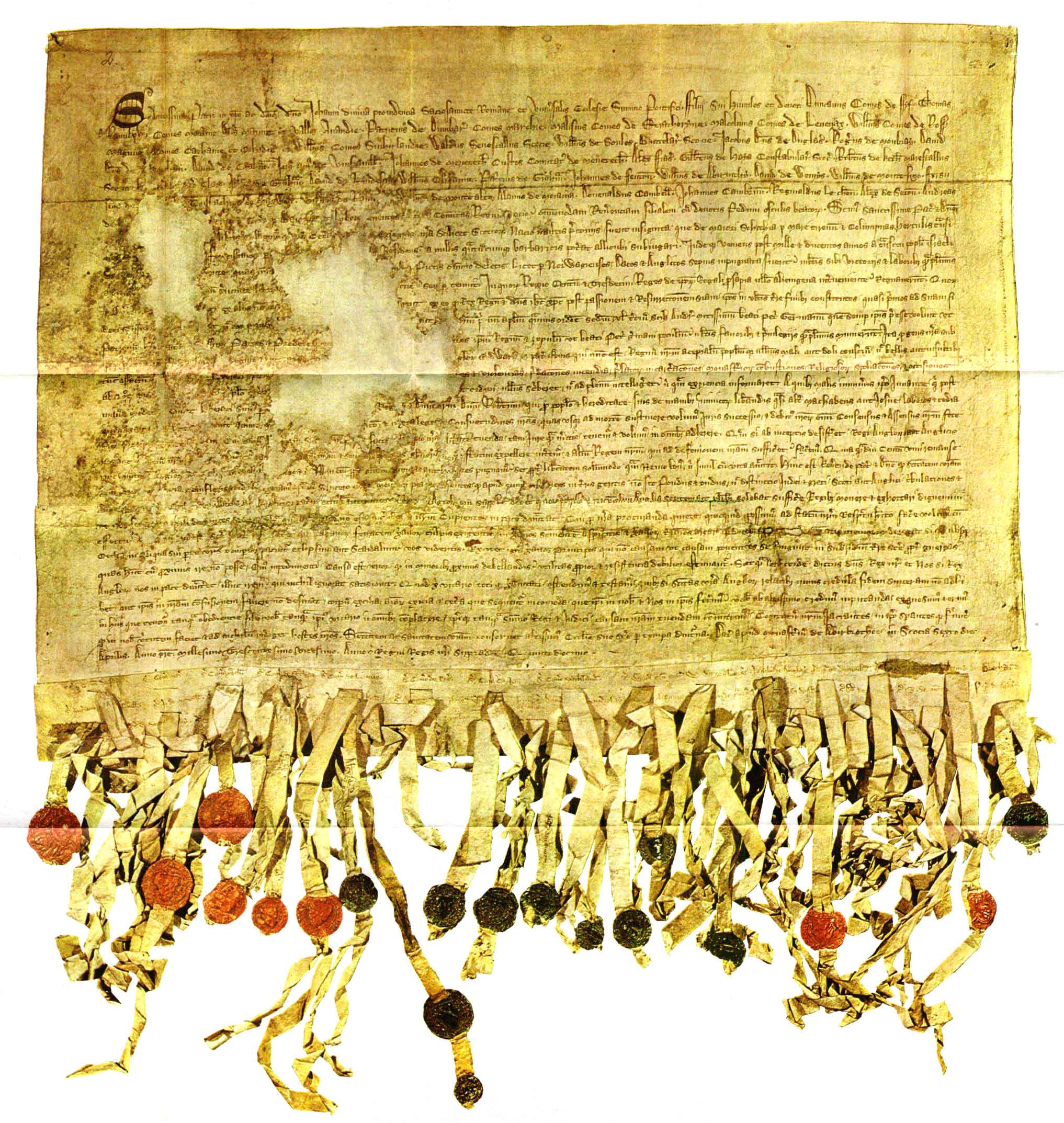
[The text of it may be as dry as an overcooked haggis, but the meaning of it is concise and unequivocal; there was a Scotland long before there was an England, it calls out, and ye can like it or lump it! Although it later forced England's Edward III to sign the Treaty of Northampton in March 1328, successive English rulers paid the declaration no heed, and the endurance of the Scottish national identity even less - always at their peril.]

402 CE - Roman general Stilicho defeated the Visigoths under Alaric I at the Battle of Pollentia by surprising them during their celebration of Easter - making this battle the very first 'War on Easter', if you will.

1320 - The Scottish nobility reaffirmed their independence by signing the Declaration of Arbroath, which was then submitted to Pope John XXII at Avignon; believed to have been drafted by Bernard of Kilwinning at Arbroath Abbey, its rhetoric represents a watershed in the First War of Scottish Independence.

1327 - The poet Petrarch first saw his idealized love, Laura (possibly Laura de Noves), in the church of Saint Clare in Avignon; he then proceeded to write 366 poems about her which, even for a smitten poet, is a lot. During the Renaissance they were collected - and are still available as - Il Canzoniere.

1385 - João, Master of the Order of Aviz, was declared King João I by Portugal's council, which met at Coimbra to settle the disputed secession; although the half-brother of his predecessor Ferdinand I, he was technically illegitimate (his mother being Pedro I's mistress Teresa Lourenço and not his consort Constance of Peñafiel). João I's ascension nevertheless ended the civil war known as the 1383-1385 Crisis, brought an end to the Portuguese Interregnum, and established the royal House of Aviz; accordingly, he was remembered within his own lifetime as João the Good.

1652 - Dutch sailor Jan van Riebeeck established a resupply camp at the Cape of Good Hope, which eventually became Cape Town.

1782 - Rama I succeeded King Taksin of Thailand, who was overthrown in a coup d'état after having been declared insane for his delusions of divinity, a practice sorely in need of restoration in certain circles today...

1814 - Napoleon abdicated, whereupon he was exiled to Elba; not very well, as it turns out, but it was a nice first try.

1830 - The Church of Jesus Christ of Latter-day Saints was organized by Joseph Smith, Jr. and others at Fayette, New York.

1895 - Oscar Wilde was arrested (at London's Cadogan Hotel) after losing a libel case against John Sholto Douglas, 9th Marquess of Queensberry.

1930 - Having left the Sabarmati Ashram in March, the Mahatma arrived at Dandi, where he raised a lump of mud and salt and declared: 'With this, I am shaking the foundations of the British Empire.' Thus began the Salt Satyagraha, and the even longer trek towards independence for India set in motion by the declaration of the Purna Swaraj in December 1929.

1947 - The first Tony Awards - given for excellence in the theatre - were presented by the American Theatre Wing at the Waldorf Astoria Hotel in New York City.

1965 - Intelsat I (nicknamed Early Bird) - the first communications satellite to be placed in geosynchronous orbit - was launched for COMSAT; deactivated in August 1969, it was briefly reactivated for its 25th Anniversary, and remains inoperational but aloft.

1968 - Racial violence erupted in dozens of cities across the United States in reaction to the assassination of Martin Luther King, Jr.; however, a double explosion which killed 41 and injured 150 in Richmond, Indiana's downtown district was related to a faulty natural gas line, and not to the riots then setting major urban centres ablaze.

1970 - Four California Highway Patrol officers - Walt Frago, Roger Gore, George Alleyn, and James Pence - were killed in a shoot out with Jack Twinning and Bobby Davis in the parking lot of a restaurant in the California town of Newhall, in what came to be called the Newhall massacre. Despite the aid of a bystander, former US Marine Gary Kness, Twinning and Davis were able to make their getaway - albeit only briefly; Davis was arrested shortly after stealing a camper van belonging to Daniel Schwartz, and Twinning killed himself to avoid capture the next morning following a hostage situation involving Stephen Hoag. Davis was found dead of an apparent suicide in his cell at Kern Valley State Prison in August 2009.

1973 - NASA launched its Pioneer 11 spacecraft to explore the outer solar system.

1994 - The Rwandan Genocide began when an aircraft carrying that country's president, Juvénal Habyarimana, and Burundian president Cyprien Ntaryamira was shot down near Kigali International Airport whereupon it crashed into the grounds of the Presidential Residence; many theories abound as to who is responsible, but the sad fact is that almost 1 million Rwandans paid the ultimate price - their own lives - for Hutu hatred of Tutsi. The conflict is eloquently described in Canadian Lieutenant-General Roméo Dallaire's memoir Shake Hands With the Devil, as well as in the 2004 film Hotel Rwanda.

2004 - Rolandas Paksas became the first president of Lithuania to be peacefully removed from office by impeachment.

2005 - Kurdish leader Jalal Talabani became President of Iraq, while Shiite Arab Ibrahim al-Jaafari was named prime minister the next day; al-Jaafari has since been replaced by Nouri al-Maliki.

2009 - A 6.3 magnitude earthquake struck near the Italian city of L'Aquila, killing 307; adding insult to injury, during an inspection of the damage by Silvio Berlusconi, the Italian president couldn't understand why those in temporary shelters were complaining, likening their plight to a 'camping weekend'. He then went on to sexually harass a woman doctor who was aiding in the relief.
*

share on: facebook

Monday, April 05, 2010

Pop History Moment: The Explosion At Ripple Rock


On this day in 1958 a sizable portion of the Canadian viewing public watched, transfixed, as one of the first coast-to-coast television broadcasts in the country's history showed them the destruction of Ripple Rock, near the Vancouver Island community of Campbell River...

Essentially an underwater mountain in the Seymour Narrows of British Columbia's Discovery Passage - at low tide a mere 2.7 meters (9 feet) underwater - Ripple Rock represented a major threat to shipping, and the area where it was situated was even described by Captain George Vancouver as 'one of vilest stretches of water in the world'. Since much of the province's mainland coastline isn't connected to the Port of Vancouver by road, residents of Haida Gwaii and cities like Prince Rupert then (as now) relied on coastal freighters for much of their food and other vital consumer items.

Ripple Rock's appetite for boats is borne out by the historical record; beginning in 1875 with the side-wheel steamer Saranac 20 large and 100 smaller vessels were either badly damaged or sunk by it at a cost of at least 110 lives. As early as 1931 a Marine Commission called for a solution to the problem; given the pace of bureaucracy, it wasn't until 1942 that the government approved its removal. The National Research Council of Canada undertook a feasibility study to consider the problem in 1953, and beginning in November 1955 a two and a half year effort to mine Ripple Rock with explosives via a 762 meter horizontal shaft began...

At 9:31:02 am 635,000 metric tons of rock and water were displaced by 1,270 metric tons of Nitramex 2H, which increased the clearing at low tide to about 14 meters (45 feet). Authorities cleared the blast zone to a radius of 3 km, and the camera operators who captured the historic images shown above were housed within a bunker when they did. The blast was felt as far away as Vancouver, and rained debris down from a maximum height of 300 m, some of which struck land on either side of the strait.

Fifty years later to the second the city of Campbell River commemorated the blast by recreating it with the aid of a special effects company; over the intervening years the event had been the subject of two songs - one by folk singer Stu Davis and another by Vancouver punk legends The Evaporators, whose 2004 third album Ripple Rock featured a song by that name.
*
share on: facebook

Gratuitous Brunette: Haruma Miura

In the interest of full disclosure I must say that I'd never heard of Haruma Miura until research uncovered his name, and further research revealed he'd be a suitable candidate for Gratuitous Brunette...

PhotobucketStill, seeing as the Pop Culture Institute's agenda supports a fair and equitable globalization* it only seems right to highlight a multi-talented actor and singer (formerly with J-pop sensations Brash Brats) from Japan rather than using this space to witter on about some one-hit wonder from the Eighties who just happens to be from the UK.

Born on this day in 1990, Miura's career began when he was just 5; alas, my complete ignorance of Japanese culture - not to mention my inability to read the language - means that all I'm able to glean about him is from his woefully inadequate English-language Wikipedia page.

If you speak Japanese you might want to check out his official website, or if you are a fan of that manga-esque stuff that makes me feel slightly uneasy you might want to leave a comment.

*Translation: Don't care where it gets hits from.
*
share on: facebook

Remembering... Howard Hughes

Photo Sharing and Video Hosting at Photobucket

While a more standard news outlet might report that on this day in 1976 Howard Hughes died, there's very little that's standard about the Pop Culture Institute; here we'd be more likely to debate precisely when the handsome and dashing aviator known as Howard Hughes died and was replaced by the agoraphobic Howard Hughes who was scared witless of germs. Nevertheless, it's a debate which could continue for years...
*
As long ago as the early 1930s Hughes was displaying symptoms of obsessive-compulsive disorder with regards to the size of peas on his dinner plate; as a film producer he was a micro-managing control freak (even more than usual), often overlooking the quality of the picture as a whole in favour of fixating on some minor flaw in costuming, for instance, as he did during production of The Outlaw. By 1947 he'd taken to locking himself away from the world, surrounded only by a few flunkies to whom he issued variable and complicated instructions; for the most part he would spend the last 30 years of his life in such a reclusive state, using his vast wealth to insulate himself from everyone and everything.
*
Certainly, he'd survived numerous plane crashes - including that of the XF-11 in July 1946 - which left Hughes addicted to various pain medications, but he may also have been susceptible to a hereditary mental illness which, given the judgements and pharmaceuticals of the day, no one at the time could have done anything to allay...
*

share on: facebook

"Gimme Gimme Gimme (A Man After Midnight)" - ABBA


Birthday gal slash pop goddess Agnetha Fältskog today turns 60; formerly one-quarter of Sweden's own ABBA - along with Björn Ulvaeus, Anni-Frid Lyngstad, and Benny Andersson - she later had a less successful solo career. Still, how does one top the massive success of a group like ABBA?

Gimme! Gimme! Gimme! (A Man After Midnight) originally appeared on a 1979 greatest hits compilation, as well as on their later album ABBA Gold, and is a must-have for ABBA fans; it was later, of course, heavily sampled as the basis for Madonna's massive hot single Hung Up.
*

share on: facebook

In Memoriam: Bette Davis

Photobucket

It's no secret that Bette Davis - born on this day in 1908 - is pretty much considered a goddess around the Pop Culture Institute; more than a dozen of her movies reside in the collection, and among actors she takes up the most space* in the stacks as well, with a half-dozen titles of biography and autobiography of varying qualities devoted to her life and work. Despite this she made more than 80 movies from her screen debut in 1931 to her death in October 1989, and has been the subject of at least a dozen books, which makes our cozy little selection representative, but far from complete.

Yet what's here is choice; to my way of thinking, if one can't have it all one should at least strive to have the best. Among the books, this means her two memoirs - The Lonely Life, written at mid-career (with Sanford Dody), and This 'N That, written near the end (with Michael Herskowitz) - and a pseudo-memoir entitled Mother Goddam. Of these three, the first two are fairly standard actressy memoirs - fairly candid, breezy in tone, with the occasional barbed anecdote for the fans (Miriam Hopkins was a bitch!); the third represents an innovation in celebrity biography which was simply too good an idea to catch on - interspersed with Whitney Stine's brisk, interesting narrative are passages by Miss Davis herself (which in the original were printed in red ink!). All three are preserved here in more or less their initial hardcover incarnations.

Also included in our collection are a slim but fact-filled volume from a series Illustrated History of the Movies (written by Jerry Vermilye), a middling biography by Barbara Leaming, and another somewhat better-than-middling biography by Charles Higham (which happens to be the first book I ever read about her, at the age of 13). Rounding out the literary side of the collection is a poisonous hatchet job written by Davis' daughter B. D. Hyman, entitled My Mother's Keeper, which is dreck, but entertaining dreck nonetheless. Recently I've been sniffing around a new bio by the thorough (and thoroughly hunky) Ed Sikov; there's another, by the Higham-esque James Spada, which might conceivably join its colleagues someday.

Yet reading about Bette Davis - whether in her 'own' words (that is to say the words of her ghost-writer) or even those of a slavishly devoted fan like Whitney Stine - simply does not do; she must be seen and heard and her performances felt to be fully understood. Selecting a favourite movie of hers is a challenge I normally don't like to undertake, even as a parlour game; for the purposes of this blog, though, I'd have to give the edge to 1937's Marked Woman, a brisk, timely melodrama in the best old-school Warner Bros. tradition. Also in the collection of the Pop Culture Institute are Of Human Bondage, The Petrified Forest, Jezebel, and Dark Victory from the 1930s, as well as The Letter, The Little Foxes, The Man Who Came to Dinner, Now, Voyager, All About Eve, What Ever Happened to Baby Jane?, and The Whales of August.

Watching her transformation over 50 years from a pop-eyed mass of neuroses in her earliest films to a soigne sophisticate at the height of her career to a monstre sacree on the long trek to immortality is not only the best biography of the woman-as-actress but also offers a striking insight into the parallel transformation of the actress-in-Hollywood as well.

*Space which is becoming increasingly coveted, I might add.
*

share on: facebook

Remembering... Nigel Hawthorne

As prestigious as the thea-tah may be, for shallow people such as myself, television is where it's at; where else, for instance, could I have discovered the genius that is Nigel Hawthorne if he'd only ever deigned to tread the boards? Especially since I only ever get to the National Theatre when I visit London, which is, uh, never. (Not that I'm bitter about that either. Much.)

PhotobucketA n y w a y... Born on this day in 1929, Hawthorne's portrayal of Sir Humphrey Appleby - the quintessential civil servant - in the timeless sitcom Yes Minister just goes to show you what can happen when real acting talent and the reach of mass media collide; wrapping his honeyed voice around mouthfuls of bureaucratic gobbledygook, Hawthorne's portrayal was equal parts charm and smarm, and left audiences absolutely certain of who's really in charge of the government*. Thanks to brilliant scripts, a strong ensemble, and his own gifts, both he and the show became internationally renowned.

In later years he continued to tackle meaty dramatic roles, playing such historical figures as George, Duke of Clarence, in the stylish film version of Richard III (1995), as well as George III in both the stage and film versions of Alan Bennett's seriocomic play The Madness of King George (onscreen opposite Helen Mirren, playing yet another Queen, in this case Charlotte). He also played Martin Van Buren in Steven Spielberg's ambitious epic Amistad (1997).

Always intensely private, in the last years of his life he was outed; despite his discomfort with the way it was done, he proceeded to give interviews on the subject, and even attended the 67th Annual Academy Awards in 1995 with his partner Trevor Bentham (only to lose the Oscar for The Madness of King George). Awarded the CBE in 1987, he became Sir Nigel in 1999. Hawthorne died of a heart attack in December 2001, while battling pancreatic cancer; his memoirs, published posthumously, are entitled Straight Face.

*The good news is, it's not the politicians; the bad news is, it's not the politicians.
*
share on: facebook

Pop History Moment: The Battle of the Ice


During the Battle of the Ice - which took place on this day in 1242 on Russia's Lake Peipus - Alexander Nevsky rebuffed an invasion attempt by the Livonian Order, a branch of the Teutonic Knights commanded by Hermann of Dorpat; Nevsky's victory was a significant setback for Roman Catholic forces during the Northern Crusades and probably saved the Russian Orthodox Church from destruction.

In the 1939 film Alexander Nevsky by Sergei Eisenstein (with a thrilling score by Sergei Prokofiev) two medieval armies meet and attempt to do battle for nothing less than men's souls; while thrilling, the film's timely overtones - coming, as they did, on the eve of World War II - somewhat distorted the historical record.
*
share on: facebook

POPnews - April 5th

Photobucket
[Jacob Roggeveen had been discharged with finding Terra Australis at the helm of a three-ship convoy - consisting of the Arend, the Thienhoven, and Afrikaansche Galey - when he accidentally encountered an island known to its residents as Rapa Nui on Easter Sunday 1722; the ships were greeted by as many as 3,000 natives and some mysterious sculptures known as moai...]

1566 - 200 Dutch noblemen, led by Hendrik van Brederode, forced their way into the presence of the country's regent - Margaret of Parma - and presented her with their Petition of Compromise, denouncing the Inquisition in the Netherlands; the Inquisition was subsequently suspended there and a delegation was sent to Spain to petition Philip II, although van Brederode himself was banished by the governor, the ruthless Duke of Alba.

1614 - Pocahontas married English colonist John Rolfe at Henricus, a plantation up river from Jamestown Settlement, after which they settled on their own property at Varina Farms.

1621 - Captain Christopher Jones left the Plymouth Colony aboard the Mayflower and returned to England.

1722 - The Dutch explorer Jacob Roggeveen became the first European to visit Easter Island.

1792 - The presidential veto power was first exercised when President George Washington vetoed the Apportionment Bill (on the grounds that it was unconstitutional); the Bill was designed to apportion representatives among the several states following a census (in this instance, that of 1790). Congress overrode this veto and the bill subsequently passed.

1804 - The High Possil Meteorite - Scotland's first recorded meteorite, and one of only four in that country's history - fell in High Possil, to the north of Glasgow (where it now resides, in the collection of the Hunterian Museum).

1818 - At the Battle of Maipú, Chile's independence movement - led by Bernardo O'Higgins and José de San Martín - won a decisive victory over Spain, leaving 2,000 Spanish and 1,000 Chilean patriots dead.

1847 - Birkenhead Park - Britain's first public civic park - was opened in (of all places) Birkenhead; designed by Joseph Paxton, it would later influence Frederick Law Olmsted's work on New York's Central Park.

1879 - Chile declared war on Bolivia and Peru, starting the War of the Pacific.

1904 - The first international rugby league match was played between England and an Other Nationalities team (comprised of Welsh & Scottish players) in Wigan's Central Park.

1932 - In the Dominion of Newfoundland 10,000 rioters unhappy with the government of Prime Minister Sir Richard Squires seized the Colonial Building; he only barely escaped with his life. As a result of the riot the Commission of Government was established, returning the colony to unelected leadership subordinate to London, and eventually leading to the country's admission into the Canadian Confederation in March 1949.

1949 - Fireside Theater had its television debut on NBC.

1951 - Americans Julius and Ethel Rosenberg were sentenced to death by Judge Irving Kaufman for engaging in espionage on behalf of the Soviet Union; their trial, which began on March 6th, had already led to their March 29th conviction.

1955 - Sir Winston Churchill resigned as British Prime Minister, citing ill-health; unbeknownst to the public, Churchill had suffered a stroke.

1958 - Ripple Rock, an underwater threat to navigation in British Columbia's Seymour Narrows, was destroyed in one of the largest non-nuclear controlled explosions to date.

1976 - During the Qingming Festival - China's annual day of mourning, held in Tiananmen Square, which was that year dominated by mourning for the country's recently deceased Premier Zhou Enlai - the removal of the usual displays of mourning evoked protests by members of the April Fifth Movement; later deemed 'counter-revolutionary' and resulting in the house arrest of Vice Premier Deng Xiaoping ordered by the Gang of Four, the Tiananmen Incident has since been considered a display of patriotism.

1986 - Three people were killed in the bombing of the La Belle Discotheque in West Berlin, two of whom were American servicemen - Kenneth T. Ford and James E. Goins - in addition to a Turkish woman, Nermin Hannay; in retaliation US President Ronald Reagan ordered Operation El Dorado Canyon against Libya, who it was believed ordered the attack.

1992 -President Alberto Fujimori used military force to dissolve the Peruvian Congress.

1998 - When Japan's Akashi-Kaikyo Bridge - linking Shikoku with Honshū at a cost of about US$3.8 billion - opened to traffic, it became the longest suspension bridge in the world, with a span of 1,991 m (6,529 ft).
*
share on: facebook
Sunday, April 04, 2010

"It Had To Be You" by Priscilla Lane


In memory of Priscilla Lane* here's a clip of her performing It Had To Be You from the 1939 film The Roaring Twenties; she also got to take a crack at My Melancholy Baby and I'm Just Wild About Harry in the film, and clips of these performances are also available on YouTube, but since this is my favourite song of the three there you go... Lane starred** in the film opposite James Cagney and Gladys George - who's seen in the above clip speaking to Lane's frequent co-star, Jeffrey Lynn.

Lane got her start in show business in the early 1930s as part of a singing quartet called the Lane Sisters, three of whom - Lola, Rosemary, and Priscilla - would each have a modicum of success on their own, while Leota did not; a fifth Lane sister, Martha, avoided show business altogether.

For all its early promise, Priscilla Lane's career in movies would essentially amount to a near-miss; although she appeared in such popular and well-received films as Four Daughters (plus its sequels Four Wives and Four Mothers), as well as Brother Rat***, Frank Capra's Arsenic and Old Lace, and Alfred Hitchcock's Saboteur (1942) her recalcitrance with the studio meant she was soon being offered fewer and weaker parts, and her seven-year contract with Warner Bros. was suspended after only five. Lane's last movie role came in the 1948 film noir Bodyguard, opposite Lawrence Tierney; except for a talk show broadcast locally in Boston circa 1958, which she did for a year, it would be the end of her career.

*Who died of chronic heart failure brought on by lung cancer on this day in 1995, aged 79.
**And was even billed above the title!
***Most notable for the presences of future US President
Ronald Reagan
and his future ex-wife Jane Wyman.
*
share on: facebook
Pop History Moment: The Killing Of Dr. King

Photobucket

Martin Luther King, Jr. and his colleague Ralph Abernathy had stayed in Room 306 of the Lorraine Motel so often that it was given the unofficial nickname of the King-Abernathy Suite; for a man who'd been the subject of many death threats - including a notable bombing of his home in January 1956 - whatever comfortable familiarity the room offered him it also offered his foes the kind of access to him that was to be his downfall. The motel, at 450 Mulberry Street in the south end of Memphis, Tennessee, was owned by black businessman Walter Bailey; originally called the Windsor Hotel, it had hosted many black notables since its opening in the 1920s - especially during the days of segregation - given its proximity to Beale Street.

King had been in Memphis to support a walkout organized by black sanitation workers, who were seeking pay equity; the previous evening he'd addressed a crowd at the Mason Temple and delivered his famous speech I've Been to the Mountaintop, which received a thunderous ovation. In it he referred to the many threats against his person, and seemed at peace with the inevitability that one of them might be successfully carried out.

Shortly after 6 PM on this day in 1968, while standing on the hotel's balcony chatting with Jesse Jackson, Dr. King was fatally shot in the neck; the image above shows those traveling with King indicating where the single shot had come from, a boarding house across the street. Witnesses initially had trouble summoning an ambulance, however, because upon learning that Dr. King had been shot the hotel's switchboard operator - Mrs. Bailey, as it turns out, the woman for whom the motel had been named - had suffered a stroke that would claim her life only a few days later. King was eventually taken to St. Joseph's Hospital, where he died.

In the days that followed King's killing dozens of American cities erupted in racial violence; surely whatever his assassins had hoped to accomplish over and above cold-blooded murder, it can safely be said that they failed miserably. The Civil Rights movement - far from foundering - gained momentum in the years following the slaying.

Two months later James Earl Ray was captured at London's Heathrow Airport, traveling on a Canadian passport under the name Ramon George Sneyd; he was later tried and sentenced to 99 years' incarceration for the killing of Dr. King, although Dexter King (among other members of the King family) don't believe Ray to be guilty of plotting the crime, despite his confession, only carrying it out. King's widow Coretta Scott King believed her husband's murder had been orchestrated by Loyd Jowers, the owner of Jim's Grill, a restaurant conveniently located across the street from the Lorraine Motel.

The Lorraine Motel is now the National Civil Rights Museum; the events of King's last days on Earth have been dramatized in the play The Man in Room 306 by Craig Allen Edwards.
*

share on: facebook

POPnews - April 4th

Photobucket
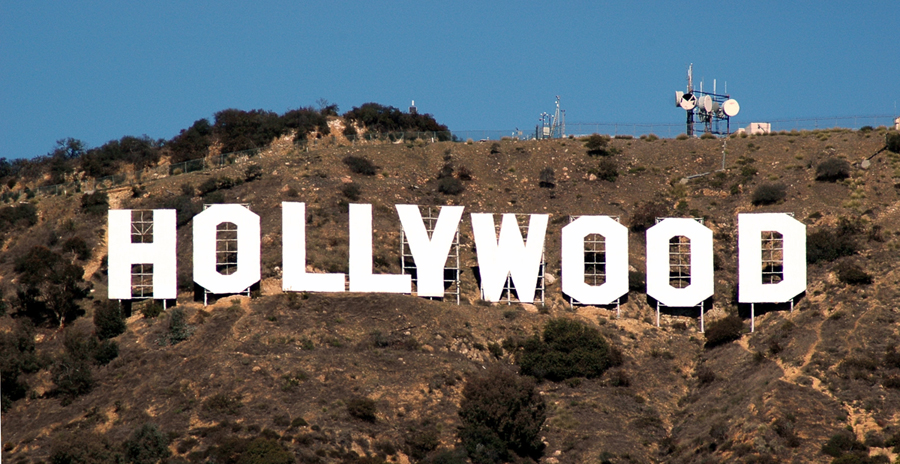
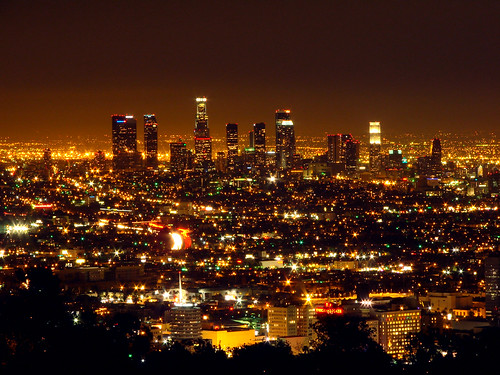
[While there are many iconic images of Los Angeles - from the Hollywood sign to the blanket of lights as observed from the top of Mulholland Drive - oddly enough, its skyline isn't one of them.]

1581 - Francis Drake was knighted by Elizabeth I aboard his ship Golden Hind; Drake had just returned to England, having circumnavigated the globe.

1660 - England's would-be King Charles II signed the Declaration of Breda, which cemented the terms of the English Restoration after the failure of Oliver Cromwell's Commonwealth, as well as spelling out the conditions under which he would agree to accept the throne.

1721 - Sir Robert Walpole took office as the first Prime Minister of the United Kingdom under King George I.

1841 - William Henry Harrison died of pneumonia, becoming both the first President of the United States to die in office and the one with the shortest term served.

1850 - Los Angeles was incorporated as a city.

1859 - The theatrical troupe known as Bryant's Minstrels debuted the song Dixie at Mechanics' Hall in New York City during the finale of their blackface minstrel show; it was an instant hit, even becoming a favourite of President Abraham Lincoln.

1866 - Russia's Tsar Alexander II narrowly escaped an assassination attempt at the hands of Dmitry Karakozov in the city of St. Petersburg.

1887 - Argonia, Kansas, elected Susanna M. Salter as the first female mayor in US history.

1939 - Faisal II became King of Iraq following the suspicious death of his father, Ghazi I.

1949 - Twelve nations signed the North Atlantic Treaty, thereby creating the North Atlantic Treaty Organisation.

1958 - The Committee for Nuclear Disarmament's Peace Symbol - designed by Gerald Holtom - was displayed in public for the first time, in London, at a march from Trafalgar Square to the Atomic Weapons Research Establishment at Aldermaston.

1960 - Senegal gained its independence from France.

1973 - New York's World Trade Center was officially dedicated.

1975 - Microsoft was founded as a partnership between Bill Gates, Paul Allen, and the Devil.

1976 - Prince Norodom Sihanouk resigned as leader of Cambodia and was placed under house arrest by the Khmer Rouge on the orders of Pol Pot.

1979 - Deposed Pakistani President Zulfikar Ali Bhutto was executed at Rawalpindi.

1983 - The Space Shuttle Challenger made its maiden voyage into space, a mission known as STS-6.

1988 - Governor Evan Mecham of Arizona - an eminent sleazebag - was convicted at the end of his impeachment trial and removed from office; as governor he had canceled the state's observance of Martin Luther King Day, making the day* of his final downfall especially apt.

*The anniversary of the assassination of Dr. King.

1991 - Senator John Heinz of Pennsylvania and six others were killed when their helicopter collided with a plane over an elementary school in Merion, Pennsylvania; his widow, Teresa Heinz, later married Senator John Kerry.
*

share on: facebook

Saturday, April 03, 2010

Pop History Moment: Dr. King's Final Speech


On this day in 1968 Dr. Martin Luther King, Jr. took the pulpit at the Mason Temple in Memphis, Tennessee (at a rally for striking black sanitation workers in that city) and raised the roof for what would be the last time. As good as his speech - now known as I've Been To The Mountaintop - was for those in attendance, it would have been a special honour to be there, to witness a powerful orator at the top of his game and utterly in command of all his powers.

By this point there had been numerous threats against King's life, and he refers to these in the speech as though it were only a matter of time before Fate caught up with him... It did of course; the following day King was assassinated in front of Room 306 at the Lorraine Motel.
*
share on: facebook

Gratuitous Brunette: Alec Baldwin

Photobucket

There should be no mystery* as to why I've chosen to post a twenty year old picture of Alec Baldwin here on this, his 52nd birthday... Still, having let his looks slide seems to have allowed an even more prodigious talent to emerge - as witnessed by the career resurgence he's gotten from playing Jack Donaghy on the NBC sitcom 30 Rock - which is not a bad trade I guess, as these things go. Anyway, Baldwin's always were the kind of looks that were too 'looky'** for my liking; for all the attention they got him they clearly also made him uncomfortable, or else he'd have found an excuse to hit the gym some time in the last decade in an effort to keep them.

I never knew until today - when conducting the cursory (some*** would say perfunctory) research I generally do for these things - that Baldwin's first job in New York City was as a bus boy at Studio 54 in the late 1970s. Whatever I would have given to be a fly on the wall in that place before I'd read that, well, now I'd double it!

Having appeared on stage in a 1986 revival of Joe Orton's Loot, in Caryl Churchill's Serious Money with Kate Nelligan, and in an acclaimed revival of Tennessee Williams' A Streetcar Named Desire as Stanley Kowalski; on television in The Doctors and on Knots Landing, as well as hosting Saturday Night Live some 14 times; and in films as diverse as Beetlejuice (1988), The Hunt for Red October (1990), and Glengarry Glen Ross (1992) - in a part which playwright David Mamet added to the movie - Baldwin has also weathered a celebrity marriage (to Kim Basinger) and several tabloid scandals (the most famous involving their daughter Ireland) in order to arrive at the utter nadir of his career, being named a Gratuitous Brunette!

*It's so not a mystery I don't even need to offer an explanation in my favourite way - namely via a snide footnote!
**Sometimes pretty people are just so pretty you can't help but look at them - rather than, say, listen to them.
***Bitches, mostly.
*
share on: facebook

POPnews - April 3rd

Photobucket
[After the turbulent reign of his half-brother Harthacanute, that of Edward the Confessor was a comparative dawdle; peace and prosperity, however, come at a price - in this case an erosion of royal authority in favour of the country's three most powerful nobles... So while the power struggles of the Crown with Godwin, Earl of Wessex, Leofric, Earl of Mercia, and Siward, Earl of Northumbria, may have threatened to tear England asunder they were excellent practice for the greater threats of ongoing Viking invasion (which would be repelled once and for all under Edward's successor Harold Godwinson at the Battle of Stamford Bridge in 1066) and the Norman Conquest to come - which would not only succeed in bringing the English under foreign rule less than a year after the Confessor's death but also ironically unite them as a people in a loathing for the French that would last for a thousand years...]

1043 - Edward the Confessor, England's penultimate Saxon King, was crowned at Winchester Cathedral.

1287 - Pope Honorius IV died; he was succeeded by Nicholas IV in February 1288 - a papal vacancy or sede vacante of more than ten months. While this was unusual the longest papal conclave in history followed the death of Pope Clement IV in November 1268, and lasted until the election of Pope Gregory X in September 1271.

1559 - The treaty known as the Peace of Cateau-Cambrésis - having been signed by representatives of England's Elizabeth I and France's Henri II the previous day - was signed by those of Henri II and Spain's Philip II at Le Cateau-Cambrésis, ending the Italian Wars.

1860 - The first successful run of the Pony Express - from Saint Joseph in Missouri to Sacramento in California - took place; it would be made entirely redundant by the advent of the First Transcontinental Telegraph in October 1861.

1882 - Robert Ford killed the outlaw Jesse James for a $5,000 reward; Ford was recently portrayed by Casey Affleck, who was Oscar-nominated for the same film - The Assassination of Jesse James by the Coward Robert Ford - that starred Brad Pitt as James.

1895 - The trial of Oscar Wilde opened; originally a libel trial instigated by Wilde himself against the frankly loathsome Marquess of Queensberry - father of Wilde's lover Lord Alfred Douglas - it ended with Wilde's own imprisonment in Reading Gaol on the grounds of homosexuality.

1922 - Joseph Stalin became the first General Secretary of the Communist Party of the Soviet Union.

1929 - An order was placed with John Brown & Company by the Cunard Line to build RMS Queen Mary, which would serve as the company's flagship for more than 30 years; retired in December 1967, the Queen Mary is now a major tourist attraction in Long Beach, California.

1936 - Bruno Richard Hauptmann was executed for the kidnap and murder of the Lindbergh baby.

1946 - Japan's Lieutenant-General Masaharu Homma was executed in the Philippines for leading the Bataan Death March.

1948 - US President Harry S. Truman signed the Marshall Plan, which authorized $5 billion in aid for 16 European countries adversely affected by World War II.

Photobucket1953 - The first issue of TV Guide (shown, at right) hit newsstands bearing a full-colour image of Desi Arnaz, Jr. - whose own birth coincided with that of Lucille Ball and Desi Arnaz's fictional son, Little Ricky*... TV Guide came about after Walter Annenberg's Philadelphia-based Triangle Publications bought up numerous similar regional periodicals such as TV Forecast, TV Digest, and Television Guide with the aim of going national. At a price of just 15 cents, it quickly became the magazine with the highest circulation in the United States, peaking at around 20 million issues sold weekly in the 1970s. In fact, it would take the advent of cable in the early 1980s to bring about its decline, and even at that it would take twenty years, the Internet, and a 500-channel universe to do it!

*Originally aired on January 19th of that year, the I Love Lucy episode entitled Lucy Goes to the Hospital was watched by some 44 million people, representing 72% of the country's televisions at that time... To put it into perspective, the inauguration of President Dwight D. Eisenhower the following day only garnered 29 million viewers! I've said it before and I'll say it again - sitcoms represent the nadir of Western Civilization... But they're so damn funny!

1955 - Apparently the ACLU announced it would defend Allen Ginsberg's Howl in court, where it was facing obscenity charges.

1968 - Martin Luther King Jr. delivered his 'I've Been to the Mountaintop' speech; it would be the last major speech given by the prominent civil rights leader before his assassination.

1982 - A Royal Navy task force left Portsmouth with the intention of retaking the Falkland Islands.

1987 - Jewels belonging to the late Duchess of Windsor fetched top price at an auction in Switzerland; in all the sale netted some $45 million - 7 times the pre-sale estimate - which went to her principal beneficiary, the Pasteur Institute.

1993 - The steeplechase at the Grand National - held annually at Aintree Racecourse near Liverpool - was declared void after a false start.

1996 - The so-called Unabomber, Theodore Kaczynski, was arrested at his cabin in Montana.

2004 - Seven suspects in the March 2004 bombing of Madrid's Estación Atocha committed suicide rather than be captured as police surrounded their hideout in Leganés; one G.E.O. officer was killed and 11 police wounded when the apartment building in which the men were hiding blew up, while between five and eight other suspects escaped in the ensuing chaos.
*

share on: facebook

Friday, April 02, 2010

"Boulder To Birmingham" by Emmylou Harris


Birthday wishes go out today to Emmylou Harris, the roots country singer-songwriter whose unique voice and striking appearance belie her low-key performance style...

While my favourite album of hers remains 2000's exemplary Red Dirt Girl, the more I hear of her earlier work the more I like; that goes very much for Boulder to Birmingham, which first appeared on Harris' 1975 album Pieces of the Sky. The song details her grief following the death of her mentor, Gram Parsons, who died of a drug overdose in September 1973 at the age of 26.
*
share on: facebook

Happy Birthday Penelope Keith

Most actors would give their eye teeth to be involved in one classic program, let alone two; which makes the career of Penelope Keith all the more extraordinary, since she's had a hand in eight, of which at least three are timeless classics of the Britcom genre...

PhotobucketThe first of these was The Good Life, which first aired in 1975, in which she played the hilariously snooty middle-class homemaker Margo Leadbetter. After three series' of that, in 1979 she undertook the role Audrey fforbes-Hamilton, a gentry woman displaced by les nouveau riches in To the Manor Born, which also ran three series. In 1990 she played the more down-to-earth Jean Price, MP, in No Job for a Lady.

In between these came roles in Sweet Sixteen, Moving, Executive Stress (another favourite of ours), Law and Disorder and Next of Kin; she also hosted a panel show on ITV entitled What's My Line?

Since the 1990s Keith has concerned herself more with stage work, and offscreen has served as High Sheriff of Surrey - one of only three women ever to hold that post. Made an OBE in 1989 for her charitable work (as President of the Actors' Benevolent Fund and with the National Trust in southwest Surrey, where she lives), she was elevated to CBE (which she is shown holding at left) in 2007.

The first three series of The Good Life were recently released on DVD under the show's North American name Good Neighbors; since then it's been devoured and enjoyed anew by the Pop Culture Institute's crack team of researchers*, proving that the classics - show and costar alike - never go out of style. Next stop: all three seasons of To the Manor Born, which has also been released on DVD alongside the superlative Silver Anniversary Special first shown at Christmas 2007.
*
share on: facebook

Gratuitous Brunette: Chris Meloni

If there is one tried-and-true rule in the lawless world of cyberspace it's that mentions of Chris Meloni will bring enough traffic to your site to clog the Holland Tunnel; of course, the same goes for any number of soulless pop tarts and vapid TV starlets whom I'd rather die than mention*, so in this case it helps that Chris Meloni is a) a very talented actor, and b) HOT. Not hot... HOT. Even, dare I say it, HAWT. Did I mention that he's hot? Oh yeah... I did.

PhotobucketA n y w a y... So if we can get past his hotness for a minute - although, frankly, why would we want to - but strictly hypothetically, if we could we'd encounter an actor savvy enough not to be typecast for one.

Consider, if you will, the two roles for which he is best known: police detective Elliot Stabler - the moral compass of Law & Order: Special Victims Unit - and Chris Keller, the amoral serial killer who gives a certain flare to male rape on Oz. That's proper range, yo...

Amazingly, Meloni turns 49 today - every one of those years a good one.

*You know who you are...
*

share on: facebook

"I Heard A Rumor" by Bananarama


While it's not unusual for me to post a birthday hat trick of videos for a solo artist, I believe this is the first time I've ever done so for an individual member of a band - in this case, Keren Woodward of Bananarama. It's even more unusual in this case, I think, because (unlike Bananarama bandmate Siobhan Fahey, say, or Belinda Carlisle of The Go-Go's) Woodward had no solo career to speak of... She did, however, succeed in landing ex-Wham! heartthrob Andrew Ridgeley, which in its way is just as rewarding as a gold record with your own name on it*.

And yet, it's not so unusual when considering a) the ground broken by Bananarama within the music industry itself, and b) the general awesomeness of their music. In fact, I could probably do this for the birthdays of all four members** of the band and never once repeat a video.

I Heard a Rumour was the first single from Bananarama's fourth studio album, Wow!; released in September 1987, it features the Stock Aitken Waterman sound at its peak of freshness. I always liked the song because it reminds me of those first few carefree years after high school, when everything seemed possible because I didn't know better. Good times...

*Especially if you're a renowned star-fucker like me!
**Bananarama always had three members; after Siobhan Fahey left to, you know, marry
Dave Stewart of Eurythmics in 1987 and generally exude cool as a member of Shakespears Sister in 1988 she was replaced by Jacquie O'Sullivan (formerly of the Shillelagh Sisters).

*
share on: facebook

"Shy Boy" by Bananarama


As alluded to in the previous post, it was on this day in 2008 when I first posted the video for Cruel Summer to mark the birthday of Keren Woodward; the following year on the same day I went to repost it and... Unique among all of Bananarama's videos on YouTube, the video existed but without an accompanying soundtrack - not even an record label authorized non-embeddable version!

I have no idea what bug it might have been that crawled up the ass of Gawd knows which record label fucks (from, in this instance, Warner Music Group) but refusing free promotion for 25 year old product at a time when music industry revenues are plummeting seems like the absolute pinnacle of douchebaggery, at least to me. Especially since music videos were originally intended for - get this - promotion! No wonder the major labels are going down faster than a coke-addled starlet in a hip-hop video...

A n y w a y... After a period of time too long to mention wasted in searching for a useful version of Cruel Summer I decided to cut my losses and instead found this clip of the trio's first-ever single - Shy Boy (Don't It Make You Feel Good) from their 1983 debut album Deep Sea Skiving; it managed to show the original progenitors of girl power at the height of their girl powers, gave my readers a snippet of the sound of the magical year 1983, and yes, even free promotion for the same people whose sole endeavour in life seems to be thwarting little old me from helping them out*.

In the meantime, today the year came back around again and what should I find? Not one but several high quality clips of Cruel Summer with their soundtrack intact! A true embarrassment of riches! Could it be that my various online screeds have succeeded in drumming some sense into the appropriate heads? I doubt it. But the Interweb gods are smiling nonetheless, so let's just enjoy it while we can, shall we?

*Which, I might add, I do at no cost to them. I don't get free promo stuff like those fat cats in Old Media; whenever I write about something I've bought it with my own hard-earned money! Okay, I'll stop ranting now...
*
share on: facebook

"Cruel Summer" by Bananarama


Birthday wishes go out today to Keren Woodward, one-third of the groundbreaking all-female pop trio Bananarama...

The song Cruel Summer has been a particular favourite of mine ever since I first heard it in that cruel summer of 1984 - the year after it was released in the UK - and is taken from their eponymous album (named, appropriately enough, Bananarama). For many years its video existed in a peculiar gray area unique to YouTube, wherein the song's vocal track was forbidden due to a specious copyright claim - even though the images were not - and the person responsible for posting the video just left it up sans sound. You can imagine the hilarity that ensued in the comments below!

Well, it's back (for now, at least) and so I plan to take fair use of Fair Use and post it here for you...
*
share on: facebook

Pop History Moment: Operation Rosario Commenced

Photobucket

It's a safe bet that there were more people in the world who hadn't heard of the Falkland Islands (some exceptions being geography buffs, higher-ups in the Argentinian and British military, and the staff of the Foreign and Commonwealth Office) than would have heard of this remote outpost in the southern Atlantic Ocean before they were invaded by Argentina on this day in 1982 . The assault - codenamed Operation Azul during its planning stage - would henceforth be known as Operation Rosario...

The defense of the islands was mounted by the governor, Sir Rex Hunt, who just two days earlier had received word from the Royal Navy of an impending amphibious assault being mobilized by the Argentine Navy - following their occupation of nearby South Georgia on March 19th. Overall command of the operation was entrusted to Major Mike Norman, also commander of the local garrison, called Naval Party 8901; in all, this force amounted to 68 Marines and 11 sailors - an unusually high number, as the garrison was in the process of changing over - aided by 25 reservists with the Falkland Islands Defence Force. Major Gary Noott assumed the role of military advisor to the governor.

In all 21 Gemini assault craft were deployed by the ARA Santisima Trinidad; under cover of early morning darkness - despite a full moon, it was cloudy - 84 troopers of the 1st Amphibious Commandos Group led by Lieutenant-Commander Guillermo Sanchez-Sabarots had been aiming to come ashore off Mullet Creek but got tangled up in kelp beds, and instead landed near Lake Point. Their stated aim was the capture Government House a short distance to the north in the capital, Stanley. Upon landing they split up; the larger group headed for a British barracks, and the smaller group for the capital.

This first wave of commandos launched a siege on the Moody Brook Barracks, having arrived there shortly after 5:30 AM, a 2.5 mile march from where they'd landed over rough terrain; they fired tear gas into the building, but later discover it to be empty. Half an hour later, on the other side of the island, twenty amphibious armoured personnel carriers came ashore from the ARA Cabo San Antonio at Yorke Bay. During their advance on Stanley they met an exchange of gunfire, with one reported injury on the Argentinian side.

At 6:30 AM the invaders to the north captured the deserted airport; at the same time a 16-man force from the south reached Government House, where they were met by 31 Marines. Three Argentines were injured in this assault, one of whom later died. The British also took three prisoners, although by this point the Islands were in no position to mount much of a defense. Over the next two-and-a-half months military sorties of increasing intensity were interspersed with diplomatic sabre-rattling on the part of Argentina's dictator Leopoldo Galtieri and Britain's Margaret Thatcher (who was no less dictatorial, but at least popularly elected).

Although war was never officially declared, the Royal Navy dispatched a Task Force from Plymouth within days, consisting of HMS Hermes and HMS Invincible (whose crew contained the Queen's second son, Prince Andrew - now the Duke of York). In all, by the cessation of the hostilities 258 British and 649 Argentinians would be dead - mainly in the sinkings of the ARA General Belgrano and HMS Sheffield - by the time the Union Jack was once again raised over Government House in Stanley on June 14th.
*
share on: facebook