Sunday, March 15, 2009

The Barington Encounter: Part Twenty

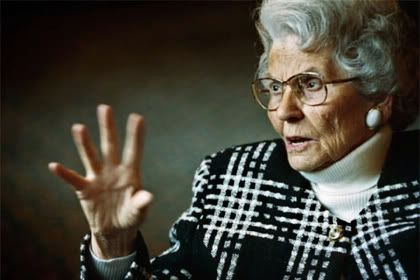
Years before Felicia Fripp's reign of terror began there was Mary Whitehouse, a bitter old crank who thought she knew well enough what everyone needed to entitle her to decide for them; ultimately, like all censorious God-botherers, she succeeded only in publicizing that which she sought to ban and died - although the two events may not be connected. Since her death in November 2001, though, Mrs. Whitehouse has become the subject of a biopic entitled Filth: The Mary Whitehouse Story, in which she's played by the incredible Julie Walters; it is the sincere hope of the Pop Culture Institute that some day Mrs. Fripp will be played in a similar manner by the gifted comedienne Ronni Ancona. ~ MSM

Photobucket

[1] * [2] * [3] * [4] * [5] * [6] * [7] * [8] * [9] * [10] * [11] * [12]

[13]
* [14] *
[15] * [16] * [17] * [18] * [19]

It seems that after Trudy Carlisle had gone between the Foreign Office and the aliens in her first ever go as Foreign Office go-between, things had all gone according to plan, or anyway fallen neatly into place. As the aliens, their new best friend, and her new boss had emerged from the nave of Barington Cathedral with her late husband currently luxuriating in (although not enjoying) hundreds of pounds worth of aromatherapy, they were met at the entrance by none other than Felicia Fripp and her vicar, Victor Vickers.

‘That’s them,’ Mrs Fripp pointed, pointlessly. ‘That’s the aliens!’

At this bit of obviosity Vickers rolled his eyes and sighed, although when he did he was careful not to let her see or hear him do it; instead, he said: ‘Really?’ Seeing his actions the aliens themselves all sighed heavily and rolled their eyes. They were glad to see at least one of them had come in peace; Mrs Fripp, on the other hand, looked like she’d just got off her Panzer and was ready to annex the Sudetenland.

While their two groups had been approaching each other determinedly yet warily until they’d first noticed each other, upon that occurrence they began to stop, and by the time they’d got close enough to converse had completely stopped and all. The sight of Felicia Fripp’s furiously knotted brow (which looked to Trudy Carlisle like the kind of macrame made in the most secure wing of a maximum security lockup) made Frederick Toady perspire profusely; even Trudy Carlisle felt the temperature go up a few degrees from the fire in the other woman’s eyes. It was the alien who, oddly enough, broke the ice.

‘How nice to see you again, neighbour’ he said, extending his hand, with its long shapely fingers and elegant wrist seemingly sculpted by DaVinci himself.

‘Don’t you touch me,’ she said, crossing her arms across where her matronly bosom would have gone, had she not been naturally ropey. The alien, still stinging from the skillet and covered all over with crucifix bites, noted the woman’s hypocrisy but said nothing of it. Just to be neighbourly, is all.

‘What’s the meaning of all this?’ piped up Vickers, even going so far as to remove the pipe from his mouth to do it.

When next he spoke, Frederick Toady was the epitome of suave, an occurrence which startled even him, except he was currently too suave to let it show. ‘My name is Frederick Toady, and I’m with the Foreign Office.’ At the sound of his unexpectedly posh voice, so like the vicar’s own, both he and his companion seemed to rest easy. ‘This is Mrs Trudy Carlisle, who is acting as our go-between.’

‘Yes...’ Mrs Fripp said, uncertain of whether or not to let him continue, but seemingly helpless under the aliens’ thrall to do anything but. Plus she couldn’t help but stare at his heavy-lidded grey eyes, in the same way the eyeball in his pendant couldn’t take its self off of her.

‘Do you know each other?’

The fact is, any of the humans could have said this to any of the other humans, referring obviously to the aliens; in this case, though, it was Frederick Toady who’d said it to Felicia Fripp.

‘Did you not just hear him - it - that call me neighbour?’ Her initial fury had fled her face, replacing itself with an entirely different kind almost simultaneously. ‘He and his coven or cult or clan or whatever they are moved into the house next to mine on Juniper Mews yesterday morning.’

Here Frederick Toady found himself rather on the horns of a dilemna, whereupon he turned to Trudy Carlisle who found herself similarly, uh, horny - not to mention dilemna-nated. In all the kerfuffle, he’d neglected to ask any of them their names, which was very near the top of page one in the Foreign Office training manual. The idea that he’d probably get sacked for such a breach of protocol, normally a comforting sensation owing to the number of times he’d felt it, failed to come, which needless to say somewhat discomfited him. Although, as has been previously said, he was being well suave and didn't let it show.

Sensing the mutual and widespread animosity between the four humans, the alien stepped forward. ‘I am Marlak of the planet Andromeda, of the star system Andromeda, conveniently located just 2.5 million light years away within the Andromedan nebula.’ By way of clarification, another of the aliens peered over Marlak’s shoulder and pointed at a spot in the sky behind and at approximately 26.35 degrees above the horizon between Mrs Fripp and her vicar, who now both turned to look. Once they’d turned back, he continued. ‘This - ’ and here he indicated the alien who’d pointed ‘ - is Grimmnha.’ Stepping aside, he pointed out the other three, naming them as he did: ‘This is Lakh, whom we call Bisree for no particular reason. This is Croupf - ’ here Croupf gave a cheeky little wave and an equally cheeky grin, because that’s the sort of Andromedan he was ‘ - and this is Lililili.’

That formality - despite its having needed to be done - accomplished nothing short of increasing everyone’s confusion, which invariably happens when one has to remember a lot of foreign names in awkward social situations. Sensing the social awkwardness like the good Briton she was, Trudy Carlisle broke the silence that had descended upon them by saying, ‘We were just off to visit the Bishop.’ To which sentiment both Felicia Fripp and Victor Vickers gave their whole-hearted assent - the first, and what Trudy felt was surely the last, time such a thing would happen.


share on: facebook

Saturday, March 14, 2009

"Last Train To London" by Electric Light Orchestra


In what may be the flimsiest pretext for a video posting in the history of the Pop Culture Institute, it's Electric Light Orchestra's Last Train to London (released as a double A-side with Confusion), from their 1979 album Discovery (better known in some circles as 'Disco? Very!').

I posted it because a) it happens to appear in yesterday's playlist, and b) it's vaguely transport related; besides which, it's possible travelers arriving late at Heathrow's new Terminal 5 may have to hurry to catch or may indeed miss said train. Hey, I said it was a flimsy pretext...
*
share on: facebook

Friday, March 13, 2009

Friday Watchlist - March 13th

James Blunt - You're Beautiful
Tom Waits - Come On Up To The House
The King's Singers - Four arms, two necks, one wreathing
Dolly Parton - Old Flames Can't Hold A Candle To You
Frankie Avalon - Beauty School Drop-Out
Beastie Boys - Paul Revere
Indigo Girls - Ghost
Electric Light Orchestra - Last Train To London
Pet Shop Boys - I Want To Wake Up
King Crimson - In The Wake Of Poseidon
Cyndi Lauper - Same Old Fucking Story
Holly Cole Trio - Cry (If You Want To)
Jane Siberry - One More Colour
The Kinks - Wicked Annabella
Kool & The Gang - Celebration
Pansy Division - Kissed
Queen Latifah - Baby Get Lost
Jan and Dean - Surf City
The Dears - Heartless Romantic
Oumou Sangare - Fantan Ni Mone (The Suffering of the Poor)
Eartha Kitt - I Want To Be Evil
Great Big Sea - Donkey Riding
Royal Crown Revue - Walking Blues
Charlene - I've Never Been To Me
David Bowie - Absolute Beginners

share on: facebook

Monday, March 09, 2009

Queen's Message To The Commonwealth, 2009

Photobucket

This year the Commonwealth commemorates its foundation sixty years ago. The London Declaration of 1949 was the start of a new era in which our member countries committed themselves to work together, in partnership and as equals, towards a shared future.

We can rightly celebrate the fact that the founding members’ vision of the future has become a reality. The Commonwealth has evolved out of all recognition from its beginning. It has helped give birth to modern nations, and the eight original countries have become fifty-three. We are now home to nearly two billion people, a third of the world’s population. Across continents and oceans, we have come to represent all the rich diversity of humankind.

Yet despite its size and scale, the Commonwealth to me has been sustained during all this change by the continuity of our mutual values and goals. Our beliefs in freedom, democracy and human rights; development and prosperity mean as much today as they did more than half a century ago.

These values come from a common responsibility exercised by our governments and peoples. It is this which makes the Commonwealth a family of nations and peoples, at ease with being together. As a result, I believe we are inspired to do our best to meet people’s most pressing needs, and to develop a truly global perspective. That is why the modern Commonwealth has stood the test of time.

But as we reflect upon our long association, we should recognize the challenges that lie ahead. Nearly one billion people of today’s Commonwealth are under 25 years of age. These are the people that this association must continue to serve in the future. It is they who can help shape the Commonwealth of today, and whose children will inherit the Commonwealth of tomorrow.

To help them make the best of their opportunities, our young men and women therefore need the opportunity to become active and responsible members of the communities in which they live. I am pleased that the Commonwealth recognizes this, and is determined to continue to put young people at its centre.

The call that brought the Commonwealth together in 1949 remains the same today. Then we joined together in a collective spirit – built on lasting principles, wisdom, energy and creativity – to meet the great tasks of our times. As the Commonwealth celebrates its sixtieth birthday, its governments, communities and we as individuals should welcome that achievement. Together, we should continue to work hard to deal with today’s challenges so that the young people of today’s Commonwealth can realize their aspirations. In that way, we can look to the future with confidence.


share on: facebook

Sunday, March 08, 2009

The Barington Encounter: Part Nineteen

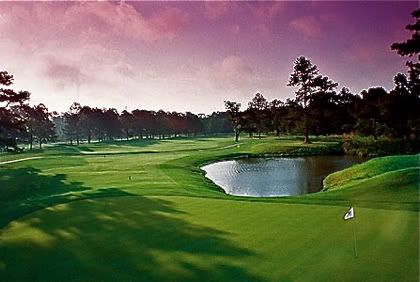
Pointlessly futile, boring for spectators, and a waste of a perfectly good Sunday morning besides... It's too bad there aren't more similarities between religion and golf or it might make for a smashing metaphor - if only I had the time to think of one with this recalcitrant excerpt and its lugubrious syntax slurping at my suddenly liquefied brain. ~ MSM

Photobucket

[1] * [2] * [3] * [4] * [5] * [6] * [7] * [8] * [9] * [10] * [11] * [12]

[13]
* [14] *
[15] * [16] * [17] * [18]

The Bishop of Barington - whose name was Robert Stephens - had not been having a good day...

However, in this case for once his day wasn't halfway down the pan already at halfway past two in the afternoon on account of the ever-inventive moral morasses into which his parishioners were continually (as well as willingly, adventurously, and he suspected altogether on-purposely) flinging themselves. It wasn't because divorces were up, or because attendance was down, nor even because in either instance ever-growing hordes of queers clamoured at his office door daily, demanding to be allowed to openly engage in both.

That it was happening on the premises of the already crumbling austere dreck he’d been sworn to oversee - which overseers' duties had once involved keeping anything like queers well away, at least until it was time for choir practice - today bothered him not one whit, and anyway even on a bad day would have bothered him far less than the fact that he was being encouraged to condone it all with a sincere smile and open arms - and it wasn't even that development peeving him today. Not was it in consideration of the cuddly-wuddly new pro-diversity Anglicanism which had appeared seemingly overnight - replacing the one that once condoned cardigans rather than condoms to protect people from the ravages of sex, and compelled its prelates and laymen alike to encourage the utmost conformity with a menacingly arched eyebrow and that variety of supercilious classism which thrives best in a bloodless rut of bake sales, garden fetes, and strawberry teas.

It wasn't even because the world he’d once known - the selfsame world he’d been repeatedly assured as a boy would last forever - had gone up the spout seemingly all of a sudden and forgotten to take him with it, leaving him stranded here with the flotsam - or was he jetsam? - as if by some great cosmic hosepipe ban. No, for the first time in a long time it wasn't any part of his vocation giving his cassock a discomfiting twist, but rather his avocation...

You see, owing to a flare-up of the gout he’d suffered during his lunch he'd not only failed to appreciate a rather fine toad-in-the-hole - made with fried bread and chased with a rather finer half pint of port - he'd shot seven over par and in doing so lost fifty quid to Rabbi Cohen on the back nine of the Barington Country Club.

Yet only a quarter of a century earlier such a thing would have been impossible; not because the Bishop had been a better golfer then, but because the Rabbi wouldn’t have been allowed on the property to play, thanks to the abundance of Christian sentiment then afoot in the country (and especially in its clubhouses) towards those Hebraically inclined, melanin-gifted, light in the loafers, or otherwise disquieting enough to the Establishment (of which he was a proud and dutiful member) to be discouraged from participating in society in the strongest possible terms.

Returning to his office that afternoon - to a job which had once seemed like a calling, but which lately seemed more like it was yelling at him - Stephens saw one of his most plodding vicars (whose name he could never make himself remember) seated in the outer office next to a pretty if plump bit of nice he was sure he’d never seen before (since he’d have remembered her if he'd had, his taste rather running to pretty if plump, despite his coarse if brittle wife). Another woman - a shrill, rather nattering, Women's Institute type whose name he’d never bothered to learn to save himself the trouble of forgetting it, although she was one of his wife's best friends - sat across from the vicar (what was his bloody name?) looking about four times better and five years younger than the last time he’d seen her, six days ago in church.

Another man sat next to her, intently picking pills of lint from a wool blazer which disconcertingly seemed to be made entirely of that fluffy mouse-gray stuff he’d often seen in the wastepaper basket next to his fishing gear, which itself was kept next to the clothes drying whatsit of which his wife seemed so inordinately proud, so much time did she spend with it.

Evidently, according to their various body languages - in and of themselves a veritable United Nations of postures and poses, communicating as readily as the expression on his secretary’s face that it hadn’t exactly been a friendly one before he’d gotten there - the bishop’s arrival had cut short a conversation, one whose mood wasn't likely to improve with his cooperation either. In fact, no one’s face wore a ‘glad to see you’ look this afternoon, including his own, which didn’t bode well for the rest of the conversation - or his day - at all.

‘I’ll be with you in a moment,’ he mumbled in what he hoped was a friendly, though not overly friendly, way - a technique he’d picked up in the several years he served as a vicar in Epsom, which had been a punishment for something he’d done in Kew, which had nevertheless been so memorable it would have been worth several years in Hackney. Shifting his golf bag from his arthritic right shoulder to his ‘never quite right since he separated it thirty years ago in the National Service’ left shoulder, no sooner had his hand groped at the comforting brass door knob than Miss Reed’s voice bagpiped up.

‘I dinna think ye’ll be wanting to go in there, sir,’ she said, her every syllable seemingly as freighted with meaning as it was drenched in brogue; it was the kind of voice that put him in mind of his other avocation - a decanter of which was waiting in his desk on the other side of this door. And truth be told, he didn’t want to go in there either, except in pursuit of that decanter (or, more accurately, its contents); on a day like this - when the sun was high in the sky and the air was warm and sweet as a lassie's breath on his neck - he’d rather be anywhere than going in there, but since in there was the nearest mouthful (or five) of Scotch he did, in fact, want to go in there just for a moment, and said so, rather too emphatically.

Actually, all he said was ‘Nonsense’. Still, his ‘nonsense’ carried more weight than Dara O’Briain combined, especially where Miss Reed was concerned. Without any further consideration he gave the knob the kind of good Tory twist any knob deserved (or indeed, was capable of) opened the door, and went into his office anyway; for emphasis, after he'd transited it, he even gave the door a wee slam.

Once on its other side - its cool, dark, friendly side - he grumbled a few indistinct curses before (or perhaps in anticipation of) slinging the golf bag off his shoulder and onto the floor, where it landed with a gratifying clatter, which clatter mainly gratified him because he knew Miss Reed had heard it, and was now eagerly perched on the edge of her ergonomic chair, fairly tingling to come in after him and pick it up. He rested a moment with his sun-scorched forehead against the cool maple veneer of his office door before lumbering across the gloomy room to the armoire wherein was stocked gin, vodka, and rum (both light and dark), in addition to brandy, port, claret, sherry, and the current object of his affections - an artisanal Scotch he’d picked up on his last trip to St. Andrew’s.

Pouring four fingers of the coppery liquor into a heavy tumbler he briefly considered putting the glassful back in the cabinet and taking the bottle to his desk; unlike a Cabinet minister, though, he was able to restrain himself and therefore swallowed the contents of the glass whole before replicating it and crossing to his desk. There he removed his jacket and shoes, taking little sips as he did, more like kisses than sips; then he swung his tired legs up onto the desk and reclined back into the comforting embrace of his leather wingback swivel chair, hoping to rest for a moment before the hullabaloo - which was once again heating up in his outer office - went supernova in here as well. It was through half-closed eyes - through the Scottish liquid and the Irish glass which contained it and past his own English feet - that he then noticed five tall blue men seated on the sofa opposite him.

‘Sweet Jesus,’ he said.

To which one of the aliens replied (utterly without cheek): ‘That’s what we’ve been led to believe.' He raised a paperback novel, flipped a few pages then scanned a few lines, and read: 'I believe it's called 'intercession'...' Here he lowered his book jerkily while raising his face fluidly, and aimed his grey eyes lambently, even limpidly, at the still-startled cleric. 'We were hoping you could speak to him for us. Put in a good word, y’know?’ All of it impeccably posh, save for the final word, which had a dangerously American ring to it.

Not bothering to take another sip but rather setting the glass down, he likewise lowered his feet until they came to rest on the thick Turkey rug spread beneath his desk; then he pressed the button on his phone that he well knew connected it to a similar one on his secretary’s desk. ‘I guess you can send everyone in now,’ is all he said before his face sank into his hands and his two handsful of face sank onto a desktop blotter stained with what anyone but him would have admitted was tears.


share on: facebook

Friday, March 06, 2009

Friday Watchlist - March 6th

Don't Fish In My Sea - Gertrude "Ma" Rainey
Carnavalito Boliviano - Yma Sumac
Christopher Robin - Gracie Fields
Let There Be Rock - Drive-By Truckers
Early Morning Rain - Bob Dylan
Muddy Water (A Mississippi Moan) - Bessie Smith
Back In The Day (Puff) - Erykah Badu
When You're Good To Mama - Queen Latifah
Beat It - Michael Jackson
The Whistle Song - Frankie Knuckles
Rock Lobster - The B-52s
Fairies Wear Boots - Black Sabbath
Locomotive - Guns N Roses
When Tomorrow Comes - Eurythmics
Hit The Road To Dreamland - Betty Hutton
Cemet'ry Gates - The Smiths
Sea of Love - The Platters
Mother's Chair - Isla Grant
Walking Blues - Robert Johnson
Still I Rise - Maya Angelou
More Than A Feeling - Boston
The Logical Song - Supertramp

share on: facebook

Sunday, March 01, 2009

POPnews Screen Test #1


Here then is the first glimpse at the potential video format POPnews will soon be taking on.

Admittedly, it's a rough glimpse, and not all the elements are in place; then again, it's not set to debut until September either, so you will undoubtedly be given a number of other glimpses into the process of developing the Pop Culture Institute's second series* before we begin coating the entire Internet in a thin goo of snarky revisionist history and supercilious puppetry.

So at least you have that to look forward to...

*The first being Vancouver Views, which is set to make its re-debut in Spring 2009!


share on: facebook

The Barington Encounter: Part Eighteen

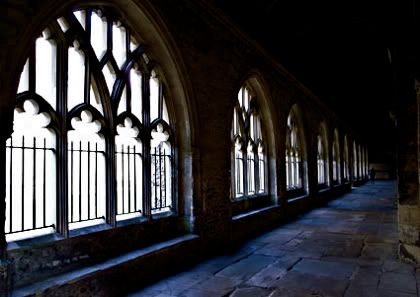
About the only original part of Barington Cathedral to survive the various waves of destruction and disrespect which have occasionally (okay - often) visited themselves upon its architecture is the catacombs, wherein lay in their eternal slumber the saintly Sybarite herself and a reputed certain royal personage, two entirely special Baringtonianites who may soon enough be joined by the very ordinary PC Gary Carlisle... ~ MSM
Photobucket

[1] * [2] * [3] * [4] * [5] * [6] * [7] * [8] * [9] * [10] * [11] * [12]

[13]
* [14] *
[15] * [16] * [17]

Entering the church, even given the dullness of the day outside, momentarily rendered Trudy Carlisle sightless. Against this occurrence she squeezed her eyes tightly shut for a few seconds, during which time she could hear nothing but the echoing sound of a few espresso machines; not that this startled her as such, since the inside of Barington Cathedral was probably the last place in the village not served by an adjacent Starbucks. Only after repeatedly sniffing the air - with conkful after conkful utterly bereft of the heaven-scent of latte - did she dare to open her eyes...

Now she was pleased to discover she could see better, which ought to have consoled her in many ways yet didn’t, not in the least; in fact, here she closed her eyes again, tighter than ever, since the first thing she’d seen after opening them was one of the aliens doing an uncanny impression of an espresso machine while reading aloud from a paperback novel as the other four performed some arcane interstellar ritual resembling a hand jive over a pile of towels which could only be described as resembling her husband’s dead body. That they’d been doing just that since approximately five the previous evening didn’t seem to bother them in the least, even though she’d been here herself less than a minute and only watching at that and already it bothered her no end.

Which is why - as has been recently established in as straightforward a manner as possible, given the author - she'd suddenly become so thoroughly comforted by the reassuring sight of the insides of her own eyelids....

Centimetring blindly forward, through what she'd recently seen to be gloom and could still hear were shushing reverberations - and with her shoes (or was that her heartbeat?) seeming to clatter like jackhammers in the mostly deserted church - she made her way forward, continuing until one such sound alerted one such alien to her presence; at which point all sound suddenly stopped and at which point her poor eyelids - which already were not having the best of days - flew apart in a manner suggesting they’d never be together again.

In that way they had that was simultaneously fluid and jerky the other four aliens turned to face her, fixing her with their luminous eyes which filled - to her delight, not to mention relief - with warmth and recognition. (Rather than, say, hunger, or the desire to conduct any sort of probe, internal or otherwise.) In fact, when the one nearest - the one we call Grimmnha - approached her and took her arm she let him, even though they'd never been formally introduced. ‘Welcome, wife of friend,’ he said to her, and something about the plummy sound of his voice removed all her reticence, which it oughtn't've done but there you have it. The others began hushing her name madrigally - ‘Trudy, Trudy, Trudy’ - until she could no longer hear her own familiar polysyllabic nomenclature in the sound being made with it...

Not that she had any idea what to say, let alone what she was expected to say; those protocols were tucked safely away in a folder all-too auspicious to be moved from Frederick Toady’s utterly inauspicious desk in its moldy old corner of the Foreign Office basement. Fat lot of good they (or it) did her there... In the meantime she bought time by listening to her name as though it were being sung by a waterfall; not next to, but actually by, mind you - as though the waterfall itself were singing.

‘You can’t bury him here,’ she said, once she'd started to feel the urge for a piddle so badly she'd need a paddle to get out of the puddle it made; whatever else she'd hope to accomplish by speaking, it made the sound of running water stop at least, and with it her various tensions receded both blissfully and better yet pisslessly from whence they'd come. She eyed them skeptically as they eyed her back noncommittally, and for a moment she was unsure if they would understand her, even though they sounded dead posh, or perhaps because of it; in all her admittedly limited experience - most of it as a shopgirl - dealing with posh people (and especially people who pretended to be posh, but really weren’t, which type these five still might turn out to be) the one consistent thing she’d learned was how much they hated being told they couldn’t do something.

‘Really,’ said the one who’d had her by the arm. It wasn’t a question, nor was it spoken with surprise; whereas it could have been uttered with sarcasm or offense, wistfulness or even charm - any of a dozen different ways really, this being England and all, and therefore the birthplace of verbal passive-aggression - it was in this case spoken with an annoying lack of intonation of any kind. Which was itself a kind of worst-case scenario, diplomacy-wise. Thinking Gary used to do the same thing, and it drove me round the twist pushed a single diamond-like tear past the blood that memory had put in her eye, magically washing it away; peeved as she had been, peeved was she no more...

By now she and the alien had reached the others, and she snuck a furtive glance at the pile of towels, just to ensure that it was, in fact, Gary. It was, or must have been; though it entirely resembled a pile of towels she recognized in its heapedness the swell of his belly and even though what remained of his remains was recumbent she could still make out the stoop of his shoulders, as surely as she’d have recognized them beneath the duvet on their bed. She gave a shudder, but one given out of obligation rather than reflex, which distinction was not lost on her. ‘This church is for kings and nobles and politicians - even artists,’ she said. ‘Very important people.’

‘Wasn’t Gary important?’ asked another alien, the one second-closest to her, whom we've heard called Lililili.

‘Only to me,’ she said, and where she normally would have been suddenly awash with grief she felt instead the way she used to when visiting her Gran’s house in the 1970s - simultaneously safe and comfortable within the memory.

‘And to us,’ said the third, Marlak, lowering the book from which he’d been reading aloud. This little bit of sentiment almost got to her, but some reserve of inner strength or other just kept it from jettisoning the sluices in her eyes...

‘You have to bury him somewhere else,’ she said, trying not to think about what she was saying or, more specifically, about whom she was saying it. To her surprise, her composure not only held but seemed to be growing.

‘He must have an important burial,’ they said in unison, and here is where Trudy became the most stymied she’d ever been. Without a word her face registered such a complex panoply of emotions that its expression could have auditioned for the Cirque du Soleil as a contortionist, with a lucrative sideline writing Cabinet despatches. All of which the aliens registered and understood without letting on, their appreciation for the complexity of female emotion being based on its lack of cohesion, which was so nearly equivalent to their own.

The tall one raised the book again and flipped backwards through it some number of pages. ‘From the section entitled Britain: A Country and Its Customs, the Encyclopedia Earthica has this to say: ‘In Britain every man is a King, and his home is his castle’.’ The alien lowered the book and raised his eyes simultaneously.

‘That’s a metaphor,’ she said.

The aliens all looked at her, then at Marlak their leader, who himself looked distinctly put out at being looked at in such a way - since he was a high-church Andromedarian, and therefore didn’t believe in leaders - even as the four of them looked imploringly back at him wishing he'd just get over himself, identity politics being a capital crime on Andromeda yet for some bizarre reason the opposite on Earth.

‘A figure of speech,’ she said, by way of further explanation. As expressions of awareness blossomed on their otherwise serene faces, three of them nodded while two of them shook their heads. Several long (what seemed like Andromedanite) seconds had passed when they all said ‘Ah!’ in unison, as though in unison they’d just been the recipients of some ancient pearl of wisdom. Which, then again, just maybe they had.

The leader said: ‘We’d been wondering. We’ve been here for 37 hours and twelve minutes and we’ve hardly seen any castles but we’ve seen lots of what we assumed were men.’

'If you weren't sure if they were men or not they probably were,' she said, and despite herself she laughed. ‘Besides which, that sentiment is well out of date. In fact, if it was ever really held at all it was only by men themselves and extremely gullible women - or else very cunning women, trying to have their way with men gullible enough to believe their own lies.’ Having said such a thing she felt she should be shocked by herself, but wasn’t, which was the really shocking thing, even though it shocked her not in the least.

The five of them seemed to think about what she’d said for awhile, during which two of them (the two who’d first shaken their heads then later nodded) seemed to grow perceptibly smaller.

‘And you are not gullible?’, the un-leader asked.

‘No mate,’ she said with a smirk, a smirk which the alien returned. ‘Anyway, Gary was opposed to human burial.’

Of all the things they’d seen or heard on Earth thus far, this notion seemed to startle them the most, and the moment she'd said it they became as agitated as chickens downwind from a KFC. ‘What did he want done with his remains in that instance,’ the one with the book asked. The Encyclopedia Earthica may have had an extensive section on Death, but it had nothing to say about the disposal of corpses that didn’t involve a shovel, and precious little about the making of them via any other means either.

‘I believe he wanted to be cremated.’ And she believed it because she’d heard him say it often enough, though he’d never been thoughtful or thorough enough in his maddeningly constablish way to ever explain why.

The one with the book raised it and leafed back a few more pages; his enormous eyes widened even further as he scanned a few lines of text, at which point he began to shake his head and mumble, ‘No, no, no,’ which activity his companions soon joined him in, filling the cavernous room with hundreds of the little words, each intoned slightly differently.

‘It’s a very commonplace practice here. On this planet. I assure you.’

Five identical blue heads cocked in five identical manners, assuming five quizzical expressions which, it scarcely needs to be said but will be anyway, were identical.

She forged on... ‘The Vikings used to send their dead in boats, floated upon the outgoing tide and filled with pitch, then set them alight from the shore by shooting flaming arrows at them. In India they put the dead on a pyre as well, before floating the whole lot down the Ganges,’ she said, suddenly an expert at things she’d previously forgotten she'd ever known.

The alien flipped through the book, pausing after a few pages. ‘Building A Viking Longboat - ’ he began to read, until she stopped him.

‘My heavens no, we don’t do it that way here. Not anymore. We send them to the crematorium.’

The five of them mulled the word ‘crematorium’ for awhile, trying to come to terms with its meaning, then trying to come to terms with it without laughing awkwardly, which was the Andromedan word for 'not bloody likely'. ‘But where, then, does one visit when one is lonely for him?’

‘Well,’ she started to say, measuring her words but scarcely needing to anymore, ‘Either we keep them in an urn on the mantel or we can scatter them at a place he liked to visit.’

There was a long pause as the aliens impassively translated this veritable rock and hard place amongst themselves. ‘Was Gary in possession of any such locale?’ Again there was a pause in the conversation because here there was a pause in Trudy Carlisle’s brain, as she translated from proper English to the estuarian patois she heard all day; they couldn’t very well scatter a man’s ashes in the car park of the DIYnot? - not that anyone would notice if they did - and (as she understood from Gary's endless blabbing on about it) Lord’s Cricket Ground already had plenty of ashes, which only left...

An image flashing across her otherwise empty mind, like the flickering beam from a film projector aimed through a smoky, black-and-white room. It was an image of...

‘King Canute,’ she said, her tone bordering on the triumphant, not a name and a tone of voice often intertwined, even when old Canute was still around. The one with the lowered book raised it again and, smiling faintly, began thumbing through its pages. Though it had been nearly twenty years ago she’d earned it, and more than nineteen years had passed since she’d last used it, Trudy Carlisle not only suddenly remembered she had an A level in history but seemed to recall every word of it that she’d ever learned, down to the casual conversations before, during, and after.

‘Once the King of this place,’ said the alien, not looking up from his book - more for the benefit of the others, or possibly to make himself seem smarter; after all, despite not wanting to be leader, he didn't mind people considering him a swot, since to be one was still a compliment on Andromeda.

‘That’s right.’ The facts came flooding back. ‘While most people say he was buried at Winchester, my university lecturer Dr. Daftford had a theory he was actually buried inside Barington Cathedral, or at least somewhere beneath it,’ she told them, and they found it fascinating, they really did, which only served to prove that they were foreigners, since none of the locals or anyway too few gave much of a toss what happened a year ago let alone a thousand or more. ‘Maybe you could technically bury Gary like a king here after all.’

‘Did Gary like it here?’

Here she bit her lip to keep it from trembling, and told a tiny fib in the cause of a greater good. ‘He loved it here.’

In truth, he only went to church when she dragged him there - Christmas or Easter every second or third year but never both in the same year; but one of the last times she'd managed it, as they were strolling up the aisle over the medieval brasses embedded in the flagstone which were some of the only above-ground remnants of the old church to survive the fire, he’d said: ‘Some way to be remembered.’ In this place, at this time, given extenuating circumstances and her desire to please her new boss on her first day of work, that would have to be good enough for all concerned.

There was a brief conference between the five of them, which to her sounded like five frogs in five blenders being blended at five different speeds. ‘When can we begin,’ asked the tallest one, tucking the book away in one of the pockets in his overalls. By her demeanour she indicated she didn’t know, and was about to say so when from behind her she heard the sound of a throat clearing. Looking from alien to alien to assure herself that the sound wasn’t one of them saying something she heard it again, only this time she’d distinctly (and indeed acoustically) heard the 'ahem' coming from behind her. She turned on her heel to face Frederick Toady, doing what can only be described as a combination of lingering and lurking in the doorway; her turn startled him visibly, although thankfully not audibly.

She approached him as cautiously as ever, before whispering: ‘They want to bury him here.’
He looked at her and blinked, then looked at them and gulped, before looking at her again and gulping and looking at them again and blinking. ‘I - I - I -’ he said, needlessly adding stammering to his repertoire of social ineptitude as the tallest, thinnest, bluest alien approached them with what seemed like a glide.

‘Problem?’ Marlak enquired of Frederick Toady.

At this point Frederick Toady felt what felt like a shower of warm liquid light wash over him. Suddenly he felt peaceful, contented, serene, and confused - mainly because he’d never felt peaceful, contented, and serene before, and definitely not all at the same time. Just as suddenly, as though a PowerPoint presentation had switched on inside his head, all he could see in his mind’s eyes were six words, which he then spoke with such decisive force it made a part of Trudy Carlisle stir, then shake, a part of her - it scarcely needed to be said - that had neither been shaken nor stirred in a very long time and was like a martini only in that it could now be lapped up in order to keep a tongue moist.

He said: ‘We’ll have to ask the bishop.’

All five nodded solemnly before lifting the pile of towels Trudy Carlisle had almost forgotten was her dead husband and repairing for the bishop’s office...


share on: facebook
Saturday, February 28, 2009

February 2009: At Least It's Over


It's no mystery to our regular readers by now what a burden and a trial I find February - and it's not just about Valentine's Day, either, although that is a big part of it. Mainly, I guess, it's because it's the end of winter here in Vancouver, and what with the rain and the lack of sunlight and all it just starts to get to me without massive infusions of retail therapy. In February's defense, this one has been one of the loveliest - in other words driest and brightest - in living memory; also, in my own defense, I did write more than 70 new posts this month. Also, as much fun as they've been to make, part of the reason I've been behind in posting is producing these videos, which take a certain amount of time to edit.

Rest assured, the Pop Culture Institute is entirely on track and will be caught up in a week or so; part of the problem has been the impending instalment of The Barington Encounter, which is both long and suffering from an indefinable flaw which has hitherto rendered it unpublishable. I think I've just about figured out what it is, and once I have that's yet another logjam cleared away.

Thanks for your patience!

~ MSM
share on: facebook

Sunday, February 22, 2009

The Barington Encounter: Part Seventeen

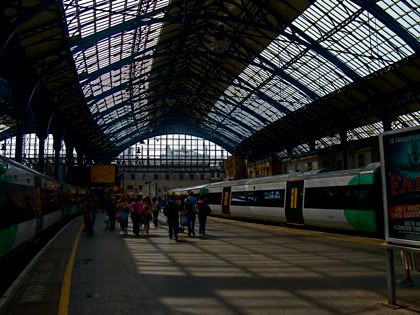
Since 1840, untold millions have passed beneath the steel-and-glass roof of Brighton Station on their way to untold millions of secret rendezvous, kinky assignations, and naughty pleasures; but not our Frederick Toady, not today anyway... ~ MSM

Photobucket

[1] * [2] * [3] * [4] * [5] * [6] * [7] * [8] * [9] * [10] * [11] * [12]

[13] * [14] * [15] * [16]

Barington Cathedral (actually the Cathedral Church of St. Sybarite) had a long and storied history - at least, it’d once had one - written, as these things are, in the loving placement of every block of stone, plank of wood, and donated memorial plaque, brass, and window in the place. It survived Henry VIII dissolving the monasteries, Oliver Cromwell dissolving the monarchy, and the Industrial Revolution dissolving just about everything else, only to be unceremoniously dissolved itself during World War II. Not that its ceremonious dissolution would have been any better, mind you, but a tasteful cenotaph excoriating Nazi atrocities next to the ruin of a church founded by William II on the site of a Saxon priory stroke sauna itself built on the site of the brothel stroke nunnery run by St. Sybarite herself would have at least brought in the tourists, in addition to looking bloody brilliant in brochures.

Only it wasn’t the Luftwaffe or indeed any other of Hitler’s other favourite outrages which reduced the once-elegant Barington Cathedral to rubble; one fine day in 1944 the caretaker carelessly tossed his fag end too close to some cans of varnish and the whole thing went up like - you should pardon the Popish connotation - a Roman candle. A thousand years of history lost in 77 minutes; Guy Fawkes himself couldn’t have done a better job, and in doing so the caretaker, though he went to his grave not knowing it, became eligible for an Iron Cross.

The parish rebuilt it, of course, when it could afford to, which meant that the majority of the new Barington Cathedral had been put up in 1972, with the rest completed by 1987.

And it showed. Oh, how it showed...

The new cathedral was even uglier than its most unflattering description; not even the talented wordsmiths at the British Tourist Authority (whose job it was to blow smoke up the arse of foreigners from near and far alike with the help of flowery adjectives) were able to come up with a better word to describe it than ‘austere’ and even that word had nearly caused a fist fight in their office when it was first bandied about. Well, a slapping match, but you get the point...

When the Prince of Wales visited in 1991 he was momentarily rendered speechless - much to the chagrin of the pack of reporters waiting for him to say something sensible so they could distort it out of all reason and thus make fun of him for it forever after - and even after he’d regained his composure the word he used, namely ‘dreck’, seemed like flattery compared to what the Bishop of Barington called it on a good day. The best thing any of the editors on that day in 1991 could say about the visit was that at least the word ‘dreck’ could be easily made to fit into a headline.

None of which, or at least very little, of course would have been known to Trudy Carlisle as she approached the lumpen pile of austere dreck from the ironically distant Cathedral Close, unaware of her being in hot pursuit by a man from the Foreign Office in a scenario that couldn’t have been less like Ian Fleming if it had been written by John Le Carre, and couldn’t have been of less interest to her than if it had been written by Jeffrey Archer.

‘I say,’ she heard a man’s voice say. ‘Are you Mrs Carlisle?’

At the sound of his voice (or, more accurately, at the sounding of her name by his voice, his voice being no inducement to any activity whatsoever) she turned to behold the sight of a man who looked to be in his fifties - but who was actually only 38 - wearing an outfit of monochrome grey approaching her rather rapidly, half running half hopping up the steps of the Cathedral, though not quite as rapidly as he might have done were he in any way gainly.

In addition to wearing a grey suit which was exactly the colour of his grey hair, he wore wire-framed spectacles, which were steel of course. He winced whenever he tried to smile (though he had once accidentally smiled after stubbing his toe), and though he wasn’t quite fat, he wasn’t quite thin either. He was, you might say, a civil servant in the Goldilocks mode (not that such a finicky girl would have chosen someone like him for anything, mind you, except maybe a spot of light bear-baiting). He seemed to wear the indignity of being himself like a sign around his neck, routinely blent into his surroundings like a shape-shifter in a house of mirrors, and on more than one occasion had managed to startle himself while alone, so extreme was his innocuity. He even made the quotations with his fingers, so you have some idea what a complete and total ‘wanker’ he was.

‘Y-yes,’ she said, unsure of what else to say to such a person. ‘I guess I am. Or was.’

‘Mrs Carlisle,’ he repeated as he reached her, somewhat out of breath, though not from exertion; it was how he always sounded, as though his entire life were an exertion, which in a very real way it was. ‘Despite the condolence-inducing situation which has brought us together I am very pleased to make your ‘acquaintance’.’

Having made his quotes he thrust his hand at her and she shook it entirely out of habit, even though it looked clammy at a distance; as she held it, it even felt like a clam, possibly a geoduck, although for the life of her she couldn’t tell how she knew such a word, let alone such an animal, having never once dared set foot inside a Chinatown. Momentarily she heard Gary’s voice in her head; he’d have been all het up by now at having been handed such a lifeless thing to shake, so evangelical was he about such things as handshakes vis-a-vis their limpness. ‘And who might you be?’ she said, petrified in her best British way of accidentally having an honest reaction to him.

‘I am Frederick Toady. A ‘representative’ of the Foreign Office.’ He let her hand go to make his other quote, which was something of a blessed relief to her as she wiped it dry on the back of her long, discreetly flowered skirt. ‘Sorry I was late. It’s quite a trek to come all the way from London to Sussex, especially when one has to change trains in Brighton.’ He looked around in a studiously approving way, unable to dislike it even if he had, lest he cast Her Majesty’s Civil Service in a bad light; he also muttered the word ‘Brighton’, but then he usually only mouthed words like ‘damn’, ‘Hell’ and ‘knickers’, even when used in their non-profane contexts, so the fact that he’d utter an actual profanity like ‘Brighton’ meant he was feeling quite daring on that otherwise ordinary day.

By now Trudy Carlisle had well and truly shrunk back from him, although she’d done so mainly to avoid being misted by his pronunciation of the word ‘Sussex’, whose incipient moistness she had never previously considered until that moment, although it did neatly sum up the climate of the place, not to mention how wet everyone there was.

‘What seems to be the ‘problem’ then?’ he enquired.

That’s when she described all that had happened to her yesterday and today, including the Andromedan national anthem, the death of her husband, the theft of his corpse from their sitting room, the blackout drunk she’d suffered as a result after the 999 operator had rung off without sending help and she’d found them all gone, then the pounding headache she’d awakened with and the morning’s mad dash across the village in order to break up the barricading within the very Cathedral before which they stood of five creatures from another planet with the body of said dead husband who was, it bears repeating, an officer of the law.

He took it quite badly, did Frederick Toady.

Yet with Whitehall efficiency he dealt with the worst of the shock by suggesting Mrs Carlisle for the job of Foreign Office go-between, at a starting salary of £28,500 per annum, which she accepted a little too readily. Nothing soothes the nerves of a civil servant quite like a good bit of squandering from the public purse, and when she’d leapt at the opportunity (even though it was the money she’d leapt at rather than the opportunity, which truth be told she rather dreaded) he sighed with multiple kinds of relief, some of which he’d never known existed until that very moment, and at least one of which was the kind of relief a workaholic feels after a bout of premature ejaculation, since it meant he could get back to work a few minutes sooner.

This meant that she could now enter the Cathedral (and hundreds of other heritage sites besides) unimpeded, which was just one of the fringe benefits of government work civil servants liked to keep to themselves. It also meant that she’d be able to afford to fly to Majorca on holiday this year, which would have been quite difficult on a policeman’s salary, unless they got a good deal on a package, and even more difficult, package or not, with the impending insurance settlement currently being tied up in all kinds of red tape at an office outside Norwich, which is where they did that sort of thing. Especially now since, with her husband dead, she’d have no double occupancy upon which to rely.

All of these thoughts (though not many more) occurred to her during a long pause in their conversation, which silence Frederick Toady found particularly nerve-wracking, since it clearly had the potential to become awkward, which potential made her feel awkward in its own unique way. He tried to get her attention, but it did not want to be got. He pulled against the cathedral’s heavy wooden doors, against which she’d slumped, and try as he might he could shift neither them nor her against them. He waved his hand in front of her face, and even tried snapping his fingers, an act as much hampered by the total lack of cool contained within them as the clamminess secreted upon them.

None of which mattered, since none of it worked.

He cleared his throat: nothing. ‘Erm,’ he said. Again, nothing. ‘I say, Mrs Carlisle,’ he tried, but as it was his curse to speak rather softly, and in this case had spoken as a lorry was passing, this had even less effect than his previous attempts, in which case, it seemed not even the tremendous roar of twelve pistons filled with diesel going past encased in a giant noisy machine could shatter her reverie.

Briefly, he considered touching her, but having just attended a workplace seminar on sexual harassment, he was unsure where; given that he was he and not some of the suave yuppies he’d seen on the make at that wine bar near his office in Park Lane he was also unsure how. Instead, he withdrew a mechanical pencil from its slightly moist place in his shirt pocket and, satisfied that its lead – which was not even lead, but was still dangerously pointy – was safely sheathed, he poked her on the forearm just above the wrist. He also used the rubber end of it, just to be extra safe.

He prodded. Quite gently at first. Then again. And again.

Force applied from him to her via the pencil eventually penetrated the sleeve of her overcoat, then the sleeve of her sweater, and finally the sleeve of her blouse. This force in turn activated a few rather blasé nerve endings in her skin, which lackadaisically sent said impulses to her brain where they waited on queue for what seemed like hours (but which was in fact only seconds, as to most nerve-endings a second seems like an hour, especially when someone’s poking at them) until they were eventually received and processed by some rather surly neurons and not even told to have a nice day afterwards, since even the neurons in Britain had gotten ruder over the past twenty years.

Trudy Carlisle turned her head and rather blankly (as well as somewhat dreamily) stared at Frederick Toady. ‘Yes?’

‘Um, er, uh,’ he stammered, having completely forgotten what it was he’d been planning to say in the event of a still-rather handsome woman looking up at him dreamily. Then he remembered: ‘Hadn’t you ought to be getting inside?’ It was the first bit of supervision he’d ever given in the thirty years of his working life, and it felt good. So good he feared he might vomit again, which would be twice in one day, a personal best, as most days it was four or five.

There was another long pause, and another sickening feeling, such as usually accompanies that circular rainbow thing-a-my on the computer screen which appears whenever you don’t know if the damn thing’s going to do what you’d asked it to or crash. ‘Right,’ said Trudy Carlisle, finally - hesitancy, in this instance brought on by genuine fear. She took a deep breath and stiffened her own upper lip better than any Botox ever could.

To his credit, Frederick Toady waited until she was inside the Cathedral before fainting dead away from relief. Not that anyone noticed. Still, at least he hadn’t vomited...


share on: facebook

Sunday, February 15, 2009

The Barington Encounter: Part Sixteen

From out of a dank basement office in the marzipan-like splendour of the Foreign Office comes the unlikeliest hero in modern fiction, Frederick Toady... ~ MSM

Photobucket

[1] * [2] * [3] * [4] * [5] * [6] * [7] * [8] * [9] * [10] * [11] * [12]

[13]
* [14] * [15]

See, now here I am getting ahead of myself again, and more’s the pity, since the story’s been a ripping one so far, and’s bound to rip some more before it’s all told...

It seems that earlier yesterday, May 12th, as the residents of Barington were luxuriating in the comfort of their suburban smugness - or whatever was left of it these days, what with the credit crunch and its concomitant smugness smackdown and that - the Andromedans’ shiny new ship was streaking high above the Sussex Downs, through an area known only to those in the know as the Sussex Ups. While streaking thereabove it was detected upon radar by the good people at RAF Farnborough whose job it is to detect things upon radar, at which point fighter jets were scrambled to intercept it, but alas, were unable to; following which eggs were scrambled, as it was well past teatime by the time the pilots’d got back, and in their dutiful zeal they’d missed out on the last of the chicken pot pie.

According to Top Secret protocols known only to the Prime Minister, the Queen, (and, for some Super Top Secret reason known only to him, Rupert Murdoch) a representative from the Foreign Office was to be dispatched forthwith - the Foreign Office having been ruled the most suitable department for dealing with interstellar visitors, who were, after all, the ultimate foreigners. That, and the Foreign Secretary drew the shortest straw at the Cabinet meeting where the decision was made, which suited the Prime Minister just fine as he was her most serious rival, rather than the Chancellor of the Exchequer, which was the more normal custom.

Well, as was the case with all UFO sightings - or at least all the ones phoned in by reliable sources - the call eventually made its way through the labyrinthine telephone switchboard of Whitehall to the Foreign Office, and thence was passed from desk to desk like the proverbial hot potato, until it could go only one iota lower. Which is when the janitor placed the sealed folder - bearing a giant red sticker upon it which said ‘In the Event of an Alien Invasion’ - on the desk of one Frederick Toady. Having only just finished his lunch, the sight of the folder (or more likely the sight of the sticker upon the folder, the folder itself being a rather bland manila in colour and not in the least provocative) caused him to quite utterly unfinish his lunch, much to the same janitor’s chagrin.

The folder was duly slit open with an official Foreign Office secret file slitter, read through tears despite hands trembling like blancmanges on cobblestones, and once the reader was finally revived it was ‘on yer bike’ for Frederick Toady who, it scarcely needs to be said, didn’t even own a bike.

Now, Frederick Toady was so low on the roster he might have been team mascot; since this was only government and not something important like football, though, he was therefore given a great deal more responsibility than dancing up and down the pitch trying to dodge the projectiles of drunken yobs - not that he wouldn’t have to do that anyway at the Christmas party. Basically, it was his job, if anything were to go wrong at the Foreign Office, to be the someone they’d sack to demonstrate to the Press (and, as an added bonus, occasionally even the Public) how really very seriously they were taking that month’s, week’s, day’s, or - the way things’d been going lately - hour’s scandal.

And when it came to sacking, Frederick Toady was your man...

Already he’d been sacked by every department in Whitehall (and a couple of them twice) except for the Foreign Office, for which he’d never worked until six months before in the course of his 20 year career. It was a career, truth be told, which had saved many others more promising and illustrious than his own, at least on the surface (which was how all careers in Whitehall were judged, since there was precious little depth to be found anywhere in Central London apart from the Jubilee Line) and in careering from department to department in the way he’d done had made quite a career for himself indeed. For this reason alone, Frederick Toady was the single most important official in Her Majesty’s Government, though since that information was classified, it was therefore unavailable to him, his own security clearance being - as has been implied - below even that of the janitor.

All of which seemed to race through his mind in a way that would have better suited the Virgin train on which he found himself seated in that disconsolately fidgety way he had about him as it (and he within it) making an alternately sluggish and immobile way across what still passed for the English countryside between London and Brighton, where Frederick Toady was already dreading a missed connection to Barington with perfectly good reason, seeing as it had left early for no particular reason and had therefore made him late before he’d even left London.


share on: facebook

Saturday, February 14, 2009

"The Heart of Saturday Night" by Tom Waits


Seeing as this year the worst day of the year* was a Saturday night, and seeing as it takes virtually no provocation for me to post a Tom Waits video, I figured this made the ideal combination...

(Looking For) The Heart of Saturday Night was the title track to Waits' 1974 album, at the height of his Asylum Years; this video contains a performance of the song he made in the UK in 1975, and features both a long, rambling, rather mordant introduction of the song, whereupon he takes his sweet time in finding the right vocal melody, before eventually landing a picture perfect rendition.

*The worst day of the year is Valentine's Day, duh!
share on: facebook

Thursday, February 12, 2009

Chumley's Fortnight In Hell


The Pop Culture Institute's latest video adventure details the challenges encountered by your intrepid reporter Cholmondeley St. John-Mainwaring in trying to put out a blog and produce enough original video content to keep the slavering maw of the Internet satisfied, all the while hopelessly saddled with a pair of housebound neurotics...

Of course, in this case, hilarity doesn't so much ensue as endure - despite Valentine's Day, overwork, and a plague of apathy!
share on: facebook

Sunday, February 08, 2009

The Barington Encounter: Part Fifteen

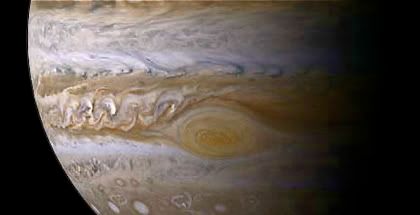
Once you get used to the temperature (about 1500 Kelvin on a good day - but it's a dry heat) the amenities offered in Great Red Spot are second to none; in fact, it's a real social whirl! Is it any wonder deities from around the galaxy have chosen it for their home away from home? ~ MSM

Photobucket

[1] * [2] * [3] * [4] * [5] * [6] * [7] * [8] * [9] * [10] * [11] * [12]

[13]
* [14]

Once Lililili had returned to 14 Juniper Mews, and related the (to them, at least) thrilling story of his maiden solo Earth-walk next door with a peace offering potful of left-over Andromedan stew from Gary Carlisle’s wake, during which he’d made the acquaintance of a discrete species his colleagues had yet to encounter, not to mention the marvellous discovery of Earthicacians engaged in sophisticated banter using archaic 38th Century Andromedan - and their seemingly encyclopedic knowledge of Centauri footballers, besides - the aliens returned to the task at hand...

Knowing nothing of human DNA, but a great deal about human burial - for reasons previously elucidated - the aliens laid Gary Carlisle out on their newly assembled kitchen table and gleefully set about pulling internal organs out of his oddly un-pocketed body to prepare them for their eventual embalming. It was all very thrilling to them, as it would be to the legions of exobiologists who were undoubtedly watching back at home... Only one heart, two small lungs rather than one big one, an appendix! Not since 14th Grade biology in primary school had they been so excited to cut open an alien and haul out its guts; other than the alien called Grimmnha, of course, whose job as a coroner at the Andromeda City Exo-Zoo routinely involved doing squeamish-making things to Persistence Lizards in the name of exo-zoölogical forensics.

Once the Egyptified scented oils and Mesopotamianated spiced unguents had been packed into the suitable orifices, smeared on the appropriate body parts, and otherwise dispensed with (most of them, it turns out, were smashing on Ryvita) the aliens called another taxi (actually the same one they’d called before - a good bet, since it was one of only three in all of Barington) to take them all to the nearest Anglican cathedral.

Somehow this got the attention of the newspapers...

Criminals of all kinds get away with larceny of all kinds in broad daylight of all kinds - even occasionally in Barington - and no one even notices (or cares if they notice, or bothers to anything about it, on the remote chance they care) but when five peaceable aliens with sky-blue skin and wearing silver boiler suits attempted (and, in fact, succeeded) in bringing a dead policeman dressed in the purple and ermine cloaks of an Andromedan emperor (hastily improvised with their brand new DIYnot? bath towels and without access to a sewing machine either) into Barington Cathedral, eventually someone noticed, and cared, and even bothered to do something about it - so maybe miracles did occur after all, even in houses of God, where God had not dwelt since moving into that converted mews on Jupiter.

Inevitably the same someone also got around to calling the papers; some time later a reporter managed to shake off the worst effects of his hangover - seeing as it was five in the afternoon, after all, and therefore nearly Happy Hour - in order to come round in person, with an equivalently haggard photographer in tow, and even the police, ironically enough for ‘colour’.

This is exactly what happened in the lowering evening of May 12th, as the stars in their unfamiliar positions danced above the alien’s heads - just in time to make the morning editions, in fact; and so it was on the morning of May 13th when Trudy Carlisle happened, in passing the tobacconist, to see a photo of her dead husband on the cover of one such morning edition, with the words ‘COP IN UFO CHOP SHOP SHOCK’ alongside. And so, even though she found it repellent, she bought the Daily Mirror anyway; since it had a picture of her dead husband on the cover, that made it okay - though only just. ‘I wish the Guardian had gotten there first,’ she was heard to mutter, although not by anyone reliable enough, not even for the Daily Mirror.

For good measure she bought a copy of Razzle in which to conceal it and then rushed across the village green, where on the hideously modernist steps of Barington Cathedral Trudy Carlisle was more or less appointed the go-between. This was said to be on account of how much she and the Andromedans had already been through; Frederick Toady of the Foreign Office thought it best, as she and they had already ‘bonded’.


share on: facebook