Showing posts with label 1773. Show all posts

Thursday, December 16, 2010

Pop History Moment: The Boston Tea Party

Photo Sharing and Video Hosting at Photobucket

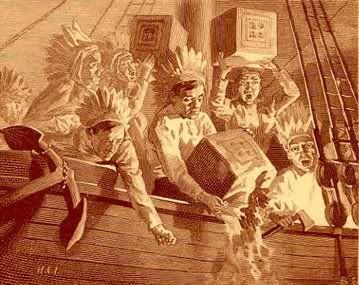
Although I'm sure very few tea parties on Beacon Hill today involve the Sons of Liberty dressed up as Narragansett Indians, the most famous 'tea party' in American history certainly did...

On this day in 1773, in order to protest the Stamp Act of 1765 and the Townshend Acts of 1767, more than 8,000 colonists crowded into Boston's Old South Meeting House just long enough to get their dander up; following that little pep rally they repaired to the harbor, where the HMS Dartmouth, HMS Beaver and HMS Eleanor were relieved of 45 tons of tea (worth £10,000), which was then ignominiously dumped into the water. One of the leaders of the rebellion was John Hancock, who was not only the first to sign the Declaration of Independence, but the only one to sign it on July 4th, 1776.

The event would light the fuse for the American Revolution, but could have easily been prevented had colonial officials been able to secure some kind of representation for them at Westminster; the right of the population to expect representation in exchange for taxation was one of the key dicta of English common law dating back to the Magna Carta. Instead, the English responded to this nascent colonial uppitiness with a series of legislation collectively known as the Intolerable Acts starting in 1774.

And we all know how well that approach turned out for them...
*
share on: facebook

Thursday, October 14, 2010

POPnews - October 14th

Photobucket
[For all its propitious beginnings - having been opened in person by The Queen herself! - Canada's 23rd Parliament was otherwise a wash... Consisting of a single session, and presided over by the minority government of John Diefenbaker, it would be the second shortest such gathering in Canadian history.]

1758 - Austria's Marshal Leopold Josef Graf Daun defeated the Prussian army of Frederick the Great at the Battle of Hochkirk during the Seven Years' War.

1773 - The first recorded Ministry of Education, the Komisja Edukacji Narodowej (Polish for Commission of National Education) was formed in Poland; the event is still commemorated there as Teachers' Day.

1805 - At the Battle of Elchingen, France's Marshal Michel Ney defeated the Austrian forces of Graf Johann von Riesch.

1806 - The Battle of Jena-Auerstädt pitted France's Emperor Napoleon and his commander Louis Nicolas Davout against Prussia's Frederick William III; the German loss to France was likely hard on Gebhard von Blücher and the Prince of Hohenlohe but a third Prussian commander, the Duke of Brunswick, got the worst of it - he died in battle.

1882 - The University of the Punjab was founded in present-day Pakistan.

1916 - Perm State University was founded in Russia.

1920 - Part of Petsamo province was ceded to Finland by the Soviet Union under the terms of the Treaty of Tartu.

1942 - A German U-boat sank the ferry SS Caribou in Newfoundland's Cabot Strait, killing 137.

1943 - Prisoners at the Sobibor death camp in Poland revolted, resulting in the death of 11 SS officers; about half of the camp's 600 prisoners escaped, of whom some 50 survived the war.

1944 - Nazi Field Marshal Erwin Rommel committed suicide rather than face Roland Freisler's People's Court and potential implication in the bomb attack of July 20th that nearly succeeded in assassinating Hitler.

1956 - Dr. B. R. Ambedkar, leader of India's Untouchable (or Dalit) caste, converted to Buddhism along with 385,000 followers, sparking the Neo-Buddhism movement.

1957 - Canada's 23rd Parliament was opened in Ottawa by Elizabeth II in her role as Queen of Canada, marking the first time a Canadian sovereign had delivered Her Government's Speech from the Throne in person.

1959 - Tasmanian-born action hero Errol Flynn died while on a business trip in Vancouver.

1964 - Leonid Brezhnev became General Secretary of the CPSU and de facto leader of the Soviet Union, ousting Nikita Khrushchev.

1966 - The Montreal Metro opened for business.

1968 - A 6.9 magnitude earthquake destroyed the Australian town of Meckering in under 40 seconds, rupturing all major roads (including the Great Eastern Highway) and railways nearby in the process.

1973 - During Thailand's Thammasat student uprising over 100,000 people protested against the Thanom military government; 77 are killed and 857 are injured by soldiers.

1981 - Vice President Hosni Mubarak was elected President of Egypt, one week after the assassination of his predecessor Anwar Sadat.

1994 - Palestinian leader Yasser Arafat, Israeli Prime Minister Yitzhak Rabin, and Israeli Foreign Minister Shimon Peres shared the Nobel Peace Prize.
*
share on: facebook
Wednesday, October 13, 2010

POPnews - October 13th

Photobucket
[Construction on the Executive Mansion would last until the first day of November 1800, and involve the labour of paid employees and slaves, immigrants and citizens alike - making it a uniquely American enterprise; the first President to live in the house at 1600 Pennsylvania Avenue was John Adams. It was set afire and gutted during the Burning of Washington in August 1814, following which it was rebuilt, and has since been added to many times.]

54 CE - Nero became Roman emperor following the death of his great uncle Claudius, who'd adopted him.

1307 - Hundreds of Knights Templar were simultaneously arrested by agents of France's King Phillip the Fair and later tortured into confessing heresy.

1332 - Rinchinbal Khan, Emperor Ningzong of Yuan became the Khagan of the Mongols and Emperor of the Yuan Dynasty - although his reign would last for only 53 days.

1773 - The Whirlpool Galaxy was discovered by Charles Messier.

1775 - The US Continental Congress ordered the establishment of the Continental Navy (which would later be renamed the United States Navy).

1792 - The cornerstone of the original White House - then known as the Executive Mansion - was laid without ceremony.

1812 - During the War of 1812, at the Battle of Queenston Heights, as part of the Niagara Campaign in Ontario, US forces under General Stephen Van Rensselaer were repulsed from invading Canada by British and native troops led by Sir Isaac Brock, who died in battle.

1843 - B'nai B'rith was founded.

1845 - A majority of voters in the Republic of Texas approve a proposed constitution that, if accepted by the US Congress, would make Texas a state.

1885 - Georgia Institute of Technology - better known as Georgia Tech - was founded.

1892 - Edward Emerson Barnard discovered D/1892 T1, the first comet discovered by photographic means.

1903 - The Boston Americans (later known as the Red Sox) beat the Pittsburgh Pirates 3-0 to win the first World Series at the Huntington Avenue Baseball Grounds five games to three.

1915 - The Battle for the Hohenzollern Redoubt marked the end of the Battle of Loos in northern France.

1917 - The 'Miracle of the Sun' was witnessed by an estimated 70,000 people in the Cova da Iria near the Portugese town of Fátima.

1923 - Ankara replaced Istanbul as the capital of Turkey.

1943 - Italy declared war on Nazi Germany, apparently...

1946 - The constitution of France's Fourth Republic was ratified.

1958 - Michael Bond published the first Paddington Bear story, featuring illustrations by Peggy Fortnum.

1972 - Uruguayan Air Force Flight 571 crashed in the Andes, on the border of Argentina and Chile; by December 23rd only 16 out of 45 people lived long enough to be rescued and/or remain uneaten. Twenty years later Ethan Hawke starred in the film Alive: The Miracle of the Andes, based on the book Alive: The Story of the Andes Survivors by Piers Paul Read.
*
share on: facebook