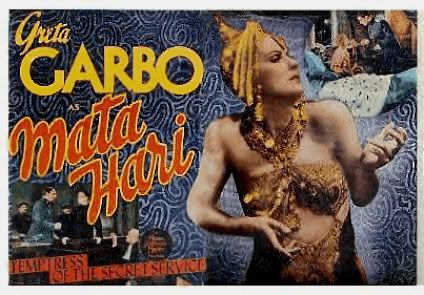
The taciturn Swede seemed to turn her dissatisfaction with everyone and everything into her stock-in-trade, making herself even more alluring even as she was pushing you away. As such she has become a symbol of ambivalence and antipathy, especially where fame and adoration are concerned.
Born on this day in 1905, she met famed director Mauritz Stiller in 1922; Stiller worked with the girl until she became a woman - if you catch my meaning - before casting her in his 1924 silent film Gösta Berlings saga, based on the novel by Nobel laureate Selma Lagerlöf. The brighter lights of Berlin called, and the newly rechristened Garbo went to appear in the 1925 film Die freudlose Gasse, by G. W. Pabst - it's English name, the utterly prescient The Joyless Street.
Shortly thereafter, Garbo sailed to America, with half of that country's news photographers seemingly in tow; her arrival in Manhattan was front-page news around the world, and her train journey across the strange new land in which she found herself was breathlessly covered by all levels of media. She arrived in Hollywood, and thus the brightest lights of all, in September 1925 still aged only 19, at which point she was rushed into production on her first film for MGM, The Torrent.
Garbo made a few hugely successful silent films before the silent cinema died the death it had coming to it; as one of the few silent stars to make a successful transition to sound, however, her star rose even higher. 1930's film version of Eugene O'Neill's Eugene O'Neill's Anna Christie was trumpeted with the tagline 'Garbo Talks', and audiences were enthralled by what they heard. Although the film is clunky to watch, and even the best-restored extant prints of it aren't in the best of shape, Garbo's serious performance is almost as compelling as Marie Dressler's comic one, despite its low-key nature; for all its faults the film, naturally, has pride of place in the collection held here at the Pop Culture Institute.
Once they got Garbo talking, however, they had difficulty shutting her up; since the studios were making oodles off her, they didn't even mind the increasingly exorbitant paycheques she was demanding. Despite the relatively short duration of her career (which she called a halt to in 1941) her filmography is jam-packed with classics: Mata Hari (1931), Grand Hotel (1932), Queen Christina (1933), Anna Karenina (1935), Camille (1936), and Ninotchka (1939). It all ended with George Cukor's Two-Faced Woman, the only one of her films that could be considered a flop.
Following her departure from Hollywood Garbo mainly lived in New York City, in a habit of increasing reclusion; her last onscreen appearance as such was in Sidney Lumet's 1984 film Garbo Talks, in which she did not appear in the least, except as a kind of phantom on whom all the action was centred. Greta Garbo died in Manhattan in April 1990, and her ashes were interred in Sweden's Skogskyrkogården Cemetery; her estate, estimated at $20 million US, went to her niece Gray Reisfield.
*
share on: facebook