Showing posts with label Langston Hughes. Show all posts
Showing posts with label Langston Hughes. Show all posts
Tuesday, February 01, 2011
"The Weary Blues" by Langston Hughes
I needed a video to fill in this spot, and a cursory search of the name Langston Hughes yielded this exemplary rendition of his 1923 poem The Weary Blues, recited by Harvard professor Allen Dwight Callahan to the accompaniment of Cab Calloway.
*
share on: facebook


"Harlem" by Langston Hughes
What happens to a dream deferred?
Does it dry up
like a raisin in the sun?
Or fester like a sore -
And then run?
Does it stink like rotten meat?
Or crust and sugar over -
like a syrupy sweet?
Maybe it just sags
like a heavy load.
Or does it explode?
*
share on: facebook
Does it dry up
like a raisin in the sun?
Or fester like a sore -
And then run?
Does it stink like rotten meat?
Or crust and sugar over -
like a syrupy sweet?
Maybe it just sags
like a heavy load.
Or does it explode?
*
share on: facebook
In Memoriam: Langston Hughes
As one of the many talented writers to emerge from the Harlem Renaissance, Langston Hughes was as influenced by his contemporaries as he influenced them, illustrating the kind of cultural foment that was present during that unprecedented era; in many ways, though, Hughes was always slightly out of place. Early in his career he was too proud to be black when most black writers were trying to be white, and during the Black Power movement which emerged towards the end of his life he was too reasonable when those emerging were angry or vindictive.
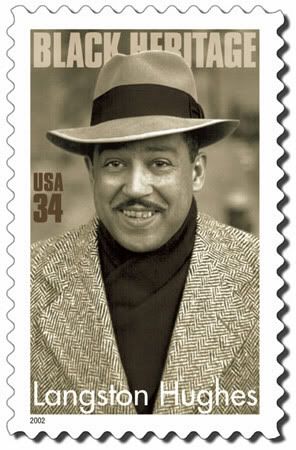 Born on this day in 1902 in Joplin, Missouri, Hughes was raised far from the lights of Manhattan; after an unsettled childhood spent throughout the Midwest, and a few years of restless travel, he eventually settled for a time in Washington, DC, where he worked as assistant to Carter G. Woodson at the Association for the Study of African American Life and History. While there he met the poet Vachel Lindsay who 'discovered' him, on the eve of the publication of his first book of poetry, The Weary Blues, in 1926.
Although Hughes briefly attended Columbia, he soon left owing to the bigotry he encountered there; his education continued at Lincoln University. Yet there are those who would say his real education came from the extensive travels he had undertaken before, during, and after his university career. Following on from his restless youth, he was later to see Mexico, Europe (living for awhile in Paris), North Africa, the Soviet Union, central Asia, China, and Japan. Yet despite the terrible racism that'd been visited upon him there, he kept returning to the United States.
Although initially drawn to the promise of change offered by Communism, the closer he got the more illusory those promises seemed; when he was called upon to testify before the Senate Permanent Subcommittee on Investigations by the notorious Senator Joseph McCarthy in 1953 like many others whose Depession-era hopes for the Party were soured by the subsequent outrages of Stalinism, Hughes had already soured on his more radical inclinations.
He was one of the grand old men of African-American letters by the time he died in May 1967, having written steadily and in every form for more than fifty years. Since then much of his reputation has rested on his presumed heterosexuality; yet it was and is a false presumption, as his work contains many coded as well as many blatant references to the contrary. Such is the power of the closet, however, that we may never have the full picture of the life of Langston Hughes.
*
share on: facebook
Born on this day in 1902 in Joplin, Missouri, Hughes was raised far from the lights of Manhattan; after an unsettled childhood spent throughout the Midwest, and a few years of restless travel, he eventually settled for a time in Washington, DC, where he worked as assistant to Carter G. Woodson at the Association for the Study of African American Life and History. While there he met the poet Vachel Lindsay who 'discovered' him, on the eve of the publication of his first book of poetry, The Weary Blues, in 1926.Although Hughes briefly attended Columbia, he soon left owing to the bigotry he encountered there; his education continued at Lincoln University. Yet there are those who would say his real education came from the extensive travels he had undertaken before, during, and after his university career. Following on from his restless youth, he was later to see Mexico, Europe (living for awhile in Paris), North Africa, the Soviet Union, central Asia, China, and Japan. Yet despite the terrible racism that'd been visited upon him there, he kept returning to the United States.
Although initially drawn to the promise of change offered by Communism, the closer he got the more illusory those promises seemed; when he was called upon to testify before the Senate Permanent Subcommittee on Investigations by the notorious Senator Joseph McCarthy in 1953 like many others whose Depession-era hopes for the Party were soured by the subsequent outrages of Stalinism, Hughes had already soured on his more radical inclinations.
He was one of the grand old men of African-American letters by the time he died in May 1967, having written steadily and in every form for more than fifty years. Since then much of his reputation has rested on his presumed heterosexuality; yet it was and is a false presumption, as his work contains many coded as well as many blatant references to the contrary. Such is the power of the closet, however, that we may never have the full picture of the life of Langston Hughes.
*
share on: facebook
Monday, June 18, 2007
Visit Langston Hughes' Apartment
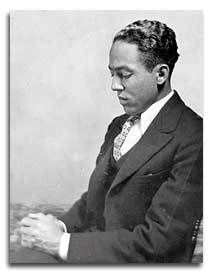 From Gothamist comes word that an apartment long-occupied by Langston Hughes has now been turned into a museum. Hughes lived in the apartment from the late Forties until his death in 1967, at the age of 65.
The writer was a major figure in the Harlem Renaissance, and throughout his life used his art to agitate in favour of greater civil rights, not just for blacks but for gays as well.
In life he was known as "the Poet Laureate of Harlem".
share on: facebook
Subscribe to:
Posts (Atom)