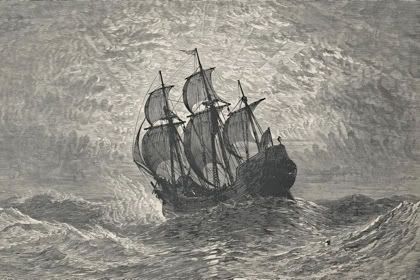
[The Mayflower, shown here in a rather romantic engraving.]
642 CE - At the Battle of Maserfield - which may have been on this day in 642 CE, or else on this day in 641 CE (at least according to the Venerable Bede) but probably wasn't on this day in 644 CE as reported by the Annales Cambriae (who knows what they were thinking!) - Penda of Mercia defeated and killed Oswald of Bernicia. Not content with this victory, Penda then went all early medieval on his foe and dismembered him; also in on the action on that day was Mercian ally Cynddylan ap Cyndrwyn of Powys.
910 CE - The last major Viking army to raid England was defeated at the Battle of Tettenhall - near modern-day Wolverhampton - by a combined force led by Edward the Elder, King of Wessex, and Earl Aethelred of Mercia.
1100 - England's King Henry I was crowned at Westminster Abbey; the fourth son of William the Conqueror succeeded his older brother William II following a suspicious hunting accident in New Forest three days earlier.
1305 - William Wallace was captured by the English at Robroyston, near Glasgow; from there he was transported to London, where he would be executed on August 23rd.
1388 - According to the Scottish*, at the Battle of Otterburn - a border skirmish between the Scottish and the English in Northumbria - Scotland's commander James Douglas, 2nd Earl of Douglas was given the ultimate Pyrrhic victory over England's Henry 'Hotspur' Percy, son of the first Earl of Northumberland; while Douglas was clearly the victor in the field he also died in battle.
910 CE - The last major Viking army to raid England was defeated at the Battle of Tettenhall - near modern-day Wolverhampton - by a combined force led by Edward the Elder, King of Wessex, and Earl Aethelred of Mercia.
1100 - England's King Henry I was crowned at Westminster Abbey; the fourth son of William the Conqueror succeeded his older brother William II following a suspicious hunting accident in New Forest three days earlier.
1305 - William Wallace was captured by the English at Robroyston, near Glasgow; from there he was transported to London, where he would be executed on August 23rd.
1388 - According to the Scottish*, at the Battle of Otterburn - a border skirmish between the Scottish and the English in Northumbria - Scotland's commander James Douglas, 2nd Earl of Douglas was given the ultimate Pyrrhic victory over England's Henry 'Hotspur' Percy, son of the first Earl of Northumberland; while Douglas was clearly the victor in the field he also died in battle.
*According to the English the battle was fought on August 19th; since they lost, it's only fair that they also lose the right to select the day of the battle. ~ MSM
1583 - Sir Humphrey Gilbert established England's first North American colony - at first little more than a seasonal fishing station - at St. John's, Newfoundland, at the same time claiming the entire island and much of the sea around it in the name of Elizabeth I.
1620 - The Mayflower - mastered by Christopher Jones - first attempted to depart England via Southampton on its first attempt to reach the New World; shortly after leaving port, her sister ship the Speedwell developed a leak, and the Pilgrim Fathers were forced to put in at Dartmouth in order to make necessary (and costly) repairs - and not for the last time, either. Later on, it would be revealed that the source of the damage to the Speedwell was sabotage by the crew, who were reluctant to take on such a lengthy, dangerous commitment for the poor compensation they were offered.
1716 - The Battle of Petrovaradin took place, giving the Habsburg Empire (with its Hungarian and Croatian allies) under Prince Eugene of Savoy a decisive victory over the Ottoman Empire and its commander, Silahdar Damat Ali Pasha, who died in battle.
1735 - In an important early victory for freedom of the press, New York Weekly Journal publisher John Peter Zenger was acquitted of seditious libel for criticizing the city's royal governor, William Cosby, on the basis that what he'd published was true. Zenger's attorney in the action was Andrew Hamilton, who defended him on a pro bono basis; in gratitude, Hamilton was later awarded the freedom of the city of New York.
1763 - During the so-called Pontiac's War, at the Battle of Bushy Run, British forces led by Henry Bouquet defeated a combined force of Delaware, Shawnee, Mingo, and Huron warriors under Chief Pontiac's commanders Guyasuta and Keekyuscung (who died in battle) at Bushy Run in western Pennsylvania.
1772 - The First Partition of Poland began; within 25 years the three partitions in total would bring an end to the Polish-Lithuanian Commonwealth.
1862 - At the Battle of Baton Rouge - during the American Civil War - along the Mississippi River near the Louisiana capital Confederate troops drove Union forces back into the city.
1884 - The cornerstone of the Statue of Liberty's pedestal was laid.
1906 - Sydney's Central Railway Station was opened.
 1925 - The political party Plaid Cymru was established - partly to preserve Welsh language and culture, which was then at risk of dying out - and partly to remove Wales from the political control of Great Britain in the most excruciatingly polite way possible - although Plaid Cymru members David John Williams and Lewis Valentine were jailed for their part in the September 1936 burning of the bombing school at RAF Penrhos, an action which saw their membership numbers double.
1957 - After five years of local success in Philadelphia, American Bandstand made its national TV debut on ABC affiliates in the United States, hosted by Dick Clark. It ran daily during the week (either live or on kinescope) until 1963, when it became a weekly show, typically airing on Saturday afternoons. Turns out the show had a good beat and you could dance to it; it ran until 1989.
1962 - Nelson Mandela was captured and imprisoned in the Johannesburg Fort. He would spend 18 of his 27 years in jail at Robben Island; in 1982 he was moved to Pollsmoor and subsequently Victor Verster Prison, from which he was famously released in February 1990.
1964 - American aircraft from carriers USS Ticonderoga and USS Constellation bombed North Vietnam as part of Operation Pierce Arrow in retaliation for strikes against US destroyers in the Gulf of Tonkin Incident. The effective start of the air portion of the Vietnam War, the operation yielded the conflict's first prisoner of war, Everett Alvarez Jr., who endured 8 and a half years of torture while in captivity.
1981 - US President Ronald Reagan fired 11,359 striking air traffic controllers, which I'm sure had nothing whatsoever to do with the major increase in airline fatalities through the 1980s. After all, who cares about public safety when there's a union to be broken?
*
share on: facebook