Showing posts with label 1176. Show all posts

Saturday, May 29, 2010

POPnews - May 29th

Photobucket
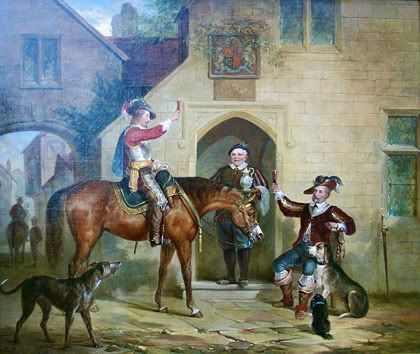
[For nearly 200 years after the fact the triumphant return of Charles II to London, on this day in 1660 - no less than his escape from Parliamentary forces on the same day in 1651 following the Battle of Worcester - was commemorated as Oak Apple Day in Britain; as depicted in this 1862 canvas by Reuben Bussey, the event was intended to be celebrated by raising a glass in toast to the King. Although the holiday was formally abolished in 1859 it is still observed by the famous red-coated Chelsea pensioners in the central court of the Royal Hospital Chelsea. Then again, it doesn't take an event half as exciting as the restoration of a monarchy to get the British to engage in a little chin-chin, does it?]

363 CE - Roman Emperor Julian the Apostate defeated the Sassanids under the walls of their capital during the Battle of Ctesiphon, although Persian Emperor Shapur II did manage to prevent Roman forces from taking the city; their hollow victory on this day would become even hollower when the Emperor was killed on June 26th at the Battle of Samarra.

1167
- At the Battle of Monte Porzio near the city of Tusculum a Roman army supporting Pope Alexander III was defeated by Christian of Buch and Rainald of Dassel whose force represented Holy Roman Emperor Frederick Barbarossa.

1176 - At the Battle of Legnano the Lombard League defeated Holy Roman Emperor Frederick I - the same dude whose army won the battle mentioned immediately above this one.

1660 - Charles II was restored to the throne of Great Britain, on his 30th birthday; the King (who managed to be crowned King of Scots in January 1651 before fleeing to the Continent) had spent the previous 11 years in exile during the Interregnum, while the English suffered under the Puritan dictatorship of Oliver Cromwell.

1677 - Following the bloodshed of Bacon's Rebellion, a treaty between the Virginia colonists of Middle Plantation and the local tribes - including the Weyanoke, the Pamunkey, the Nottoway, and the Nansemond - sought to establish a lasting peace. Try and guess how (or indeed, if) they did...

1780 - At the Battle of Waxhaws during the American Revolution Lieutenant Colonel Banastre Tarleton massacred 113 of Colonel Abraham Buford's continentals in Lancaster, South Carolina, allegedly after they had surrendered.

1790
- Rhode Island became the last of the Thirteen Colonies to ratify the US Constitution and was admitted to the Union as the 13th US state.

1848 - Wisconsin became the 30th US state.

1867 - An agreement between Austria and Hungary called Ausgleich (or 'the Compromise') was born through Act 12, which established the Austro-Hungarian Empire with its capital at Vienna; the Austrian Emperor Franz Joseph was later crowned King of Hungary to solidify what became known as the Dual Monarchy.

1913 - Igor Stravinsky's ballet score for The Rite of Spring was premiered in Paris at the Théâtre des Champs-Élysées, conducted by Pierre Monteux; almost from the first note of the opening movement the atonal music brought catcalls from the audience. When the dancers of Serge Diaghilev's Ballets Russes - as choreographed by Vaslav Nijinsky - appeared, eschewing the grace of classical ballet for what we would recognize as modern dance, a riot broke out.

1914 - In a heavy fog the ocean liner RMS Empress of Ireland collided with the Norwegian collier Storstad in the Gulf of St. Lawrence, near the Quebec town of Rimouski; in just 14 minutes the liner sank, with a loss of 1,024 lives, leaving just 453 survivors among the passengers and crew.

1919 - The Republic of Prekmurje was founded.

1953 - Sir Edmund Hillary and Sherpa Tenzing Norgay became the first known people to reach the summit of Mount Everest and return safely from the summit.

1954 - The first of the annual Bilderberg conferences was held in the Netherlands.

1964 - The Arab League met in East Jerusalem to discuss the Palestinian situation in Israel, which led to the formation of the Palestinian Liberation Organization.

1969 - A general strike in Córdoba, Argentina, led to a period of civil unrest known as Cordobazo.

1982 - Pope John Paul II became the first pontiff ever to visit Canterbury Cathedral.

1985 - Amputee Steve Fonyo completed his cross-Canada marathon at Victoria, British Columbia; the 14-month run was intended to complete the work left undone by Terry Fox on his earlier Marathon of Hope, as well as to honour him for having done it.

2004 - The World War II Memorial - located in the National Mall - was dedicated by President George W. Bush in Washington, DC; ironically, World War II was one war a member of the Bush family had actually fought in.
*
share on: facebook

Saturday, May 22, 2010

POPnews - May 22nd

Photobucket
[Conrad Martens' lyrical depiction of the HMS BeagleBeagle was actually made during its second voyage as opposed to its first, and depicts an encounter between the European crew and the natives of Tierra del Fuego... But from what I've been able to ascertain there was no artist on that first voyage, or if there was his work hasn't survived, or if it has it isn't on the Internet, or if it is I sure a Hell can't find it. So there; this'll have to do. As my Grandmother used to say, 'it's as close a damnit is to swearing...']

1176 - The second of two assassination attempts made against Saladin by the Hashshashin - during the Siege of Azaz, north of Aleppo, in Syria - was foiled; well-armoured, Saladin received only superficial wounds.

1377 - Pope Gregory XI issued five papal bulls to denounce the doctrines of English theologian John Wycliffe, one of which was sent to the Archbishop of Canterbury, Simon of Sudbury; the British refused to enforce them, or did so fitfully at best, setting the stage for the English Reformation.

1455 - During the Wars of the Roses, Yorkists Richard, Duke of York, and Richard Neville, Earl of Warwick, defeated and captured England's Lancastrian King Henry VI at the First Battle of St Albans, killing his commander Edmund, Duke of Somerset, in the process.

1762 - Peace broke out after Sweden and Prussia signed the Treaty of Hamburg.

1809 - During the second and final day of the Battle of Aspern-Essling, near Vienna, Napoleon was repelled by an enemy army for the first time in a decade; after having easily conquered much of Europe, his loss at the hands of Archduke Charles, Duke of Teschen, rendered the seemingly undefeatable French emperor vulnerable, at least temporarily.

1819 - The SS Savannah left port at Savannah, Georgia - captained by Moses Rogers - in an attempt to become the first steamship to cross the Atlantic Ocean; the ship arrived at Liverpool on June 20th.

1826 - The HMS Beagle departed Plymouth under the command of Captain Pringle Stokes with naturalist Charles Darwin aboard; during this, his first voyage, the crew surveyed much of Patagonia and Tierra del Fuego while over the course of the five-year expedition Darwin began to formulate his theory of natural selection.

1842 - Farmers Lester Howe and Henry Wetsel discovered the Howe Caverns, in upstate New York's Schoharie County, when they stumbled upon a large gaping hole in the ground.

1856 - Congressman Preston Brooks of South Carolina savagely beat Senator Charles Sumner about the head with a wooden Gutta-percha cane in the nearly deserted hall of the US Senate for a speech Sumner had made three days earlier attacking Southerners - specifically Stephen A. Douglas of Illinois and Andrew Butler (Brooks' uncle) - who sympathized with pro-slavery violence along the Kansas-Missouri border during the so-called Bleeding Kansas Crisis in the run-up to the American Civil War; those attempting to aid Sumner were held off by Brooks' fellow Congressional thugs, Laurence M. Keitt, also of South Carolina, and Henry A. Edmundson of Virginia.

1915 - Lassen Peak erupted, making it the only volcanic eruption other than Mount St. Helens in the Lower 48 during the 20th century.

1936 - Aer Lingus (Aer Loingeas) was registered as an airline by the Irish government, making it the national airline of the Republic of Ireland.

1939 - Prior to the outbreak of World War II, Axis powers Germany and Italy signed the Pact of Steel.

1960 - An earthquake measuring 9.5 on the moment magnitude scale, hit southern Chile; now known as the Great Chilean Earthquake, it's the most powerful earthquake ever recorded. Although centered at Cañete, the city of Valdivia was hardest hit.

1964 - US President Lyndon B. Johnson announced the goals of his Great Society social reforms at a speech in Ann Arbor, Michigan; aimed at bringing 'an end to poverty and racial injustice' in America, they were largely successful - and would continue to be - except most of them were set aside by one of his successors, Ronald Reagan, at the behest of such noted neo-conservatives as Irving Kristol.

1967 - A fire at Brussels' L'Innovation department store became the most devastating fire in Belgian history, resulting in 323 dead and missing and 150 injured when the 1897 wooden structure became engulfed in flames in under 10 minutes.

1972 - Ceylon adopted a new constitution which made it a republic, changed its name to Sri Lanka, and joined the Commonwealth of Nations.

1990 - North and South Yemen were unified to create the Republic of Yemen.

2002 - The remains of missing intern Chandra Levy were found in DC's Rock Creek Park; the situation around her disappearance have never been adequately explained, especially by her lover Gary Condit, who at the time was a Congressman for California's 18th District.

2004 - The town of Hallam, Nebraska, was wiped out by a powerful F4 tornado that was later estimated to be an astounding 2.5 miles wide, killing one local resident.
*
share on: facebook