Showing posts with label 363 CE. Show all posts
Showing posts with label 363 CE. Show all posts
Saturday, June 26, 2010
POPnews - June 26th
363 CE - Roman Emperor Julian the Apostate was killed during a retreat from the Sassanid Empire following the Battle of Samarra; General Jovian was proclaimed Emperor in his place by the troops on the battlefield.
1284 - According to legend, the Pied Piper lured 130 children away from the German town of Hamelin.
1409 - Petros Philargos was crowned Pope Alexander V after the Council of Pisa, joining Pope Gregory XII in Rome and Pope Benedict XII in Avignon, causing a double schism in the Roman Catholic Church.
1541 - Spanish conquistador Francisco Pizarro was assassinated in Lima by Don Diego de Almagro, who was later caught and executed for the crime.
1819 - The bicycle was patented. History does not record when bicyclists first began to demand the right to ride their bicycles wherever they damn well please without consideration for others - such as on the sidewalk or inside public buildings (as they've been known to do in Vancouver at least) but at least one amateur historian (namely me) suspects it was immediately thereafter.
1857 - The first investiture of the Victoria Cross was held in London's Hyde Park; Queen Victoria herself awarded the prestigious medal for bravery to 62 out of 111 eligible veterans of the Crimean War that day, including one to Charles Davis Lucas who'd been the first to earn his (during the bombardment of Bomarsund). It has since been awarded 1351 times, with 94 of them going to Canadians.
1927 - The Cyclone roller coaster opened on Coney Island.
1934 - Apparently President Franklin D. Roosevelt signed the Federal Credit Union Act, which aptly enough allowed for the establishment of credit unions. You know... Federally.
1945 - The United Nations Charter was signed in San Francisco by 50 of its 51 original signatories; only Poland had to wait, since they'd sent no delegate to the United Nations Conference on International Organization.
1959 - Elizabeth II, Queen of Canada, and US President Dwight D. Eisenhower opened the St. Lawrence Seaway.
1963 - US President John F. Kennedy boosted morale in West Berlin by declaring 'Ich bin ein Berliner' in the partitioned area of that city; JFK's elegant Commie-bashing can be seen and heard above, but if it's as much like porno to you as it is to me, it's definitely NSFW.
1974 - At the Marsh Supermarket in Troy, Ohio, the Universal Product Code on a package of Wrigley's Juicy Fruit chewing gum became the first item ever to be scanned.
1975 - During a shootout on the Pine Ridge Indian Reservation in South Dakota two FBI agents (Special Agents Jack R. Coler and Ronald A. Williams) and an American Indian Movement member named Joe Stuntz were killed; Leonard Peltier was later convicted of the murders following a controversial trial.
1976 - The CN Tower, the world's tallest free-standing structure on land, was opened.
1977 - The Yorkshire Ripper killed 16 year-old shop girl Jayne MacDonald in Leeds, changing the public's perception of the killer; she was the first of his victims who was not a prostitute, and with her death British women began to fear that any of them could be next.
1995 - Hamad bin Khalifa al-Thani deposed his father Khalifa bin Hamad al-Thani, the Emir of Qatar, in a bloodless coup.
1996 - Irish journalist Veronica Guerin was shot and killed in her car by drug dealers while stopped at a traffic light on the Naas Dual Carriageway on the outskirts of Dublin; her story was told in a movie by Joel Schumacher, in which Guerin was played by Cate Blanchett.
1997 - The US Supreme Court ruled that the Communications Decency Act violated the First Amendment.
2003 - The U.S. Supreme Court ruled in Lawrence v. Texas that gender-based sodomy laws were unconstitutional.
*
share on: facebook


Saturday, May 29, 2010
POPnews - May 29th
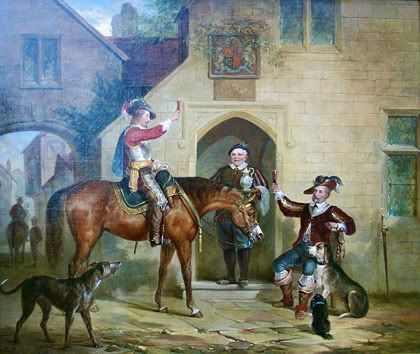
[For nearly 200 years after the fact the triumphant return of Charles II to London, on this day in 1660 - no less than his escape from Parliamentary forces on the same day in 1651 following the Battle of Worcester - was commemorated as Oak Apple Day in Britain; as depicted in this 1862 canvas by Reuben Bussey, the event was intended to be celebrated by raising a glass in toast to the King. Although the holiday was formally abolished in 1859 it is still observed by the famous red-coated Chelsea pensioners in the central court of the Royal Hospital Chelsea. Then again, it doesn't take an event half as exciting as the restoration of a monarchy to get the British to engage in a little chin-chin, does it?]
363 CE - Roman Emperor Julian the Apostate defeated the Sassanids under the walls of their capital during the Battle of Ctesiphon, although Persian Emperor Shapur II did manage to prevent Roman forces from taking the city; their hollow victory on this day would become even hollower when the Emperor was killed on June 26th at the Battle of Samarra.
1167 - At the Battle of Monte Porzio near the city of Tusculum a Roman army supporting Pope Alexander III was defeated by Christian of Buch and Rainald of Dassel whose force represented Holy Roman Emperor Frederick Barbarossa.
1176 - At the Battle of Legnano the Lombard League defeated Holy Roman Emperor Frederick I - the same dude whose army won the battle mentioned immediately above this one.
1660 - Charles II was restored to the throne of Great Britain, on his 30th birthday; the King (who managed to be crowned King of Scots in January 1651 before fleeing to the Continent) had spent the previous 11 years in exile during the Interregnum, while the English suffered under the Puritan dictatorship of Oliver Cromwell.
1677 - Following the bloodshed of Bacon's Rebellion, a treaty between the Virginia colonists of Middle Plantation and the local tribes - including the Weyanoke, the Pamunkey, the Nottoway, and the Nansemond - sought to establish a lasting peace. Try and guess how (or indeed, if) they did...
1780 - At the Battle of Waxhaws during the American Revolution Lieutenant Colonel Banastre Tarleton massacred 113 of Colonel Abraham Buford's continentals in Lancaster, South Carolina, allegedly after they had surrendered.
1790 - Rhode Island became the last of the Thirteen Colonies to ratify the US Constitution and was admitted to the Union as the 13th US state.
1848 - Wisconsin became the 30th US state.
1867 - An agreement between Austria and Hungary called Ausgleich (or 'the Compromise') was born through Act 12, which established the Austro-Hungarian Empire with its capital at Vienna; the Austrian Emperor Franz Joseph was later crowned King of Hungary to solidify what became known as the Dual Monarchy.
1913 - Igor Stravinsky's ballet score for The Rite of Spring was premiered in Paris at the Théâtre des Champs-Élysées, conducted by Pierre Monteux; almost from the first note of the opening movement the atonal music brought catcalls from the audience. When the dancers of Serge Diaghilev's Ballets Russes - as choreographed by Vaslav Nijinsky - appeared, eschewing the grace of classical ballet for what we would recognize as modern dance, a riot broke out.
1914 - In a heavy fog the ocean liner RMS Empress of Ireland collided with the Norwegian collier Storstad in the Gulf of St. Lawrence, near the Quebec town of Rimouski; in just 14 minutes the liner sank, with a loss of 1,024 lives, leaving just 453 survivors among the passengers and crew.
1919 - The Republic of Prekmurje was founded.
1953 - Sir Edmund Hillary and Sherpa Tenzing Norgay became the first known people to reach the summit of Mount Everest and return safely from the summit.
1954 - The first of the annual Bilderberg conferences was held in the Netherlands.
1964 - The Arab League met in East Jerusalem to discuss the Palestinian situation in Israel, which led to the formation of the Palestinian Liberation Organization.
1969 - A general strike in Córdoba, Argentina, led to a period of civil unrest known as Cordobazo.
1982 - Pope John Paul II became the first pontiff ever to visit Canterbury Cathedral.
1985 - Amputee Steve Fonyo completed his cross-Canada marathon at Victoria, British Columbia; the 14-month run was intended to complete the work left undone by Terry Fox on his earlier Marathon of Hope, as well as to honour him for having done it.
2004 - The World War II Memorial - located in the National Mall - was dedicated by President George W. Bush in Washington, DC; ironically, World War II was one war a member of the Bush family had actually fought in.
*
share on: facebook
Subscribe to:
Posts (Atom)