Showing posts with label 1538. Show all posts

Thursday, February 24, 2011

POPnews - February 24th

Photobucket
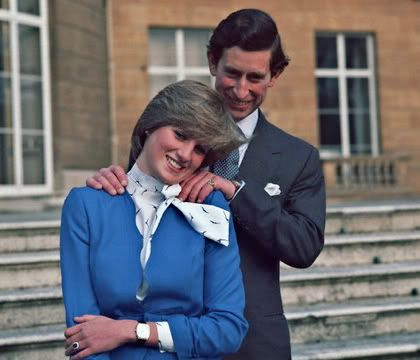
[Is it merely that hindsight is 20/20, or were Charles' and Diana's problems obvious from the start? When asked by a particularly impudent reporter on this day in 1981 if he was in love, the Prince replied: 'Yes. Whatever in love means...' Anyway, their engagement, marriage, separation, and divorce (not to mention her August 1997 death and his April 2005 re-marriage) kept the waters chummed for a generation of tabloid reporters, paparazzi, and various other media bottom feeders - myself included.]

303 CE
- Roman Emperor Galerius published an edict that began the persecution of Christians in his portion of the Empire, which would uphold the Diocletianic Persecution for the next decade.

1387
- King Charles III of Naples and Hungary was assassinated at Visegrád on the orders of Elisabeth of Bosnia, widow of the late King Louis I and mother of the rightful heir Mary of Hungary; although he was succeeded as King of Naples by his son Ladislas, Mary was reinstated as Queen of Hungary.

1538 - The secret Treaty of Nagyvarad between Holy Roman Emperor Ferdinand I and the Ottoman Empire following the Ottoman victory at the Battle of Mohács allowed for John Zápolya to become King of Hungary while the Emperor would retain control of the western parts of the Hungarian Kingdom.

1582 - Pope Gregory XIII announced the Gregorian calendar.

1607 - One of the first works recognized as an opera, L'Orfeo - with music by Claudio Monteverdi and libretto by Alessandro Striggio - premiered at the ducal palace in Mantua before the Accademia degl'Invaghiti during that year's carnival.

1711 - The premiere of Rinaldo by George Friderich Handel - the first Italian opera written for the London stage - was held at Haymarket.

1804 - London's third Drury Lane Theatre burnt to the ground, leaving owner Richard Brinsley Sheridan destitute.

1826 - The signing of the Treaty of Yandaboo marked the end of the First Burmese War.

1848 - France's King Louis-Philippe abdicated.

1875 - The SS Gothenburg hit the Great Barrier Reef and sank off of eastern Australia's Queensland coast, with the loss of approximately 102 lives - not to mention the damage it did to the coral.

1893 - Western Washington University was established by Governor John McGraw, with the first class officially entered six years later to the day.

1909 - The Hudson Motor Car Company was founded.

1942 - During the ersatz Battle of Los Angeles, an indeterminate number of UFOs flying over wartime LA caused a blackout order at 2:25 AM, attracting a barrage of anti-aircraft fire which ultimately killed 3 civilians in a city still skittish just three months after the attack on Pearl Harbor.

1945 - Egyptian Premier Ahmed Maher Pasha was assassinated by 28-year-old Mustafa Essawy in the Egyptian Parliament after reading a decree; although originally thought to belong to the Muslim Brotherhood, which Pasha had recently tried to suppress, it was later revealed that the assassin was a member of the country's dominant political organization, the Wafd Party. Essawy's motive remains unclear.

1970 - National Public Radio was founded in the United States.

1981 - Buckingham Palace announced the engagement of The Prince of Wales to Lady Diana Spencer.

1989 - United Airlines Flight 811 - bound for New Zealand from Honolulu - ripped open during flight, sucking 9 passengers out of the business-class section.
2006 - Philippine President Gloria Macapagal-Arroyo declared Proclamation 1017, placing the country in a state of emergency in attempt to subdue a possible military coup led by Brigadier Gen. Danilo Lim.

2008
- Fidel Castro retired as the President of Cuba after nearly fifty years.
*
share on: facebook

Friday, December 17, 2010

POPnews - December 17th

Photobucket
[That the Simpsons have evolved over their record-breaking run is evident in this image of them from their earliest appearances.]

920 CE - Romanos I was crowned co-emperor alongside the underage Emperor Constantine VII; he then married his daughter Helena Lekapene to the pre-teen monarch over the objections of the boy's mother, Zoe, who was so formidable she went from the concubine of Leo VI to Empress and thence to being the regent of the Byzantine Empire on her son's behalf.

942 CE - Normandy's Duke William I was assassinated by supporters of Arnulf I, Count of Flanders.

1538 - Pope Paul III excommunicated England's King Henry VIII.

1586 - Go-Yozei became Emperor of Japan following the abdication of his grandfather Emperor Ōgimachi.

1600 - France's King Henry IV married Marie de' Medici following the annulment of his marriage to Marguerite de Valois.

1807 - Napoleon issued the Milan Decree in order to enforce the Berlin Decree, which had initiated the Continental System, whereby the French Emperor hoped to ruin England's economy by forcing the rest of Europe to undertake a trade embargo against them. The entire thing backfired, not only hurting Europe but strengthening the British Empire into the bargain.

1819 - Simón Bolívar declared the independence of the Republic of Gran Colombia in Angostura - now the Venezuelan city of Ciudad Bolívar.

1862 - Union General Ulysses S. Grant issued General Order No. 11, expelling all Jews from Tennessee, Mississippi, and Kentucky; although he issued the order to stop the smuggling of cotton - which he blamed on the Jews - he later disowned it, claiming it had been drafted by an underling and that he had signed it without reading it.

1865 - The first performance of Franz Schubert's Symphony No. 8 (best known as his Unfinished Symphony) was given in Vienna, under the direction of Johann Herbeck - 37 years after its composer's death.

1918 - During the the so-called Darwin Rebellion as many as 1000 members of the Australian Workers' Union, led by Harold Nelson, marched on Government House in the capital of Australia's Northern Territory, Darwin; once there they burnt an effigy of John Gilruth, demanding his resignation from the post of Administrator of the Northern Territory. Gilruth later fled the town onboard HMAS Encounter.

1935 - The Douglas DC-3 airplane - engineered by a team led by Arthur E. Raymond - made its maiden flight; the DC-3 would revolutionize cross-country commercial aviation in America, reducing the east-west flight from more than 32 hours in 1934 to under 15 by 1936, as well as providing sleeping berths and an onboard kitchen.

1967
- Australia's Prime Minister Harold Holt went for a swim near Portsea, Victoria - and never came back; while there are numerous theories as to what happened to him, for a satirical take on the tragic event, only Shaun Micallef's The Micallef Program will do.

1969 - The US Air Force closed its investigation of UFOs, called Project Blue Book, after 17 years of study found no credibility in thousands of sightings.

1973 - 30 passengers were killed in an attack at Rome's Leonardo da Vinci Airport when Palestinian terrorists threw phosphorous bombs onto Pan-Am's Flight 110; the plane had been destined for Beirut.

1978 - The Workers Party of Jamaica was founded by Trevor Munroe; the anniversary is only pertinent because the party is now defunct, its founder has since renounced Marxism, and I felt like gloating over a failed Marxist movement because that's what I'm like.

1981 - US Brigadier-General James L. Dozier was kidnapped by Italy's left-wing Red Brigade in Verona; he was rescued during a raid on an apartment in Padua 42 days later.

1983 - Harrods was bombed by the IRA, killing six and injuring 90.

1989 - Originally a series of shorts on The Tracey Ullman Show (beginning in April 1987) The Simpsons characters were given their own show on Fox; that show's first episode, Simpsons Roasting on an Open Fire, debuted on this day. Currently in its twentieth season, it is both the longest-running animated series in American prime-time, as well as the longest-running sitcom in American history.

1999 - The United Nations General Assembly passed Resolution 54/134 designating November 25th thereafter as the annual International Day to Eliminate Violence Against Women.
*
share on: facebook

Thursday, October 28, 2010

POPnews - October 28th

Photobucket
[For me, Lady Liberty defines what America is all about in a way that the likes of Caribou Barbie defines the (thankfully) complete and total failure of neoconservative ideology and the apocalypse it's intended to provoke...]

1538 - The first university in the New World, the Universidad Santo Tomás de Aquino, was established in the Dominican Republic.

1664 - The Duke of York and Albany's Maritime Regiment of Foot - currently the UK's Royal Marines - was established.

1776 - During the American Revolution the Battle of White Plains handed George Washington an early defeat as General William Howe's larger British and Hessian force arrived at White Plains, in Upstate New York, attacking and capturing Chatterton Hill.

1886 - In New York Harbor, US President Grover Cleveland dedicated Frédéric Auguste Bartholdi's monumental Statue of Liberty, a gift to America from the people of France; the statue embodies Libertas, the ancient Roman goddess of freedom from slavery, oppression, and tyranny.

1891 - The Mino-Owari Earthquake, the largest earthquake in Japanese history, struck Gifu Prefecture.

1893 - Tchaikovksy's Symphony No. 6 in B Minor, Pathétique premiered in St. Petersburg, only nine days before the composer's mysterious and untimely death...

1905 - George Bernard Shaw's Mrs. Warren's Profession was first performed in New York. The play had already been censored in the UK by the Lord Chamberlain and so had to be staged there at London's New Lyric Club, rather than in a theatre; the American performance, then, was to be its first on a public stage - and it was raided by police as well! Better that Mrs. Warren should be unemployed, I guess...

1919 - The US Congress passed the Volstead Act over President Woodrow Wilson's veto, paving the way for Prohibition to begin the following January.

1922 - On the third day of their March on Rome, Italian fascists led by Benito Mussolini arrived at their destination and took over the government.

1929 - Black Monday, the first day of trading following Black Thursday in the Wall Street Crash of 1929, also saw major stock market upheaval.

1936 - US President Franklin D. Roosevelt re-dedicated the Statue of Liberty on the 50th anniversary of her debut.

1942 - The Alaska Highway (also called the Alcan Highway) was completed, connecting British Columbia's Dawson Creek to Fairbanks, Alaska.

1943 - The alleged Philadelphia Experiment supposedly occurred.

1954 - The modern Kingdom of the Netherlands was re-founded as a federal monarchy.

1962 - Soviet leader Nikita Khrushchev announced that he had ordered the removal of Soviet missile bases in Cuba, effectively defusing the Cuban Missile Crisis.

1965 - Nostra Aetate - the 'Declaration on the Relation of the Church with Non-Christian Religions' of the Second Vatican Council - was promulgated by Pope Paul VI, which absolved the Jews of their role in the death of Jesus Christ, reversing Innocent III's declaration from 760 years previous. Apparently, though, no one thought to tell Mel Gibson.

1971 - Britain launched its first (and, as of 2009, only) satellite, Prospero, into low Earth orbit atop a Black Arrow carrier rocket, containing a single experiment to test solar cells and a tape recorder which failed in May 1973 after 730 plays. Still in orbit, it can be heard on 137.560 MHz, and is expected to stay aloft for another hundred years.

1986 - The centennial of the Statue of Liberty's dedication was celebrated in New York Harbor; leading the festivities was US President Ronald Reagan.

2005 - Lewis 'Scooter' Libby, US Vice-President Dick Cheney's chief of staff, was indicted in the Valerie Plame case; he resigned later that day. Libby did, that is; as for Cheney he refuses to go away.
*
share on: facebook

Friday, August 06, 2010

POPnews - August 6th

Photobucket
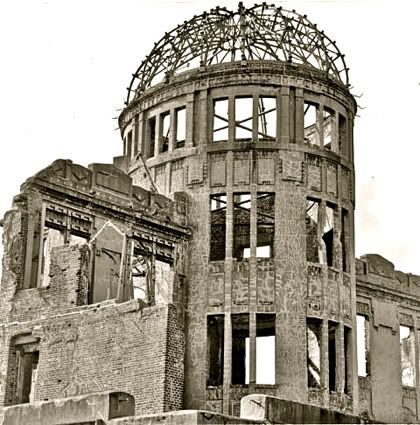
[Originally built as an exhibition hall by Czech architect Jan Letzel, the since-renamed Genbaku (or atomic bomb) Dome represents ground zero of the bombing of Hiroshima, even though the actual hypocentre of the blast was 150 m (490 feet) away and 600 m (1,968 feet) in the air. As the city was being rebuilt, debate raged over whether to leave the structure standing or demolish it; today its ruin serves as the centrepiece of the Hiroshima Peace Memorial Park - as well as an elegant tombstone for as many as 200,000 people killed either directly or indirectly by the blast (many of whom were simply vaporized) - making it a very poignant tribute to survival indeed...]

1284 - The Italian city-state of Pisa was defeated at the Battle of Meloria by Genoa - thereby ruining its once-mighty naval power over the issue of which city had sovereignty over the islands of Sardinia and Corsica.

1538
- Gonzalo Jiménez de Quesada founded the Colombian city of Bogotá.

1661 - The Treaty of The Hague was signed by Portugal and the Dutch Republic, whereby the latter relinquished control over its South American holding of New Holland - better known today as Brazil - to the former.

1806
- Francis II - the last Holy Roman Emperor - abdicated; don't feel bad for him, though, as he was still Emperor of Austria.

1825 - Bolivia gained its independence from Spain.

1845 - The Russian Geographical Society was founded in Saint Petersburg.

1862 - During the American Civil War the Confederate ironclad warship CSS Arkansas was scuttled on the Mississippi River after suffering damage in a battle with USS Essex at the Battle of Baton Rouge the previous day.

1870 - The Battle of Wörth was fought during the Franco-Prussian War, resulting in a decisive Prussian victory for Emperor Friedrich III over French commander Patrice MacMahon; the engagement could more rightly be called the Battle of Reichshoffen, however, or else the Second Battle of Wörth - the first one having been fought in December 1793, at which French general Lazare Hoche handed the Prussians a defeat during the Napoleonic Wars.

1890 - The first person ever to die in the electric chair, William Kemmler, was executed at New York state's Auburn Prison.

1926 - Gertrude Ederle became the first woman ever to swim the English Channel.

1930 - Judge Joseph Force Crater stepped into a taxi in New York City and was never seen again...

1942 - Wilhelmina of the Netherlands became the first reigning Queen ever to address a Joint Session of the US Congress.

1945 - The Japanese city of Hiroshima was devastated by an atomic bomb - nicknamed 'Little Boy' - dropped from the American B-29 bomber Enola Gay.

1956 - The DuMont Television Network made its final broadcast, which was a boxing match at the St. Nicholas Arena.

1961 - Soviet cosmonaut Gherman Titov spent the day in space on board Vostok 2, in the meantime orbiting the Earth 17 times; Titov's flight came just four months after Yuri Gagarin's historic single orbit aboard Vostok 1 on April 12th.

1962 - Jamaica gained its independence from the United Kingdom while remaining within the Commonwealth.

1987 - Dr David Owen resigned as leader of Britain's Social Democratic Party following a vote by party members to merge with the Liberal Party, with which it had sided during the 1983 and 1987 General Elections as the SDP-Liberal Alliance; following the merger the party called itself the Liberal Democrats, although a few stalwarts of the old party (including Owen himself) held out as the SDP throughout 1988.

1988 - The Tompkins Square Park Police Riot in New York City spurred reform of the NYPD, who were responsible for the melee that transpired that night.

1996 - Punk legends Ramones gave their final concert, at The Palace in Los Angeles.
*

share on: facebook