[When, in 1794, Captain George Vancouver first happened upon Icy Strait (at the south end of Glacier Bay) it was choked with ice that was said to be 'a mile thick'; by the time John Muir visited the area in 1879 the Grand Pacific Glacier had retreated to the head of the bay, and by 1916 it was at the mouth of Tarr Inlet, about 100 km (65 miles) from where Captain Vancouver first sighted it. What the fastest documented glacial retreat in history so generously revealed was a rugged landscape of uncommon beauty. In all, not a bad trade...]
138 CE - Roman Emperor Hadrian adopted Antoninus Pius, effectively making him his successor; on the same day Antoninus adopted Lucius Ceionius Commodus (son of the deceased Aelius Caesar) and Marcus Annius Verus (who was the grandson of a Senator buddy of Hadrian's of the same name and who just so happened to be betrothed to Aelius Caesar’s daughter Ceionia Fabia). All of which means Hadrian's Villa must have been one pretty hopping place, even eight years after the death of the Emperor's beloved Antinous...
1308 - Edward II was crowned King of England in Westminster Abbey in the presence of his gaily caparisoned boyfriend Piers Gaveston (the original angertwink) who failed to bear St. Edward's Crown up the aisle with the suitable solemnity and while wearing the royal purple besides, a fuming 12-year-old Queen Isabella (not yet known as the She-Wolf of France) smarting that she had failed to win the King's heart, and an increasingly irate nobility with swords half-unsheathed for both Gaveston and the King... Even before Sir John Bakewell was trampled to death, things were not going well!
1570 - Pope Pius V excommunicated Elizabeth I via his papal bull entitled Regnans in Excelsis.
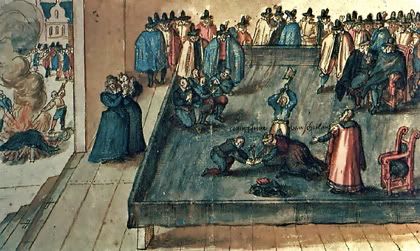
1601 - The Earl of Essex, former favourite of Elizabeth I, was afforded the privilege of a private execution at the Tower of London's Tower Green for his complicity in a plot to overthrow her.
1713 - Prussia's King Frederick I died; he was succeeded by his son, who reigned as Frederick William I.
1797 - Irish-American Colonel William Tate and his force of 1000-1500 French soldiers - having landed in Wales near Llanwnda three days earlier - surrendered at the Royal Oak pub in Fishguard having been routed in part by a girl, Jemima Nicholas, during an erstwhile military campaign now known as the Last Invasion of Britain.
1850 - China's Emperor Minning - known following his death as the Daoguang Emperor - died; he was succeeded by his son, Yichu, who in time would be posthumously known as the Xianfeng Emperor.
1866 - Miners in Calaveras County, California, discovered what is now called the Calaveras Skull - human remains that supposedly indicated that man, mastodons, and elephants had co-existed; it was later revealed to have been a hoax.
1901 - J.P. Morgan incorporated the United States Steel Corporation.
1912 - Marie-Adélaïde, the eldest of Guillaume IV's six daughters, became the first reigning Grand Duchess of Luxembourg.
1925 - Glacier Bay National Monument - now Glacier Bay National Park and Preserve - was established in Alaska.
1933 - The USS Ranger - the first custom-built aircraft carrier - was launched, sponsored by First Lady Lou Henry Hoover, who was herself something of a battleship.
1941 - The February strike, the first organized agitation against Nazi anti-Semitism by the good Christians of Amsterdam, failed to bring that city to a standstill, and was suppressed by the Germans within 48 hours; the action nevertheless boosted Dutch morale during a particularly bleak season, giving much aid and comfort to Holland's growing Resistance movement.
1951 - The first Pan American Games were held, in Buenos Aires.
1956 - In his speech On the Personality Cult and its Consequences Soviet leader Nikita Khrushchev denounced the actions of Joseph Stalin.
1964 - Following a much-hyped bout versus Sonny Liston in Miami (actually the first of two) Cassius Clay - soon to become even better known as Muhammad Ali - became Heavyweight Champion of the World. At the age of 22, Clay was the youngest man to ever hold the title; following his victory, by TKO, he famously jumped around the ring declaring 'I am the greatest!'
1972 - Coal miners in Britain called off a strike after causing a state of emergency and jeopardizing the country's power supply in exchange for a fat pay rise.
1986 - As the culmination of the People Power Revolution, President Ferdinand Marcos fled the Philippines after 20 years of dictatorial rule, ceding power to Corazon Aquino, who became the country's first woman president.
1994 - Dr. Baruch Kappel Goldstein committed the Mosque of Abraham massacre in the West Bank city of Hebron's Cave of the Patriarchs, opening fire with an automatic rifle and killing 29 Palestinian worshipers (and injuring 125 more) before being subdued and beaten to death by survivors. During subsequent rioting outside Aghli Hospital in western Hebron the Israeli Army killed 26 more Palestinians and 9 Israelis.
*
1308 - Edward II was crowned King of England in Westminster Abbey in the presence of his gaily caparisoned boyfriend Piers Gaveston (the original angertwink) who failed to bear St. Edward's Crown up the aisle with the suitable solemnity and while wearing the royal purple besides, a fuming 12-year-old Queen Isabella (not yet known as the She-Wolf of France) smarting that she had failed to win the King's heart, and an increasingly irate nobility with swords half-unsheathed for both Gaveston and the King... Even before Sir John Bakewell was trampled to death, things were not going well!
1570 - Pope Pius V excommunicated Elizabeth I via his papal bull entitled Regnans in Excelsis.
1601 - The Earl of Essex, former favourite of Elizabeth I, was afforded the privilege of a private execution at the Tower of London's Tower Green for his complicity in a plot to overthrow her.
1713 - Prussia's King Frederick I died; he was succeeded by his son, who reigned as Frederick William I.
1797 - Irish-American Colonel William Tate and his force of 1000-1500 French soldiers - having landed in Wales near Llanwnda three days earlier - surrendered at the Royal Oak pub in Fishguard having been routed in part by a girl, Jemima Nicholas, during an erstwhile military campaign now known as the Last Invasion of Britain.
1850 - China's Emperor Minning - known following his death as the Daoguang Emperor - died; he was succeeded by his son, Yichu, who in time would be posthumously known as the Xianfeng Emperor.
1866 - Miners in Calaveras County, California, discovered what is now called the Calaveras Skull - human remains that supposedly indicated that man, mastodons, and elephants had co-existed; it was later revealed to have been a hoax.
1901 - J.P. Morgan incorporated the United States Steel Corporation.
1912 - Marie-Adélaïde, the eldest of Guillaume IV's six daughters, became the first reigning Grand Duchess of Luxembourg.
1925 - Glacier Bay National Monument - now Glacier Bay National Park and Preserve - was established in Alaska.
1933 - The USS Ranger - the first custom-built aircraft carrier - was launched, sponsored by First Lady Lou Henry Hoover, who was herself something of a battleship.
1941 - The February strike, the first organized agitation against Nazi anti-Semitism by the good Christians of Amsterdam, failed to bring that city to a standstill, and was suppressed by the Germans within 48 hours; the action nevertheless boosted Dutch morale during a particularly bleak season, giving much aid and comfort to Holland's growing Resistance movement.
1951 - The first Pan American Games were held, in Buenos Aires.
1956 - In his speech On the Personality Cult and its Consequences Soviet leader Nikita Khrushchev denounced the actions of Joseph Stalin.
1964 - Following a much-hyped bout versus Sonny Liston in Miami (actually the first of two) Cassius Clay - soon to become even better known as Muhammad Ali - became Heavyweight Champion of the World. At the age of 22, Clay was the youngest man to ever hold the title; following his victory, by TKO, he famously jumped around the ring declaring 'I am the greatest!'
1972 - Coal miners in Britain called off a strike after causing a state of emergency and jeopardizing the country's power supply in exchange for a fat pay rise.
1986 - As the culmination of the People Power Revolution, President Ferdinand Marcos fled the Philippines after 20 years of dictatorial rule, ceding power to Corazon Aquino, who became the country's first woman president.
1994 - Dr. Baruch Kappel Goldstein committed the Mosque of Abraham massacre in the West Bank city of Hebron's Cave of the Patriarchs, opening fire with an automatic rifle and killing 29 Palestinian worshipers (and injuring 125 more) before being subdued and beaten to death by survivors. During subsequent rioting outside Aghli Hospital in western Hebron the Israeli Army killed 26 more Palestinians and 9 Israelis.
*
share on: facebook