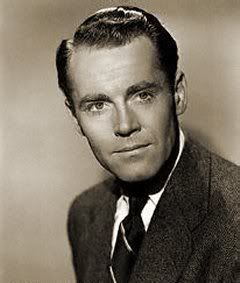
Young Mr. Lincoln (1939) - In typical Hollywood fashion Fonda's Lincoln is altogether prettier than history's Lincoln; also in typical Hollywood fashion, the facts of the plot don't necessarily jibe with those of any official biography. Hollywood lore has it Fonda was reluctant to play such a great man, echoing Lincoln's own humility to a tee, and thanks to that as well as the accomplished direction of John Ford and the film's quality-minded producer Darryl F. Zanuck, the film is rendered emotionally true if occasionally factually spurious.
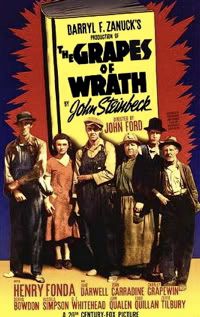 The Grapes of Wrath (1940) - Long considered Fonda's greatest role, much of the credit for that goes to John Steinbeck, whose fictional characters were often flawed yet triumphed in spite of it. Steinbeck's novel loses none of its sweep here as the Joad family travels from Oklahoma to California during the Dust Bowl, encountering the usual technological, geographical, and classist obstructions along the way. Although the movie and the novel differ greatly in both their politics and endings - Steinbeck's original being too honest for the Hollywood of the time - it is still a very satisfying experience to watch. Filmed in sepia to great emotional effect by legendary cinematographer Gregg Toland, if anything the visual aspects of the film are distracting, necessitating multiple viewings; how many depends on how distracted you are by pretty things.
The Lady Eve (1941) - No actor of this era could have asked for a better sparring partner on film than Barbara Stanwyck; director Preston Sturges makes the most of her inherent larceny (in real life she was an orphan who came up the hard way from Brooklyn and through the Broadway chorus) by pairing her with the painful earnestness and puppy dog eyes of Fonda, and demonstrated his flair for comedy - even if it did set him up for a string of roles in which he was routinely pussy-whipped to within an inch of his life. Featuring a cast comprised of the cream of Hollywood's character actors, neither Stanwyck nor Fonda ever looked lovelier.
The Big Street (1942) - Before we loved Lucy she played a variety of roles in which she wasn't the slightest bit lovable (and a couple in which she was a little too lovable, if you catch my meaning); this is one of the former. Exactly why nice guy Henry Fonda falls for a mercenary bitch like Lucille Ball is a mystery, but maybe it shouldn't be; goodness knows, it happens often enough in life, so why not in the movies? Damon Runyon's story - originally entitled Little Pinks - is typically mawkish, but is herein honed to a shine by screenwriter Leonard Spigelglass, who milks the third act so effectively by the time The End appears onscreen you won't be crying anymore because you'll have run out of tears.
Mister Roberts (1955) - By the time Fonda was cast in this one he'd been away from Hollywood for awhile, immersing himself in his first love - the stage; only the insistence of director John Ford managed to sway the gnat-like attention spans of studio executives into casting him. Also notable as the final film role of William Powell, it has the kind of heavyweight cast that only a Steven Soderbergh or a Woody Allen could get away with today, including James Cagney, Jack Lemmon, and Ward Bond.
12 Angry Men (1957) - The ultimate jury room thriller is mainly shot on a single set, in close-up, and by the end of it the claustrophobia has become almost palpable, exactly as intended; not only will you see every bead of sweat on every brow and every upper lip, you'll have them yourself. Director Sidney Lumet's first feature film stays close to the script of the play on which it was based, explores themes such as bigotry, and allows Fonda the chance to liberal the place up with his trademark panache in his courageous defense of a defendant guilty only of being the wrong colour.
Advise and Consent (1962) - Allen Drury's novel was suitably lurid to have censor-busting director Otto Preminger fairly salivating to direct it. A heavyweight cast featuring Charles Laughton, Don Murray, Walter Pidgeon, Peter Lawford, Gene Tierney, Franchot Tone, Lew Ayres, and Burgess Meredith among others does justice to the heavyweight themes on offer, and reminds us that politics didn't become a dirty game a few years ago, but probably always was one. So as to give the nation's prudes the collective collywobbles, Preminger set some of the film's scenes in a gay bar - by general consensus the first time any director had ever done such a thing*.
*Although you'll never convince me that Victor Fleming's The Wizard of Oz wasn't entirely set in one.
On Golden Pond (1981) - Fonda's final film marked not only the first time he'd ever worked with fellow legend Katharine Hepburn but amazingly also the first time they'd ever met! In fact, the hat he wears throughout the film had once belonged to Spencer Tracy, and was a gift from her; one almost wonders what Tracy would have done with the role - for about two minutes, that is, after which you'll find it hard to believe anyone else had ever assayed the role, even though Ernest Thompson's play had been performed before (and has been performed since). Unusual in its depiction of the elderly as (gasp!) human the film was prescient in that the gold in the pond was likely due to the reflection of all the Oscars it would garner.
*
share on: facebook