Showing posts with label 1738. Show all posts

Tuesday, May 25, 2010

POPnews (US) - May 25th

Photobucket

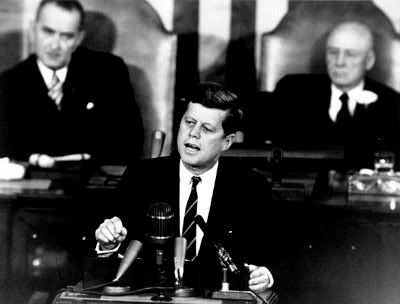
['...I believe that this nation should commit itself to achieving the goal, before this decade is out, of landing a man on the moon and returning him safely to the earth. No single space project in this period will be more impressive to mankind, or more important for the long-range exploration of space; and none will be so difficult or expensive to accomplish.' With these words, President John F. Kennedy extended the space race begun with the October 1957 launch of Sputnik 1 by the Soviet Union.]

1738
- A treaty between Pennsylvania and Maryland ended the Conojocular War with the settlement of a boundary dispute and an exchange of prisoners.

1787 - Delegates convened a Constitutional Convention in Philadelphia to write a new Constitution for the United States, with George Washington presiding.

1865 - 300 people were killed when an ordnance depot exploded in Mobile.

1925 - John T. Scopes was indicted for teaching Charles Darwin's theory of natural selection in violation of Tennessee's Butler Act, precipitating the Scopes Trial.
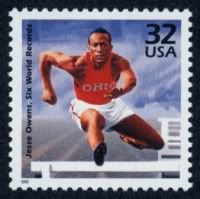
Photobucket1935 - Within a 45 minute period Jesse Owens of Ohio State University set three world records and tied a fourth at the Big Ten Conference Track and Field Championships in Ann Arbor - completing the 100 yard dash in ­ 9.6 seconds, the 220 yard dash in ­ 21.0 seconds and making a long jump of ­ 24 feet 10 inches - an event rightly commemorated by the US Postal Service. Not allowed to live on campus with his team mates and unable to eat or stay with them while on the road, Owens worked part time to put himself through school because he was also ineligible for scholarships. Despite this, his was a work ethic and competitive nature which enabled him to rise above such a disgusting level of racism.

1936 - The Remington Rand strike, led by the American Federation of Labor, began.

1953 - At the Nevada Test Site, the US government conducted its first and only test of nuclear artillery.

1955 - A night time F5 tornado struck the small city of Udall, Kansas, killing 80 and injuring 273, making it the deadliest tornado to ever occur in the state and the 23rd deadliest in US history.

1961 - President John F. Kennedy announced before a special joint session of Congress his goal to initiate a project to put a 'man on the moon' before the end of the decade.

1966 - NASA launched Explorer 32 from Cape Canaveral; its purpose was to study the Earth's upper atmosphere.

1979 - At Chicago's O'Hare International Airport, American Airlines Flight 191 crashed during takeoff, killing 271 on board and two people on the ground.

1999 - The US House of Representatives released the Cox Report which detailed China's nuclear espionage against the US over the prior two decades.

2001 - Boulder's Erik Weihenmayer became the first blind person to reach the summit of Mount Everest.
*

share on: facebook

Monday, May 24, 2010

POPnews - May 24th

Photobucket
[It was with considerable razzmatazz that the Brooklyn Bridge was finally opened on this day in 1883, which was maybe less than appropriate, considering the tragedies that occurred during its construction - not the least of which were the death of its architect, John Roebling and the incapacitation of his son and successor, Washington Roebling. In fact, it was largely due to the indefatigable efforts of the younger Roebling's wife, Emily Warren Roebling, that the project was completed at all. The entire thrilling story is told in a work of popular history by David McCullough, called The Great Bridge, which naturally is housed in the collection of the Pop Culture Institute; the tale also opens Brooklyn Bridge (1981), the first documentary made by Ken Burns for PBS, which was narrated by McCullough.]


1487 - Lambert Simnel was crowned as 'King Edward VI' at Christ Church Cathedral in Dublin; Simnel, along with Perkin Warbeck, was a pretender to the English throne which had been usurped by Henry VII at the Battle of Bosworth Field in August 1485. Neither of them had any right to the throne, though, whereas Henry VII did*; so while the King was initially lenient towards them when they became a threat to his rule he reluctantly had them put to death.

*Sort of... At least a better one than either of them!

1621 - The Protestant Union was formally dissolved under pressure from Ferdinand II, the Holy Roman Emperor; the event was one of many factors contributing to the continuance of the Thirty Years' War.

1626 - Peter Minuit bought Manhattan Island from the Canarsee - a Metoac band related to the Lenape Nation - even though they had no right to sell it; the transaction greatly displeased the Weckquaesgeek (whose land it actually was) and who later fought the Dutch during Kieft's War in retaliation. The sale - for 60 guilders but often since rendered as $24 - has been used to bigoted ends ever since to prove the triumph of the supposedly superior European over the stupid heathens, but in fact the sale greatly strengthened the Canarsee in the region by not only undermining their rivals but helping them to obtain technology, since the sale was not in cash but in trade goods for that value, goods which enabled them to get the upper hand geopolitically.

1689 - The English Parliament passed the Act of Toleration protecting Protestant Nonconformists (in other words, those who dissented from the Church of England) from religious discrimination; Roman Catholics were intentionally excluded from protection.

1738 - John Wesley converted from Anglicanism, essentially launching the Methodist movement; the day is celebrated annually by Methodists as Aldersgate Day.

1798 - The Irish Rebellion of 1798 - led by the United Irishmen against British rule and inspired by both the American and French revolutions - began in the counties of Leinster and Kildare.

1830 - Mary Had a Little Lamb, a poem by Sarah Josepha Hale, was published.

1844 - When Samuel F. B. Morse sent a Bible quotation - 'What hath God wrought' (Numbers 23:23) - from the Old Supreme Court Chamber in the US Capitol to his assistant, Alfred Vail, in Baltimore along a single wire strung beside the track of the Baltimore and Ohio Railroad it became the first message ever sent by telegraph.

1883 - The Brooklyn Bridge was opened to traffic after 14 years of construction, which had begun in January 1870.

1930 - Amy Johnson became the first woman to fly solo from England to Australia, having departed from Croydon on May 5 and flown a total of 11,000 miles before landing at Darwin; the de Havilland Gipsy Moth in which she made her historic flight (and which she named 'Jason') is currently on display at the Science Museum in London.

1943 - Josef Mengele became chief medical officer at the Auschwitz concentration camp.

1962 - As part of NASA's Project Mercury, astronaut Scott Carpenter orbited the Earth three times in the Aurora 7 space capsule.

1970 - The drilling of the Kola Superdeep Borehole began in the Soviet Union.

1976 - At the so-called Judgment of Paris professional wine testers rated wines from California higher than their French counterparts, challenging the notion that France was the foremost producer of the world's best wines.

1989 - Sonia Sutcliffe - wife of Peter Sutcliffe, the so-called Yorkshire Ripper, who was found guilty in 1981 of the gruesome murders of 13 women - was awarded £600,000* in damages after winning an action against Private Eye; the magazine's editor, Ian Hislop, had the temerity to suggest in print that there was a bidding war for Mrs. Sutcliffe's story - which there was, as was later proven - and famously stated following the trial 'If that's justice, then I'm a banana.' As for Private Eye, they scored a major PR coup by holding a fundraiser, known as the Bananaballs Fund, with the amount left over donated to the families of Sutcliffe's victims.

*The sum was later reduced to £60,000 on appeal, which at the time was £100,000 more than the previous record-holder for libel in Britain, and a hundred times greater than any compensation given to Sutcliffe's victims.

1990 - Earth First! activists Judi Bari and Darryl Cherney were critically injured when a pipe bomb planted in their car exploded in Oakland, California; the FBI initially attempted to charge them with the crime, but once it was proven to them that such a thing was not possible no further investigation was carried out. The culprit or culprits remain unknown.

1992 - The last Thai dictator, General Suchinda Kraprayoon, resigned following a series of pro-democracy protests known as Black May.

1993 - Eritrea gained its independence from Ethiopia with Isaias Afewerki as the new country's first Provisional President.

2001 - Owing to faulty construction the third story of the Versailles wedding hall - in Jerusalem's Talpiot suburb - collapsed, killing 23 and injuring more than 200 in what is considered Israel's worst-ever civil accident. In the aftermath of the disaster laws were passed which tightened the regulation of construction, and the hall's owners - Avraham Adi, Uri Nisim, and Efraim Adiv - were found guilty of causing death by negligence. The ruin was demolished in 2007, and the land remains unoccupied, although across the street there is a memorial garden honouring the victims.
*
share on: facebook

Sunday, April 18, 2010

POPnews - April 18th

Photobucket
[Not only did the Midnight Ride of Paul Revere alert American patriots to an impending British invasion at the outset of the American Revolution, it's since found itself a comfortable niche in pop culture; this 1931 painting by Grant Wood (the painter most famous for American Gothic) is a stylized view of Revere's brave act, but Henry Wadsworth Longfellow's poem Paul Revere's Ride went even further, taking utter liberties with the historical record in the name of art. Plus the entire undertaking is responsible for the phrase 'one if by land, two if by sea' as well, which I always thought was a little too poetic just to be part of the name of a Sandra Bullock-Denis Leary movie, no matter how charming a movie it is.]

1025 - Bolesław Chrobry became the first King of Poland when he was crowned in Gniezno.

1161 - Theobald of Bec - who was appointed by Archbishop of Canterbury by England's King Stephen in 1138 - died; he was succeeded by the altogether more famous Thomas Becket.

1506 - The cornerstone of the current St. Peter's Basilica was laid by Pope Julius II; much of what is now known as Old St. Peter's Basilica - built by Emperor Constantine I between 326 and 333 CE - was taken down or swallowed up by the new building, which was designed by Donato Bramante.

1518 - Bona Sforza - second wife of Sigismund I - was crowned as queen consort of Poland.

1738 - Madrid's Real Academia de la Historia (or Royal Academy of History) was founded by King Felipe V to study history 'ancient and modern, political, civil, ecclesiastical, military, scientific, of letters and arts, that is to say, the different branches of life, of civilization, and of the culture of the Spanish people'; the Academy currently has 370 members.

1775 - Paul Revere and William Dawes warned residents of the countryside around Boston of British troop movements on the evening before the Battles of Lexington and Concord, which would mark the outbreak of the American Revolution. Revere was given the shorter way - via Somerville, Medford, and Arlington - whereas Dawes took a more circuitous route through Boston Neck upon the orders of Dr Joseph Warren to warn John Hancock and Samuel Adams that they were in danger of arrest.

1797 - At the Battle of Neuwied forces of the First French Republic under Lazare Hoche scored a victory against the Holy Roman Empire and the Hapsburg Austrian forces of General Wermecek.

1831 - The University of Alabama was founded, featuring a strong curriculum of book-larnin', cipherin', and such.

1848 - An American victory by General Winfield Scott against Antonio López de Santa Anna at the Battle of Cerro Gordo opened the way for the US invasion of Mexico during the Mexican-American War; in addition to inflicting heavy casualties against their opponents (including the death of General Ciriaco Vasquez and the capture of his fellow generals Luis Pinzon, Jose M. Jarrero, R. Diaz de La Vega, Manuel Norriega, and Jose Obando) Scott's men forced Santa Anna to flee on horseback without the benefit of his prosthetic leg, which is still on display at the Illinois National Guard in Springfield to this day.

1880 - An F4 tornado struck Marshfield, Missouri, killing 99 people and injuring 100; while there's nothing so unusual about that, according to Ripley's Believe It or Not! one of the survivors was a child in a cradle, found up a tree! That would make this particular tornado one of the most remembered in history, as it has been considered the genesis of the nursery rhyme Rock A Bye Baby, even if it turns out the story is utter bunk; the verse is actually much older, and originated - as these things often do - as an English satire called Lilliburlero.

1909 - Joan of Arc was beatified in Rome by Pope St. Pius X.

1915 - French pilot Roland Garros was shot down and glided (glid?) to a landing behind German lines during World War I; having failed to destroy his plane, its interrupter gear was eventually seized, costing the Allies their tactical edge. The resulting Fokker Scourge brought a new level of carnage to aerial combat.

1923 - Yankee Stadium - also known as The House that Ruth Built - opened; it has since been torn down.

1942 - The Doolittle Raid - the first attack on the Japanese mainland by American forces - was made in retaliation for Japan's earlier attack on Pearl Harbor; although the raid - planned by Lieutenant-Colonel James 'Jimmy' Doolittle - did prove that bombers could successfully be launched from aircraft carriers, the raid was otherwise tactically indecisive.

1949 - The Republic of Ireland Act came into force.

1980 - The Republic of Zimbabwe (formerly Rhodesia) came into being, with Canaan Banana as the country's first President.

1983 - A suicide bomber destroyed the US embassy in Beirut, killing 63 people; responsibility was claimed by the Islamic Jihad Organization.

1988 - The US launched Operation Praying Mantis against Iran in the largest naval battle since World War II.

2009 - The Welsh-born actress Stephanie Parker - who played Stacey Weaver on BBC Wales' television series, Belonging - was found hanged near Pontypridd, in an apparent suicide; she was 22.
*
share on: facebook

Thursday, April 15, 2010

POPnews - April 15th

Photobucket
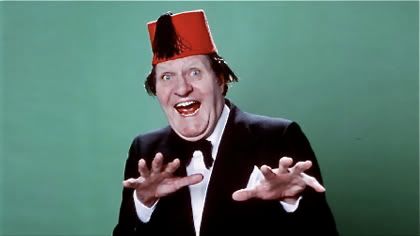
[Many's the performer who can be said to have died
on stage; Tommy Cooper, though, actually did it!]

1450 - At the Battle of Formigny, which was fought near the end of the Hundred Years' War, the French under the Comte de Clermont and Arthur III, Duke of Brittany, attacked and nearly annihilated Thomas Kyriell's English forces, finally ending the English domination of Northern France that began when Normandy's William the Conqueror invaded England in October 1066.

1632 - At the Battle of Rain - during the Thirty Years' War - Swedish forces under Gustavus Adolphus defeated the armies of the Holy Roman Empire and the Catholic League commanded by Count Johan Tzerclaes of Tilly.

1715 - The Pocotaligo Massacre triggered the start of the Yamasee War in Colonial South Carolina.

1738 - Serse - an opera, in Italian, by George Frideric Handel - premiered at London's King's Theatre, Haymarket.

1755 - Samuel Johnson's A Dictionary of the English Language was published, by Richard Bentley, in London.

1802 - William Wordsworth was out for a walk with his sister Dorothy when he saw a 'long belt' of daffodils, inspiring him to write I Wandered Lonely as a Cloud - although, at Dorothy's insistence, he didn't open his poem with the line 'I wandered lonely as a cow' like he'd wanted. Smart lady...

1865 - US President Abraham Lincoln died, having been shot the previous evening by John Wilkes Booth; upon his death Andrew Johnson became the 17th President of the United States.

1920 - Anarchists Sacco and Vanzetti allegedly murdered two security guards while robbing the Slater-Morrill Shoe Company in South Braintree, Massachusetts; in the more than seven years that followed prior to their August 1927 execution their case became a cause célèbre, involving the luminous likes of Dorothy Parker, Edna St. Vincent Millay, Bertrand Russell, John Dos Passos, Upton Sinclair, George Bernard Shaw and H. G. Wells among many others.

1941 - During the Belfast Blitz, two hundred Luftwaffe bombers attacked that Ulster city, killing more than nine hundred people, injuring 1,500 (400 of them seriously) and damaging half of the city's 70,000 houses - leaving 100,000 homeless in a population of 425,000.

1942 - The George Cross, Britain's highest civilian honour for valour, was awarded to 'the island fortress of Malta - its people and defenders' by King George VI.

1945 - The Bergen-Belsen concentration camp was liberated.

1947 - Jackie Robinson debuted for the Brooklyn Dodgers, breaking baseball's color line.

1955 - Ray Kroc opened his first franchise of a McDonald's restaurant, in Des Plaines, Illinois; although it was technically the ninth McDonald's overall, Kroc soon ended up taking over the entire company.

1957 - The British Columbia town of White Rock officially separated from Surrey and was incorporated as a new city; to be honest, though, the only reason I've mentioned it here is because both of them have since been gobbled up by Metro Vancouver.

1967 - Scotland defeated rival England 3-2 at Wembley Stadium, causing Scottish football fans to jokingly claim their side as 'Unofficial World Champions', creating the phenomenon of the Unofficial Football World Championships.

1984 - British comedian Tommy Cooper suffered a massive heart attack while performing on the ITV variety programme, Live From Her Majesty's; he was later pronounced dead on arrival at Westminster Hospital.

1986 - In retaliation for the bombing of the La Belle Discotheque in West Berlin on April 5th - in which two U.S. servicemen and a Turkish woman were killed - US President Ronald Reagan ordered major bombing raids against the Libyan cities of Tripoli and Benghazi, which killed 60 people - including Muammar Gaddafi's 15-month-old adopted daughter, Hanna.

1989 - The death of Hu Yaobang ignited the Tiananmen Square protests in Beijing; this last organized campaign aimed at bringing democracy to China was savagely suppressed by Communist authorities by June 4th.

2003 - US troops in Baghdad captured Abu Abbas, leader of the Palestine Liberation Front, which killed American Leon Klinghoffer on the hijacked cruise liner the Achille Lauro in October 1985.
*
share on: facebook