Thursday, March 03, 2011

POPnews - March 3rd

Photobucket
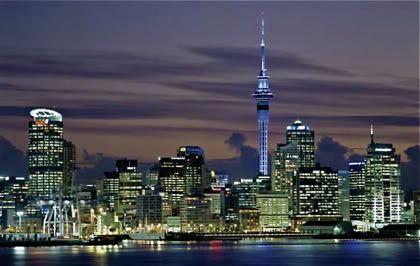
[Located on the corner of Victoria and Federal Streets in the Auckland CBD, the Sky Tower looms 328 metres (1,076 ft) over the largest city in New Zealand, making it the 15th tallest member of the World Federation of Great Towers.]

1284 - The Statute of Rhuddlan incorporated the Principality of Wales into England.

1575 - India's Mughal Emperor Jalaluddin Muhammad Akbar defeated a Bengali army at the Battle of Tukaroi.

1585 - The Olympic Theatre, designed by Andrea Palladio, was inaugurated in Vicenza.

1776 - The first amphibious landing of the US Marine Corps began the Battle of Nassau.

1845 - Florida became the 27th US state.

1855 - Alexander II became Tsar of Russia following the death of his father Nicholas I.

1861 - Russia's Tsar Alexander II signed the Emancipation Manifesto into law, thereby abolishing Russian serfdom. 

1865 - The Hongkong and Shanghai Banking Corporation, founding member of the HSBC Group, was opened by Thomas Sutherland at Wardley House in Hong Kong.

1875 - The first ever organized indoor game of ice hockey was played at Montreal's Victoria Skating Rink, as recorded by the Montreal Gazette.

1878 - Bulgaria regained its independence from the Ottoman Empire according to the Treaty of San Stefano, a day still celebrated there as Liberation Day; shortly thereafter the Congress of Berlin stripped the newly liberated nation of its status, making it once again an autonomous state of the Ottoman Empire.

1918 - Germany, Austria and Russia signed the Treaty of Brest-Litovsk, ending Russia's involvement in World War I and leading to the independence of Finland, Estonia, Latvia, Lithuania, and Poland.

1924 - A 1400-year-old Islamic caliphate was abolished when Abdul Mejid II of the Ottoman Empire was deposed; this last remnant of the old regime gave way to the reformed Turkey of Kemal Atatürk.

1942 - Ten Japanese warplanes raided the town of Broome in Western Australia, killing more than 100 people.

1943 - 173 people (including 62 children) were killed in a crush while trying to enter an air-raid shelter at London's Bethnal Green tube station.

1944 - The Order of Nakhimov and Order of Ushakov were instituted in USSR as the highest naval awards. 

1961 - Hassan II became King of Morocco following the death of his father Mohammed V.

1997 - The tallest free-standing structure in the Southern Hemisphere, Sky Tower opened in downtown Auckland after two-and-a-half years of construction.

2005 - James Roszko killed four Royal Canadian Mounted Police constables - Peter Schiemann, Anthony Gordon, Lionide Johnston, and Brock Myrol - during a drug bust at his property in Rochfort Bridge, Alberta, then committed suicide; the so-called Mayerthorpe Incident was the deadliest peace-time incident for the RCMP since 1885's North-West Rebellion.

2009 - The Sri Lankan Cricket Team was attacked by terrorists while on their way to the Gaddafi Stadium in Lahore for the third day of a second Test Match against Pakistan; six members of the team were injured by the 12 gunmen, while two civilians and two police officers were killed.
*
share on: facebook

Wednesday, March 02, 2011

"We've Only Just Begun" by The Carpenters


Born on this day in 1950, Karen Carpenter's sweet voice - which I've always found a curious blend of haunting and soothing - made The Carpenters into superstars of 1970s radio; similarly, her gentleness is often on display in television appearances, such as this hippy-riffic performance on The Ed Sullivan Show in 1970, which also demonstrates her abilities as a drummer.

Carpenter's February 1983 death while recovering from anorexia nervosa was one of the first such celebrity deaths to have an impact on me; because I'd grown up listening to her, not to mention the fact that I used to be an even more melodramatic whoopsie than I am even now, I had a little bit of a breakdown when I heard the news, and got to miss school that day as a result.
*
share on: facebook

Happy Birthday Laraine Newman

Laraine Newman's pioneering work as one of the original cast members of Saturday Night Live will always ensure her a place in the hearts and minds of - ahem - people of a certain age, myself wholeheartedly included, even though I am very much on the young end of that particular spectrum, thank you very much.

PhotobucketBorn on this day in 1952, Newman's comedy career began with the legendary comedy troupe The Groundlings, and her character-driven work on SNL definitely benefited from that. In fact, she was one of the first people on television to impersonate the verbal cadences and mannerisms of that peculiar breed of young lady most often found at the Sherman Oaks Galleria - the Valley Girl.

Since leaving the cast of SNL after five seasons in 1980 Newman's career has been spotty at best; still, whenever she does appear, it's always a delightful surprise.

To read her many trenchant (not to mention occasionally bitter and often hilarious) insights into her time on the show, read the excellent Live From New York: An Uncensored History of Saturday Night Live, edited by Tom Shales and James Andrew Miller; or, you can always watch her in action. The first five seasons of SNL are available in their glorious commercial-free entirety on DVD.
*
share on: facebook

POPnews - March 2nd

Photobucket
[87 km (54 miles) southeast of Seattle the highest peak in the Cascade Range rises above a primordial rain forest of uncommon lushness and beauty; on clear days it towers over a similarly lovely urban jungle as well, serving as a constant reminder of our frailty as humans on this planet. Part of the Cascade Volcanic Arc - along with its fellows Baker, Jefferson, Shasta and Garibaldi - Rainier could in theory get uppity like Mount St. Helens and play tag with the approximately 10 million people living in the region using nothing but molten rock. Then again, it probably won't...]

986 CE - Louis V - the last Carolingian monarch and remembered today as Louis le Fainéant (Louis Do-Nothing) - became King of the Franks.

1127 - Charles the Good, Count of Flanders, was assassinated for distributing bread to the poor during a famine. The bastard...

1808 - The first meeting of the Wernerian Natural History Society - the Scottish learned society founded the previous January 12th which closed down in April 1858 - was held in Edinburgh.

1815
- The Kandyan Convention was signed by the British (represented by John d'Oyly) and Sri Lanka's last King Sri Vikrama Rajasinha; the treaty was not popular with the people of Kandy, a kingdom in mountainous central Sri Lanka, who had been holding off the invasion of their island since 1796. Its signing and implementation would bring about the Uva Rebellion against the colonial Governor, Robert Brownrigg.

1836 - The Texas Declaration of Independence was adopted at the Convention of 1836, held at Washington-on-the-Brazos; this opening salvo of the Texas Revolution - owing in large part to the tyrannical rule of Mexico's President-General Antonio López de Santa Anna - resulted in the creation of the Republic of Texas.

1865 - The Volkner Incident - the murder of missionary Carl Völkner during New Zealand's Second Taranaki War - brought about the mass confiscation of land occupied by the Maori of Whakatohea.

1867 - The US Congress passed the first of four Reconstruction Acts, which were intended to return the country to normalcy following the US Civil War during the period known as Reconstruction.

1877 - Just two days before the Inauguration was scheduled to occur, the US Congress declared Rutherford B. Hayes the winner of the election even though Samuel J. Tilden had won the majority of the popular vote in November 1876.

1888 - The Convention of Constantinople was signed signed by Great Britain, Germany, Austro-Hungary, Spain, France, Italy, the Netherlands, Russia, and the Ottoman Empire, guaranteeing free maritime passage through the Suez Canal during war and peace.

1899 - Mount Rainier National Park was established in the US state of Washington.

1903 - New York City's Martha Washington Hotel opened at 30 E. 30th Street, becoming the first hotel exclusively for women; it's still in business under the name Hotel 30 30, although the women-only policy has been dropped.

1939 - Cardinal Eugenio Pacelli was elected Pope following the death of Pius XI, taking the name Pius XII.

1955 - King Norodom Sihanouk of Cambodia abdicated in favor of his father, King Norodom Suramarit, opting to serve as Prime Minister instead.

1956 - Morocco declared its independence from France.

1962 - Wilt Chamberlain set an NBA record by scoring 100 points in a single game.

1969 - The first test flight of the Anglo-French Concorde was conducted in the skies over Toulouse, France.

1970 - Ian Smith declared Rhodesia a republic, breaking that country's last links with Britain.

1978 - Czech Vladimír Remek became the first non-Russian or non-American to go into space aboard Soyuz 28.

1996 - Ranabima Royal College was established in Kandy, Sri Lanka, on the anniversary of the signing of the Kandyan Convention.
*
share on: facebook

Tuesday, March 01, 2011

World City-Zen: Rio de Janeiro

Photobucket

Although the picturesque coastal setting of Guanabara Bay - where today South America's third largest conurbation resides - was first explored by Gaspar de Lemos in January 1502 (thus its name) the city itself wouldn't appear there for more than six decades; and while it was a French explorer named Nicolas Durand de Villegaignon who founded the area's first European settlement at Fort Coligny on the bay's Serigipe Island in 1555 (during the France Antarctique period) it was actually on this day in 1565 that Estácio de Sá established Rio de Janeiro following a successful military action against the French.

De Sa's contribution is now commemorated in the naming of thousands of schools and roadways throughout Brazil, including Rio's Estácio neighbourhood.

The city was made capital of Brazil when the Portugese royal family found itself exiled from Europe in 1808. It would remain the capital following the establishment of the Brazilian monarchy under Pedro I in 1822, would continue in that role after the country became a republic in 1889, and was only relieved of the duty when administrative authority decamped to Brasília in April 1960.

As so often happens, the tropical paradise of Rio de Janeiro has also earned a reputation for crime; amidst its Carnival celebrations, famous beaches such as Copacabana and Ipanema, and major tourist attractions like Christ the Redeemer atop Corcovado, gangs of heavily armed thugs roam the city's favelas and posh neighbourhoods alike wreaking mayhem. The city's residents, known as cariocas, seem to take it all in their stride as they strive to provide visitors with the warm welcome generations of tourists have come to expect from them. It only remains to be seen if the city's problems can be successfully curtailed by the time it welcomes the world as the host of the 2016 Summer Olympic Games.
*
share on: facebook

"It's Not The End Of The World" by Super Furry Animals


Birthday wishes go out today to Dafydd Ieuan, drummer with Welsh pop outfit Super Furry Animals, whose 2002 single It's Not the End of the World? is seen here animated by Numero 6 (David Nicolas); the single originally appeared on the band's album Rings Around the World.
*

share on: facebook

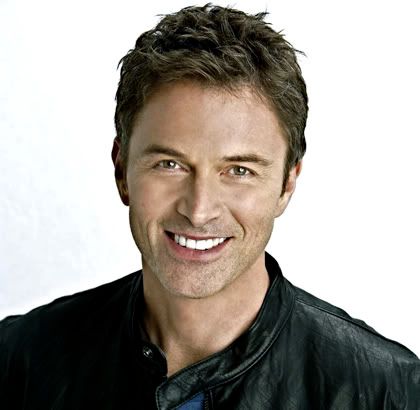
Gratuitous Brunette: Tim Daly

Photobucket

When I added the First Season of Wings to the collection of the Pop Culture Institute, I did so quietly, fully aware that certain snobs I work with* would turn up their turned up noses even further, possible causing themselves some kind of chiropractic trauma... Honestly, I don't know why I bother. For its unique setting, strong ensemble, and not one but two hot guys in the leads - Tim Daly and Steven Weber as the brothers Hackett - Wings is just about all I look for in a sitcom. Oh, and Daly's shirtless scenes didn't hurt either...

Lately, of course, I haven't been as into what Tim Daly's up to, since hour-long medical dramas are pretty much the opposite of what I'm down with (with the obvious exception of House) but apparently Daly is still burning up TV screens on Private Practice - the Grey's Anatomy spin-off that gave pop culture McDreamy and McSteamy (my personal favourite of the two). Anyway, today McHumpy turns an age-defying 55, one of a generation who are stretching the boundaries of hotness to unprecedented dimensions.

Photobucket*Chumley sez: All I said was that I preferred the show after
Tony Shalhoub joined the cast in Season Three but before Thomas Haden Church left in Season Six, you overly touchy fusspot...
*

share on: facebook

The Death of Gruffydd ap Llewelyn Fawr

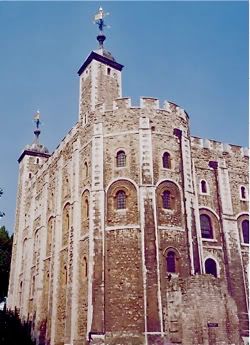
Although very little is known about Gruffydd ap Llewelyn Fawr, it's clear that he wasn't the sort of man to let a namby-pamby little thing like incarceration in the Tower of London keep him down; having been a prisoner for much of his life, on this day in 1244 he'd clearly had enough.

PhotobucketThe first-born - albeit illegitimate - son of Llywelyn the Great came into this world at the outset of the 13th Century, at a time when the Kings of England (especially Henry III and his son Edward I) were trying mightily to subdue the rugged land and equally rugged populace to their immediate west, in Wales. Offered as a prisoner to King John while still a boy, upon his father's death Gruffydd was released, only to be taken prisoner thereafter by his legitimate half-brother Dafydd (by King John's daughter Joan), who for a time was recognized as Prince of Wales.

Following his internment in 1240 Gruffydd's own wife Senena petitioned Henry III for her husband's release, going so far as to pay 600 marks, which was a very princely ransom indeed; the King considered the petition, pocketed the money, then reneged on the deal - and to think it's the Welsh who have the reputation of welshing (in other words, not keeping their end of the bargain)!

And so it was that on this day in 1244 - the feast day of St. David, patron saint of Wales - that Gruffydd ap Llewelyn Fawr fashioned himself a rope out of whatever fabric he could find and attempted to lower himself out of the window of his cell in the White Tower; a sturdily built man, a hastily improvised method of escape... The outcome is pretty obvious.

He was found - dead - the following morning by the Yeoman of the Guard, and his body was transported to Aberconwy and the behest of the abbott, where he was buried beside his father; in the years following his death Gruffydd's sons - Owain, Llywelyn, Dafydd and Rhodri - would scrap over Wales in between their tussles with the English, and in the end it would be Llewelyn who emerged the victor.

Alas, he is remembered to history as Llewelyn Ein Llyw Olaf, or Llewelyn Our Last Leader, the last Welsh-born Prince of Wales before the conquests of Edward I rendered Wales unto the control and fealty of the British Crown, which took his august title and bestowed it henceforth upon the eldest son of its wearer.
*
share on: facebook

What's The Occasion? St. David's Day


In honour of St. David's Day, the Welsh national day - the day that proud Celtic country's patron saint died - here's a catchy little earworm courtesy of Gethin Jones, whose channel on YouTube features many such informative and humourous animations, as does his website.
*
share on: facebook

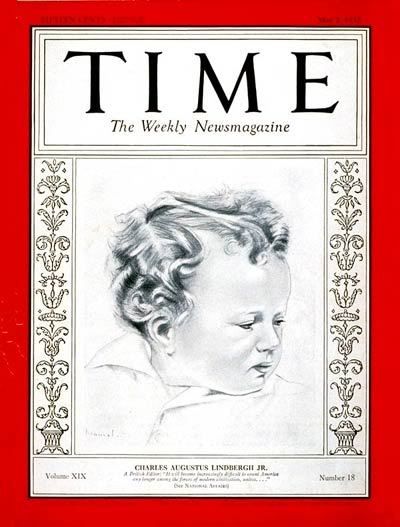
Pop History Moment: The Taking Of The Lindbergh Baby

Photobucket

When nanny Betty Gow put her infant charge to bed at 8 PM on this day in 1932 it had been a day like any other; little did she know that when she checked in on him just past 9 PM it would be the last time she would ever see him alive. At 10PM, she looked in on him again, only this time he was gone. Rushing to find the baby's parents, she strove to stay calm in case either of them had taken him - his mother understandably doted on him and his father, despite a stoic countenance, could be a bit of a practical joker; when it was clear neither of them had taken the child the couple's butler, Ollie Whately, called the police in the nearest town, Hopewell, New Jersey, at around 10:25 PM. Chief Harry Wolf arrived promptly on the scene.

It's every parent's nightmare - in this case it would soon become the entire country's nightmare as well; for this was no ordinary baby, but the only son of famed aviator Charles Lindbergh and his wife Anne Morrow Lindbergh. Armed with a rifle, Lindbergh senior searched the grounds of their home. Beneath a second-storey window he found a makeshift ladder, it's top rung broken*; above it, inside the nursery, the baby's bedding was found untouched, but there were muddy footprints on the rug and a note on the window sill, handwritten by someone obviously semi-literate, demanding a $50,000 ransom for the baby's safe return.

Overnight the private tragedy of the Lindberghs became what has been called the first media circus, and which America's leading journalist of the day H.L. Mencken called 'the biggest story since the Resurrection'; the next morning President Herbert Hoover vowed to 'move Heaven and Earth' to find the child, going so far as to pass the Lindbergh Law, which would make kidnapping a federal offense. The Lindberghs offered a $50,000 reward, to which the state of New Jersey added $25,000; this is a substantial sum even now, but in the early days of the Great Depression it represented a fortune - more than a million dollars in today's money.

The baby's body, or anyway the body of a baby, was found by the side of the road near the Lindbergh's estate in May 1932 by a delivery man named William Allen who happened to stop along a stretch of road to relieve himself, but it would be more than 30 months before a German immigrant itinerant carpenter and petty criminal named Bruno Hauptmann would be collared for the crime. He was arrested in September 1934, put on trial in January 1935, found guilty the following month after an laughably inept trial, and executed in April 1936 despite constant protestations of his own innocence.

*One theory states that the child may have been killed during the abduction - thus the relevance of the broken ladder rung.
*
share on: facebook

POPnews - March 1st

Photobucket
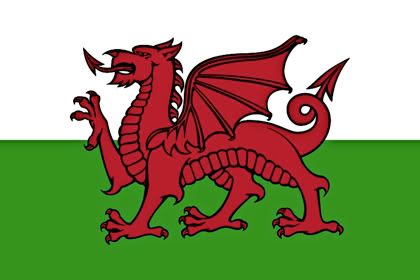
[Although thought to be in use since Roman times, and on record as a symbol of Wales since 830 CE, the red dragon is at risk from the Welsh Christian Party - whose leader George Hargreaves vowed during the 2007 Welsh Assembly elections to have it removed if elected as it was clearly the sign of the Devil. The Party took not one of the 60 seats on offer, and polled less than 9,000 votes; by contrast, the Green Party also failed to win any seats, but still got more than 33,000 votes.]

589 CE - By tradition Saint David, the patron saint of Wales, died.

1562 - Over 1,000 Huguenots were massacred by Catholics loyal to Francis, Duc de Guise in Wassy; this atrocity marked the start of the French Wars of Religion, which would only be quelled by the Edict of Nantes, issued by King Henri IV in 1598.

1565 - The city of Rio de Janeiro was founded by Estácio de Sá.

1692 - Sarah Good, Sarah Osborne and Tituba (an Arawak slave) were brought before local magistrates in Salem Village, Massachusetts, beginning what would become known as the Salem witch trials.

1781 - The Continental Congress adopted the Articles of Confederation.

1815 - Napoleon returned to the French mainland, having escaped from Elba, where he'd been banished under the terms of the Treaty of Fontainebleau.

1845 - US President John Tyler signed a bill authorizing the annexation of the Republic of Texas.

1872 - Yellowstone National Park was established as the world's first national park.

1912 - Albert Berry made the first parachute jump from a moving airplane.

1936 - Construction on Hoover Dam was completed.

1953 - Joseph Stalin collapsed, having suffered a stroke; he died four days later.

1954 - Four Puerto Rican nationalists - Lolita Lebrón, Rafael Cancel Miranda, Andres Figueroa Cordero, and Irving Flores Rodríguez - attacked the United States Capitol building, injuring five Representatives, including Alvin M. Bentley (R-Michigan), who took a bullet to the chest, Clifford Davis (D-Tennessee), who was shot in the leg, Ben F. Jensen (R-Iowa), who was shot in the back, as well as George Hyde Fallon (D-Maryland) and Kenneth A. Roberts (D-Alabama).

1961 - The Peace Corps was established when President John F. Kennedy signed Executive Order 10924; the Peace Corps Act was passed by Congress in September of that year. Since it was formed more than 187,000 people have served in 139 countries.

1966 - The Soviet Union's Venera 3 space probe crashed on Venus, making it the first human spacecraft to land on another planet's surface.

1971 - A bomb exploded in a men's room in the US Capitol; a far-left proto-revolutionary group calling itself the Weather Underground claimed responsibility.

1973 - Palestinian Black September terrorists stormed the Saudi embassy in the capital of Sudan, resulting in the Khartoum diplomatic assassinations.

1980 - NASA's Voyager 1 probe confirmed that Janus (one of the more elusive moons of Saturn) existed.

2004 - Terry Nichols was convicted of state murder charges and of being an accomplice to Oklahoma City bomber Timothy McVeigh.

2006 - Queen Elizabeth II officially opened the new debating chamber - called the Senedd - at the National Assembly for Wales in Cardiff, marking a milestone in Welsh devolution.
*
share on: facebook

Monday, February 28, 2011

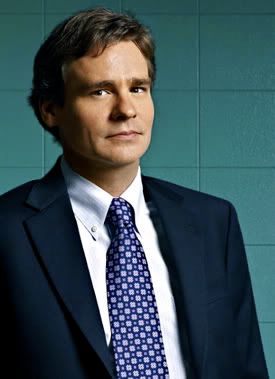
Gratuitous Brunette: Robert Sean Leonard

Photobucket
Although he rose to prominence in such 20th Century period pics as Dead Poets Society, Mr. & Mrs. Bridge, and Swing Kids, in our arrogant opinion birthday boy Robert Sean Leonard (and particularly his bottom lip) attained their peak of succulence under a Tuscan sun during the Italian Renaissance; as Claudio in Kenneth Branagh's 1993 film adaptation of William Shakespeare's Much Ado About Nothing he only had to pout to steal the whole show from such deli hams as Emma Thompson, Michael Keaton, and Branagh himself. Following the success of that film, he returned to the American costumer idiom, playing Ted Archer in The Age of Innocence, Martin Scorsese's curious adaptation of Edith Wharton's 1920 novel of the same name.

Of course, in the 21st Century he's been better known for wearing modern clothes in his role as Dr. James Wilson on Fox-TV's hit medical drama House - not least of all because of the homoerotic subtext between his character and the title character, Gregory House, played by Hugh Laurie. Personally I don't see it - can't straight guys be close friends without it leading to anything so fun* - but then I have no gaydar either, so what do I know?

*Even though there's a whole sub-genre of gay porno detailing with such relationships, which just happens to be one of my favourite gay porno subgenres, I don't think all straight guys who are friends have to have sex with each other. Like the ugly ones, for instance...
*

share on: facebook

In Memoriam: Blondin

Photobucket

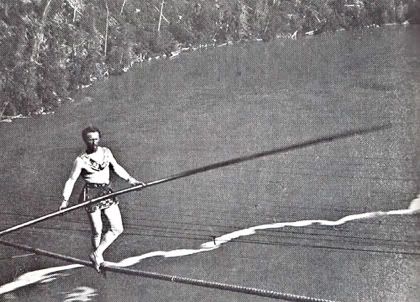
As tightrope walkers go, few if any have attained the level of fame which accrued to Blondin, who was born on this day in 1824... Gymnastically precocious, his first public performance came before he was six years old - following just six months of training at the École de Gymnase in the southern French city of Lyon - at which he was billed 'The Little Wonder'.

The act for which he is most famous came when, as part of his tour of America in the 1850s, he crossed Niagara Falls on a tightrope - during which he was extensively photographed* with his manager Harry Colcord riding on his back**. It was for his numerous feats of derring-do in the UK that he owed his enduring reputation, though, among them a series of performances at London's Crystal Palace and Dublin's Royal Portobello Gardens, plus a crossing of Birmingham's Edgbaston Reservoir.

Having retired in in the mid-1870s, Blondin came out of retirement in 1880, and continued performing until 1896, when he gave his final performance in Belfast; he died in Ealing in February 1897, and was buried in Kensal Green Cemetery.

*Well, for the time anyway; it was, after all, June 1859.
**During that performance he also cooked and ate an omelette at the midpoint of the rope, 50 m (160 feet) above the swirling maelstrom below.
*
share on: facebook

"Drops Of Jupiter (Tell Me)" by Train


Birthday wishes go out today to the talented singer and multi-instrumentalist Patrick Monahan who, as lead singer of Train, had a monster hit in 2001 with Drops of Jupiter (Tell Me), which originally appeared on the band's second album of the same name. Monahan has said he was inspired to write the song by the death of his mother.

He's also released a solo album, 2007's Last of Seven.
*
share on: facebook

Pop History Moment: The Killing of Olof Palme

Photobucket - Video and Image Hosting

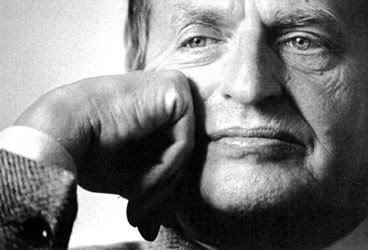
On this day in 1986 Sweden's two-time Prime Minister Olof Palme - head of the Social Democratic Party and a well-respected (if low-key) diplomat on the world stage - was assassinated on a street in Stockholm, in front of his wife Lisbet, who was also injured in the attack.

Shortly thereafter the well-known right-wing extremist Victor Gunnarsson was arrested, and questioned by police, only to be released. It was more than two years later that a petty criminal named Christer Pettersson was arrested, tried, and convicted of the crime; he was released on appeal a year later, and died in 2004.

No one else has ever been charged, although several suspects have been discussed in the more than twenty years since Palme's murder, including South African superspy Craig Williamson, Anthony White, and Bertil Wedin; Germany's Red Army Faction (also known as the Bader-Meinhof) have actually claimed responsibility. As many motives as killers have also been suggested, from Palme's opposition to apartheid, his role in 1975's West German embassy siege, and a Swedish weapons deal with India.

To date the investigation into the killing of Olof Palme has cost the government of Sweden € 38 million and produced 700,000 pages of documentation, yet no answers...
*
share on: facebook

POPnews - February 28th

Photobucket
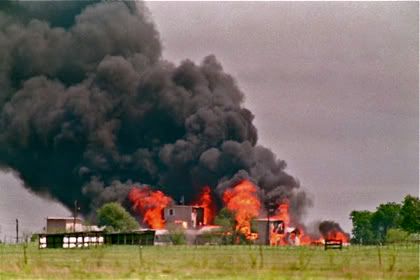
[Waco's shoddily built Mount Carmel Center met its fiery end on April 19th after a fifty-one day standoff (begun on this day in 1993) along with 79 pseudo-Christian fanatics obsessed with Armageddon who more than got their wish; the worst of it was that 21 of those who died were children, whose brief lives had already been tainted by hateful rhetoric, religious brainwashing and, it was reported, sexual abuse.]

202 BCE - The coronation ceremony of Liu Bang as Emperor Gaozu of Han took place, initiating four centuries of the Han Dynasty's rule over China.

870 CE - The Fourth Council of Constantinople closed.

1827 - The Baltimore & Ohio Railroad was incorporated, becoming the first railroad in America to offer the commercial transportation of both people and freight.

1838 - Robert Nelson, leader of the Patriotes, proclaimed the independence of Lower Canada - better known today as Québec.

1844 - A gun on the USS Princeton exploded while on a cruise of the Potomac River, killing 8 US Cabinet members - Secretary of State Abel P. Upshur and Secretary of the Navy Thomas Gilmer among them - and several others besides, including Colonel David Gardiner, the father of President John Tyler's fiance Julia Gardiner (both of whom had been lucky enough to escape injury).

1850 - The University of Utah opened in Salt Lake City.

1870 - The Bulgarian Exarchate was established by decree of Sultan Abd-ul-Aziz of the Ottoman Empire.

1897 - Queen Ranavalona III, Madagascar's last reigning monarch, was deposed by a French military force.

1935 - Nylon was discovered by Wallace Carothers.

1947 - In Taiwan, civil disorder was put down at a loss of 30,000 civilian lives; the event later became known as the 228 Incident.

1953 - James D. Watson and Francis Crick announced to friends that they'd determined the chemical structure of DNA, which would be formally announced the following April.

1975 - A major crash at London's Moorgate Tube station killed 43 people.

1983 - The final episode of the long-running TV sitcom M*A*S*H was domestically broadcast, becoming the most watched television episode in history to date, with 106 million viewers in the US; these figures have since been surpassed, by Super Bowl XLIV, which attracted 106.5 million viewers in February 2010.

1985 - The Provisional IRA carried out a mortar attack on the Royal Ulster Constabulary police station at Newry, killing nine officers; it was the the highest loss of life for a single day in the history of the RUC.

1993 - Who could have guessed that when Bureau of Alcohol, Tobacco and Firearms agents raided the Branch Davidian church with a warrant to arrest the group's leader David Koresh that it would all end so thrillingly? While four ATF agents and five Davidians died in this initial raid, a further 82 Davidians (including their leader) died in the brimstone-less fire shown above.

1997 - The North Hollywood shootout took place, in which bank robbers Larry Phillips, Jr. and Emil Matasareanu were killed in a shootout with police.

2001 - The Nisqually Earthquake - measuring 6.8 on the Richter Scale - affected the Nisqually Valley, Seattle, Tacoma, and Olympia in Washington state.

2004 - Over 1 million Taiwanese took part in the 228 Hand-in-Hand Rally, forming a 500-kilometre (300-mile) long human chain to commemorate that country's 228 Incident in 1947.

2007 - The New Horizons spacecraft - on its way to Pluto - flew past Jupiter.
*

share on: facebook

Sunday, February 27, 2011

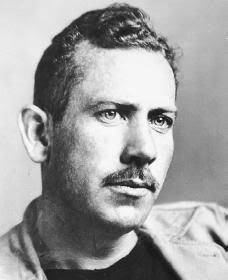
In Memoriam: John Steinbeck

The influence exerted by John Steinbeck over my writing cannot be measured... To be completely honest, it cannot be detected in any way, but it's still there! Whereas Steinbeck's writing is vivid and lucid, though, mine has been characterized as 'giddy and shallow'*. Still, his easy facility with adjectives and his compassion for those of his characters whose lives haven't worked out as planned had a major impact on me at the time I was first considering a life in letters. So while I know I'll never be his equal I'm still proud to call myself his acolyte.

Photo Sharing and Video Hosting at PhotobucketBorn on this day in 1902 in California's Salinas Valley, the landscape made its impact on him early; again and again he extolled the region's beauty (as well as the hardships encountered by its residents) in such works as 1922's The Pastures of Heaven, perennial middle-school reading list stalwart The Red Pony, Tortilla Flat, Cannery Row and its sequel Sweet Thursday, East of Eden and Of Mice and Men.

So vivid was his handling of imagery, so sensitive his approach to character, that many of Steinbeck's works were made into films - including The Moon is Down and The Pearl - even as they were being written. Yet he only wrote one work directly for the screen, which happens to be Alfred Hitchcock's legendary Lifeboat, starring Tallulah Bankhead, Hume Cronyn, and John Hodiak. Steinbeck later asked that his name be removed from the film, though, believing it to have racist undertones. Another, The Wayward Bus, proved to be the highlight of Jayne Mansfield's attempts at acting.

Long pestered by the FBI for his left-wing sympathies, John Steinbeck was awarded the Nobel Prize for Literature in 1962; he died of a heart attack in December 1968, and has been accorded many of the honours which normally accrue to one of his popularity and genius, including plaques and statues galore, as well as enduring readership.

*I stand by my original assessment. ~ Chumley
*

share on: facebook

"You Raise Me Up" by Josh Groban


Although I've always thought Josh Groban was hella cute - and howled as loudly as anyone with laughter at his expletive-laden solo in Jimmy Kimmel's hilarious viral video sensation I'm Fucking Ben Affleck - it was Groban's gutsy appearance on Never Mind The Buzzcocks in December 2008 that permanently cemented my admiration of him.

Here Groban is seen performing his biggest hit to date, You Raise Me Up - with music by Secret Garden's Rolf Løvland and lyrics by Brendan Graham - on The Ellen DeGeneres Show accompanied by the African Children's Choir in August 2007; it's posted here, naturally, because today is his birthday.
*
share on: facebook

Pop History Moment: De Gaulle Escapes Assassination

Photobucket - Video and Image Hosting

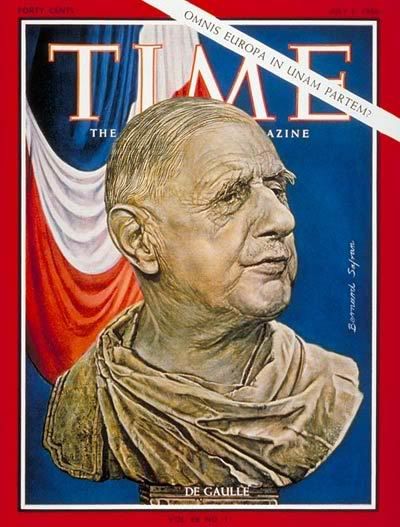
On this day in 1963 Antoine Argoud - arch enemy of French President Charles de Gaulle, member of the Organisation de l'Armée Secrète, and opponent of Algerian independence, as well as a former colonel in the French Army - was charged with an assassination attempt against the President, the second of two in which he would be involved*.

Argoud was found bound and gagged in a van parked near Paris' Quai des Orfèvres, having been heavily beaten by men he claimed were with the French Secret Police (known as Les Barbouzes, or the Bearded Ones) but whose assailants later claimed to be with the OAS; Argoud, they said, had been roughly handled as punishment for bungling to plot to kill de Gaulle.

Argoud was sentenced to life imprisonment for his role in the abortive plot, but subsequently released as part of a general amnesty in May 1968.

*The first - the so-called Algiers Putsch - had been masterminded by General Raoul Salan in April 1961.
*
share on: facebook

Best Of The Best: Elizabeth Taylor

National Velvet - Before she was given access to the kind of animals who'd leave their wives for her and devote themselves to buying her the kind of jewellery with which her name would one day become synonymous, Elizabeth Taylor's co-stars were the more traditional animals associated with little girls - namely dogs and horses. Of course, the previous year's Lassie Come Home (only her second film appearance) set a precedent of its own, by featuring her first gay co-star, Roddy McDowall, whereas this particular outing paired her with renowned pint-sized cherry-picker Mickey Rooney.

Little Women - The three versions of Louisa May Alcott's Civil War era chestnut each have their own unique charms; George Cukor's 1933 version is known for the verve demonstrated by its cast struggling hard to overcome the limitations of antique film-making equipment, whereas Gillian Armstrong's 1994 version has the accuracy in its art direction which is the hallmark of the modern movie industry*. Mervyn LeRoy's 1949 version might just be the version Goldilocks would choose; not only is it technically perfect and sartorially accurate, it features a sixteen-year-old Elizabeth Taylor fairly bursting her stays with dewy goodness.

*I've neglected to mention David Lowell Rich's 1978 version because... Well, just because. Besides which, it was made for TV... 'Nuff said!

Father of the Bride - Occasionally (okay, often) art doesn't so much mirror life as plagiarize it outright; nowhere is this more true than in Hollywood where, in 1950, art held up the life of Elizabeth Taylor with a knife and thoroughly menaced it before making off with a goodly amount of loot. As Taylor prepared to embark upon the first leg of what would eventually become a 10K walk down the matrimonial aisle - in this case with Conrad 'Nicky' Hilton, great uncle of that other tabloid mainstay - MGM chose to give Taylor the gift that keeps on giving, namely publicity. Cast as her parents were screen legends Spencer Tracy and Joan Bennett, while her fiancee in this case was played by Don Taylor, one of the few men in Hollywood Taylor didn't end up marrying.

A Place in the Sun - The process by which a movie camera burns images onto celluloid with the assistance of light is one of the most important in my life, and yet one which I only barely understand (as evidenced by my ham-handed description of the process at the beginning of this sentence); by itself it forms the core of my faith more certainly (not to mention in the here and now) than some magic tricks performed by a Jewish troublemaker who may or may not have lived two thousand years ago ever could. Yet when it comes to over-egging the faith pudding, having Elizabeth Taylor and Montgomery Clift share a screen in the shimmering black and white that was abundant in 1951 provides for a very rich treat indeed, not to mention one high in protein. As the other side of Taylor's glamourous coin, Shelley Winters offers a rare, moving performance as a drudge.

Giant - A big movie adapted from a big book, larded with big stars and shown on some of the biggest screens in film history, no movie ever had a more accurate title than Giant. Director George Stevens' adaptation of Edna Ferber's novel costars Rock Hudson and James Dean as rival oil men or something, while Taylor is the woman who comes between them*; Giant's place in pop culture was assured when Robert Altman made his 1982 film version of the play Come Back to the Five and Dime, Jimmy Dean, Jimmy Dean, which was set in the Texas town of Marfa where Giant was shot.

*Talk about the willing suspension of disbelief; like a woman ever came between those two.

Raintree County - Taylor received her first Academy Award nomination under the direction of Edward Dmytryk for her portrayal of a southern belle with a secret; as would eventually become standard for any of her movies, the story of what happened behind the scenes easily rivaled the story that ended up onscreen - in this case the near-fatal car crash that shattered what little peace of mind her perennial costar Montgomery Clift would enjoy. The film also stars Eva Marie Saint and Agnes Moorehead.

Cat on a Hot Tin Roof - The incendiary movies adapted from the even more incendiary plays of Tennessee Williams helped to put fatal cracks in the myth of the 1950s, and who better to play the kind of woman determined not to be trapped by conformity than the raving beauty who'd only recently emerged from America's one-time sweetheart? As Maggie the Cat, Taylor gave her most nuanced performance ever, blending hurt and fury into each lengthy monologue and using the sexuality her husband rejects to plead their case with the dying Big Daddy against the grasping machinations of the hopelessly square Gooper (Jack Carson) and his perennially pregnant wife Mae (Madeleine Sherwood). Opposite Paul Newman and Burl Ives Taylor gives a surprisingly strong performance, given that her real-life husband Mike Todd died in a plane crash during production.

Suddenly Last Summer - By 1959 Elizabeth Taylor's life was bound up with those of two of the world's most famous gay men - Tennessee Williams and Montgomery Clift - and one of the Broadway stage's most famous fictional gay men, Sebastian Venable. It all made this film the perfect storm, even before the involvement of Katharine Hepburn, playing against type as a villainess in major denial about her too-beloved mama's boy. Dealing with the still-shocking taboo of mental illness - and under the threat of a lobotomy - Taylor's character makes a harrowing descent into madness, culminating in a three-minute monologue in the last reel that will blow whatever part of your mind may have been left unblown by the rest of it.

BUtterfield 8 - John O'Hara's shockingly frank 1935 novel was never going to be made into a movie in the decade after it was published, nor even in the decade after that, but it had to be toned down considerably* to even reach movie screens when it did, in 1960. Despite a strong, surly performance from Taylor opposite the reptilian Laurence Harvey and the real-life paramour (Eddie Fisher) whose scandalous desertion of his wife Debbie Reynolds for the recently widowed Taylor caused the considerable sympathy directed at her following the death of her husband Mike Todd to evaporate overnight, Taylor won her first Academy Award for playing Gloria Wandrous after nominations in each of the previous three years; still, Taylor and Fisher hated the film once it was done.

*In true Hollywood fashion, the movie bears almost no resemblance to the book.

Who's Afraid of Virginia Woolf? - Taking a major risk by setting her sex symbol status aside at its height, Taylor tears up the screen opposite her famously on-again off-again husband Richard Burton as the slatternly, horrible Martha to his bitter, cranky George. The four handed cast* (Taylor and Burton were joined by George Segal as Nick and Sandy Dennis as Honey) gives director Mike Nichols' adaptation of Edward Albee's play a claustrophobic feeling which feels perfect, given the claustrophobic feeling of many marriages, including that of George and Martha's. Nevertheless, it netted Taylor her second and final Oscar.

*There were two minor characters in the film not present in the play - the roadhouse owner and his waitress wife - portrayed by the film's gaffer Frank Flanagan, and his wife Agnes.

The Taming of the Shrew - The last time Elizabeth Taylor's extraordinary beauty found itself served by a quality script was under the able tutelage of Franco Zeffirelli; of course, it helps that the film was adapted from a work by the greatest writer who ever lived, William Shakepeare. Yet not even Shakespeare could have imagined a relationship as stormy and eternal as that of Taylor and Burton. More of an imagining of the play rather than an adaptaion - since it pushed the major subplot of Bianca and her various suitors (among them Michael York) into the background - Taylor's Kate and Burton's Petruchio got more of an opportunity to be three-dimensional characters, besides being well-photographed in a lush Italian landscape.
*
share on: facebook
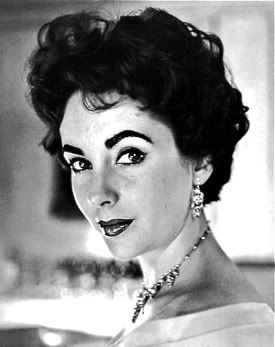
Gratuitous Brunette: Elizabeth Taylor

PhotobucketOne of the most beautiful women who's ever lived, despite a brief flirtation with her Inner Diva at the height of her fame in the 1960s, Elizabeth Taylor has consistently proven to be as lovely on the inside as she has been on the outside; for her friendships with gay men since childhood she has more than earned the prestigious accolade of gay icon*, and for providing comfort to people living with AIDS and HIV long before it was trendy she's distinguished herself as one of the 20th Century's foremost humanitarians as well.

Today is her birthday, which is well nigh a religious holiday around the Pop Culture Institute; may we suggest a movie marathon, consisting of A Place in the Sun, Cat on a Hot Tin Roof, and Who's Afraid of Virginia Woolf? in celebration?

*Although heaven knows what horrible thing she ever did to deserve the entirely unsought-after 'honour' of Gratuitous Brunette...
*
share on: facebook
Happy Birthday Wendy Liebman


This recent appearance by Wendy Liebman on The Late Show with David Letterman wasn't the first one she'd made since I'd become her Facebook friend, but merely the latest in a long career which has seen her win fans around the world...

I'm not sure where I first saw her - likely on a late night talk show, or else in front of a cheesy brick wall on some stand-up show on basic cable, as long ago as the late 1980s - but I know that from that first appearance I was enamoured of the way she employed redirection in landing her punchlines, giving her Catskills-inspired shtick an entirely modern twist.

Why she's never been given a sitcom is one of those eternal mysteries that keeps my ink-stained heart beating; after all, maybe one day I'll be the one to write it for her...
*
share on: facebook
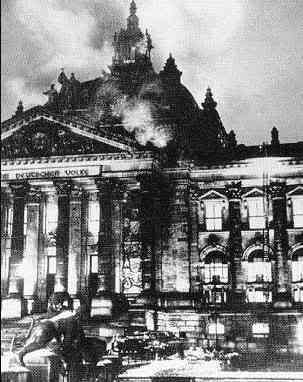
Pop History Moment: The Burning of the Reichstag

PhotobucketShortly after 2:15 AM on this day in 1933 an unemployed Dutch brick layer named Marinus van der Lubbe was discovered shirtless inside the German parliament building, which was by then being inexorably engulfed in flames. He quickly confessed to having set the fire, and was arrested.

Whatever van der Lubbe had hoped to achieve by torching the Reichstag, undoubtedly it wasn't the suspension of democracy and the rise of National Socialism, although that is what happened. Newly elected Chancellor Adolf Hitler jumped on the fact that the arsonist in custody was a prominent Communist, and took the fire as an excuse to begin implementing his agenda.

Hitler's first pogrom dealt a savage blow to Germany's Left, beginning with a ban on that country's Communist Party; by the time van der Lubbe was executed 11 months later the Nazis had swept to power and the Third Reich was no longer just a paranoid fantasy but a very chilling reality.

The Reichstag became the focus of German reunification after the fall of the Berlin Wall in November 1989, and was extensively renovated by Norman Foster (having been rebuilt between 1961-4 by Paul Baumgarten). It now houses the country's Bundestag once again.
*
share on: facebook
POPnews - February 27th

Photobucket
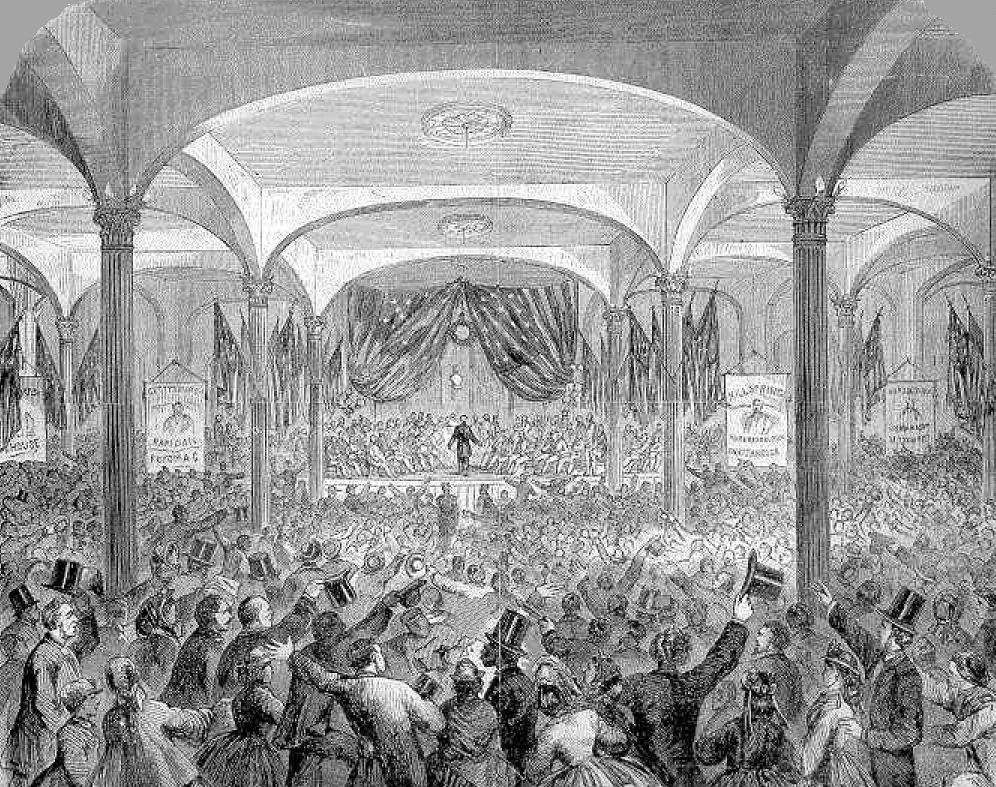
[It was a vast and jubilantly rowdy crowd like this one who were on hand to witness Abraham Lincoln's Cooper Union Address - at which he opposed the pro-slavery views of Stephen A. Douglas, his greatest political rival - in advance of the Republican National Convention, which was set for mid-May.]

1594 - The famed Huguenot warrior Henri III of Navarre was crowned King Henry IV of France at Chartres Cathedral, having only recently converted to Catholicism at the behest of his mistress Gabrielle d'Estrées; owing largely to his issuance of the Edict of Nantes in April 1598, which gave his former co-religionists an array of rights they had been denied, the reign of le Vert galant would mark the end of a generation of sectarian strife following the St. Bartholomew's Day massacre.

1617 - Sweden and Russia signed the Treaty of Stolbovo - ending the Ingrian War and shutting Russia out of the Baltic Sea.

1700 - The island of New Britain was discovered by William Dampier.

1801 - Pursuant to the District of Columbia Organic Act of 1801 Washington, DC, was placed under the jurisdiction of the US Congress.

1812 - Poet Lord Byron gave his first address as a member of Britain's House of Lords, one of the few ever in defense of the Luddites - a radical rabble of textile workers who had been destroying looms in his home county of Nottinghamshire. A strong advocate of social reform, during his time in the upper house Byron also supported greater rights for Catholics.

1844 - The Dominican Republic gained its independence from Haiti.

1860 - Abraham Lincoln made a speech at Manhattan's Cooper Union which was later seen as largely responsible for his election to the Presidency the following November.

1900 - The British Labour Party was founded.

1902 - Australian Harry 'Breaker' Morant was executed during the Second Boer War under controversial circumstances - accused of the summary murder of prisoners under his command which may or may not have happened. A film was made about the life and death of 'Breaker' Morant in 1980 which starred Edward Woodward as its doomed hero; the film's director, Bruce Beresford, adapted the 1978 play Breaker Morant: A Play in Two Acts, written by Kenneth G. Ross, for the screen and was Oscar-nominated for his efforts.

1922 - Leser v. Garnett - a challenge to the US Constitution's Nineteenth Amendment, which had allowed American women the right to vote in 1920 - was rebuffed by the Supreme Court.

1940 - Martin Kamen and Sam Ruben discovered carbon-14.

1943 - The Rosenstrasse protest started in Berlin following a more general resistance to Nazi anti-Semitism by trades unionists during Fabrikaktion.

1951 - The Twenty-second Amendment to the US Constitution - limiting Presidents to two terms - was ratified.

1963 - Juan Bosch became the Dominican Republic's first democratically elected president since the assassination of Rafael Trujillo in May 1961.

1973 - The American Indian Movement occupied Wounded Knee, South Dakota.

1976 - The formerly Spanish territory of Western Sahara, under the auspices of the Polisario Front, declared the country's independence as the Sahrawi Arab Democratic Republic.

1989 - Venezuela was rocked by the Caracazo.

1996 - Satoshi Tajiri created Pokémon.

2003 - Rowan Williams was enthroned as the 104th Archbishop of Canterbury.
*

share on: facebook