Thursday, July 29, 2010
Now Showing: The Wedding of the Prince and Princess of Wales (1981)
It was intended to be the wedding to end all weddings - not merely a family event but, in the best royal way, the expression of Britain's joy; in all, it would be one of those well-planned spectacles for which London has become justifiably famous over the last nine centuries. Alas, the planning fell short by failing to plan for a happy ending, the marriage fell flat despite producing two handsome and hearty sons, and for awhile the spectacle trotted out daily by the tabloids threatened not only the royal couple's peace of mind but the public's as well...
The press had always followed the women in whom The Prince of Wales had expressed an interest, but none quite so fervently as the shy nineteen-year-old preschool teacher named Lady Diana Spencer. In the months leading up to their nuptials her every facet was scrutinized and from every angle as well; her hairstyle was copied, the dresses she appeared in were run up seemingly overnight and available for sale in the nation's High Street boutiques almost faster than she could wear them. Even her gaffes - such as the famous photo of her in a sheer skirt, backlit by brilliant sunshine - only served to endear her to the public.
For a recession-weary Britain at risk of being permanently rent asunder by the most divisive Prime Minister in the island's history*, the impending royal wedding united old and young, brown and black and white, and even attracted support in the more unusual corners of society**. Despite a few glitches in protocol - since Constantine II, the ex-King of Greece, was in attendance as a relative of the Royal Family, the President of Greece Constantine Karamanlis declined to attend, for instance - and a change in venue from the more usual Westminster Abbey to the baroque splendour of St. Paul's Cathedral, the pomp and the hype worked together.
Or at least they did on that brilliantly sunny day in 1981...
*To be fair to Margaret Thatcher, though, the country became far more united in its dislike of her and her callous policies than it might have been otherwise...
**Along the wedding root punks could be spotted holding up signs bearing such cheeky slogans as 'Up Chuck and Di'!
*
share on: facebook


Pop History Moment: The Marriage of the Prince and Princess of Wales

On this day in 1981 the greatest fairy tale of modern times was enacted when Lady Diana Spencer - youngest daughter of Earl Spencer and Mrs. Frances Shand Kydd - married The Prince of Wales at St Paul's Cathedral in London. Everything was planned down to the last detail - from the star-studded seating arrangement to the elaborate bridal gown - and everything would have gone perfectly, except...
No one thought to plan the happy ending!
*
share on: facebook
"Make Your Own Kind Of Music" by "Mama" Cass Elliot
Make Your Own Kind of Music first appeared on Cass Elliot's 1969 solo album Bubblegum, Lemonade and Something for Mama (which appears not to be on CD - boo! hiss!!); inasmuch as every song posted on the Pop Culture Institute can in some way be taken as an anthem of ours, so is this one, only more so. In a world where most creative children have their sparks doused* Elliot's message is not only sympathetic to that plight but defiant in the face of it as well. What a wonderful world this would be if those adults whose dreams had been thwarted as children would not only leave their succeeding generation alone to create and dream in peace but make it their responsibility to see that it never happened again...
Elliot's death (on this day in 1974, at the age of only 32) has often been erroneously attributed to a ham sandwich - a misogynist as well as fattist attribution; the truth is that she died in her sleep of a heart attack, and was found with a partially eaten sandwich in her room, which gave rise to the inaccurate speculation.
Her death came at the height of a career high, following the second of two triumphant shows at the London Palladium; she was survived by her seven year old daughter Owen Vanessa Elliot, who went to live with Cass' sister Leah Kunkel, and later became a singer in her own right. Despite the utter dearth of information about the younger Elliot online, interest in her is obviously high; when I published her name in a post on this blog to mark the occasion of Cass Elliot's birthday in 2008 I recorded several hundred hits over the next three months as a result.
*More prevalent then than now, but still an all-too persistent trend in the culture, sadly.
*
share on: facebook
POPnews - July 29th

[Although Mary Queen of Scots was one of the beauties of her age - and thanks to the tutelage of her mother Marie de Guise was intellectually capable of good governance - her terrible taste in men (both romantically and in her choice of advisors) as much as her warped distrust of her cousin Elizabeth I proved to be her undoing.]
1014 - During the Byzantine-Bulgarian Wars, at the Battle of Kleidion, Byzantine Emperor Basil II inflicted a decisive defeat on the Bulgarian army; news of his subsequent savage treatment of 15,000 prisoners reportedly caused Bulgaria's Tsar Samuil to die of shock.
1030 - During the Ladejarl-Fairhair succession wars, at the Battle of Stiklestad, Norway's King Olaf II fought and died trying to regain his throne from the Danes; His Majesty was later canonized, and is commemorated from Norway to Minnesota as Saint Olaf, although he may be best remembered today as the namesake of Rose Nylund's hometown...
1565 - The widowed Mary Queen of Scots married Henry Stuart, Lord Darnley, Duke of Albany at Holyrood Palace in Edinburgh.
1567 - 13-month-old James VI was crowned King of Scotland at The Church of the Holy Rude in Stirling following the deposition of his mother, Mary Queen of Scots; the sermon at his coronation was preached by John Knox.
1693 - During the War of the Grand Alliance, at the Battle of Landen, French commander Marshal Luxembourg won a Pyrrhic victory over Allied English-Dutch forces under the Dutch Republic's stadtholder William III.
1830 - France's King Charles X abdicated following the July Revolution; he was succeeded by Louis-Philippe I, who reigned as King of the French from the period of instability known as the July Monarchy until February 1848.
1848 - In the midst of the Irish Potato Famine the Tipperary Revolt - an unsuccessful nationalist uprising in that Irish city against British rule - was put down by police.
1851 - Annibale de Gasparis discovered the asteroid 15 Eunomia in the inner main asteroid belt.
1858 - The United States and Japan signed the Harris Treaty at the Ryōsen-ji temple in Shimoda.
1864 - Confederate spy Belle Boyd was arrested by Union troops and detained at the Old Capitol Prison in Washington, DC.
 1900 - Italy's King Umberto I (shown, at right) was assassinated by Italian-born anarchist Gaetano Bresci while on a visit to Monza; His Majesty had previously survived an assassination attempt at the hands of Giovanni Passanante in November 1978, and another in April 1897 following an attack by Pietro Acciarito. Bresci later claimed he was avenging those killed in the Bava-Beccaris massacre, of which the King had approved - going so far as to specifically commend its architect, General Fiorenzo Bava Beccaris; Bresci's actions also inspired a similar killing, that of US President William McKinley in September 1901 by Leon Czolgosz.
1920 - Construction of Oregon's Link River Dam began as part of the Klamath Reclamation Project.
1948 - After a hiatus of 12 years caused by World War II, the first Summer Olympics to be held since the 1936 Summer Olympics in Berlin - The Games of the XIV Olympiad - opened in London.
1957 - The International Atomic Energy Agency is established.
1958 - US President Dwight D. Eisenhower signed the National Aeronautics and Space Act into law, creating the National Aeronautics and Space Administration (NASA).
1966 - Bob Dylan was injured in a motorcycle accident near Woodstock, New York.
1967 - Off the coast of North Vietnam the USS Forrestal caught fire, causing the worst US naval disaster since World War II, killing 134.
1976 - In New York City David Berkowitz - the soon-to-be so-called Son of Sam - killed Donna Lauria and seriously wounded Jody Valenti in the first of a series of attacks which had women in that city on edge for the next year. The story of the killings was the subject of Spike Lee's 1999 film Summer of Sam, in which Berkowitz was played by Michael Badalucco.
1993 - The Israeli Supreme Court acquitted accused Nazi death camp guard John Demjanjuk of all charges and he was set free.
*
share on: facebook
Wednesday, July 28, 2010
POPnews - July 28th

[As this contemporary newspaper photo shows, it's possible for a fully fueled aircraft to strike a skyscraper without knocking the whole thing down!]
1364 - At the Battle of Cascina the Republic of Florence's troops under Galeotto Malatesta scored a victory over those of the Republic of Pisa, whose army - led by the English mercenary John Hawkwood - had only recently pillaged the treasures of Florence.
1493 - Fire ravaged Moscow, clearing the way for the construction of Red Square.
1540 - England's King Henry VIII had Thomas Cromwell executed in the morning then married Catherine Howard in the afternoon.
1609 - When the first settlers arrived in Bermuda after their ship, the Sea Venture, foundered there during a storm while en route to the Jamestown Colony in Virginia, the event was immortalized by William Shakespeare in his play The Tempest.
1794 - In a stunning example of 'what comes around goes around', Maximilien Robespierre was taken to the Place de la Revolution in Paris and executed on the guillotine without trial, just like one of the estimated 17,000+ people he condemned to die in a similar way while in power.
1809 - During the Peninsular War, at the Battle of Talavera, Sir Arthur Wellesley's combined British, Portuguese and Spanish army defeated a French force under Joseph Bonaparte.
1821 - José de San Martín declared the independence of Peru from Spain.
1896 - The city of Miami, Florida, was incorporated.
1932 - President Herbert Hoover ordered US troops to forcibly remove the Bonus Army from Washington, DC; it was Hoover's callous disregard for these military veterans, as well as his cavalier attitude toward the suffering of ordinary Americans due to the worsening Great Depression, which would ultimately cost him re-election in November.
1945 - At 9:49 AM on a foggy Saturday morning pilot Lieutenant Colonel William F. Smith, Jr. accidentally flew a B-25 bomber into the the north side of the Empire State Building between the 79th and 80th floors (actually the offices of the National Catholic Welfare Council) killing 14 and injuring 26. One survivor, Betty Lou Oliver, made a record-breaking 75 story free fall in a disabled elevator.
1972 - Dockworkers in Britain went on strike.
1973 - 600,000 people attend a rock festival at the Watkins Glen International Raceway; Summer Jam at Watkins Glen attracted such headliners as The Allman Brothers Band, The Band, and the Grateful Dead.
1976 - The Tangshan earthquake - with a moment magnitude measuring between 7.8 and 8.2 - struck the Chinese city of Tangshan, killing 242,769 and injuring 164,851.
1988 - Paddy Ashdown defeated Alan Beith to be elected leader Britain's perennial third party, the newly formed SDP-Liberal alliance - which had only recently been formed by the merger of the Liberal Party with the Social Democrats.
1996 - The prehistoric remains of Kennewick Man were discovered on the banks of the Columbia River near Kennewick, Washington.
1996 - The prehistoric remains of Kennewick Man were discovered on the banks of the Columbia River near Kennewick, Washington.
2002 - Nine coal miners trapped in the flooded Quecreek Mine in Somerset County, Pennsylvania, were rescued after 77 hours underground.
2005 - The Provisional Irish Republican Army declared an end to its thirty year long armed campaign in Northern Ireland.
2008 - The historic Grand Pier in Weston-super-Mare burnt down for the second time in 80 years; it is currently being rebuilt, and is scheduled to open in June 2010.
*
*
share on: facebook
Tuesday, July 27, 2010
Remembering... Bob Hope
Bob Hope is someone with whom I have always had something of a love-hate relationship... On the one hand, from an early age I've enjoyed his shtick, whether on one of his many TV specials, talk show appearances, on radio or in films; whether being sardonic, self-deprecating, or wry, he only ever was so in the most assured manner, without having to go over the top to get the laugh, and to observe him at work was to witness a master at the top of his game. On the other hand, Hope had a very antediluvian sensibility, whose act (at least when the cameras weren't running) could be homophobic in the extreme; so much so, in fact, that late in life Hope was required by court order to record a series of public service announcements against homophobia.
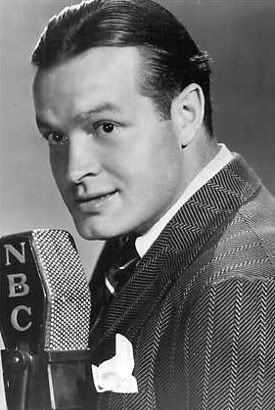 He said afterward in an interview that he learned from the experience; even if all he learned was to watch what he said in case any professional homosexuals were listening, it would prove that at least he'd learned something. Then again, everything he'd ever achieved had been because of his ability to read an audience and give them what they wanted, so his aplomb in this instance was very much to be expected.
For all that, no one could ever deny Bob Hope's immense humanitarianism; beginning in May 1941 Hope had a long and fruitful relationship with the USO, and in that capacity visited military bases in wartime and peace around the world. He was one of the few who did what he could to provide comfort to soldiers fighting the Vietnam War; for fifty years of service to that organization - which included sixty tours, often to war zones - President Bill Clinton awarded Hope the title of 'honorary veteran', which he later said was the greatest honour he'd ever been given when, to be quite honest, it was the greatest honour he'd ever earned.
Bob Hope died on this day in 2003, one of the few Hollywood entertainers to have achieved his hundredth birthday. He faced his death with the same comedic sense he used to face life; when his daughter asked him where he'd like to be buried, he said 'Surprise me.'
*
share on: facebook
He said afterward in an interview that he learned from the experience; even if all he learned was to watch what he said in case any professional homosexuals were listening, it would prove that at least he'd learned something. Then again, everything he'd ever achieved had been because of his ability to read an audience and give them what they wanted, so his aplomb in this instance was very much to be expected.For all that, no one could ever deny Bob Hope's immense humanitarianism; beginning in May 1941 Hope had a long and fruitful relationship with the USO, and in that capacity visited military bases in wartime and peace around the world. He was one of the few who did what he could to provide comfort to soldiers fighting the Vietnam War; for fifty years of service to that organization - which included sixty tours, often to war zones - President Bill Clinton awarded Hope the title of 'honorary veteran', which he later said was the greatest honour he'd ever been given when, to be quite honest, it was the greatest honour he'd ever earned.
Bob Hope died on this day in 2003, one of the few Hollywood entertainers to have achieved his hundredth birthday. He faced his death with the same comedic sense he used to face life; when his daughter asked him where he'd like to be buried, he said 'Surprise me.'
*
share on: facebook
Happy Birthday Norman Lear
To someone like me, who adores the sitcom format beyond all reasonable measure, Norman Lear is something of a demi-god; Lear is personally responsible for a string of socially conscious, ground-breaking shows throughout the 1970s, which themselves were responsible for bringing a plethora of social issues into American living rooms which otherwise might not have been discussed there...
 Beginning with the January 1971 premiere of All in the Family - which itself was based on the Britcom Til Death Us Do Part - Lear spent most of the next decade on a roll, spinning shows out of shows out of shows: All in the Family begat both Maude and The Jeffersons, while Maude later begat Good Times.
Sanford and Son was another Americanization, this time of the Britcom Steptoe and Son; another original idea was One Day at a Time, which dealt with the daily travails of a single mother - a first for American prime time.
By the time he guest-hosted Saturday Night Live in 1976, though, some of the bloom had come off his rose; in a filmed montage of Lear interacting with his stars which formed the centrepiece of his monologue, those of Good Times are conspicuously absent. For a producer who'd built his name on shows with a redeeming social message, he was by then being accused by John Amos and Esther Rolle of not dealing with the issues faced by a black family living in the projects - in this case Chicago's Cabrini-Green - choosing instead to pander to a younger demographic by focusing on the teenage antics of break-out star Jimmie Walker.
By the 1980s people's tastes had changed - or so we are supposed to believe - and none of Lear's subsequent shows achieved the success of his earlier work, although all* drew otherwise critical raves for their sharp insights on topical issues.
*Especially The Powers That Be.
*
share on: facebook
Beginning with the January 1971 premiere of All in the Family - which itself was based on the Britcom Til Death Us Do Part - Lear spent most of the next decade on a roll, spinning shows out of shows out of shows: All in the Family begat both Maude and The Jeffersons, while Maude later begat Good Times.Sanford and Son was another Americanization, this time of the Britcom Steptoe and Son; another original idea was One Day at a Time, which dealt with the daily travails of a single mother - a first for American prime time.
By the time he guest-hosted Saturday Night Live in 1976, though, some of the bloom had come off his rose; in a filmed montage of Lear interacting with his stars which formed the centrepiece of his monologue, those of Good Times are conspicuously absent. For a producer who'd built his name on shows with a redeeming social message, he was by then being accused by John Amos and Esther Rolle of not dealing with the issues faced by a black family living in the projects - in this case Chicago's Cabrini-Green - choosing instead to pander to a younger demographic by focusing on the teenage antics of break-out star Jimmie Walker.
By the 1980s people's tastes had changed - or so we are supposed to believe - and none of Lear's subsequent shows achieved the success of his earlier work, although all* drew otherwise critical raves for their sharp insights on topical issues.
*Especially The Powers That Be.
*
share on: facebook
Now Showing: "A Wild Hare" starring Bugs Bunny
On this day in 1940 Bugs Bunny made his cartoon debut, starring alongside Elmer Fudd in A Wild Hare; the prototype Bugs who appeared in Porky's Hare Hunt in April 1938 was never named and therefore, to purists like me, can't really be considered the genuine article any more than the little black duck in Porky's Duck Hunt can be considered Daffy Duck.
A Wild Hare was directed by Tex Avery, and features many of the usual suspects one comes to associate with the Merrie Melodies: Bugs is voiced by Mel Blanc and Elmer by Arthur Q. Bryan, with animation by Virgil Ross (supervising Robert McKimson, Rod Scribner, and Charles McKimson) and music by Carl Stalling.
*
share on: facebook
POPnews - July 27th
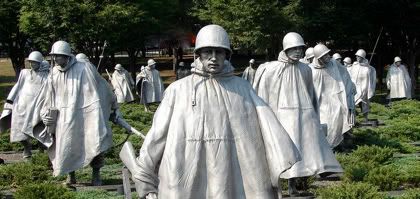
[First authorized in October 1986 under the auspices of the American Battle Monuments Commission, ground was broken at the site of the Korean War Veterans Memorial by President George H. W. Bush on Flag Day in June 1992; it was finally dedicated by US President Bill Clinton and Korean President Kim Young Sam on the 42nd anniversary of the armistice that ended the war.]
1214 - At the Battle of Bouvines King Philip II of France made the most of his home court advantage by defeating England's King John; it was as much his lack of military prowess (on abundant display here) as his dictatorial style that would lead to King John's being forced to sign Magna Carta within a year.
1689 - The Battle of Killiecrankie - itself part of England's so-called Glorious Revolution, which sought to replace England's Catholic King James II with the husband-and-wife Protestants William of Orange and James II's daughter Mary II - ended; despite being a Jacobite victory over the forces of Hugh Mackay, the Jacobite commander Viscount Dundee died in battle, which basically ensured the triumph of the Orangemen the following year.
1694 - A Royal Charter was granted to the Bank of England.
1694 - A Royal Charter was granted to the Bank of England.
1789 - The first US federal government agency, the Department of Foreign Affairs, was established; it would later be renamed the Department of State.
1794 - Maximilien Robespierre - the pre-eminent villain of the French Revolution - was arrested as part of the so-called Thermidorian Reaction to the Reign of Terror.
1794 - Maximilien Robespierre - the pre-eminent villain of the French Revolution - was arrested as part of the so-called Thermidorian Reaction to the Reign of Terror.
1914 - Felix Manalo registered the Iglesia ni Cristo with the Filipino government.
1921 - A team of researchers at the University of Toronto led by Dr. Frederick Banting announced its discovery of insulin, a hormone whose practical application greatly improved both the quality and span of diabetics' lives.
1940 - Bugs Bunny's debut cartoon - A Wild Hare - was released by Warner Brothers.
1949 - The first jet-powered airliner, the deHavilland Comet, made its initial flight.
1953 - The Korean War ended when representatives of the United States, the People's Republic of China, and North Korea signed an armistice agreement; Syngman Rhee, president of South Korea, refused to sign but pledged to observe the armistice.
1965 - Edward Heath was chosen to lead Britain's Conservative Party, thwarting Reginald Maudling and Enoch Powell in their efforts to replace Alec Douglas-Home.
1976 - Former Japanese prime minister Kakuei Tanaka was arrested on suspicion of violating foreign exchange and foreign trade laws in connection with the Lockheed bribery scandals.
1977 - Boris Yeltsin - party boss in the Sverdlovsk region and acting on orders from Moscow he later claimed to have disagreed with - had Ipatiev House in Ekaterinburg bulldozed; regular readers of the Pop Culture Institute will remember Ipatiev House as the place where Tsar Nicholas II, his family and servants were executed. After the fall of communism the Church of All Saints was built on the site to honour the martyred Romanov royals.
1981 - Ken Barlow married Deirdre Langton on Coronation Street, which sparked a nationwide mania and had 24 million viewers rapt in front of telly, like.
1990 - The Jamaat al Muslimeen staged a coup d'état attempt in Trinidad and Tobago, occupying the country's Parliament and the studios of Trinidad and Tobago Television - besides holding Prime Minister A. N. R. Robinson and most of his cabinet, as well as the staff at the television station - hostage for 6 days.
1995 - Washington DC's Korean War Veterans Memorial was dedicated.
1996 - A pipe bomb exploded at Centennial Olympic Park during the 1996 Summer Olympics in Atlanta, killing Alice Hawthorne and injuring 111 in addition to causing a Turkish cameraman named Melih Uzunyol to suffer a fatal heart attack while fleeing the scene; initially the hero of the Centennial Olympic Park bombing, security guard Richard Jewell later became the prime suspect, before former US Army munitions expert Eric Robert Rudolph was captured and confessed to the bombing (in addition to three others).
2007 - News helicopters from television stations KNXV and KTVK collided in mid-air above Steele Indian School Park in central Phoenix while covering a police chase; there were no survivors among the four men in the air - KTVK pilot Scott Bowerbank and photographer Jim Cox and pilot Craig Smith and photographer Rick Krolak of KNXV - but thankfully no one on the ground was hurt. Not only was this was the first known such incident, it remains the worst civil aviation incident in the history of that Arizona city.
*
*
share on: facebook
Monday, July 26, 2010
"Angie" by The Rolling Stones
Rock icon Mick Jagger today turns 67, making him eligible for his pension - if he'd only sit still long enough to claim it! It's easy to forget, if one had only seen him recently, that once upon a time - prior to all the debauchery and before he became a grotesque parody of himself, albeit an entertaining one - Sir Mick was a major sex symbol; that's partly why I chose this vintage bit of fun to post today.
Mainly, though, I chose Angie because of the story behind it...
Originally included on The Rolling Stones' 1973 album Goats Head Soup, the song was primarily written by Keith Richards, whose daughter Angela had just been born; from that simple explanation has sprung 35 years' worth of gossip and whispering and generally speaking all the stuff that makes the Internet so fun*. Some people seem to think the song is about an affair Jagger is alleged to have had with David Bowie's wife Angela; still others think of the song as a ruse or a smokescreen or a bluff or an apology, possibly even intended to cover up an affair Jagger might have had with Bowie himself.
Either way, the song has become a part of pop music lore, precisely because of the uncertainty surrounding its provenance; that it was used without permission as a campaign song by German Chancellor Angela Merkel is meaningless next to the possibility that it might signify a little intra-celebrity adultery that may or may not have happened more than three decades ago.
*Aside from porn, of course.
*
share on: facebook
The Life And Crimes Of Ed Gein
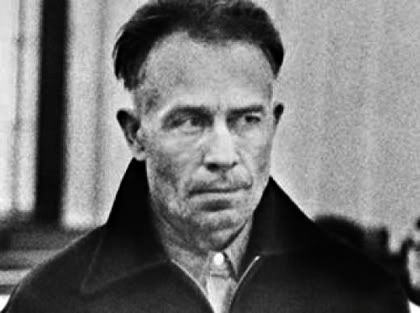
As a serial killer Ed Gein* was never going to win any awards. While he's known to have killed two people, and is suspected in the deaths of ten more, those numbers aren't even going to get a mention on the Six O'Clock News these days unless there's some kind of weird kink involved, which is where Gein's story starts to get newsworthy...
Naturally, his childhood was a disaster, destroyed in part by a violent, alcoholic father; whatever joy his father didn't manage to wring from the life of his young son the boy's devoutly Christian mother (and her fondness for the Book of Revelations) did. Gein - born in August 1906 - was also a slight child with an effeminate manner, which meant that he couldn't even find solace in his peer group at school, which he left anyway after the seventh grade. In other words, being raised by monsters turned him into a monster, and so he never had much of a chance to be anything else.
Following the death of his father from a heart attack in 1940 and the mysterious death of his brother Henry in May 1944**, Gein lived alone on a remote farm outside Plainfield, Wisconsin, with only his mother for company. His mother's own death from a series of strokes just months later in 1945 left him all alone in the world; thanks to his mother's teachings he was unable to form friendships, let alone with women. It was during these years that Gein began visiting area graveyards and exhuming the bodies of recently deceased middle-aged women to harvest their body parts as macabre trophies.
For some reason known only to Gein - he may, in fact, have been looking to replace his mother - he killed local hardware store owner Bernice Worden in November 1957. During their investigation of that crime, police not only discovered Worden's body in a shed on his property, they also discovered the evidence of Gein's other nocturnal activities, including definitive evidence that linked him to the murder, three years earlier, of another local woman named Mary Hogan - he'd kept her face and scalp and fashioned it into a mask.
Ed Gein's crimes so riveted people that it was only a matter of time before his grisly influence crept into the culture; the characters of Norman Bates (Psycho), Leatherface (The Texas Chainsaw Massacre), and Buffalo Bill (The Silence of the Lambs) and their stories were all based, in part, on the life and crimes of Ed Gein who, on this day in 1984, finally found peace when he died of respiratory failure while incarcerated at the Mendota Mental Health Institute in Madison, Wisconsin; he was 77. His place of burial - next to his mother, in Plainfield Cemetery - is currently unmarked, because ghoulish souvenir seekers first vandalized then stole his headstone***, for which he should consider himself lucky.
Thanks in part to the bad name people like him have given it, very few people rob graves anymore, for which he should consider himself grateful.
*Pronounced GEEN, with a hard G like 'ghoul'.
**Henry Gein allegedly died while fighting a wildfire near the family farm, even though the cause of death was several blunt traumas to the skull.
***The headstone was recovered near Seattle the year after it was stolen, and is currently kept at a museum in Wautoma, Wisconsin.
*
share on: facebook
"Fat Lip" by Sum 41
Birthday wishes go out today to Dave Baksh, founding member and former lead guitarist of Canadian pop-punk trio Sum 41; since leaving that group in 2006, Baksh has been affiliated with the metal-reggae quintet Brown Brigade.
Fat Lip was the first single from the band's second album, 2001's All Killer No Filler, and is arguably the band's biggest single to date; Rolling Stone magazine described the sound of the song as if Sum 41 went from blink-182 to Beastie Boys to Black Sabbath, all in one song - which seems an entirely apt description of the proceedings.
*
share on: facebook
POPnews - July 26th

[Although it took the arrogance and douchebaggery of the Tories to win World War II, after that horror had ended the British electorate clearly felt it needed a different type of government when it came time to rebuild their shattered kingdom... It was under the new Prime Minister that the modern welfare state took hold in the UK - a hold that wouldn't be broken until another Tory, Margaret Thatcher, came to power in May 1979.]
811 CE - At the Battle of Pliska Byzantine emperor Nicephorus I was slain and his heir, Stauracius, was seriously wounded.
1469 - During England's dynastic Wars of the Roses, the Battle of Edgecote Moor pitted the forces of Richard Neville, 16th Earl of Warwick and the House of Lancaster against those of King Edward IV and the House of York, as commanded by William Herbert, Earl of Pembroke.
1533 - The climactic moment of the Spanish conquest of the Inca Empire came when Incan emperor Atahualpa - who'd been captured by Francisco Pizarro in November 1532 at the Battle of Cajamarca - was forced to abdicate.
1581 - Following the establishment of the Republic of the Seven United Netherlands as per the terms of the Union of Utrecht (signed in January 1579) the Dutch issued the Plakkaat van Verlatinghe (or Act of Abjuration) - drafted by Andries Hessels, Jacques Tayaert, Jacob Valcke, and Pieter van Dieven - with which they declared their independence from the Spanish king, Philip II. This act of defiance wouldn't be formally recognized until the signing of the Twelve Years' Truce, which brought a temporary cessation to hostilities in the Eighty Years' War between 1609 and 1621.
1788 - New York became the 11th US state.
1803 - The Surrey Iron Railway, arguably the world's first public railway, opened in south London.
1847 - Liberia declared its independence from the United States; the country's first president was Joseph Jenkins Roberts.
1882 - Richard Wagner's opera Parsifal received its world premiere at the Festspielhaus in Bayreuth.
1887 - L. L. Zamenhof published Dr. Esperanto's International Language.
1945 - The Labour Party won a resounding victory in Great Britain's first postwar general election, sweeping Winston Churchill and his Conservatives from power and sending Clement Attlee to 10 Downing Street in Churchill's place. Although the election was held on July 5th, it took three weeks for officials to tabulate and announce the results.
1948 - The US military was desegregated when President Harry S Truman signed Executive Order 9981.
1952 - Egypt's King Farouk abdicated in favor of his son Fuad, three days after a coup staged by General Muhammad Naguib and Gamal Abdel Nasser of the Free Officers Movement.
1953 - Fidel Castro led an unsuccessful attack on the Moncada Barracks, thus beginning the Cuban Revolution.
1965 - The Maldives were granted full independence from the United Kingdom.
1990 - The Americans with Disabilities Act of 1990 was signed into law by President George H. W. Bush; the act would later benefit his son, who managed to become president despite being a total retard.
1991 - Paul 'Pee-wee Herman' Reubens was arrested in a Sarasota porno theater.
1999 - Combat in the so-called Kargil War between India and Pakistan ended - a day still celebrated as Kargil Vijay Diwas in India.
2005 - The Space Shuttle Discovery blasted off on flight mission STS-114 - the first to be scheduled following the Columbia Disaster in 2003.
*
share on: facebook
Sunday, July 25, 2010
"Ball 'n' Chain" by Big Mama Thornton
While legendary blues performer Big Mama Thornton died on this day in 1984, the music she recorded and popularized will live on...
For instance, Thornton was the first to record Hound Dog, which she did in 1952, four years before Elvis Presley; she was also the first to record Ball 'n' Chain, which was later a huge hit for Janis Joplin.
As to the video - recorded in the year she died - I think it shows Thornton's commanding presence backed up by an extremely tight band, which is always entertaining.
*
share on: facebook
POPnews (UK) - July 25th

1603 - James VI of Scotland was crowned first king of Great Britain, extending his personal reign over Scotland to include England, Ireland, and Wales as well.
1797 - Horatio Nelson lost more than 300 men and his right arm during an attempted conquest of the Spanish island of Tenerife at the Battle of Santa Cruz de Tenerife.
1837 - The first commercial application of an electric telegraph was successfully demonstrated by William Cooke and Charles Wheatstone on a wire 2.4 km (1.5 miles) long, which had been strung between London's Euston Station and Camden Town station of the London and North Western Railway.
1909 - Louis Blériot made the first flight across the English Channel in a heavier-than-air machine, traversing from Calais to Dover in 37 minutes.
1959 - The SR-N1 hovercraft - built by Saunders-Roe on the Isle of Wight - crossed the English Channel from Calais to Dover in just over 2 hours on the anniversary of Louis Blériot's historic flight.
1969 - Gerald Brooke - a British national and teacher of Russian who, along with his wife Barbara, had been arrested in April 1965 for anti-Soviet activities - was released by Soviet authorities in exchange for Morris and Lona Cohen (aka Peter and Helen Kroger) of the Portland Spy Ring.
1978 - Louise Brown, the world's first test tube baby, was born.
1987 - Former MP for Louth and deputy chair of the Conservative Party, author of cheesy potboilers, and pathological liar Jeffrey Archer was awarded £500,000 in damages and up to £700,000 in legal costs by Mr Justice Caulfield from the tabloid newspaper The Daily Star for its allegation that Archer had paid to have sex with a prostitute named Monica Coghlan. At the time it was the richest libel payout in the country's history. The jury's deliberation lasted just four hours, following a three-week trial; turns out they should have deliberated a little longer... It was proved in court in 2001 that Archer had perjured himself - indeed, had 'perverted the course of justice' - during the trial, for which he was subsequently jailed for four years by Mr Justice Potts in July 2001.
1989 - Diana, Princess of Wales, opened the Landmark AIDS Centre in south-east London; Her Royal Highness precipitated a media maelstrom at the event by holding hands with and embracing AIDS patients during her visit - at a time when even healthcare workers who dealt with people affected by the disease still wore gloves.
*
share on: facebook
"Blow The Wind Southerly" by Maureen Forrester
In an effort* to raise the tone of the proceedings around here, I have decided to include a bit of classical music just now; here Canadian contralto Maureen Forrester** performs the old English folk song Blow the wind southerly on CBC-TV in June 1965. She is accompanied on piano by John Newmark but, alas, the clip doesn't credit his comely page turner.
Maybe that's her name... Paige Turner!
(So much for trying to class up the joint...)
*Basically tokenism, given the gargantuan effort necessary, but it's well-intentioned tokenism nonetheless.
**Who would have needed those leather lungs to blow eighty candles southerly on this day in 2010, had she not died the previous June 16th.
*
share on: facebook
Pop History Moment: The Birth of Louise Brown
On this day in 1978 the world's first test tube baby, Louise Brown, was born at Oldham and District Hospital near Manchester. Needless to say, those responsible have continued to monitor the notoriously press-shy girl as she grew into womanhood for possible side-effects related to the unusual manner of her conception, and none have as yet been detected...
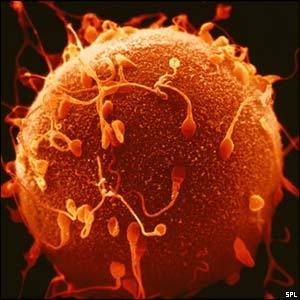 Something about this story so riveted my eight-year-old brain that I still, to this day, don't fully understand my fascination. Certainly, little me would have enjoyed the triumph of science over Nature, as I was quite the little Tory back then.
Mainly, though, I can remember thinking that with this girl's birth, something greater than one little life was achieved. There have been many days since then that have felt like a clear line had been drawn between the past and the present, but that, I guess, was the first.
Of course, it's possible many of you out there agree with me... Or not. Either way - and whatever your take on reproductive technology is - since I first published this post two years ago it has been consistently among the Pop Culture Institute's top ten hit-getters.
*
share on: facebook
Something about this story so riveted my eight-year-old brain that I still, to this day, don't fully understand my fascination. Certainly, little me would have enjoyed the triumph of science over Nature, as I was quite the little Tory back then.Mainly, though, I can remember thinking that with this girl's birth, something greater than one little life was achieved. There have been many days since then that have felt like a clear line had been drawn between the past and the present, but that, I guess, was the first.
Of course, it's possible many of you out there agree with me... Or not. Either way - and whatever your take on reproductive technology is - since I first published this post two years ago it has been consistently among the Pop Culture Institute's top ten hit-getters.
*
share on: facebook
POPnews (US) - July 25th
1814 - During the War of 1812, at the Battle of Lundy's Lane, reinforcements for General Phineas Riall's British and Canadian forces arrived near Niagara Falls and a bloody, all-night battle with Jacob Brown's Americans began shortly after 6 pm, following which the Americans retreated to Fort Erie.
1853 - Joaquin Murietta - the famous Californio bandit known as 'Robin Hood of El Dorado' - was killed.
1861 - Near the outset of the American Civil War the Crittenden-Johnson Resolution was passed by Congress stating that the war was being fought to preserve the Union and not to end slavery.
1866 - The US Congress passed legislation authorizing the rank of General of the Army (commonly called '5-star general'); Lieutenant General Ulysses S. Grant became the first recipient of this rank.
1868 - Wyoming became a United States territory.
1897 - Writer Jack London sailed to join the Klondike Gold Rush where he wrote his first successful stories; while in the far north, though, his health rapidly deteriorated, leaving him toothless from scurvy and his face permanently scarred.
1898 - The US invasion of Puerto Rico began when troops landed at the harbor of Guánica, led by General Nelson A. Miles; while the land invasion, proper, began that day, sea-based bombardment and shelling of the capital city of San Juan had been occurring since May 1898.
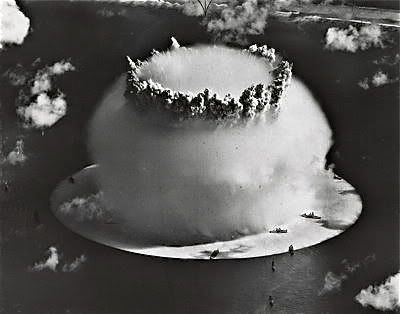
1946 - As part of Operation Crossroads the US military detonated an atomic bomb underwater in the lagoon of Bikini Atoll; owing to radioactive contamination, the site remains uninhabitable to this day.
1956 - 45 miles south of Nantucket Island, the Italian ocean liner SS Andrea Doria collided with the MS Stockholm in heavy fog and sank the next day, killing 51.
1969 - President Richard Nixon declared the Nixon Doctrine, stating that the United States now expected its Asian allies to take care of their own military defense; this began the so-called 'Vietnamization' of the Vietnam War.
1978 - The Cerro Maravilla Incident occurred when Puerto Rican independence activists Carlos Soto Arriví and Arnaldo Darío Rosado were killed in a police ambush; their driver was undercover agent Alejandro Gonzalez Malavé, who was himself killed eight years later by Los Macheteros.
*
share on: facebook
"Boogie Wonderland" by Earth Wind & Fire
Birthday wishes go out today to Verdine White, the energetic bassist for disco pioneers Earth, Wind & Fire. Boogie Wonderland originally burned up dance floors in 1979 with the able assistance of The Emotions; the song was originally included on their album I Am.
I have no idea where the video came from, except that I asked the YouTube gods for it and this is what they found. I've been dancing around the hallowed halls of the Pop Culture Institute ever since...
*
share on: facebook
POPnews - July 25th

[The Brunswick Manifesto was not met with the fearful response that had been hoped for when it was issued, on this day in 1792 by Charles William Ferdinand, Duke of Brunswick... In fact, this contemporary caricature wittily conveys the contempt the document was given - and not just by the French, either! In fact, it's issuance may indeed have worsened the French Revolution by giving the impression that the King, Louis XVI, was collaborating with the Prussian and Austrian allied army. (He wasn't - but try and explain that to an angry mob!)]
306 CE - Constantine I was proclaimed Roman Emperor by his troops.
864 CE - By issuing the Edict of Pistres France's so-called 'First King' Charles the Bald ordered defensive measures to be taken against the Vikings.
1547 - Henri II was crowned King of France following the death of his father Francois I.
1567 - Don Diego de Losada founded the city of Santiago de Leon de Caracas - modern-day Caracas, the capital city of Venezuela - after defeating Mariche chief, Tamanaco.
1593 - France's Huguenot King Henri IV publicly converted to Roman Catholicism at the behest of his mistress, Gabrielle d'Estrées.
1792 - The Brunswick Manifesto - principally written by Louis Joseph de Bourbon, Prince de Condé - was issued to the population of Paris, promising vengeance if the French Royal Family was harmed during the ongoing revolution.
1925 - The Telegraph Agency of the Soviet Union (TASS) was established.
1934 - Eight Austrian Nazis (including Paul Hudl, Franz Holzweber, Otto Planetta) assassinated Austrian Chancellor Engelbert Dollfuss in a failed coup attempt known as the July Putsch.
1940 - General Henri Guisan ordered the Swiss Army to resist German invasion and make surrender illegal.
1943 - Benito Mussolini was forced out of office by his own Italian Grand Council; he was replaced by Pietro Badoglio.
1958 - The African Regroupment Party (PRA) held its first congress in Cotonou.
1984 - Salyut 7 cosmonaut Svetlana Savitskaya became the first woman to perform a space walk.
1993 - Israel launched a massive attack against Lebanon in what the Israelis called Operation Accountability, and the Lebanese called the Seven-Day War.
1994 - Israel and Jordan signed the Washington Declaration, which formally ended the state of war that'd existed between the nations since 1948.
1995 - A gas bottle exploded in the Saint Michel station of line B of the RER (also known as Paris' regional train network) killing eight and wounding 80.
1997 - When K.R. Narayanan was sworn-in as India's 10th president he became the first Dalit - a class formerly known as 'untouchable' - to hold this office.
2000 - Air France Flight 4590 - a Concorde supersonic passenger jet - crashed just after takeoff from Paris' Charles de Gaulle International Airport, killing all 109 aboard and 4 on the ground besides; the accident successfully grounded all remaining Concorde aircraft.
2007 - Pratibha Patil was sworn in as India's first woman president.
2009 - Harry Patch, the last surviving soldier to have served in the trenches in World War I, died aged 111.
*
share on: facebook
Subscribe to:
Posts (Atom)