Sunday, May 30, 2010

Pop History Moment: The Lincoln Memorial Was Dedicated

Photo Sharing and Video Hosting at Photobucket

On this day in 1922 the Lincoln Memorial - which had been designed by Henry Bacon after the Temple of Zeus at Olympia - was dedicated in Washington, DC; the sculptor on the project was Daniel Chester French, and the interior murals were executed by Jules Guerin. The Lincoln Memorial's position offers it sweeping views of both the National Mall and the Potomac River, and it shares the opposite view of the Reflecting Pool from the Washington Monument. Within are engraved the words of the Gettysburg Address and Lincoln's second inaugural address.

So much more than merely a monument to the 16th President of the United States, the Lincoln Memorial is also a powerful sigil; it's image appears - pointedly, in my opinion - on the reverse of America's only brown money (the penny*), and at times of crisis Americans** have gone to find solace there, especially during the Civil Rights Movement. Both Marian Anderson and Martin Luther King, Jr. at different times appeared with the soaring pillars and monumental statue of the Great Emancipator behind them to remind their country of the promise of freedom made by him, the same promise which cost Lincoln his life.

Ironically, the memorial to one of the greatest Presidents was dedicated during the Administration of one of the worst - Warren G. Harding - although thankfully he didn't attend the dedication ceremony, which was handled by former President and then-Chief Justice of the Supreme Court William Howard Taft; in the crowd that day was the only surviving child of President Abraham Lincoln and First Lady Mary Todd Lincoln, Robert Todd Lincoln.

*Not to mention its 21st Century equivalent, the $5 bill.
**Particularly those of the penny-coloured persuasion.
*

share on: facebook

POPnews - May 30th

Photobucket
[A somewhat smaller version of Tsao Tsing-yuan's Goddess of Democracy lives on in the beautifully landscaped grounds of the University of British Columbia in Vancouver, having been erected there by that institution's Alma Mater Society; it was built in honour of the one which temporarily resided in Beijing's Tiananmen Square during the nascent pro-democracy movement which tried to emerge in China in 1989 and which Chinese officials brutally quashed, then spent the next twenty years attempting to expunge from the historical record. Similar replicas exist in Hong Kong's Victoria Park, in Portsmouth Square in San Francisco's Chinatown, on the grounds of the campus of York University in Toronto, at the University of Calgary, at Freedom Park in Arlington, and at the Victims of Communism Memorial in Washington, DC.]

1416 - The Council of Constance, called by the Holy Roman Emperor Sigismund - a supporter of Antipope John XXIII - ordered Jerome of Prague burned at the stake following his trial for heresy. Because that's what Jesus would have done.

1431 - 19-year-old Joan of Arc was burned at the stake in Rouen.

1434 - At the end of the Hussite Wars, during the Battle of Lipany, Utraquist forces led by Diviš Bořek of Miletínek defeated and almost annihilated the Taborite forces of Prokop the Great. I have no idea what it means, but I just loved typing it...

1536 - England's King Henry VIII married Jane Seymour, who had previously been a lady-in-waiting to his first two wives, the cast-off Katherine of Aragon and the now-headless Anne Boleyn.

1574 - Henri III became King of France following the death of his brother Charles IX.

1635 - Following the Thirty Years' War the Peace of Prague was signed.

1806 - Andrew Jackson (the future 7th President of the United States) killed Charles Dickinson in a duel after he'd accused Jackson's wife Rachel Donelson Robards Jackson of bigamy - an accusation which may, in fact, have been technically accurate. Dickinson was the only man Jackson ever managed to kill, despite his having taken part in 13 duels; he was himself hit in the ribs, but made a speedy recovery and, despite being 39 years old at the time, in fact lived another 40 years.

1814 - At the end of the War of the Sixth Coalition the Treaty of Paris was signed, returning French borders to their 1792 extent, where they were prior to the Napoleonic Wars.

1854 - The Kansas-Nebraska Act became law, establishing (oddly enough) the US territories of Nebraska and Kansas in addition to repealing the Missouri Compromise of 1820.

1876 - Abd-ul-Aziz, sultan of the Ottoman Empire, was deposed and succeeded by his nephew Murat V.

1883 - A rumor that the Brooklyn Bridge was about to collapse caused a stampede which led to the  trampling deaths of twelve people.

1911 - At the Indianapolis Motor Speedway, the first Indianapolis 500 ended with Ray Harroun in his Marmon Wasp becoming the first winner of the 500-mile auto race.

1914 - The new and then-largest Cunard ocean liner RMS Aquitania - displacing 45,647 tons - sailed on her maiden voyage from Liverpool to New York City.

1922 - The Lincoln Memorial was dedicated by former President and then-current Supreme Court Chief Justice William Howard Taft.

1948 - A dike along the flooding Columbia River in Oregon broke, obliterating the town of Vanport within minutes; in all fifteen people died and tens of thousands were left homeless.

1953 - New Zealand's Auckland Harbour Bridge was officially opened by Prime Minister Sidney Holland, joining Saint Marys Bay to Northcote.

1971 - The Mariner program's Mariner 9 was launched to map 70% of the surface of Mars, and to study temporal changes in the atmosphere and surface of the planet.

1972 - The Angry Brigade went on trial over a series of 25 bombings throughout Britain.

1989 - The 33-foot high Goddess of Democracy statue was unveiled in Beijing's Tiananmen Square by student demonstrators during a well-publicized series of pro-democracy protests there.
*
share on: facebook

Saturday, May 29, 2010

"Everything My Heart Desires" by Adam Rickitt


At first it was just a song I liked. Then, one day, curiosity got the better of me*, and I went looking for a picture of its singer - just to help me put a face to a name, you understand; goodness knows, I liked what I saw well enough - but then, that's no surprise, since British pop music has recently developed a disdain for uggos which is practically American. So I suppose it was only a matter of time before I saw that it was his birthday and went looking for the video of the song I liked sung by the guy I thought was cute so I could post it here. And that's when it started to get weird...

That's when I read the bio of Adam Rickitt - expecting the usual scant detail and dull sameness one gleans from the bumf of most pop tarts - and stumbled upon a story worthy of the greatest writer, or even me. The discovery of a middle class upbringing didn't surprise me, but the revelations that he went through a bout of bulimia did. Even the appearance on Coronation Street (in which he was the second actor to play Nick Tilsley) made sense, as the soap once famous for its old boots and crochety coots inexorably drifts into a showcase for any pretty face capable of sounding even vaguely Mancunian**.

So given the face and the visible abs and the eating disorder and the performance of pop music - plus the fact that as Nick Tilsley he was responsible for Corrie's first all-male liplock (with Todd Grimshaw, played by Bruno Langley) - that he had once upon a time courted the gay community to establish his fan base sort of made sense. His involvement with the Conservative Party, though, only fits because Rickitt himself seems to be a raging closet case; then again, he may just be a typical actor, which means he's definitely a raging closet case.

Rickitt's flirtation with politics***, though, seems to have been even shorter than his pop career, which spawned a six record deal with Polydor, one actual album (2000's ironically titled Good Times) and three singles - each with less impact than the previous one, this being the second of them - following which he was unceremoniously dropped by his label. A whirl through the shallow morass of reality television seems to have encouraged him to decamp to New Zealand, where he's currently appearing on television as Kieran Mitchell in the drama Shortland Street. Since his emigration he's been accused of shoplifting from an Auckland grocery store.

All of which leads me to think a) we haven't heard the last of Adam Rickitt, and b) what batshit crazy thing is he going to do next? Only time - and the Pop Culture Institute - will tell...

*Either that or I was high.
**Although, to be fair, Christopher Quinten - who played Brian Tilsley in the 1970s and 80s - was pretty hot. Not Michael Le Vell (Kevin Webster) hot; then again I never was that fond of blondes. But I digress...
**He was a prospective parliamentary candidate for the Tories in the Cheshire riding of Macclesfield near where he was raised; an outcry by the riding's longtime MP Sir Nicholas Winterton put a swift end to that.
*
share on: facebook

"You Can Sleep While I Drive" by Melissa Etheridge


From her second album, Brave and Crazy - released all the way back in 1989 - comes You Can Sleep While I Drive, which remains one of my all-time favourite love songs (even despite the automobile imagery). It's a sign of Melissa Etheridge's virtuosity that the song - even though obviously female-centered - speaks that universal urge, the urge to be needed and loved, so eloquently.
*
share on: facebook

Happy Birthday Melissa Etheridge

Photobucket

Melissa Etheridge is right to give thanks; thanks to medical science, good fortune, and a legion of well-wishers, the cancer she was diagnosed with in October 2004 is gone. Two years later her partner Tammy Lynn Michaels gave birth to Etheridge's third and fourth children, a boy and a girl; Etheridge, of course, already had two children with her longtime partner Julie Cypher.  Etheridge and Cypher separated in September 2000 while Etheridge and Michaels parted ways in April 2010.

Etheridge's eleven studio albums run a fairly narrow gamut - bluesy rockers, heartfelt ballads - but do so in a way that is so uniquely her own, so sincere (without the overarching earnestness of, say, the Indigo Girls) that each new one feels like an old friend even before it's out of the plastic. With a smoky voice that is all her own, Melissa Etheridge gets her fans the old-fashioned way: she earns them.
*
share on: facebook

In Memoriam: John Fitzgerald Kennedy

Photo Sharing and Video Hosting at Photobucket

More words have been written about John F. Kennedy - born on this day in 1917 - than any of us could read in a lifetime; the thirty-fifth President of the United States has been praised, vilified, and everything in between. There have been those who criticized his private peccadilloes to deflect attention from their own personal malfeasance, and those who like to claim that because he liked to chase skirt he was something less than he was: a dreamer.

From the Peace Corps to the Space Program, Kennedy had big dreams, forceful dreams, the kind that got into people's heads and helped them to dream as well. History has been gradually rewriting the role he played in the escalation of the Vietnam War and his role in the Bay of Pigs Invasion; but even history has a hard time getting past whether or not (or even how often) he had sex with Marilyn Monroe. History, after all, is just the stories we tell each other about our shared past - and that is a pretty good story.

Either way, the life that officially ended with Lee Harvey Oswald's bullet gave birth to the legend of JFK, a larger than life figure who, because of his early death, now gets to be all things to all people. To the Right he's a demon, specifically because he was handsome and populist and gave people hope (which is in direct contravention of Republican ideology), to the Left he's nothing short of a secular saint to be evoked rhetorically at will, and to us here in the Centre he may just be the last person to embody what made the United States of America great - not America, not States, but United...
*
share on: facebook

"Centipede" by Rebbie Jackson


Few people seem to remember Rebbie Jackson, and even fewer her 1984 hit Centipede - but I sure do! In fact, it's on my iPod as we speak. The song was produced by her younger brother Michael Jackson, and features a wild video, in which the eldest Jackson sibling works her red dress for all it's worth.

It's her birthday today, and I'd wish her one, except she's a Jehovah's Witness, and as such doesn't celebrate birthdays; still, I couldn't resist the urge to post this video today.
*
share on: facebook

Pop History Moment: The Conquest Of Everest

Photo Sharing and Video Hosting at Photobucket

On this day in 1953 New Zealander Edmund Hillary and Sherpa Tenzing Norgay became the first known people to reach the summit of Mount Everest, also known as Chomolungma; the mountain is frequently cited as the highest in the world, and indeed its summit is the highest land elevation above sea level. It was named for George Everest, at one time the surveyor-general of India*.

Hillary and Norgay attained the summit at 11:30 AM local time and, most importantly, they later made a safe descent. There has been debate in the mountaineering community whether George Mallory and Andrew Irvine had in fact beaten them to the summit 29 years earlier; if they did they certainly never lived to tell about it.

News of the conquest of Mount Everest reached London on the morning of Elizabeth II's coronation, whipping the already ecstatic crowds into an even greater frenzy.

*As his name was pronounced Eee-verest, that is more correctly how the mountain's adopted name should be pronounced; it just isn't.
*
share on: facebook

POPnews - May 29th

Photobucket
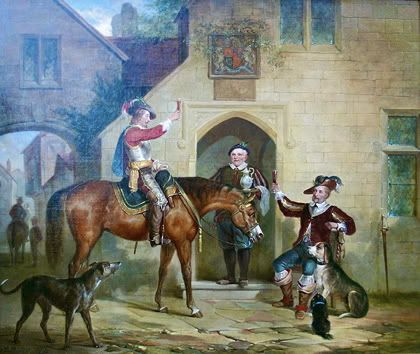
[For nearly 200 years after the fact the triumphant return of Charles II to London, on this day in 1660 - no less than his escape from Parliamentary forces on the same day in 1651 following the Battle of Worcester - was commemorated as Oak Apple Day in Britain; as depicted in this 1862 canvas by Reuben Bussey, the event was intended to be celebrated by raising a glass in toast to the King. Although the holiday was formally abolished in 1859 it is still observed by the famous red-coated Chelsea pensioners in the central court of the Royal Hospital Chelsea. Then again, it doesn't take an event half as exciting as the restoration of a monarchy to get the British to engage in a little chin-chin, does it?]

363 CE - Roman Emperor Julian the Apostate defeated the Sassanids under the walls of their capital during the Battle of Ctesiphon, although Persian Emperor Shapur II did manage to prevent Roman forces from taking the city; their hollow victory on this day would become even hollower when the Emperor was killed on June 26th at the Battle of Samarra.

1167
- At the Battle of Monte Porzio near the city of Tusculum a Roman army supporting Pope Alexander III was defeated by Christian of Buch and Rainald of Dassel whose force represented Holy Roman Emperor Frederick Barbarossa.

1176 - At the Battle of Legnano the Lombard League defeated Holy Roman Emperor Frederick I - the same dude whose army won the battle mentioned immediately above this one.

1660 - Charles II was restored to the throne of Great Britain, on his 30th birthday; the King (who managed to be crowned King of Scots in January 1651 before fleeing to the Continent) had spent the previous 11 years in exile during the Interregnum, while the English suffered under the Puritan dictatorship of Oliver Cromwell.

1677 - Following the bloodshed of Bacon's Rebellion, a treaty between the Virginia colonists of Middle Plantation and the local tribes - including the Weyanoke, the Pamunkey, the Nottoway, and the Nansemond - sought to establish a lasting peace. Try and guess how (or indeed, if) they did...

1780 - At the Battle of Waxhaws during the American Revolution Lieutenant Colonel Banastre Tarleton massacred 113 of Colonel Abraham Buford's continentals in Lancaster, South Carolina, allegedly after they had surrendered.

1790
- Rhode Island became the last of the Thirteen Colonies to ratify the US Constitution and was admitted to the Union as the 13th US state.

1848 - Wisconsin became the 30th US state.

1867 - An agreement between Austria and Hungary called Ausgleich (or 'the Compromise') was born through Act 12, which established the Austro-Hungarian Empire with its capital at Vienna; the Austrian Emperor Franz Joseph was later crowned King of Hungary to solidify what became known as the Dual Monarchy.

1913 - Igor Stravinsky's ballet score for The Rite of Spring was premiered in Paris at the Théâtre des Champs-Élysées, conducted by Pierre Monteux; almost from the first note of the opening movement the atonal music brought catcalls from the audience. When the dancers of Serge Diaghilev's Ballets Russes - as choreographed by Vaslav Nijinsky - appeared, eschewing the grace of classical ballet for what we would recognize as modern dance, a riot broke out.

1914 - In a heavy fog the ocean liner RMS Empress of Ireland collided with the Norwegian collier Storstad in the Gulf of St. Lawrence, near the Quebec town of Rimouski; in just 14 minutes the liner sank, with a loss of 1,024 lives, leaving just 453 survivors among the passengers and crew.

1919 - The Republic of Prekmurje was founded.

1953 - Sir Edmund Hillary and Sherpa Tenzing Norgay became the first known people to reach the summit of Mount Everest and return safely from the summit.

1954 - The first of the annual Bilderberg conferences was held in the Netherlands.

1964 - The Arab League met in East Jerusalem to discuss the Palestinian situation in Israel, which led to the formation of the Palestinian Liberation Organization.

1969 - A general strike in Córdoba, Argentina, led to a period of civil unrest known as Cordobazo.

1982 - Pope John Paul II became the first pontiff ever to visit Canterbury Cathedral.

1985 - Amputee Steve Fonyo completed his cross-Canada marathon at Victoria, British Columbia; the 14-month run was intended to complete the work left undone by Terry Fox on his earlier Marathon of Hope, as well as to honour him for having done it.

2004 - The World War II Memorial - located in the National Mall - was dedicated by President George W. Bush in Washington, DC; ironically, World War II was one war a member of the Bush family had actually fought in.
*
share on: facebook

Friday, May 28, 2010

Happy Birthday Kylie Minogue

For many years Kylie Minogue was as big a pop star in most of the English-speaking world - and a fair share of the rest of it as well - as Madonna, but because she wasn't an accepted presence in the United States, she was something of a secret amongst us Commonwealth cousins (although, to be quite fair, her fame in Canada was very much a gays-only affair); so while the monster success of a little ditty entitled Can't Get You Out Of My Head ruined the secret for all the rest of us, it finally brought her that one crucial market which had eluded her, and how could any of us begrudge her that? Especially after all she'd given us.

PhotobucketIt was therefore quite a shock when it was announced in 2005 that she had breast cancer; as has so often happened, it looked like just as she was poised to take on the whole world, she would be taken from it.

Well, if good wishes were chemotherapy - and in a very real way they are - then it's no wonder she pulled through her health scare with flying colours. No doubt every homo from Sydney to St. Ives lit candles and got on their knees in a way they never had before, and can therefore take their share of the credit for her quick recovery.

So loyal are Kylie's fans, in fact, that after it was announced she was breaking up with her boyfriend Olivier Martinez he had to go into hiding owing to a wave of harassment by waiters, shop assistants, and the like; only a press conference by our girl managed to quell the loathing. As terrible as it is, this is the kind of thing I find hilariously funny; they take away our rights left and right and we let them, but one greasy haired Frenchman dumps our diva and suddenly it's every man to the ramparts.

Today is Kylie's 42nd birthday, and it's my sincerest hope that I'll still be here writing about her on her 84th, as she tours the world performing her typically spirited rendition of Spinning Around on a Zimmer Frame.
*
share on: facebook

"Johnny Come Home" by Fine Young Cannibals


If I never hear the song She Drives Me Crazy again, it'll be too soon; in fact, I have renamed that particular number It Drives Me Crazy, which is how I sing along to it even now, twenty years after its release. Which is not to say that I don't like Fine Young Cannibals or the prodigious gifts of lead singer Roland Gift - whose birthday it is today - merely that the song has been ruined for me in perpetuity by excessive radio play.

That - plus the tendency by me to favour obscurity over ubiquity* - has driven me to choose Johnny Come Home to post here instead; from their self-titled 1985 debut album, the song made it all the way to #8 in the UK, and #9 on the US Dance Chart.

*Not to mention that this particular clip is introduced by a smoking cute VJ.
*

share on: facebook

Pop History Moment: The Opening of the Chrysler Building

Photo Sharing and Video Hosting at Photobucket

On this day in 1930 construction was completed on the Chrysler Building, the building having been officially opened the day before. Designed by William Van Alen, it wasn't as universally hailed upon its opening as it is now. The New Yorker's famed architectural grumblepot Lewis Mumford sniffed at its 'inane romanticism', 'meaningless voluptuousness', and 'void symbolism'. Indeed, the building is a triumphant celebration of the automobile, and even casts its shadow on Grand Central Terminal, itself the crowning achievement of the age of rail.

The Chrysler Building - located at the corner of 42nd Street and Lexington Avenue - has the rare distinction of having had no deaths occur as a result of its construction. It was the world's tallest building for four weeks short of a year; the Empire State Building surpassed it on May 1st, 1931. It was, however, the first man-made structure to stand over 1000 feet tall, and remains an elegant Art Deco beacon in the Manhattan skyline.
*
share on: facebook

POPnews - May 28th

Photobucket
[It's hard to believe in an age when fertility drugs yield such bumper crops as McCaughey Septuplets, the Chukwu Octuplets, and the human Pez dispenser known as the Octomom, but once upon a time the Dionne Quintuplets were a medical marvel - made all the more marvelous by the fact that Annette, Cecile, Emilie, Marie, and Yvonne were born two months premature. Nevertheless, they were the first such babies born to survive infancy, which made them nearly as famous as their exploitation by the government of Ontario. Alas, the Quints were only five in number for twenty years; the first of the sisters to die was Emilie, who suffocated during an epileptic seizure at the convent where she was a postulant in August 1954.]

585 BCE - A solar eclipse occurred - as predicted by Greek philosopher and scientist Thales - while Alyattes was battling Cyaxares during the Battle of Halys, which later came to be known as the Battle of the Eclipse; according to Herodotus, in the midst of fighting the sky went dark, which the combatants took as an omen of divine disapproval of their ongoing 15-year war, following which a truce was hastily arranged. Since eclipses are regular phenomena, this is also one of the cardinal dates from which other dates can be calculated.

1533 - Thomas Cranmer, Archbishop of Canterbury, declared the marriage of England's King Henry VIII to Anne Boleyn valid.

1588 - The Spanish Armada - with 130 ships and 30,000 men under the command of the Duke of Medina Sidonia - set sail from Lisbon heading for the English Channel intent on the invasion of England in retribution for the execution of Mary, Queen of Scots; so vast was the flotilla it took two days for all of its vessels to leave port.

1830 - President Andrew Jackson signed the Indian Removal Act which ordered Indians (especially those of the Five Civilized Tribes) removed to reservations; opposition to the Act in Congress was led by Davy Crockett, and the debate was rancourous.

1863 - The 54th Massachusetts Volunteer Infantry, the first African American regiment to serve in the War Between the States, left Boston to fight for the Union under the command of Colonel Robert Gould Shaw.

1864 - Austrian-born Mexican Emperor Maximilian arrived in Mexico for the first time.

1892 - John Muir organized the Sierra Club in San Francisco.

1905 - Near the end of the Russo-Japanese War the Battle of Tsushima ended with the destruction of Russia's Baltic Fleet by Admiral Togo Heihachiro and the Imperial Japanese Navy.

1926 - Ditadura Nacional was established in Portugal to suppress the unrest of the First Republic as a result of that day's coup d'état; the resultant Estado Novo would remain in place until the Carnation Revolution of April 1974.

1930 - Manhattan's iconic Chrysler Building officially opened.

1934 - The Dionne quintuplets were born - to Olivia and Elzire Dionne - in the village of Corbeil (near Callender, Ontario) with the assistance of Dr. Allan Roy Dafoe and two midwives, Madame Legros and Madame Lebel; they later became the first quintuplets to survive infancy, at which time they were commercially exploited by the government of Ontario. The whole sordid story is best told in The Dionne Years, by Canada's own populist historian Pierre Berton.

1937 - San Francisco's Golden Gate Bridge was officially opened to vehicle traffic by US President Franklin D. Roosevelt, who pushed a button at his desk in the White House which turned on the traffic lights.

1940 - Eighteen days after being invaded, the Kingdom of Belgium surrendered to Nazi Germany, at which time King Leopold III of the Belgians was placed under house arrest in Brussels.

1952 - The Memphis Kiddie Park opened in Brooklyn, Ohio; the park's Little Dipper roller coaster would become the oldest operating steel roller coaster in North America, and is still in operation.

1975 - Fifteen West African countries signed the Treaty of Lagos, thus creating the Economic Community of West African States.

1977 - The Beverly Hills Supper Club in Southgate, Kentucky, caught fire, killing 165 people inside and injuring 200 others just before the early show of headliner John Davidson.

1987 - 19-year-old West German pilot Mathias Rust evaded the Soviet Union's air defenses by landing a private plane in Moscow's Red Square; he was immediately detained and later sentenced to four years in prison, although he was released after 432 days following the intervention of Soviet leader Andrei Gromyko.

1999 - After 22 years of work intended to remove centuries of grime and undo the damage caused by previous restorations, Leonardo da Vinci's masterpiece The Last Supper was put back on display in Milano.

2003 - Peter Hollingworth became the first Governor-General of Australia to resign his office as a result of criticism of his conduct.
*
share on: facebook

Thursday, May 27, 2010

"I Got You" by Split Enz


Birthday wishes go out today to Neil Finn, the guitarist and lead singer formerly with New Zealand's pioneering New Wave band Split Enz, also formerly with Crowded House, and currently with himself, recording and touring as a solo act.

Taken from the band's 1980 album True Colours, I Got You was written by Neil Finn and, until the advent of their 1982 single Six Months in a Leaky Boat* was their biggest hit internationally.

*Despite its reputation as a comment against the Falklands War, the song was actually released a month before the outbreak of that particular hostility which, let's face it, no one outside of Casa Rosada saw coming...
*

share on: facebook

In Memoriam: Dashiell Hammett

Although he only published five novels in his writing career, they are five of the best detective novels in the American canon, and Dashiell Hammett - born on this day in 1894 - is rightly a legend for writing them.

Photo Sharing and Video Hosting at Photobucket Despite that, his novels are probably better known these days for the movie versions made of them: The Thin Man (1934) starring William Powell and Myrna Loy who played Nick and Nora Charles to giddy perfection, The Glass Key, made twice (first in 1935 with George Raft and again in 1942 starring Alan Ladd and Veronica Lake) as well as The Maltese Falcon - also made twice - first in 1931 starring Ricardo Cortez, and in a more famous version in 1941 starring Humphrey Bogart as Sam Spade.

The movies are today considered classics of film noir and the novels are even grittier. They are written with a bracing verve that reading them actually got my heart pounding, especially Red Harvest. Only Red Harvest and The Dain Curse have never received the Hollywood treatment, although the latter was made into a mini-series for American TV in 1978, starring James Coburn.

Hammett's reputation today owes as much to his 30-year relationship to Lillian Hellman as his talent. She out-lived him by 32 years, and in that time worked as hard at burnishing his reputation as she did at perfecting her own myth. A 1999 TV movie made by A&E entitled Dash & Lilly memorably starred Sam Shepard and Judy Davis as the literary lovers.
*
share on: facebook

Pop History Moment: The Death of Nehru

Photo Sharing and Video Hosting at Photobucket

On this day in 1964 Jawaharlal Nehru, first Prime Minister of India, died suddenly of a suspected heart attack; he was succeeded on an interim basis by Gulzarilal Nanda until, 13 days later, Lal Bahadur Shastri was elected to lead the Congress Party.

Following his lying-in-state, Nehru was cremated according to Shantivana rites on the banks of the Yamuna River near the capital of New Delhi, a ceremony watched by tens of thousands of mourners. The subject of numerous books and films, he was probably most notably portrayed by Roshan Seth, who played him in Richard Attenborough's 1982 film Gandhi.
*

share on: facebook

Disney's Silly Symphony: "The Three Little Pigs"


On this day in 1933 Walt Disney (via United Artists) released this little cartoon - actually a cleverly disguised parable of defiance in the face of mass angst brought on by the Great Depression - as part of its Silly Symphonies series; Three Little Pigs also introduced the song Who's Afraid of the Big Bad Wolf?, composed by Frank Churchill, which became something of an anthem for the times. The film was highly popular, running in some theaters for months, and went on to win an Academy Award in 1934 in the category Best Short Subject: Cartoons.

Notable for depicting the way the menaced pigs help each other during a time of financial crisis (especially as it relates to the challenges faced in regards to housing), it's this very tendency which the Pop Culture Institute fears has been bred out of people following thirty years' indoctrination by a neoconservative agenda. Still, the message is apt, even today, when a return to cooperation might be just the thing to help people out of the morass caused by competition.
*

share on: facebook

POPnews - May 27th

Photobucket
[Among the more bizarre aspects of the Century of Progress Fair included having its lights turned on by the star Arcturus, whose beams had been said to leave their source during Chicago's previous fair, the World's Columbian Exposition in 1893. (Although owing to an error in calculation, they would have actually left in 1896... Oops!) Unlike the earlier fair - the so-called 'White City', which was built to a neo-classical Grecian design and featured an all-white colour scheme - this one was both a riot of colour and a triumph of ultra-modern Art Deco. The fair's principal attraction was the Sky Ride, a transporter bridge running parallel to Lake Michigan and designed to ferry visitors from one end of the 171.5 hectare (424 acre) grounds to the other while offering outstanding views of the entire site along the way.]

927 CE - During the Battle of the Bosnian Highlands the forces of Bulgarian Tsar Simeon the Great led by Duke Alogobotur were decisively defeated by those of Tomislav, first King of Croatia.

1153 - Malcolm IV became King of Scotland following the death of his grandfather, David I; the 12 year-old who came to be known as Malcolm the Maiden was crowned at Scone.

1647 - Peter Stuyvesant was inaugurated as Director-General of New Netherland; there might have been a party, but one of his first official acts was closing all the taverns.

1703 - Russia's Tsar Peter the Great founded the city of Saint Petersburg.

1798 - At the outset of the Irish Rebellion of 1798 the Battle of Oulart Hill took place in Wexford.

1860 - Giuseppe Garibaldi entered the Sicilian capital of Palermo with his Redshirts as part of his campaign for Italian Unification known as the Expedition of the Thousand, following both a successful siege of the city and a plebiscite by its population to forsake the Kingdom of Two Sicilies for the Kingdom of Italy.

1896 - The F4-strength St. Louis-East St. Louis Tornado struck, killing at least 255 people; it has the distinction of being one of the first tornadoes whose devastation was extensively photographed after the fact.

1905 - The Battle of Tsushima - the last and most decisive sea battle of the Russo-Japanese War - began; Japanese admiral Heihachiro Togo destroyed two-thirds of the Russian Fleet, commanded by Zinovy Rozhestvensky.

1933 - The Century of Progress World's Fair opened at Chicago's Burnham Park.

1937 - San Francisco's Golden Gate Bridge - creating a vital link between the city and neighbouring Marin County - was opened to pedestrian traffic by Mayor Angelo Rossi; more than 200,000 people walked across on that day to the lilting strains of the bridge's specially written theme song, There's a Silver Moon on the Golden Gate.

1939 - DC Comics published Detective Comics #27, which introduced Batman - co-created by artist Bob Kane and writer Bill Finger - who went on to become one of the most popular comic book superheroes of all time.

1941 - The German battleship Bismarck was sunk during a fierce fight in the North Atlantic, killing almost 2,100 men - fortunately, all of them Nazis. The event is dramatized in the enthusiastically titled if factually inaccurate 1960 film Sink the Bismarck!, directed by Lewis Gilbert, which was itself based on the book The Last Nine Days of the Bismarck by C. S. Forester.

1942 - During Operation Anthropoid a combined Czechoslovakian-British effort to assassinate Reichssicherheitshauptamt Chief Reinhard Heydrich carried out by Jan Kubiš and Jozef Gabčík near Bulovka Hospital in Prague failed to kill him on that day, although he did die eight days later of blood poisoning. As for the assassins, they committed suicide three weeks later during a siege on Prague's Church of St. Cyril and St. Methodius rather than surrender.

1957 - Toronto's 1050 CHUM AM became the first radio station in Canada to broadcast a Top 40 rock n' roll format.

1960 - In Turkey, a military coup led by General Cemal Gürsel removed President Celal Bayar and the rest of his democratically elected government from office.

1967 - The US Navy aircraft carrier USS John F. Kennedy was christened by his widow Jacqueline Kennedy and their daughter Caroline at Newport News, Virginia.

1980 - During the Gwangju Massacre, airborne and army troops retook the South Korean city of Gwangju from civil militias, killing at least 207.

1995 - Actor Christopher Reeve was paralyzed from the neck down after falling from his horse Eastern Express (eerily nicknamed Buck) during the Commonwealth Dressage and Combined Training Association finals at the Commonwealth Park equestrian center in Culpeper, Virginia.

1998 - Michael Fortier was sentenced to 12 years in prison and fined $200,000 for failing to warn authorities about the Oklahoma City bombing terrorist plot.
*
share on: facebook

Wednesday, May 26, 2010

Happy Birthday Your Royal Highness

One would think that writing about royalty would be easy; given that royal lives - whether they be English, Dutch, or Danish - are so similar, so prescribed, so much the property of the state that despite world travel and easy access to the best and brightest of their respective nations the only differences between them would be in their scandals.

PhotobucketThis is where I am thwarted; the eldest son and heir of Denmark's Queen Margrethe II and her consort Prince Henrik is a conscientious, shy man without so much as a speeding ticket to his name, at least as far as my research can uncover. I actually typed 'Crown Prince Frederik scandal' into Google while conducting my research into this piece and it laughed at me; if you've never been laughed at by Google, let me tell you it's a humiliating experience. Just to see what it's like try typing in 'michael sean morris dating' and wait for hilarity to ensue!

A n y w a y... About the only untoward thing the Prince has ever done is to court and then wed an Australian named Mary Donaldson, whom he married at Copenhagen Cathedral in May 2004 (as previously reported by the Pop Culture Institute). In the commission of said courtship he wrote her some rather florid poetry - and that is the extent of it. Despite what could have been a really ripping scandal - even knowing what little I do about sheilas* - Ms. Donaldson has proven to be an exemplary princess-in-training, giving birth to Prince Christian in October 2005 and Princess Isabella in April 2007.

Today is His Royal Highness' 42nd birthday, and a biography of him (cleverly entitled Frederik – kronprins af Danmark) was recently published which relates the whole completely seemly and utterly unlurid story. Written by Gitte Redder and Karin Palshøj, whose previous work was a similarly unauthorized look at the life of Crown Princess Mary, as far as I can tell there are no plans to publish it in English, and since I have no plans to learn Danish the situation remains at an impasse...

*Australian slang for women.
*

share on: facebook

"Leaning On A Lamppost" by George Formby


One of the most popular figures of British entertainment during the middle years of the 20th Century was George Formby - who was born in Wigan on this day in 1904...

Often found strumming on his ukelele singing the slightly racy songs associated with the British music hall, Formby excelled in films as well as on records*. His death in March 1961 came before the current plague of cynicism afflicted England, and as such he was sorely missed (rather than mocked as an anachronism, say, which he would have been only a few years later).

*Cumbersome forerunners of the CD, made of black vinyl, and much favoured as collector's items by neo-Luddites today for the space they take up and the ease with which they are damaged.
*

share on: facebook