Sunday, April 18, 2010

Pop History Moment: San Francisco Devastated By Earthquake, Fire

Photo Sharing and Video Hosting at Photobucket

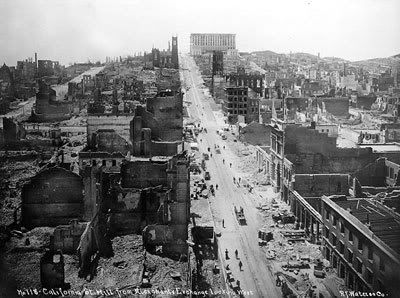
On April 17th, 1906, San Francisco was the jewel of the Pacific; early photographs show a range of uncommonly beautiful buildings in both commercial and residential districts...

An earthquake as powerful as the one that struck the city on this day in 1906 was bad enough - 7.8 on the Richter scale, with its epicentre at Mussel Rock - but it's really fire that's the scourge of cities, and it certainly scourged this one. Broken gas mains caused some of the fires; still others were set by citizens for insurance purposes. Either way, equally ruptured water mains hampered firefighters, and the inferno raged for four days and four nights. Only a few pre-1906 structures survived, including the Ferry Building, which was doused with water by nearby fire boats.

Afterwards, people lived in tent cities for two years or more as rubble was carted away and entire neighbourhoods rose from the ashes. Beginning in 1915 - by which time the reconstruction was largely complete - survivors began meeting at Lotta's Fountain on the anniversary of the disaster in commemoration. The same year's Panama-Pacific Exposition - originally intended to celebrate the opening of the Panama Canal - became the impetus to rebuild the city.

It's a curious thing how a city's buildings can be reduced to ruins but its civic pride can remain undamaged, or indeed often even increase. Again and again throughout history such things have happened, and yet places as diverse as Rome, London, and New Orleans persist. For all that cities seem to conspire to crush our souls, they also manage to inspire us in equal or greater measure.

The events of this day inspired the 1936 film San Francisco, but oddly enough the story hasn't yet had a retelling yet during the age of CGI - despite being the subject of numerous books and documentaries.
*
share on: facebook

POPnews - April 18th

Photobucket
[Not only did the Midnight Ride of Paul Revere alert American patriots to an impending British invasion at the outset of the American Revolution, it's since found itself a comfortable niche in pop culture; this 1931 painting by Grant Wood (the painter most famous for American Gothic) is a stylized view of Revere's brave act, but Henry Wadsworth Longfellow's poem Paul Revere's Ride went even further, taking utter liberties with the historical record in the name of art. Plus the entire undertaking is responsible for the phrase 'one if by land, two if by sea' as well, which I always thought was a little too poetic just to be part of the name of a Sandra Bullock-Denis Leary movie, no matter how charming a movie it is.]

1025 - Bolesław Chrobry became the first King of Poland when he was crowned in Gniezno.

1161 - Theobald of Bec - who was appointed by Archbishop of Canterbury by England's King Stephen in 1138 - died; he was succeeded by the altogether more famous Thomas Becket.

1506 - The cornerstone of the current St. Peter's Basilica was laid by Pope Julius II; much of what is now known as Old St. Peter's Basilica - built by Emperor Constantine I between 326 and 333 CE - was taken down or swallowed up by the new building, which was designed by Donato Bramante.

1518 - Bona Sforza - second wife of Sigismund I - was crowned as queen consort of Poland.

1738 - Madrid's Real Academia de la Historia (or Royal Academy of History) was founded by King Felipe V to study history 'ancient and modern, political, civil, ecclesiastical, military, scientific, of letters and arts, that is to say, the different branches of life, of civilization, and of the culture of the Spanish people'; the Academy currently has 370 members.

1775 - Paul Revere and William Dawes warned residents of the countryside around Boston of British troop movements on the evening before the Battles of Lexington and Concord, which would mark the outbreak of the American Revolution. Revere was given the shorter way - via Somerville, Medford, and Arlington - whereas Dawes took a more circuitous route through Boston Neck upon the orders of Dr Joseph Warren to warn John Hancock and Samuel Adams that they were in danger of arrest.

1797 - At the Battle of Neuwied forces of the First French Republic under Lazare Hoche scored a victory against the Holy Roman Empire and the Hapsburg Austrian forces of General Wermecek.

1831 - The University of Alabama was founded, featuring a strong curriculum of book-larnin', cipherin', and such.

1848 - An American victory by General Winfield Scott against Antonio López de Santa Anna at the Battle of Cerro Gordo opened the way for the US invasion of Mexico during the Mexican-American War; in addition to inflicting heavy casualties against their opponents (including the death of General Ciriaco Vasquez and the capture of his fellow generals Luis Pinzon, Jose M. Jarrero, R. Diaz de La Vega, Manuel Norriega, and Jose Obando) Scott's men forced Santa Anna to flee on horseback without the benefit of his prosthetic leg, which is still on display at the Illinois National Guard in Springfield to this day.

1880 - An F4 tornado struck Marshfield, Missouri, killing 99 people and injuring 100; while there's nothing so unusual about that, according to Ripley's Believe It or Not! one of the survivors was a child in a cradle, found up a tree! That would make this particular tornado one of the most remembered in history, as it has been considered the genesis of the nursery rhyme Rock A Bye Baby, even if it turns out the story is utter bunk; the verse is actually much older, and originated - as these things often do - as an English satire called Lilliburlero.

1909 - Joan of Arc was beatified in Rome by Pope St. Pius X.

1915 - French pilot Roland Garros was shot down and glided (glid?) to a landing behind German lines during World War I; having failed to destroy his plane, its interrupter gear was eventually seized, costing the Allies their tactical edge. The resulting Fokker Scourge brought a new level of carnage to aerial combat.

1923 - Yankee Stadium - also known as The House that Ruth Built - opened; it has since been torn down.

1942 - The Doolittle Raid - the first attack on the Japanese mainland by American forces - was made in retaliation for Japan's earlier attack on Pearl Harbor; although the raid - planned by Lieutenant-Colonel James 'Jimmy' Doolittle - did prove that bombers could successfully be launched from aircraft carriers, the raid was otherwise tactically indecisive.

1949 - The Republic of Ireland Act came into force.

1980 - The Republic of Zimbabwe (formerly Rhodesia) came into being, with Canaan Banana as the country's first President.

1983 - A suicide bomber destroyed the US embassy in Beirut, killing 63 people; responsibility was claimed by the Islamic Jihad Organization.

1988 - The US launched Operation Praying Mantis against Iran in the largest naval battle since World War II.

2009 - The Welsh-born actress Stephanie Parker - who played Stacey Weaver on BBC Wales' television series, Belonging - was found hanged near Pontypridd, in an apparent suicide; she was 22.
*
share on: facebook

Saturday, April 17, 2010

"Never Said" by Liz Phair


Birthday wishes go out today to Liz Phair, whose 1993 debut album* Exile in Guyville gave the double-Y chromosome sound of grunge an X or two to contend with - 18 songs' worth in fact - and none too soon...

Universally hailed by critics as one of that year's best, Exile in Guyville boasted sales of 200,000 that year (and some 450,000 to date) despite little radio play and no evident singles. Rather, the album plays best as a cohesive whole, taking the listener on a journey not unlike its cultural predecessor, the Rolling Stones' classic 1972 album Exile on Main Street.

*Previously Phair had released such offerings as 1991's Girly Sound on cassette only, in the tried-and-true lo-fi format best known to artists just starting out.
*
share on: facebook

Pop History Moment: English Literature Is Born

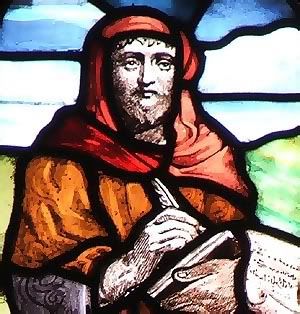
On this day in 1397 Geoffrey Chaucer first read The Canterbury Tales at the court of Richard II. The book is actually an unfinished frame narrative, built around 24 individual stories, but was intended to contain 120; it is modeled after The Decameron. Scholars and historians agree that the pilgrimage in the book - from Southwark to the tomb of Saint Thomas Becket at Canterbury Cathedral - was begun on the same day a decade earlier.

Photo Sharing and Video Hosting at PhotobucketThe Canterbury Tales' signal achievement is in its use of English (in fact, Middle English), then an emerging language and much looked down upon by the French-speaking nobility. Many have referred to Chaucer as the father of English literature; many others (mostly jocks) have referred to him in far less charitable terms. Invariably, I would have to tutor many of those in the latter group, which was still better than getting shoved into lockers - especially since te lockers in question were usually closed at the time of said shoving.

A n y w a y... I liked it, but wasn't 'in like' with it, if I may continue to use the high school vernacular. As with Shakespeare, I admired Chaucer's use of language, and the cobbling together of high art and low (some of the tales are quite raunchy). As much as I admire rococo diction, though, I also like things that get to the point.

Whan that Aprill, with his shoures soote
The droghte of March hath perced to the roote
And bathed every veyne in swich licour,
Of which vertu engendred is the flour;

Whan Zephirus eek with his sweete breeth
Inspired hath in every holt and heeth
The tendre croppes, and the yonge sonne
Hath in the Ram his halfe cours yronne,
And smale foweles maken melodye,

That slepen al the nyght with open eye-
(So priketh hem Nature in hir corages);
Thanne longen folk to goon on pilgrimages
And palmeres for to seken straunge strondes
To ferne halwes, kowthe in sondry londes;

And specially from every shires ende
Of Engelond, to Caunterbury they wende,
The hooly blisful martir for to seke
That hem hath holpen, whan that they were seeke.


It is pretty, though; I'll have to give it that.
*
share on: facebook

POPnews - April 17th

Photobucket
[Her Majesty pointedly wore blue - the colour of Quebec - to the otherwise red-and-white ceremony at which she and her Prime Minister signed the Constitution of Canada into law; despite her unpopularity in La belle province she's said to be quite fond of them, and was apparently reluctant to put her name to anything so important that didn't include them, even if their exclusion was almost entirely due to the intransigence of Parti Québécois Premier René Lévesque. In the end, she saved her megawatt smiles for the crowd and her mile-wide scowls for Pierre, as together they gave Canadians a document - most especially via the Canadian Charter of Rights and Freedoms - that would codify theirs as the highest of modern ideals, and their country as an exemplar in the family of nations.]

69 CE - After the First Battle of Bedriacum, Vitellius became Roman Emperor - the third during the so-called Year of the Four Emperors - following the death of his predecessor Otho.

1080 - Denmark's King Harald III - the illegitimate son of King Sweyn II Estridsson and a concubine whose name has been lost to history - died; although married to Margareta Hasbjörnsdatter Harald III died without an heir, and so was succeeded by his brother, Canute IV the Saint. In fact, three more of his brothers would also occupy the throne of Denmark in time...

1397 - Geoffrey Chaucer told his Canterbury Tales for the first time at the court of England's King Richard II; scholars of his work have also identified this date (albeit ten years earlier, in 1387) as when the book's pilgrimage to Canterbury is said to have commenced.

1521 - Having arrived the previous day, Martin Luther spoke to the assembly at the Diet of Worms, at which point he refused to recant his teachings - teachings which the Roman church considered heresy.

1861 - At the outset of the American Civil War, Virginia seceded from the Union.

1865 - Mary Surratt was arrested as a co-conspirator in the assassination of US President Abraham Lincoln, who'd died the previous day.

1895 - China and Japan signed the Treaty of Shimonoseki, marking the end of the First Sino-Japanese War; under the terms of the treaty the defeated Qing Empire was forced to renounce its claims on Korea and to concede the southern portion of the Fengtien province, Taiwan and the Pescadores Islands to Japan.

1907 - Immigration officials at Ellis Island processed 11,747 people on this, the single busiest day in its history.

1942 - POW French General Henri Giraud escaped from his castle prison in Festung Königstein.

1961 - A group of Cuban refugees financed and trained by the CIA landed at Cuba's Bay of Pigs with the aim of ousting Fidel Castro; the subsequent Bay of Pigs Invasion, uh, did not go well.

1964 - The Ford Motor Company unveiled the Ford Mustang at the New York World's Fair.

1969 - Sirhan Sirhan was convicted of assassinating US Presidential candidate Senator Robert F. Kennedy in June 1968.

1970 - The ill-fated Apollo 13 spacecraft returned to Earth safely.

1973 - Federal Express delivered its first package.

1982 - At a ceremony on Parliament Hill in Ottawa, the Canadian Constitution was signed by the Queen of Canada and Prime Minister Pierre Trudeau.

1984 - PC Yvonne Fletcher was killed by gunfire outside the Libyan People's Bureau in London during a small demonstration outside the embassy; ten others were wounded. The events led to an 11-day siege of the building.

1986 - The Three Hundred and Thirty Five Years' War - first declared in March 1651 between the Netherlands and Britain's Isles of Scilly - ended.

1999 - Shortly after 5:30 PM a nail bomb planted by neo-Nazi David Copeland outside the Iceland Supermarket at the junction of Electric Avenue and Brixton Road exploded, injuring fifty people, some seriously; in addition to this attack, aimed at London's black community, Copeland would be responsible for similar hate crimes against the Bengali and gay communities over the next two weeks.

2004 - Indian actress Soundarya - who starred in more than 90 films in her 12-year career - died in a plane crash near Bangalore; she was 31.
*
share on: facebook

Friday, April 16, 2010

Gratuitous Brunette: Jon Cryer

I'd like to think I'm not one of those people who tries to trap a star in amber, refusing to let them grow or develop beyond whatever adolescent crushes I might have had on them... For instance, as cute as Jason Bateman was in Silver Spoons - and he was - I'm just as comfortable perving on his tall, dark, and hilarious self in Arrested Development a generation later.

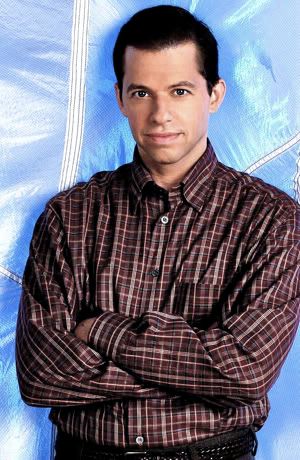
PhotobucketThe same goes for Jon Cryer, who practically invented geek chic when he assayed the role of Duckie in Pretty in Pink opposite the scowl who walked like a girl (aka Molly Ringwald); but that doesn't mean I wasn't thrilled to see him resurface on television after some twenty years, courtesy of Two and a Half Men - a show I didn't want to like but that I ended up liking despite myself*.

Born on this day in 1965 to Broadway actors David and Gretchen Cryer, the world's foremost Matthew Broderick impersonator has been delighting audiences for a quarter of a century now, and shows no signs of slowing down... Although, the Sitcom Curse** being what it is, who knows where he might turn up next, or even if he and his career will even get a third act. One thing is certain - as long as there's a Pop Culture Institute Jon Cryer will have a following...

*Not to mention itself!
**The Sitcom Curse can be described as a combination of typecasting, burn-out, and the comfort that comes from earning fat residuals; it conveniently, if glibly, explains how an actor who's outstanding on one show can disappear from view entirely when it does.

*
share on: facebook

"Beds Are Burning" by Midnight Oil


Midnight Oil's 1987 hit Beds Are Burning may be the world's only pop song about aboriginal rights*; whether or not it is, it is certainly one of the most famous. Either way, much of the song's success is due to its singer, birthday boy Peter Garrett, whose snarly vocals can be clearly heard to exhort 'just give it back!' - which, as far as pop songs go, is not merely political but entirely unequivocal on the issue of native title.

The band's consistency regarding this issue was much in evidence as Garrett and his bandmates - Martin Rotsey, Peter Gifford, Robert Hirst, and Jim Moginie - performed the song at the 2000 Sydney Olympics in black clothes emblazoned with the word 'sorry' in white letters. Their protest could be said to be highly visible, since it was seen by billions of viewers around the world who'd tuned in to watch the closing ceremonies of the Games. Not only did Midnight Oil's performance that evening shake up the conservatives who dominate the International Olympic Committee it pretty effectively shamed then-Prime Minister John Howard, who had refused to apologize for the numerous outrages committed against the country's original inhabitants over the previous two centuries, including (but not limited to) the Stolen Generations.

Originally appearing on the band's sixth studio album, Diesel and Dust, Beds Are Burning has been covered several times - most notably in 2006 by Pearl Jam; as for Peter Garrett, since November 2007 he's been making numerous appearances in Canberra - as Minister for the Environment, Heritage and the Arts in Prime Minister Kevin Rudd's Labor Party government.

*Then again, it may not be... We're looking into it.
*
share on: facebook

Happy Birthday Your Majesty

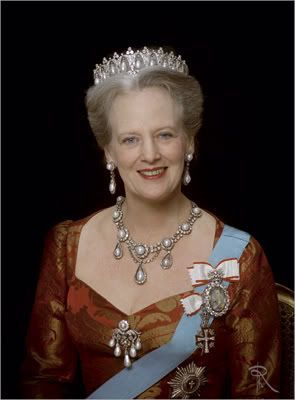
Photo Sharing and Video Hosting at PhotobucketHer Majesty Queen Margrethe II of Denmark turns 70 today.

She ascended the throne in January 1972, having succeeded her father Frederick IX at his death. In fact, Danish law had to be altered to allow for this eventuality; 1953's Act of Succession meant that then-Princess Margrethe would one day be queen in her own right. The previous queen, Margrethe I, ruled first Denmark, then Norway, and eventually Sweden under the Kalmar Union (which she founded) beginning in 1375 and until her death in 1412.

Trained as an archaeologist, Her Majesty is also a skilled painter, and speaks six languages; she studied at Girton College, Cambridge, Aarhus University, the Sorbonne, and the London School of Economics.
*
share on: facebook

Pop History Moment: Queen Launches Royal Yacht Britannia

Photo Sharing and Video Hosting at Photobucket

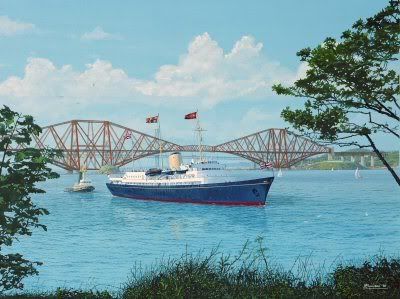
On this day in 1953 thousands were on hand to welcome the Queen and the Duke of Edinburgh when they arrived in Scotland to launch the new royal yacht, HMY Britannia, just six weeks before her coronation...

Britannia
was built by John Brown & Co. Ltd in Clydebank, with the hopeful intention (sadly, unmet) of giving Scotland's once-mighty shipbuilding industry a badly needed boost. What was given a boost, though, was morale; of an afternoon the crowd heartily cheered their beautiful young queen, sang Rule Britannia, and momentarily forgot the ration cards and the bomb craters, even in a heavy rain.

Over the next forty years, the Royal Yacht Britannia would convey the Queen and her family to ports of call across the globe, covering more than a million nautical miles; for a nation fond of its nautical lore, the vessel - a floating palace, really - would help make Elizabeth II that seafaring nation's seafaringest monarch ever.

Designed for use as a hospital ship in times of war, thankfully Britannia was never called upon to that end; she did once convey a thousand refugees from a civil war in Aden, though, in 1986.

Britannia was decommissioned in 1997; now permanently moored at Leith's Ocean Terminal, she currently serves as an exhibition ship, hosting conferences, banquets, and the like.
*
share on: facebook

"Son Of A Preacher Man" by Dusty Springfield


For obvious reasons, I've always been fond of the song Son of a Preacher Man; long before I knew that it was uber-cool white soul goddess Dusty Springfield who was responsible for it, I was humming (and even singing) along to its dulcet tones with somewhat less than dulcet tones of my own, which made for more than one awkward moment between me and my fifth grade teacher I can tell you.

Today would have been Dusty Springfield's 71st birthday; had she not succumbed to breast cancer just weeks before her 60th birthday, the Pop Culture Institute is certain she'd be singing still - and cannot verify either way whether she is or isn't anyway - except to say that thanks to the various and sundry miracles of modern technology not only will she always be with us, she will continue expanding her fan base from the great beyond...
*
share on: facebook

POPnews - April 16th

Photobucket
[When I first heard that the Catholic Church subjected Martin Luther to the Diet of Worms I can remember thinking 'What is this, the Inquisition or I'm A Protestant Heretic... Get Me Out Of Here!?' Of course I was much much younger then; it must have been four or five years ago now. Ah, youth...]

73 CE - The Jewish-held fortress of Masada fell to the Romans after several months of siege, ending the First Jewish-Roman War with the mass suicide of Sicarii fugitives who'd been barricaded inside; in April 1981 a miniseries starring Peter O'Toole dramatized these events, based on the book The Antagonists by Ernest Gann.

1346
- The Serbian Empire was proclaimed in Skopje by Stefan Uros IV Dusan, known as Dusan Silni or Dusan the Mighty; in time it would end up occupying much of the Balkans.

1521 - Martin Luther made an appearance before the Diet of Worms to have his religious convictions examined by the Holy Roman Emperor Charles V; following his five-day examination Luther was offered exile at Wartburg Castle by Frederick III, Elector of Saxony.

1582 - Spanish conquistador Hernando de Lerma founded the settlement of Salta in Argentina.

1746 - At the Battle of Culloden - the last military battle on British soil - Scotland's French-supported Jacobites attempted to put the Catholic James Francis Edward Stuart (known as the Old Pretender) on the Protestant throne of England, then occupied by George II. They were soundly defeated by the King's forces, led by his son the Duke of Cumberland.

1780 - The University of Münster was founded in North Rhine-Westphalia.

1858 - The Wernerian Natural History Society, a Scottish learned society and offshoot of the Royal Society of Edinburgh, closed down; its first meeting had been held in March 1808.

1912 - American aviatrix Harriet Quimby became the first woman to fly an airplane across the English Channel.

1919 - Mahatma Gandhi organized a day of prayer and fasting in Amritsar in response to British attacks on Indian protestors at the Jallianwala Bagh Massacre three days earlier.

1925 - During an assault by the Bulgarian Communist Party on Sofia's St. Nedelya Church, 150 were killed and 500 wounded.

1943 - Dr. Albert Hofmann discovered the psychedelic effects of LSD.

1945 - The US Army liberated Nazi Germany's maximum security prisoner of war camp Oflag IV-C (better known as Colditz Castle).

1947 - An explosion on board a freighter in port caused the city of Texas City to catch fire, killing almost 600.

1963 - Dr. Martin Luther King, Jr. wrote his famous Letter from Birmingham Jail while incarcerated in Alabama for protesting against segregation.

1964 - Following a trial at the Buckinghamshire Assizes in Aylesbury for the 12 men of a fifteen member gang apprehended for committing the Great Train Robbery in August 1963 Mr. Justice Edmund Davies sentenced those convicted - including mastermind Bruce Reynolds and the soon-to-be celebrated Ronnie Biggs - to a total of 307 years.

1972 - Apollo 16 was launched toward the Moon from Florida's Cape Canaveral.

1987 - British Conservative MP Harvey Proctor appeared at London's Bow Street Magistrates' Court charged with gross indecency; formerly known for his extreme right-wing views, he is now remembered for the fondness with which he spanked and caned rent-boys.

2003 - The Treaty of Accession was signed in Athens, admitting 10 new member states to the European Union.

2007 - At the Virginia Tech massacre - the deadliest mass shooting in modern American history - a gunman named Seung-Hui Cho killed 32 people and injured 23 others before committing suicide.
*

share on: facebook

Thursday, April 15, 2010

"Blitzkrieg Bop" by The Ramones


When the song Blitzkrieg Bop was released in April 1976 few involved (including members of the band, I'm sure) could have predicted that the Ramones' self-titled debut album would not only elevate these four misfits from Queens - Tommy, Dee Dee, Johnny, and Joey (who died on this day in 2001) - into the musical stratosphere but spawn an entirely new genre of music as well...
*
share on: facebook

"My Heart Will Go On" by Celine Dion


How could I blog about the sinking of the RMS Titanic and not include Céline Dion singing the Hell out of the instantly timeless ballad My Heart Will Go On? I mean, I could easily do it - especially given how I feel generally about her David Foster-esque caterwauling - but in the spirit of completeness (and padding) I've included it as well.

With music by James Horner and lyrics by Will Jennings, the song was a massive hit everywhere in 1998, helped in part by the video, which was directed by Bille Woodruff; the theme song of James Cameron's effects-heavy if screenplay-light 1997 blockbuster Titanic, Cameron originally did not want the song for his film - likely afraid it might take even a scintilla of attention away from him. Horner eventually convinced him to include the track, which went on to become not only the best-selling single of 1998 but one of the best-selling singles of all time, as well as winning the Academy Award for Best Original song, four Grammy Awards, and a Golden Globe among many other accolades.

Which just goes to show you a) what James Cameron knows, and b) what opportunity for free cross-promotion one of Hollywood's biggest egoes might have passed up were it not for the cooler (and smaller) heads around him*.

*In the interest of full disclosure I should say that I worked one day with James Cameron, on the series finale of Dark Angel - an episode called Freak Nation... He was a major-league douchebag. Not an artist with a vision, not a perfectionist, a great big steaming pile of bully!
*
share on: facebook

Pop History Moment: The Sinking of RMS Titanic

Photo Sharing and Video Hosting at Photobucket

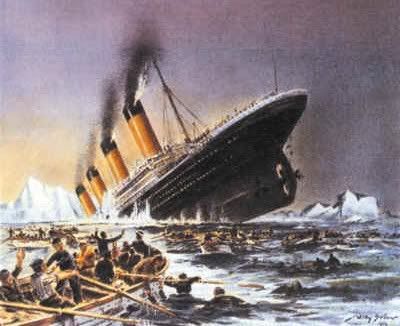
Just before midnight RMS Titanic of the White Star Line under the command of Captain Edward J. Smith - while on her maiden voyage from Southampton to New York City (via Cherbourg, France, and Cobh, Ireland) - struck an iceberg on a calm, moonlit night in the North Atlantic. She sank just after 2 AM on this day in 1912, having broken in two.

Each country appointed its own commission to look into the disaster, and there was almost as much trans-Atlantic sniping as there was trans-Atlantic shipping for many years to come as a result. The US claimed the death toll was 1,517, while the UK reported the official death toll as 1,490; either way you look at it, there had been 2,229 passengers and crew on board, making for only 700 or so survivors. Current laws then required the ship to carry only 16 lifeboats for a maximum of 3,547 passengers; Titanic carried 20, although only 18 were launched in the disaster, and most of them weren't full.

While the majority of the casualties were in steerage, many prominent people also died on that night, including the ship's builder Thomas Andrews, British journalist William Thomas Stead, the owner of Macy's department store Isidor Straus and his wife Ida, author Jacques Futrelle, as well as millionaire socialites Benjamin Guggenheim and John Jacob Astor IV. Among the survivors were Margaret 'The Unsinkable Molly' Brown, Sir Cosmo Duff Gordon and his wife couturiere Lady Lucille Duff-Gordon, silent movie actress Dorothy Gibson, and the White Star Line's managing director J. Bruce Ismay.

The unprecedented disaster brought about changes not only to maritime law, but also public attitudes toward corporate and media hyperbole. The ship had been declared 'unsinkable', though not by the White Star Line itself; in addition to life boats, subsequent seagoing vessels were also equipped with life vests, and the disaster brought about the formation of the International Ice Patrol.

The wreck was discovered in 1985 by Robert Ballard, and it has since been extensively photographed by him. More than 6,000 relics from the Titanic have also been brought to the surface, although without his collusion; Ballard has repeatedly likened such activity as tantamount to grave robbery. In fact, the site of the wreck - 2 miles southeast of Cape Race, Newfoundland - has been so jeopardized by visitors and freeloaders alike that it may disappear altogether within the next 50 years.

The story of the Titanic disaster has been a popular subject for pop culture almost since it happened; Walter Lord's book A Night to Remember is most notable, but Morgan Robertson's 1898 novella Futility, was written a chilling 14 years before RMS Titanic's ill-fated voyage, and bears many eerie similarities to it. Lord's book was adapted into a movie, predictably called A Night to Remember (1958); the American version, entitled simply Titanic (1953) starred Barbara Stanwyck. And then there was the awesome spectacle and the shitty script of James Cameron's 1997 film Titanic, which chillingly depicted the downside of technology while simultaneously offering Leonardo DiCaprio and Kate Winslet canoodling across class lines.
*
share on: facebook

"I Wandered Lonely As A Cloud" by William Wordsworth

I wandered lonely as a cloud
That floats on high o'er vales and hills,
When all at once I saw a crowd,
A host, of golden daffodils;
Beside the lake, beneath the trees,
Fluttering and dancing in the breeze.

Continuous as the stars that shine
And twinkle on the milky way,
They stretched in never-ending line
Along the margin of a bay:
Ten thousand saw I at a glance,
Tossing their heads in sprightly dance.

The waves beside them danced; but they
Out-did the sparkling waves in glee:
A poet could not but be gay,
In such a jocund company:
I gazed--and gazed--but little thought
What wealth the show to me had brought:

For oft, when on my couch I lie
In vacant or in pensive mood,
They flash upon that inward eye
Which is the bliss of solitude;
And then my heart with pleasure fills,
And dances with the daffodils.
*
share on: facebook

POPnews - April 15th

Photobucket
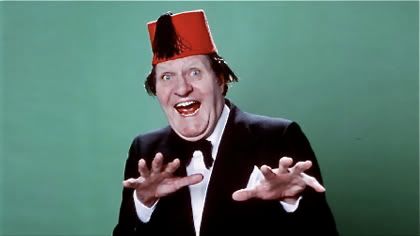
[Many's the performer who can be said to have died
on stage; Tommy Cooper, though, actually did it!]

1450 - At the Battle of Formigny, which was fought near the end of the Hundred Years' War, the French under the Comte de Clermont and Arthur III, Duke of Brittany, attacked and nearly annihilated Thomas Kyriell's English forces, finally ending the English domination of Northern France that began when Normandy's William the Conqueror invaded England in October 1066.

1632 - At the Battle of Rain - during the Thirty Years' War - Swedish forces under Gustavus Adolphus defeated the armies of the Holy Roman Empire and the Catholic League commanded by Count Johan Tzerclaes of Tilly.

1715 - The Pocotaligo Massacre triggered the start of the Yamasee War in Colonial South Carolina.

1738 - Serse - an opera, in Italian, by George Frideric Handel - premiered at London's King's Theatre, Haymarket.

1755 - Samuel Johnson's A Dictionary of the English Language was published, by Richard Bentley, in London.

1802 - William Wordsworth was out for a walk with his sister Dorothy when he saw a 'long belt' of daffodils, inspiring him to write I Wandered Lonely as a Cloud - although, at Dorothy's insistence, he didn't open his poem with the line 'I wandered lonely as a cow' like he'd wanted. Smart lady...

1865 - US President Abraham Lincoln died, having been shot the previous evening by John Wilkes Booth; upon his death Andrew Johnson became the 17th President of the United States.

1920 - Anarchists Sacco and Vanzetti allegedly murdered two security guards while robbing the Slater-Morrill Shoe Company in South Braintree, Massachusetts; in the more than seven years that followed prior to their August 1927 execution their case became a cause célèbre, involving the luminous likes of Dorothy Parker, Edna St. Vincent Millay, Bertrand Russell, John Dos Passos, Upton Sinclair, George Bernard Shaw and H. G. Wells among many others.

1941 - During the Belfast Blitz, two hundred Luftwaffe bombers attacked that Ulster city, killing more than nine hundred people, injuring 1,500 (400 of them seriously) and damaging half of the city's 70,000 houses - leaving 100,000 homeless in a population of 425,000.

1942 - The George Cross, Britain's highest civilian honour for valour, was awarded to 'the island fortress of Malta - its people and defenders' by King George VI.

1945 - The Bergen-Belsen concentration camp was liberated.

1947 - Jackie Robinson debuted for the Brooklyn Dodgers, breaking baseball's color line.

1955 - Ray Kroc opened his first franchise of a McDonald's restaurant, in Des Plaines, Illinois; although it was technically the ninth McDonald's overall, Kroc soon ended up taking over the entire company.

1957 - The British Columbia town of White Rock officially separated from Surrey and was incorporated as a new city; to be honest, though, the only reason I've mentioned it here is because both of them have since been gobbled up by Metro Vancouver.

1967 - Scotland defeated rival England 3-2 at Wembley Stadium, causing Scottish football fans to jokingly claim their side as 'Unofficial World Champions', creating the phenomenon of the Unofficial Football World Championships.

1984 - British comedian Tommy Cooper suffered a massive heart attack while performing on the ITV variety programme, Live From Her Majesty's; he was later pronounced dead on arrival at Westminster Hospital.

1986 - In retaliation for the bombing of the La Belle Discotheque in West Berlin on April 5th - in which two U.S. servicemen and a Turkish woman were killed - US President Ronald Reagan ordered major bombing raids against the Libyan cities of Tripoli and Benghazi, which killed 60 people - including Muammar Gaddafi's 15-month-old adopted daughter, Hanna.

1989 - The death of Hu Yaobang ignited the Tiananmen Square protests in Beijing; this last organized campaign aimed at bringing democracy to China was savagely suppressed by Communist authorities by June 4th.

2003 - US troops in Baghdad captured Abu Abbas, leader of the Palestine Liberation Front, which killed American Leon Klinghoffer on the hijacked cruise liner the Achille Lauro in October 1985.
*
share on: facebook

Wednesday, April 14, 2010

What Didn't Happen The Night Lincoln Was Shot


I don't think mere words are enough to describe how frustrated that last post made me. For one thing, it took four days to write it, and for another... Well, there doesn't need to be another, because that's bad enough. Every time I was tempted to scrap it, though, I'd watch this video, and somehow find the strength to continue.

That's because this video - while hilarious - is also utterly wrong. Despite what it may look like to the casual observer, the Pop Culture Institute prides itself on accuracy; I won't guarantee there won't be opinion or bias in any given piece, but I take pains to be as accurate as possible. Which, given the many and varied vagaries of history, is truly a sucker's game.

Nevertheless, I also pride myself on my sense of humour, which is why I invite you now to enjoy this brightly coloured pack of lies.

Hard Drinkin' Lincoln was the brainchild of Simpsons stalwart Mike Reiss, and was created for Icebox.com; Reiss and director Xeth Feinberg also created Queer Duck.
*
share on: facebook

Pop History Moment: The Shooting of Abraham Lincoln

Photo Sharing and Video Hosting at Photobucket

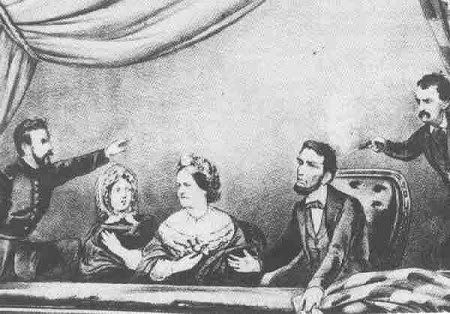
On this day in 1865 - Good Friday - US President Abraham Lincoln was fatally shot during a performance of Our American Cousin at Ford's Theatre in Washington, DC, by John Wilkes Booth; his killing was part of a larger plot to also kill Vice-President Andrew Johnson and Secretary of State William H. Seward. Only Booth was successful; Lewis Powell's attack on Seward resulted in a subsequent facial disfigurement for the statesman (not yet famous for the Alaska Purchase and still recovering from a near-fatal carriage accident nine days earlier), and George Atzerodt lost the nerve he'd been attempting to gain by getting drunk, meaning the Vice-President alone was spared the cabal's larcenous attentions.

The plot had originally involved the kidnap of the 16th President in order to hold him captive in the South until the Union Government resumed prisoner exchanges, upon which the badly understaffed Confederate Army relied. Booth, one of the most famous actors of his day and a noted Confederate sympathizer, changed his mind after attending a speech given by Lincoln outside the White House in which the President announced he planned to give blacks the right to vote. 'That is the last speech he will ever give,' he said to his companion and fellow conspirator David Herold, as they passed out through the gates in the direction of Lafayette Square, now with murder on their minds.

After pardoning Confederate spy George S.E. Vaughn at the behest of Missouri senator John B. Henderson, Lincoln and First Lady Mary Todd Lincoln made their way to the theatre, and were joined in the Presidential Box by Major Henry Rathbone and his fiancee Clara Harris. Since they'd arrived after the curtain had gone up, the play was halted briefly to acknowledge their entrance; seeing as the Confederacy had only just surrendered, the reception they received was fulsome in its enthusiasm. Lincoln didn't enjoy being fussed over, so they soon enough took their seats; as the play resumed, Booth emerged from the neighbouring Star Saloon and made his way silently up the stairs and into the vestibule behind their box, brandishing both a deringer and a knife.

Having barred the vestibule door from the inside with a music stand he waited, listening for his cue. Booth had timed his shot so that it would be covered by the great laugh a certain line always got. The line came - 'you sockdologizing old mantrap' - followed by the laugh, at which time Booth fired one shot into the back of the President's head, causing it to loll forward. Rathbone rose and grabbed Booth by the coat, at which time Booth slashed at him with the knife, wounding Rathbone.

That's when Booth leapt onto the stage; having caught one of his spurs in the bunting adorning the box, he landed awkwardly, breaking his left leg just above the ankle. Many in the audience, who hadn't heard the shot, seemed confused by what was going on. 'Sic semper tyrannis' Booth shouted from centre stage. 'The South is avenged.' Then he dashed off, running into the alley behind the theatre and there mounted his waiting horse. The assassin had already melted into the night when Clara Harris called out 'He has shot the President!' The stunned crowd of 1500 erupted in pandemonium; among members of the audience only the distinguished veteran and lawyer Joseph B. Stewart - at 6-foot-5 said to be the tallest man in Washington - attempted to chase Booth, but was unsuccessful.

A doctor named Charles Leale rushed to aid the wounded President, forcing his way through the throng who were already vowing to burn the theatre to the ground. The play's star Laura Keene fled from the stage, where her efforts to calm the crowd had proven futile; once inside the box she cradled the President's head in her lap, soaking her handkerchief in his blood as she sobbed. Following a peremptory examination and subsequent diagnosis of a massive, fatal head wound, the quick thinking Leale - formerly an Army surgeon and still just 23 years old - decided he could not let the President die on the floor of a theatre. Even still, a five or six block journey to the White House over rutted dirt roads would surely hasten his death. With the aid of Drs. Charles Taft and Albert King and several soldiers Lincoln was carried across 10th Street to Petersen's Boarding House, where a lodger named Henry Safford showed them in.

Lincoln lingered there in a ground floor bedroom, unconscious, for nine hours, not dying until just after 7:22 the next morning, April 15th; among his attendants on that long night was Dr. Anderson Ruffin Abbott, a Canadian-educated black. Despite a broken leg, Booth evaded capture for 12 days, but was eventually cornered and himself killed on April 26th when a tobacco barn in which he was hiding at Garrett's Farm near Bowling Green, Virginia, was set ablaze; in the ensuing chaos a Union soldier named Boston Corbett shot Booth in the neck, paralyzing him following which he was dragged from the inferno. His last words, spoken three hours later on the farmhouse porch, were 'Useless, useless...'

Booth's co-conspirators - Mary Suratt, Lewis Powell, David Herold, and George Atzerodt - were all hanged at Old Arsenal Penitentiary in July 1865 for their part in the conspiracy; Mary Suratt became the first woman in American history to be given such a sentence. Mary Todd Lincoln died at home in July 1882, having spent three months of 1875 in an insane asylum. In December 1883 Major Rathbone - then US Consul to Hanover - murdered his wife of sixteen years, Clara Harris, following which he was institutionalized until his death in August 1911.

The events of the assassination of President Abraham Lincoln and its aftermath are thrillingly retold in James L. Swanson's book Manhunt: The 12-Day Chase For Lincoln's Killer.
*
share on: facebook

POPnews - April 14th

Photobucket
[Shortly after noon on this day in 1935 a cloud of dust traveling 100 kilometres (60 miles) an hour came swirling out of the American West over the Great Plains... Not the first - and by no means the last - by 1940 dust storms such as this one had forced 2.5 million people to flee what was left of their farms for greener pastures, while an untold quantity of the once-fertile topsoil that had once upon a time made those farms bountiful ended up at the bottom of the Atlantic Ocean.]

43 BCE - At the Battle of Forum Gallorum Mark Antony - while besieging Julius Caesar's assassin Decimus Junius Brutus in Mutina - defeated the forces of the consul Pansa, who was killed.

1434 - The foundation stone of Cathedral St. Peter and St. Paul in Nantes was laid by John, Duke of Brittany and Jean de Malestroit, Bishop of Nantes; the first architect on the site was Guillaume de Dammartin, who was later replaced by Mathurin Rodier.

1471 - In England, Yorkist forces under Edward IV defeated their Lancastrian opponents under the Earl of Warwick at the Battle of Barnet, during which Warwick was killed and following which the deposed monarch was able to resume his throne - the first and only English King to do so*.

*Charles II technically became King upon the removal of his father Charles I's head in January 1649, but since Parliament under Oliver Cromwell had abolished the monarchy as it abolished its monarch, technically the succession was broken - at least in England.

1775 - The first abolition society in the North America - the Society for the Relief of Free Negroes Unlawfully Held in Bondage - was established in Philadelphia by Benjamin Franklin and Benjamin Rush.

1846 - The Donner Party of pioneers departed for California from Springfield, Illinois, on what would become a year-long journey of hardship, cannibalism, and survival.

1865 - US Secretary of State William H. Seward and his family were attacked in his home by Lewis Powell at the same time as President Abraham Lincoln was being shot at Ford's Theatre by John Wilkes Booth; a third attack, against Vice President Andrew Johnson - meant to be carried out by George Atzerodt - was not.

1881 - The Four Dead in Five Seconds Gunfight erupted in El Paso, Texas.

1894 - Thomas Edison demonstrated the kinetoscope - a device for peep-show viewing using photographs that flip in sequence, a precursor to movies.

1912 - The British passenger liner RMS Titanic hit an iceberg in the North Atlantic just before midnight; the so-called un-sinkable ship sank within hours, with the loss of more than 1,500 lives.

1927 - The first Volvo rolled off the assembly line in Gothenburg.

1931 - The Spanish Cortes deposed King Alfonso XIII and proclaimed the 2nd Spanish Republic.

1935 - 'Black Sunday' - arguably the single worst dust storm of the US Dust Bowl - reduced visibility to five feet in some places, smothering wild and domesticated animals and people alike in its relentless advance; stretching from the Dakotas to Texas, drought coupled with unwise farming methods and a lack of understanding about conservation almost brought the once-rich agricultural output of the nation to a standstill.

1943 - James Boarman, Fred Hunter, Harold Brest and Floyd G. Hamilton took part in an attempted escape from Alcatraz. Boarman was shot in the water and is presumed dead; although his body was never found, his accomplices were all recaptured.

1958 - The Soviet satellite Sputnik 2 fell from orbit after a mission duration of 162 days.

1968 - At the 41st Academy Awards, an unprecedented tie between Katharine Hepburn (for The Lion in Winter) and Barbra Streisand (for Funny Girl) resulted in the two sharing that year's Best Actress Oscar.

1978 - At a series of demonstrations in Tbilisi, thousands of Georgians protested against the attempt by the Soviet authorities to change the constitutional status of their language.

1994 - In a friendly fire incident during Operation Provide Comfort in northern Iraq, two US Air Force aircraft mistakenly shot down two US Army helicopters, killing 26 people.

2002 - Venezuelan President Hugo Chavez returned to office two days after being ousted and arrested by his country's military.

2005 - The Oregon Supreme Court nullified nearly 3,000 marriage licenses issued to gay couples a year earlier by Multnomah County.
*

share on: facebook